SUBSCRIBE TO OUR FREE NEWSLETTER
Daily news & progressive opinion—funded by the people, not the corporations—delivered straight to your inbox.
5
#000000
#FFFFFF
To donate by check, phone, or other method, see our More Ways to Give page.
Daily news & progressive opinion—funded by the people, not the corporations—delivered straight to your inbox.
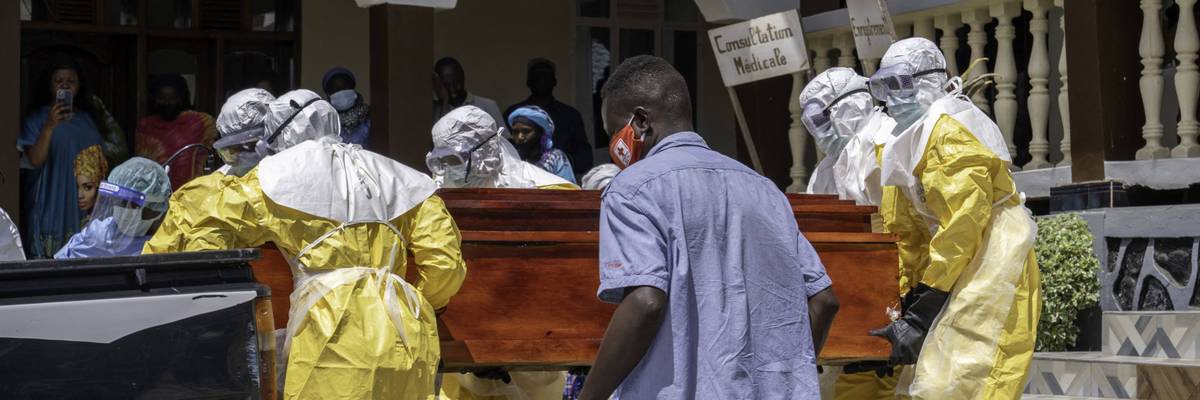
The coffin of a person believed to have died from Ebola is hoisted by health worker at a hospital in Bunia, in the eastern Democratic Republic of the Congo, on May 25, 2026.
"The delay in detecting the outbreak means that we are now playing catch-up with a very fast-moving epidemic."
World Health Organization Director-General Tedros Adhanom Ghebreyesus warned Monday that the swiftly spreading Ebola outbreak in the Democratic Republic of Congo and Uganda "will get worse before it gets better," as a deadly delay in detecting infections has responders to the epidemic "playing catch-up."
"The outbreak is spreading rapidly," Tedros said during a virtual ministerial meeting on the matter. "So far, 101 cases have been confirmed in DRC, with 10 confirmed deaths. But we know the epidemic in DRC is much larger. There are now more than 900 suspected cases and 220 suspected deaths."
"Countries bordering DRC are at especially high risk and should take immediate action," he asserted. "In Uganda, there are five confirmed cases and one death."
Tedros pointed out that "there are several aspects of this outbreak that make it especially challenging."
"First, the delay in detecting the outbreak means that we are now playing catch-up with a very fast-moving epidemic," he said. "We are urgently scaling up operations, but at the moment, the epidemic is outpacing us."
"Second, as you know, the provinces of Ituri and North Kivu are highly insecure, with intensified fighting in recent months, causing more than 100,000 people to be newly displaced," the WHO chief continued. "There is also significant distrust of outside authorities among the local population. In the past week, there have been two security incidents at health facilities."
"WHO is fully committed to working under the leadership of the governments of DRC and Uganda, side by side with Africa [Centers for Disease Control and Prevention] and all other partners," Tedros added. "We will not rest until we bring this outbreak under control."
Ebola—which typically kills between 25% and 90% of infected people, depending upon the strain of the virus and quality of available medical care—causes widespread and often catastrophic damage to the body’s blood vessels, immune system, and organs.
Critics say US President Donald Trump's ideologically driven decision to withdraw the US from the WHO, his administration's dismantling of the US Agency for International Development (USAID), and reduced funding for the US Centers for Disease Control and Prevention's global public health efforts have adversely affected the response to the current Ebola epidemic, compared with 2014 and 2019 outbreaks.
After US Secretary of State Marco Rubio said last week that the WHO was "a little late" in identifying new Ebola infections, Tedros retorted that "we don’t replace the country’s work, we only support them," and suggested that Rubio's comments could be rooted in "a lack of understanding" of the agency and countries' responsibilities.
While Rubio said that “our number-one objective on Ebola, before anything else... has to be, we can’t have it affect the United States,” public health experts warn that Trump administration actions could make it more likely that the virus will make its way to the country.
There is currently no confirmed CDC director, Food and Drug Administration commissioner, or surgeon general.
Taking aim at Trump's evisceration of key public health agencies and programs, Congresswoman Rosa DeLauro (D-Conn.) said last week: “Ebola does not wait for bureaucratic reorganizations. It spreads when surveillance systems are weakened, health workers are laid off, clinics lack protective equipment, and communities lose the trusted partners who help detect and contain outbreaks before they become public health emergencies."
"This is the perfect storm President Trump created," she continued. "He recklessly dismantled USAID, withheld and slashed other United States assistance to the region, fired critical staff, and created global health chaos. This is not efficiency. It is dangerous neglect."
"The United States spent years building the relationships, supply chains, laboratories, and community health networks that help stop deadly diseases at their source," DeLauro added. "The Trump administration tore into that capacity and now wants to pretend the consequences were unforeseeable.”
Dear Common Dreams reader, It’s been nearly 30 years since I co-founded Common Dreams with my late wife, Lina Newhouser. We had the radical notion that journalism should serve the public good, not corporate profits. It was clear to us from the outset what it would take to build such a project. No paid advertisements. No corporate sponsors. No millionaire publisher telling us what to think or do. Many people said we wouldn't last a year, but we proved those doubters wrong. Together with a tremendous team of journalists and dedicated staff, we built an independent media outlet free from the constraints of profits and corporate control. Our mission has always been simple: To inform. To inspire. To ignite change for the common good. Building Common Dreams was not easy. Our survival was never guaranteed. When you take on the most powerful forces—Wall Street greed, fossil fuel industry destruction, Big Tech lobbyists, and uber-rich oligarchs who have spent billions upon billions rigging the economy and democracy in their favor—the only bulwark you have is supporters who believe in your work. But here’s the urgent message from me today. It's never been this bad out there. And it's never been this hard to keep us going. At the very moment Common Dreams is most needed, the threats we face are intensifying. We need your support now more than ever. We don't accept corporate advertising and never will. We don't have a paywall because we don't think people should be blocked from critical news based on their ability to pay. Everything we do is funded by the donations of readers like you. When everyone does the little they can afford, we are strong. But if that support retreats or dries up, so do we. Will you donate now to make sure Common Dreams not only survives but thrives? —Craig Brown, Co-founder |
World Health Organization Director-General Tedros Adhanom Ghebreyesus warned Monday that the swiftly spreading Ebola outbreak in the Democratic Republic of Congo and Uganda "will get worse before it gets better," as a deadly delay in detecting infections has responders to the epidemic "playing catch-up."
"The outbreak is spreading rapidly," Tedros said during a virtual ministerial meeting on the matter. "So far, 101 cases have been confirmed in DRC, with 10 confirmed deaths. But we know the epidemic in DRC is much larger. There are now more than 900 suspected cases and 220 suspected deaths."
"Countries bordering DRC are at especially high risk and should take immediate action," he asserted. "In Uganda, there are five confirmed cases and one death."
Tedros pointed out that "there are several aspects of this outbreak that make it especially challenging."
"First, the delay in detecting the outbreak means that we are now playing catch-up with a very fast-moving epidemic," he said. "We are urgently scaling up operations, but at the moment, the epidemic is outpacing us."
"Second, as you know, the provinces of Ituri and North Kivu are highly insecure, with intensified fighting in recent months, causing more than 100,000 people to be newly displaced," the WHO chief continued. "There is also significant distrust of outside authorities among the local population. In the past week, there have been two security incidents at health facilities."
"WHO is fully committed to working under the leadership of the governments of DRC and Uganda, side by side with Africa [Centers for Disease Control and Prevention] and all other partners," Tedros added. "We will not rest until we bring this outbreak under control."
Ebola—which typically kills between 25% and 90% of infected people, depending upon the strain of the virus and quality of available medical care—causes widespread and often catastrophic damage to the body’s blood vessels, immune system, and organs.
Critics say US President Donald Trump's ideologically driven decision to withdraw the US from the WHO, his administration's dismantling of the US Agency for International Development (USAID), and reduced funding for the US Centers for Disease Control and Prevention's global public health efforts have adversely affected the response to the current Ebola epidemic, compared with 2014 and 2019 outbreaks.
After US Secretary of State Marco Rubio said last week that the WHO was "a little late" in identifying new Ebola infections, Tedros retorted that "we don’t replace the country’s work, we only support them," and suggested that Rubio's comments could be rooted in "a lack of understanding" of the agency and countries' responsibilities.
While Rubio said that “our number-one objective on Ebola, before anything else... has to be, we can’t have it affect the United States,” public health experts warn that Trump administration actions could make it more likely that the virus will make its way to the country.
There is currently no confirmed CDC director, Food and Drug Administration commissioner, or surgeon general.
Taking aim at Trump's evisceration of key public health agencies and programs, Congresswoman Rosa DeLauro (D-Conn.) said last week: “Ebola does not wait for bureaucratic reorganizations. It spreads when surveillance systems are weakened, health workers are laid off, clinics lack protective equipment, and communities lose the trusted partners who help detect and contain outbreaks before they become public health emergencies."
"This is the perfect storm President Trump created," she continued. "He recklessly dismantled USAID, withheld and slashed other United States assistance to the region, fired critical staff, and created global health chaos. This is not efficiency. It is dangerous neglect."
"The United States spent years building the relationships, supply chains, laboratories, and community health networks that help stop deadly diseases at their source," DeLauro added. "The Trump administration tore into that capacity and now wants to pretend the consequences were unforeseeable.”
World Health Organization Director-General Tedros Adhanom Ghebreyesus warned Monday that the swiftly spreading Ebola outbreak in the Democratic Republic of Congo and Uganda "will get worse before it gets better," as a deadly delay in detecting infections has responders to the epidemic "playing catch-up."
"The outbreak is spreading rapidly," Tedros said during a virtual ministerial meeting on the matter. "So far, 101 cases have been confirmed in DRC, with 10 confirmed deaths. But we know the epidemic in DRC is much larger. There are now more than 900 suspected cases and 220 suspected deaths."
"Countries bordering DRC are at especially high risk and should take immediate action," he asserted. "In Uganda, there are five confirmed cases and one death."
Tedros pointed out that "there are several aspects of this outbreak that make it especially challenging."
"First, the delay in detecting the outbreak means that we are now playing catch-up with a very fast-moving epidemic," he said. "We are urgently scaling up operations, but at the moment, the epidemic is outpacing us."
"Second, as you know, the provinces of Ituri and North Kivu are highly insecure, with intensified fighting in recent months, causing more than 100,000 people to be newly displaced," the WHO chief continued. "There is also significant distrust of outside authorities among the local population. In the past week, there have been two security incidents at health facilities."
"WHO is fully committed to working under the leadership of the governments of DRC and Uganda, side by side with Africa [Centers for Disease Control and Prevention] and all other partners," Tedros added. "We will not rest until we bring this outbreak under control."
Ebola—which typically kills between 25% and 90% of infected people, depending upon the strain of the virus and quality of available medical care—causes widespread and often catastrophic damage to the body’s blood vessels, immune system, and organs.
Critics say US President Donald Trump's ideologically driven decision to withdraw the US from the WHO, his administration's dismantling of the US Agency for International Development (USAID), and reduced funding for the US Centers for Disease Control and Prevention's global public health efforts have adversely affected the response to the current Ebola epidemic, compared with 2014 and 2019 outbreaks.
After US Secretary of State Marco Rubio said last week that the WHO was "a little late" in identifying new Ebola infections, Tedros retorted that "we don’t replace the country’s work, we only support them," and suggested that Rubio's comments could be rooted in "a lack of understanding" of the agency and countries' responsibilities.
While Rubio said that “our number-one objective on Ebola, before anything else... has to be, we can’t have it affect the United States,” public health experts warn that Trump administration actions could make it more likely that the virus will make its way to the country.
There is currently no confirmed CDC director, Food and Drug Administration commissioner, or surgeon general.
Taking aim at Trump's evisceration of key public health agencies and programs, Congresswoman Rosa DeLauro (D-Conn.) said last week: “Ebola does not wait for bureaucratic reorganizations. It spreads when surveillance systems are weakened, health workers are laid off, clinics lack protective equipment, and communities lose the trusted partners who help detect and contain outbreaks before they become public health emergencies."
"This is the perfect storm President Trump created," she continued. "He recklessly dismantled USAID, withheld and slashed other United States assistance to the region, fired critical staff, and created global health chaos. This is not efficiency. It is dangerous neglect."
"The United States spent years building the relationships, supply chains, laboratories, and community health networks that help stop deadly diseases at their source," DeLauro added. "The Trump administration tore into that capacity and now wants to pretend the consequences were unforeseeable.”