

SUBSCRIBE TO OUR FREE NEWSLETTER
Daily news & progressive opinion—funded by the people, not the corporations—delivered straight to your inbox.
5
#000000
#FFFFFF
To donate by check, phone, or other method, see our More Ways to Give page.
Daily news & progressive opinion—funded by the people, not the corporations—delivered straight to your inbox.
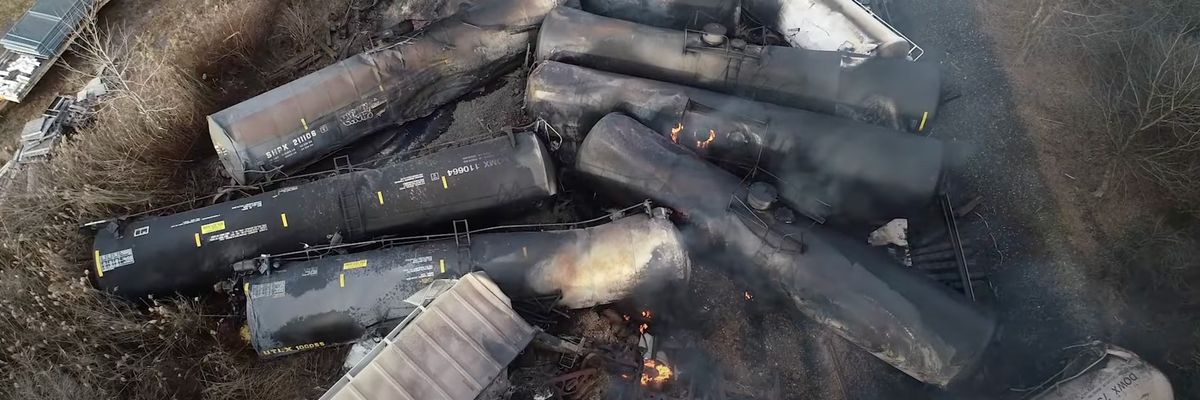
This video screenshot released by the U.S. National Transportation Safety Board (NTSB) shows the site of a derailed freight train in East Palestine, Ohio on February 6, 2023.
"Congress must pass a comprehensive rail safety bill that addresses the issues rooted in the industry's current operating practices," said one labor group.
Six months after a Norfolk Southern freight train carrying hazardous materials derailed and burned in East Palestine, Ohio, railroad workers on Thursday urged Congress to pass comprehensive safety legislation to stop their employers from "choosing Wall Street over Main Street."
"On this somber occasion, rail labor unions once again renew our calls for safety reforms," the Transportation Trades Department (TTD) of the AFL-CIO, which represents 37 unions, said in a statement. "For years, workers have sounded the alarm about deadly safety conditions in the freight rail industry. The industry's safety failures contribute to more than 1,000 freight train derailments a year."
"There have been more than 60 high-profile derailments since East Palestine, including multiple [incidents] in Ohio, Pennsylvania, and Montana," the labor group continued. "Through it all, freight rail companies have maintained their fundamental disregard for public safety. Safety is just a buzzword to the railroads."
TTD added:
Since the East Palestine disaster, rail companies have lobbied to evade or weaken safety provisions, such as the two-person crew minimum staffing standard in legislation pending before Congress. They have also sought to gut proposed safety requirements for rail inspections, defect detectors, and more. While fending off proposed safety measures, railroads have also repeatedly sought waivers from existing federal safety rules.
Shortly after the February 3 East Palestine derailment, chemical spill, and burnoff—which released toxins into the air and forced the evacuation of area residents—rail workers blamed what one member of the Brotherhood of Locomotive Engineers and Trainmen-Teamsters union called "greedy profiteers who externalize risks and reap profits at our expense."
In the wake of recent rail accidents, workers, politicians, and safety advocates pointed to the railroad industry's profit-maximizing scheduling system that forces fewer workers to manage longer trains in less time. Unions and progressive lawmakers contend that this makes the nation's rail system more dangerous and contributes to derailments.
Some critics also noted that rail industry operatives spent more than a half billion dollars lobbying against improved railroad safety rules at the federal and state levels over the past two decades, while others drew attention to the billions of dollars in stock buybacks and dividends issued by railroad companies—money advocates say would be better spent on ensuring better staffing and safety levels.
On Thursday, The Lever reported that Occidental Petroleum, the company that manufactured the toxic chemicals released during the East Palestine disaster, gave $2 million to the leading Senate Republican super PAC as "rail safety legislation stalled in Congress."
In March, U.S. Sens. Sherrod Brown (D-Ohio), J.D. Vance (R-Ohio), Bob Casey (D-Pa.), Marco Rubio (R-Fla.), John Fetterman (D-Pa.), and Josh Hawley (R-Mo.) introduced the bipartisan Railway Safety Act of 2023, legislation that would impose limits on freight train lengths—which in some cases currently exceed three miles.
While welcomed by some safety advocates, critics said the bill has "loopholes big enough to operate a 7,000-foot train through."
The Railway Safety Act was introduced a day after Democratic U.S. Reps. Ro Khanna (D-Calif.) and Chris Deluzio (D-Pa.) put forth a bill that would require the U.S. Department of Transportation to impose stricter regulations on trains carrying hazardous materials.
Later in March, Sens. John Fetterman (D-Pa.), Bob Casey (D-Pa.), and Sherrod Brown (D-Ohio) introduced the Railway Accountability Act, which would direct the Federal Railroad Administration to study wheel-related accidents and mechanical defects.
The legislation would also implement new brake safety measures, improve switchyard safety protocols, ensure rail companies provide adequate safety equipment to their workers, and compel large freight operators to report close calls and dangerous events.
Advocates lamented that none of the bills have passed in the six months since East Palestine.
"Congress must pass a comprehensive rail safety bill that addresses the issues rooted in the industry's current operating practices," TTD said. "Absent these federal actions, rail corporations will keep choosing Wall Street over Main Street and rail safety will further deteriorate."
"Above all, rail corporations must grapple with the moral bankruptcy of their current safety operations and come to their senses," TTD added. "If the moral calculation is not persuasive, perhaps the financial calculation will be."
Dear Common Dreams reader, It’s been nearly 30 years since I co-founded Common Dreams with my late wife, Lina Newhouser. We had the radical notion that journalism should serve the public good, not corporate profits. It was clear to us from the outset what it would take to build such a project. No paid advertisements. No corporate sponsors. No millionaire publisher telling us what to think or do. Many people said we wouldn't last a year, but we proved those doubters wrong. Together with a tremendous team of journalists and dedicated staff, we built an independent media outlet free from the constraints of profits and corporate control. Our mission has always been simple: To inform. To inspire. To ignite change for the common good. Building Common Dreams was not easy. Our survival was never guaranteed. When you take on the most powerful forces—Wall Street greed, fossil fuel industry destruction, Big Tech lobbyists, and uber-rich oligarchs who have spent billions upon billions rigging the economy and democracy in their favor—the only bulwark you have is supporters who believe in your work. But here’s the urgent message from me today. It's never been this bad out there. And it's never been this hard to keep us going. At the very moment Common Dreams is most needed, the threats we face are intensifying. We need your support now more than ever. We don't accept corporate advertising and never will. We don't have a paywall because we don't think people should be blocked from critical news based on their ability to pay. Everything we do is funded by the donations of readers like you. When everyone does the little they can afford, we are strong. But if that support retreats or dries up, so do we. Will you donate now to make sure Common Dreams not only survives but thrives? —Craig Brown, Co-founder |
Six months after a Norfolk Southern freight train carrying hazardous materials derailed and burned in East Palestine, Ohio, railroad workers on Thursday urged Congress to pass comprehensive safety legislation to stop their employers from "choosing Wall Street over Main Street."
"On this somber occasion, rail labor unions once again renew our calls for safety reforms," the Transportation Trades Department (TTD) of the AFL-CIO, which represents 37 unions, said in a statement. "For years, workers have sounded the alarm about deadly safety conditions in the freight rail industry. The industry's safety failures contribute to more than 1,000 freight train derailments a year."
"There have been more than 60 high-profile derailments since East Palestine, including multiple [incidents] in Ohio, Pennsylvania, and Montana," the labor group continued. "Through it all, freight rail companies have maintained their fundamental disregard for public safety. Safety is just a buzzword to the railroads."
TTD added:
Since the East Palestine disaster, rail companies have lobbied to evade or weaken safety provisions, such as the two-person crew minimum staffing standard in legislation pending before Congress. They have also sought to gut proposed safety requirements for rail inspections, defect detectors, and more. While fending off proposed safety measures, railroads have also repeatedly sought waivers from existing federal safety rules.
Shortly after the February 3 East Palestine derailment, chemical spill, and burnoff—which released toxins into the air and forced the evacuation of area residents—rail workers blamed what one member of the Brotherhood of Locomotive Engineers and Trainmen-Teamsters union called "greedy profiteers who externalize risks and reap profits at our expense."
In the wake of recent rail accidents, workers, politicians, and safety advocates pointed to the railroad industry's profit-maximizing scheduling system that forces fewer workers to manage longer trains in less time. Unions and progressive lawmakers contend that this makes the nation's rail system more dangerous and contributes to derailments.
Some critics also noted that rail industry operatives spent more than a half billion dollars lobbying against improved railroad safety rules at the federal and state levels over the past two decades, while others drew attention to the billions of dollars in stock buybacks and dividends issued by railroad companies—money advocates say would be better spent on ensuring better staffing and safety levels.
On Thursday, The Lever reported that Occidental Petroleum, the company that manufactured the toxic chemicals released during the East Palestine disaster, gave $2 million to the leading Senate Republican super PAC as "rail safety legislation stalled in Congress."
In March, U.S. Sens. Sherrod Brown (D-Ohio), J.D. Vance (R-Ohio), Bob Casey (D-Pa.), Marco Rubio (R-Fla.), John Fetterman (D-Pa.), and Josh Hawley (R-Mo.) introduced the bipartisan Railway Safety Act of 2023, legislation that would impose limits on freight train lengths—which in some cases currently exceed three miles.
While welcomed by some safety advocates, critics said the bill has "loopholes big enough to operate a 7,000-foot train through."
The Railway Safety Act was introduced a day after Democratic U.S. Reps. Ro Khanna (D-Calif.) and Chris Deluzio (D-Pa.) put forth a bill that would require the U.S. Department of Transportation to impose stricter regulations on trains carrying hazardous materials.
Later in March, Sens. John Fetterman (D-Pa.), Bob Casey (D-Pa.), and Sherrod Brown (D-Ohio) introduced the Railway Accountability Act, which would direct the Federal Railroad Administration to study wheel-related accidents and mechanical defects.
The legislation would also implement new brake safety measures, improve switchyard safety protocols, ensure rail companies provide adequate safety equipment to their workers, and compel large freight operators to report close calls and dangerous events.
Advocates lamented that none of the bills have passed in the six months since East Palestine.
"Congress must pass a comprehensive rail safety bill that addresses the issues rooted in the industry's current operating practices," TTD said. "Absent these federal actions, rail corporations will keep choosing Wall Street over Main Street and rail safety will further deteriorate."
"Above all, rail corporations must grapple with the moral bankruptcy of their current safety operations and come to their senses," TTD added. "If the moral calculation is not persuasive, perhaps the financial calculation will be."
Six months after a Norfolk Southern freight train carrying hazardous materials derailed and burned in East Palestine, Ohio, railroad workers on Thursday urged Congress to pass comprehensive safety legislation to stop their employers from "choosing Wall Street over Main Street."
"On this somber occasion, rail labor unions once again renew our calls for safety reforms," the Transportation Trades Department (TTD) of the AFL-CIO, which represents 37 unions, said in a statement. "For years, workers have sounded the alarm about deadly safety conditions in the freight rail industry. The industry's safety failures contribute to more than 1,000 freight train derailments a year."
"There have been more than 60 high-profile derailments since East Palestine, including multiple [incidents] in Ohio, Pennsylvania, and Montana," the labor group continued. "Through it all, freight rail companies have maintained their fundamental disregard for public safety. Safety is just a buzzword to the railroads."
TTD added:
Since the East Palestine disaster, rail companies have lobbied to evade or weaken safety provisions, such as the two-person crew minimum staffing standard in legislation pending before Congress. They have also sought to gut proposed safety requirements for rail inspections, defect detectors, and more. While fending off proposed safety measures, railroads have also repeatedly sought waivers from existing federal safety rules.
Shortly after the February 3 East Palestine derailment, chemical spill, and burnoff—which released toxins into the air and forced the evacuation of area residents—rail workers blamed what one member of the Brotherhood of Locomotive Engineers and Trainmen-Teamsters union called "greedy profiteers who externalize risks and reap profits at our expense."
In the wake of recent rail accidents, workers, politicians, and safety advocates pointed to the railroad industry's profit-maximizing scheduling system that forces fewer workers to manage longer trains in less time. Unions and progressive lawmakers contend that this makes the nation's rail system more dangerous and contributes to derailments.
Some critics also noted that rail industry operatives spent more than a half billion dollars lobbying against improved railroad safety rules at the federal and state levels over the past two decades, while others drew attention to the billions of dollars in stock buybacks and dividends issued by railroad companies—money advocates say would be better spent on ensuring better staffing and safety levels.
On Thursday, The Lever reported that Occidental Petroleum, the company that manufactured the toxic chemicals released during the East Palestine disaster, gave $2 million to the leading Senate Republican super PAC as "rail safety legislation stalled in Congress."
In March, U.S. Sens. Sherrod Brown (D-Ohio), J.D. Vance (R-Ohio), Bob Casey (D-Pa.), Marco Rubio (R-Fla.), John Fetterman (D-Pa.), and Josh Hawley (R-Mo.) introduced the bipartisan Railway Safety Act of 2023, legislation that would impose limits on freight train lengths—which in some cases currently exceed three miles.
While welcomed by some safety advocates, critics said the bill has "loopholes big enough to operate a 7,000-foot train through."
The Railway Safety Act was introduced a day after Democratic U.S. Reps. Ro Khanna (D-Calif.) and Chris Deluzio (D-Pa.) put forth a bill that would require the U.S. Department of Transportation to impose stricter regulations on trains carrying hazardous materials.
Later in March, Sens. John Fetterman (D-Pa.), Bob Casey (D-Pa.), and Sherrod Brown (D-Ohio) introduced the Railway Accountability Act, which would direct the Federal Railroad Administration to study wheel-related accidents and mechanical defects.
The legislation would also implement new brake safety measures, improve switchyard safety protocols, ensure rail companies provide adequate safety equipment to their workers, and compel large freight operators to report close calls and dangerous events.
Advocates lamented that none of the bills have passed in the six months since East Palestine.
"Congress must pass a comprehensive rail safety bill that addresses the issues rooted in the industry's current operating practices," TTD said. "Absent these federal actions, rail corporations will keep choosing Wall Street over Main Street and rail safety will further deteriorate."
"Above all, rail corporations must grapple with the moral bankruptcy of their current safety operations and come to their senses," TTD added. "If the moral calculation is not persuasive, perhaps the financial calculation will be."

