5
#000000
#FFFFFF
To donate by check, phone, or other method, see our More Ways to Give page.
Daily news & progressive opinion—funded by the people, not the corporations—delivered straight to your inbox.

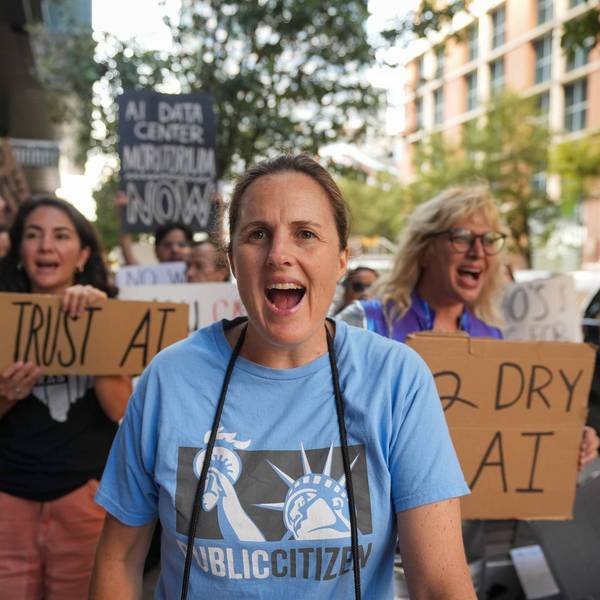
Protesters during a "Stop the AI Race" demonstration calling for a slowdown in the development of advanced artificial intelligence systems outside City Hall in San Francisco, California, on September 17, 2026.
"Wild that candidates are avoiding an enormously consequential issue with broad bipartisan support among voters, for fear of unleashing attack ads from super PACs funded by a tiny handful of AI billionaires and corporations."
A veteran aide for Sen. Bernie Sanders (I-Vt.) has some choice advice for Democrats running for office in this year's election, which is to ignore the guidance some of them are reportedly receiving from their political consultants on the question of regulating the artificial intelligence industry in the face of growing public concerns about runaway machine learning and the data center buildout that big tech companies are pursuing nationwide.
Warren Gunnels, who currently serves as the minority staff director for Sanders on the Health, Education, Labor and Pensions (HELP) Committee in the US Senate, issued his advice in response to a Politico article published Thursday, which had the headline "Democratic advisers are warning their candidates not to go too hard at AI."
While the reporting noted that members of the Democratic Party's consultancy class are "privately encouraging their battleground candidates to avoid talking about AI regulations out of fear that powerful tech groups will unleash a tidal wave of spending against them" ahead of this year's midterm election, Gunnels offered a 9-word antidote to what he considered bad political advice and a failure to recognize where most voters are on the issue.
"Nine words," said Gunnels in his post: "Fuck the consultants, End Citizens United, Ban super PACs." Gunnels backed up his statement with recent polling data suggesting that a strong stance on AI and data centers would likely help, not hurt, those seeking elected office.
Gunnels wasn't the only one to react negatively.
Brendan Fischer, director of strategic investigations at the Campaign Legal Center, said it's "wild that candidates are avoiding an enormously consequential issue with broad bipartisan support among voters, for fear of unleashing attack ads from super PACs funded by a tiny handful of AI billionaires and corporations."
The US Supreme Court's 2010 ruling in the Citizens United case, which unleashed a tidal wave of dark money campaign spending, said Fischer, "promised unlimited political spending would mean more speech and a more robust marketplace of ideas. But instead, candidates are chilled from discussing issues voters care about for fear of angering wealthy interests capable of spending millions to defeat them."
In July, Business Insider reported that the AI industry had already spent at least $65 million in midterm races, though other estimates have put that figure much higher. Meanwhile, Elon Musk, CEO of Space X and a major player in the AI space with his GROK model, has vowed to spend a $100 million help his preferred candidates and the Republican Party win.
At a summit on the need for robust regulation of the AI industry held earlier this week, Sanders said he had a message for leaders and executives running theses tech companies.
"My message to the AI CEO’s: If you truly care about the future of humanity," said Sanders, "stop pouring hundreds of millions of dollars into super PACs to defeat Members of Congress and candidates who are fighting for serious guardrails on AI."
My message to the AI CEO’s:
If you truly care about the future of humanity, stop pouring hundreds of millions of dollars into super PACs to defeat Members of Congress and candidates who are fighting for serious guardrails on AI. pic.twitter.com/2HooEeOQr3
— Sen. Bernie Sanders (@SenSanders) September 15, 2026
As the debate over AI regulation has emerged as a major topic in Washington, DC, and on the campaign trail in recent weeks, a series of polls have confirmed public anxieties about the technology.
A poll from The Associated Press-NORC Center for Public Affairs Research and the Energy Policy Institute at the University of Chicago released Wednesday showed that more than half of US voters (53%) are “extremely” or “very” concerned about artificial intelligence’s environmental impacts, and the poll also found broader concerns about the negative impacts of data centers, especially on local water resources and utility rates.
"Change is scary, and I think some of that is being reflected here,” said Michael Greenstone, who directs the University of Chicago institute that collaborated on the survey, of the results.
The Politico reporting, which drew Gunnel's fiery response, also acknowledged the public sentiment, but described how consultants working on various Democratic campaigns are trying to avoid provoking the ire of deep-pocketed tech giants:
Some top Democratic candidates and their campaigns are quietly trying to avoid crossing any red lines for tech super PACs — even as it’s unclear exactly what those lines would be, after Musk and two of the biggest AI CEOs called for more regulation on the technology last week.Democrats are especially wary of Leading the Future, a pro-AI industry super PAC that spent over $25 million in primary races this year and is backed by investors and executives of OpenAI. The rival super PAC network, Public First Action, pushes for AI regulation and is funded by OpenAI’s chief competitor, Anthropic.
While the fears of being targeted by the industry cash may not be unfounded, progressives like Gunnels suggest that a willingness to take a stand against powerful AI companies is exactly the kind of fight voters want to see from party candidates.
For the Politico article, Rep. Pramila Jayapal (D-Wash.), former chair of the Congressional Progressive Caucus in the House, explained how AI super PACs "come out and they say that they’re concerned, that they want regulation. But then they spend huge amounts of money on defeating anybody who wants legislative regulation."
In a social media post Thursday night, however, Jayapal backed the congressional campaign of Will Lawrence, running as a Democrat to win an open seat in Michigan's 7th Congressional District, by saying voters "need leaders who answer to their constituents, not the corporations that paid for their election."
Following Gunnels advice that bucking the influence of corporate donors is actually a key component of a winning electoral strategy in the 2026 midterms, Jayapal said "electing fighters who don’t take corporate PAC money"—whether on the issue of AI, healthcare, housing policy, or broader concerns about economic inequality and affordability—is key for Democrats.
Dear Common Dreams reader, It’s been nearly 30 years since I co-founded Common Dreams with my late wife, Lina Newhouser. We had the radical notion that journalism should serve the public good, not corporate profits. It was clear to us from the outset what it would take to build such a project. No paid advertisements. No corporate sponsors. No millionaire publisher telling us what to think or do. Many people said we wouldn't last a year, but we proved those doubters wrong. Together with a tremendous team of journalists and dedicated staff, we built an independent media outlet free from the constraints of profits and corporate control. Our mission has always been simple: To inform. To inspire. To ignite change for the common good. Building Common Dreams was not easy. Our survival was never guaranteed. When you take on the most powerful forces—Wall Street greed, fossil fuel industry destruction, Big Tech lobbyists, and uber-rich oligarchs who have spent billions upon billions rigging the economy and democracy in their favor—the only bulwark you have is supporters who believe in your work. But here’s the urgent message from me today. It's never been this bad out there. And it's never been this hard to keep us going. At the very moment Common Dreams is most needed, the threats we face are intensifying. We need your support now more than ever. We don't accept corporate advertising and never will. We don't have a paywall because we don't think people should be blocked from critical news based on their ability to pay. Everything we do is funded by the donations of readers like you. When everyone does the little they can afford, we are strong. But if that support retreats or dries up, so do we. Will you donate now to make sure Common Dreams not only survives but thrives? —Craig Brown, Co-founder |
A veteran aide for Sen. Bernie Sanders (I-Vt.) has some choice advice for Democrats running for office in this year's election, which is to ignore the guidance some of them are reportedly receiving from their political consultants on the question of regulating the artificial intelligence industry in the face of growing public concerns about runaway machine learning and the data center buildout that big tech companies are pursuing nationwide.
Warren Gunnels, who currently serves as the minority staff director for Sanders on the Health, Education, Labor and Pensions (HELP) Committee in the US Senate, issued his advice in response to a Politico article published Thursday, which had the headline "Democratic advisers are warning their candidates not to go too hard at AI."
While the reporting noted that members of the Democratic Party's consultancy class are "privately encouraging their battleground candidates to avoid talking about AI regulations out of fear that powerful tech groups will unleash a tidal wave of spending against them" ahead of this year's midterm election, Gunnels offered a 9-word antidote to what he considered bad political advice and a failure to recognize where most voters are on the issue.
"Nine words," said Gunnels in his post: "Fuck the consultants, End Citizens United, Ban super PACs." Gunnels backed up his statement with recent polling data suggesting that a strong stance on AI and data centers would likely help, not hurt, those seeking elected office.
Gunnels wasn't the only one to react negatively.
Brendan Fischer, director of strategic investigations at the Campaign Legal Center, said it's "wild that candidates are avoiding an enormously consequential issue with broad bipartisan support among voters, for fear of unleashing attack ads from super PACs funded by a tiny handful of AI billionaires and corporations."
The US Supreme Court's 2010 ruling in the Citizens United case, which unleashed a tidal wave of dark money campaign spending, said Fischer, "promised unlimited political spending would mean more speech and a more robust marketplace of ideas. But instead, candidates are chilled from discussing issues voters care about for fear of angering wealthy interests capable of spending millions to defeat them."
In July, Business Insider reported that the AI industry had already spent at least $65 million in midterm races, though other estimates have put that figure much higher. Meanwhile, Elon Musk, CEO of Space X and a major player in the AI space with his GROK model, has vowed to spend a $100 million help his preferred candidates and the Republican Party win.
At a summit on the need for robust regulation of the AI industry held earlier this week, Sanders said he had a message for leaders and executives running theses tech companies.
"My message to the AI CEO’s: If you truly care about the future of humanity," said Sanders, "stop pouring hundreds of millions of dollars into super PACs to defeat Members of Congress and candidates who are fighting for serious guardrails on AI."
My message to the AI CEO’s:
If you truly care about the future of humanity, stop pouring hundreds of millions of dollars into super PACs to defeat Members of Congress and candidates who are fighting for serious guardrails on AI. pic.twitter.com/2HooEeOQr3
— Sen. Bernie Sanders (@SenSanders) September 15, 2026
As the debate over AI regulation has emerged as a major topic in Washington, DC, and on the campaign trail in recent weeks, a series of polls have confirmed public anxieties about the technology.
A poll from The Associated Press-NORC Center for Public Affairs Research and the Energy Policy Institute at the University of Chicago released Wednesday showed that more than half of US voters (53%) are “extremely” or “very” concerned about artificial intelligence’s environmental impacts, and the poll also found broader concerns about the negative impacts of data centers, especially on local water resources and utility rates.
"Change is scary, and I think some of that is being reflected here,” said Michael Greenstone, who directs the University of Chicago institute that collaborated on the survey, of the results.
The Politico reporting, which drew Gunnel's fiery response, also acknowledged the public sentiment, but described how consultants working on various Democratic campaigns are trying to avoid provoking the ire of deep-pocketed tech giants:
Some top Democratic candidates and their campaigns are quietly trying to avoid crossing any red lines for tech super PACs — even as it’s unclear exactly what those lines would be, after Musk and two of the biggest AI CEOs called for more regulation on the technology last week.Democrats are especially wary of Leading the Future, a pro-AI industry super PAC that spent over $25 million in primary races this year and is backed by investors and executives of OpenAI. The rival super PAC network, Public First Action, pushes for AI regulation and is funded by OpenAI’s chief competitor, Anthropic.
While the fears of being targeted by the industry cash may not be unfounded, progressives like Gunnels suggest that a willingness to take a stand against powerful AI companies is exactly the kind of fight voters want to see from party candidates.
For the Politico article, Rep. Pramila Jayapal (D-Wash.), former chair of the Congressional Progressive Caucus in the House, explained how AI super PACs "come out and they say that they’re concerned, that they want regulation. But then they spend huge amounts of money on defeating anybody who wants legislative regulation."
In a social media post Thursday night, however, Jayapal backed the congressional campaign of Will Lawrence, running as a Democrat to win an open seat in Michigan's 7th Congressional District, by saying voters "need leaders who answer to their constituents, not the corporations that paid for their election."
Following Gunnels advice that bucking the influence of corporate donors is actually a key component of a winning electoral strategy in the 2026 midterms, Jayapal said "electing fighters who don’t take corporate PAC money"—whether on the issue of AI, healthcare, housing policy, or broader concerns about economic inequality and affordability—is key for Democrats.
A veteran aide for Sen. Bernie Sanders (I-Vt.) has some choice advice for Democrats running for office in this year's election, which is to ignore the guidance some of them are reportedly receiving from their political consultants on the question of regulating the artificial intelligence industry in the face of growing public concerns about runaway machine learning and the data center buildout that big tech companies are pursuing nationwide.
Warren Gunnels, who currently serves as the minority staff director for Sanders on the Health, Education, Labor and Pensions (HELP) Committee in the US Senate, issued his advice in response to a Politico article published Thursday, which had the headline "Democratic advisers are warning their candidates not to go too hard at AI."
While the reporting noted that members of the Democratic Party's consultancy class are "privately encouraging their battleground candidates to avoid talking about AI regulations out of fear that powerful tech groups will unleash a tidal wave of spending against them" ahead of this year's midterm election, Gunnels offered a 9-word antidote to what he considered bad political advice and a failure to recognize where most voters are on the issue.
"Nine words," said Gunnels in his post: "Fuck the consultants, End Citizens United, Ban super PACs." Gunnels backed up his statement with recent polling data suggesting that a strong stance on AI and data centers would likely help, not hurt, those seeking elected office.
Gunnels wasn't the only one to react negatively.
Brendan Fischer, director of strategic investigations at the Campaign Legal Center, said it's "wild that candidates are avoiding an enormously consequential issue with broad bipartisan support among voters, for fear of unleashing attack ads from super PACs funded by a tiny handful of AI billionaires and corporations."
The US Supreme Court's 2010 ruling in the Citizens United case, which unleashed a tidal wave of dark money campaign spending, said Fischer, "promised unlimited political spending would mean more speech and a more robust marketplace of ideas. But instead, candidates are chilled from discussing issues voters care about for fear of angering wealthy interests capable of spending millions to defeat them."
In July, Business Insider reported that the AI industry had already spent at least $65 million in midterm races, though other estimates have put that figure much higher. Meanwhile, Elon Musk, CEO of Space X and a major player in the AI space with his GROK model, has vowed to spend a $100 million help his preferred candidates and the Republican Party win.
At a summit on the need for robust regulation of the AI industry held earlier this week, Sanders said he had a message for leaders and executives running theses tech companies.
"My message to the AI CEO’s: If you truly care about the future of humanity," said Sanders, "stop pouring hundreds of millions of dollars into super PACs to defeat Members of Congress and candidates who are fighting for serious guardrails on AI."
My message to the AI CEO’s:
If you truly care about the future of humanity, stop pouring hundreds of millions of dollars into super PACs to defeat Members of Congress and candidates who are fighting for serious guardrails on AI. pic.twitter.com/2HooEeOQr3
— Sen. Bernie Sanders (@SenSanders) September 15, 2026
As the debate over AI regulation has emerged as a major topic in Washington, DC, and on the campaign trail in recent weeks, a series of polls have confirmed public anxieties about the technology.
A poll from The Associated Press-NORC Center for Public Affairs Research and the Energy Policy Institute at the University of Chicago released Wednesday showed that more than half of US voters (53%) are “extremely” or “very” concerned about artificial intelligence’s environmental impacts, and the poll also found broader concerns about the negative impacts of data centers, especially on local water resources and utility rates.
"Change is scary, and I think some of that is being reflected here,” said Michael Greenstone, who directs the University of Chicago institute that collaborated on the survey, of the results.
The Politico reporting, which drew Gunnel's fiery response, also acknowledged the public sentiment, but described how consultants working on various Democratic campaigns are trying to avoid provoking the ire of deep-pocketed tech giants:
Some top Democratic candidates and their campaigns are quietly trying to avoid crossing any red lines for tech super PACs — even as it’s unclear exactly what those lines would be, after Musk and two of the biggest AI CEOs called for more regulation on the technology last week.Democrats are especially wary of Leading the Future, a pro-AI industry super PAC that spent over $25 million in primary races this year and is backed by investors and executives of OpenAI. The rival super PAC network, Public First Action, pushes for AI regulation and is funded by OpenAI’s chief competitor, Anthropic.
While the fears of being targeted by the industry cash may not be unfounded, progressives like Gunnels suggest that a willingness to take a stand against powerful AI companies is exactly the kind of fight voters want to see from party candidates.
For the Politico article, Rep. Pramila Jayapal (D-Wash.), former chair of the Congressional Progressive Caucus in the House, explained how AI super PACs "come out and they say that they’re concerned, that they want regulation. But then they spend huge amounts of money on defeating anybody who wants legislative regulation."
In a social media post Thursday night, however, Jayapal backed the congressional campaign of Will Lawrence, running as a Democrat to win an open seat in Michigan's 7th Congressional District, by saying voters "need leaders who answer to their constituents, not the corporations that paid for their election."
Following Gunnels advice that bucking the influence of corporate donors is actually a key component of a winning electoral strategy in the 2026 midterms, Jayapal said "electing fighters who don’t take corporate PAC money"—whether on the issue of AI, healthcare, housing policy, or broader concerns about economic inequality and affordability—is key for Democrats.