
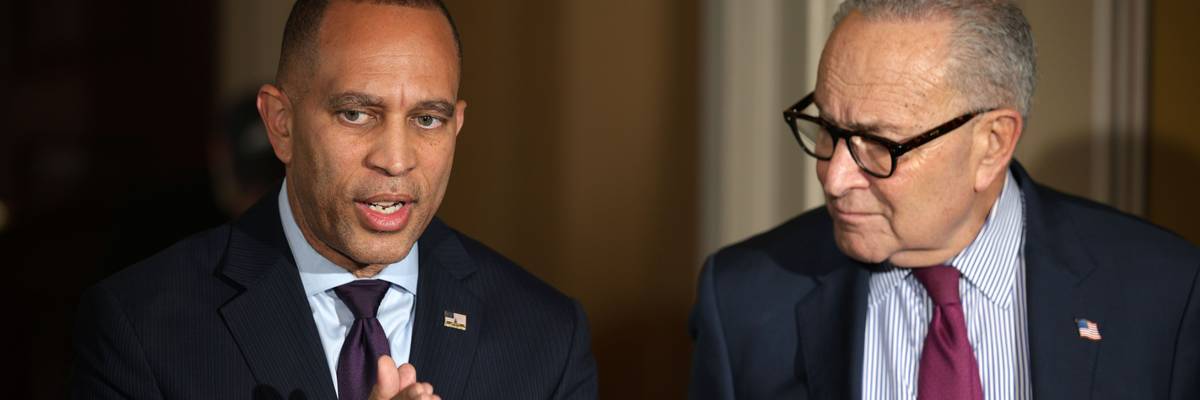
US House Minority Leader Hakeem Jeffries (D-NY) (L) speaks while Senate Minority Leader Chuck Schumer (D-NY) (R) looks on during an October 16, 2025 press briefing on Capitol Hill in Washington, DC.
Majority of Democrats, Independents Want Leaders to Fight GOP Attacks on AI Rules
"Voters are angry about Big Tech’s rogue AI telling teens to commit suicide and they want to see their congressional leaders fighting back," said one campaigner.
A poll published Friday revealed that a majority of Democratic and Independent US voters want congressional Democrats to fight GOP efforts to block states from passing laws regulating artificial intelligence—even as the technology evolves at a speed that has many experts concerned about serious and possibly existential consequences.
The Demand Progress poll of 2,257 likely voters conducted by Tavern Research found that voters across the political spectrum are wary of Big Tech's ability or willingness to ensure safe development of AI, with just 8% of Democratic respondents, 9% of Independents, and 18% of Republicans saying they trust companies to "adequately prioritize safety."
Respondents across the board—81% of Democrats and Independents and 74% of Republicans—also agreed that "large technology companies have too much influence over AI policy."
Although an earlier Republican attempt to slip a 10-year ban on state AI regulation into the massive One Big Beautiful Bill Act signed by President Donald Trump in July was shot down in the Senate, a bill introduced in September by Rep. Michael Baumgartner (R-Wash.) would impose a temporary moratorium on state laws regulating artificial intelligence.
So far, Trump's most notably robust regulation of artificial intelligence has been his executive order aimed at preventing "woke AI." His other AI-related edicts have rolled back regulations, including some meager steps taken under former President Joe Biden to bolster safety.
Last month, Trump signed a directive launching the Genesis Mission, "a new national effort to use artificial intelligence to transform how scientific research is conducted and accelerate the speed of scientific discovery"—even as critics warned that the administration's lax approach to regulation poses safety and structural risks.
As experts urge a more measured approach or even a pause to AI development, 56% of Democratic and 62% of Independent respondents to the new poll want Senate Minority Leader Chuck Schumer (D-NY) and House Minority Leader Hakeem Jeffries (D-NY) to work to block Republicans’ policy to prevent states from regulating AI.
Additionally, 61% of Democratic voters and 68% of Independents said they would be less likely to support a Democratic member of Congress who backed a bill to prevent states from regulating AI. Just 15% of Democrats and 14% of Independents said that they would be more likely to support lawmakers who approve such legislation.
On Monday, House Democratic Leader Hakeem Jeffries avoided taking a stance on the issue, saying that it “hasn't been brought to the leadership level yet.”This isn't enough. Our poll found that voters want to see their congressional leaders fighting back against AI deregulation.
[image or embed]
— Demand Progress (@demandprogress.bsky.social) December 5, 2025 at 6:53 AM
On Monday, Jeffries avoided taking a stance on the Republican effort to ban AI guardrails, arguing that it hasn't yet reached the leadership level. Critics urged him to speak out against the legislation.
“Democratic and Independent voters overwhelmingly want to see Hakeem Jeffries and Chuck Schumer fighting Donald Trump and Big Tech’s attempt to ban states from enacting AI safeguards, not back down and compromise,” Demand Progress policy director Emily Peterson-Cassin said in a statement Friday.
“It’s not enough for Leader Jeffries to say that the issue hasn’t been brought to him yet," she added. "Voters are angry about Big Tech’s rogue AI telling teens to commit suicide and they want to see their congressional leaders fighting back.”
Opponents of a more cautious approach to AI development argue that the United States cannot afford to fall behind competitors including China in the rush to achieve artificial general intelligence (AGI), a hypothetical advanced AI that can understand, learn, and apply knowledge of any subject as well as or better than a typical human.
The race to AGI and development of AI systems in general is fraught with perils ranging from cybercrime, consumer manipulation, erosion of democracy, and worsening inequality to what many experts warn is the distant but possible threat of uncontrollable AI wiping out humanity.
With so much uncertainty—and even danger—accompanying the unprecedented promise of AI, an increasingly aware public favors caution. Majorities of respondents to poll after poll say they want more, not less, AI regulation.
We are at a crossroads
This country and this world are at a monumental crossroads. In a few short weeks, US voters will have an opportunity to beat back the forces of fascism and confront the billionaires who are rigging the economy, our media system, and our democracy, making it increasingly impossible for ordinary people to get by. We’re not just talking about the election. We’re talking about what must be done once these fascist elements are vanquished from power. We need a bolder set of solutions than what either major party has so far been willing to offer and a working-class movement ready to fight like hell for it. Trump didn't emerge from nowhere. The conditions that fueled MAGA authoritarianism were created by decades of radical neoliberal economic policies and a corrupt political system dominated by corporate interests. They slashed taxes on the super-rich, promising that the benefits would trickle down. They said giveaways to the corporate titans would make life more affordable for the rest of us. It was all bullshit. And when a bitter, betrayed populace searches for someone to blame, right-wing demagogues have little trouble finding scapegoats. People know when they're being lied to, but you won't hear any of this from the corporate media. Only independent journalism—powered and funded by people who believe in building a better world—can deliver truly trustworthy daily news. Our Fall Campaign is underway, and we need your help. To power our newsroom through the rest of the year, we need to raise $125,000 by midnight on October 31. So if you share our vision, please contribute whatever you can to sustain our work. |
A poll published Friday revealed that a majority of Democratic and Independent US voters want congressional Democrats to fight GOP efforts to block states from passing laws regulating artificial intelligence—even as the technology evolves at a speed that has many experts concerned about serious and possibly existential consequences.
The Demand Progress poll of 2,257 likely voters conducted by Tavern Research found that voters across the political spectrum are wary of Big Tech's ability or willingness to ensure safe development of AI, with just 8% of Democratic respondents, 9% of Independents, and 18% of Republicans saying they trust companies to "adequately prioritize safety."
Respondents across the board—81% of Democrats and Independents and 74% of Republicans—also agreed that "large technology companies have too much influence over AI policy."
Although an earlier Republican attempt to slip a 10-year ban on state AI regulation into the massive One Big Beautiful Bill Act signed by President Donald Trump in July was shot down in the Senate, a bill introduced in September by Rep. Michael Baumgartner (R-Wash.) would impose a temporary moratorium on state laws regulating artificial intelligence.
So far, Trump's most notably robust regulation of artificial intelligence has been his executive order aimed at preventing "woke AI." His other AI-related edicts have rolled back regulations, including some meager steps taken under former President Joe Biden to bolster safety.
Last month, Trump signed a directive launching the Genesis Mission, "a new national effort to use artificial intelligence to transform how scientific research is conducted and accelerate the speed of scientific discovery"—even as critics warned that the administration's lax approach to regulation poses safety and structural risks.
As experts urge a more measured approach or even a pause to AI development, 56% of Democratic and 62% of Independent respondents to the new poll want Senate Minority Leader Chuck Schumer (D-NY) and House Minority Leader Hakeem Jeffries (D-NY) to work to block Republicans’ policy to prevent states from regulating AI.
Additionally, 61% of Democratic voters and 68% of Independents said they would be less likely to support a Democratic member of Congress who backed a bill to prevent states from regulating AI. Just 15% of Democrats and 14% of Independents said that they would be more likely to support lawmakers who approve such legislation.
On Monday, House Democratic Leader Hakeem Jeffries avoided taking a stance on the issue, saying that it “hasn't been brought to the leadership level yet.”This isn't enough. Our poll found that voters want to see their congressional leaders fighting back against AI deregulation.
[image or embed]
— Demand Progress (@demandprogress.bsky.social) December 5, 2025 at 6:53 AM
On Monday, Jeffries avoided taking a stance on the Republican effort to ban AI guardrails, arguing that it hasn't yet reached the leadership level. Critics urged him to speak out against the legislation.
“Democratic and Independent voters overwhelmingly want to see Hakeem Jeffries and Chuck Schumer fighting Donald Trump and Big Tech’s attempt to ban states from enacting AI safeguards, not back down and compromise,” Demand Progress policy director Emily Peterson-Cassin said in a statement Friday.
“It’s not enough for Leader Jeffries to say that the issue hasn’t been brought to him yet," she added. "Voters are angry about Big Tech’s rogue AI telling teens to commit suicide and they want to see their congressional leaders fighting back.”
Opponents of a more cautious approach to AI development argue that the United States cannot afford to fall behind competitors including China in the rush to achieve artificial general intelligence (AGI), a hypothetical advanced AI that can understand, learn, and apply knowledge of any subject as well as or better than a typical human.
The race to AGI and development of AI systems in general is fraught with perils ranging from cybercrime, consumer manipulation, erosion of democracy, and worsening inequality to what many experts warn is the distant but possible threat of uncontrollable AI wiping out humanity.
With so much uncertainty—and even danger—accompanying the unprecedented promise of AI, an increasingly aware public favors caution. Majorities of respondents to poll after poll say they want more, not less, AI regulation.
- Trump's AI Action Plan Includes 'Zombie' Moratorium on State Regulations ›
- Experts Demand 'Pause' on Spread of Artificial Intelligence Until Regulations Imposed ›
- 140+ Groups Oppose House GOP's Sweeping Ban on State AI Regulation ›
- 'Godfather of AI' Demands Strict Regulations to Stop Technology From Wiping Out Humanity ›
- Does Swarm of Lobbyists at Governors Summit Help Explain Democrats' Silence on Trump AI Order? | Common Dreams ›
- Opinion | Will Democrats Finally Get Real About AI? | Common Dreams ›
- Trump-Aligned PAC Drops Six Figures in Texas on 'AI Brainrot' Ad Putting Talarico in a Dress | Common Dreams ›
- Opinion | How (And Why) AI is Eroding Democracy in the US | Common Dreams ›
- Opinion | Big AI is Blitzing Washington; It's Time for Democratic Leadership to Choose a Side | Common Dreams ›
- Opinion | Congress Should Regulate What AI Agents Can Do, Not Just How Smart They Are | Common Dreams ›
- 'F*ck the Consultants': Free Advice Offered for Democrats in Need of a Position on AI | Common Dreams ›
A poll published Friday revealed that a majority of Democratic and Independent US voters want congressional Democrats to fight GOP efforts to block states from passing laws regulating artificial intelligence—even as the technology evolves at a speed that has many experts concerned about serious and possibly existential consequences.
The Demand Progress poll of 2,257 likely voters conducted by Tavern Research found that voters across the political spectrum are wary of Big Tech's ability or willingness to ensure safe development of AI, with just 8% of Democratic respondents, 9% of Independents, and 18% of Republicans saying they trust companies to "adequately prioritize safety."
Respondents across the board—81% of Democrats and Independents and 74% of Republicans—also agreed that "large technology companies have too much influence over AI policy."
Although an earlier Republican attempt to slip a 10-year ban on state AI regulation into the massive One Big Beautiful Bill Act signed by President Donald Trump in July was shot down in the Senate, a bill introduced in September by Rep. Michael Baumgartner (R-Wash.) would impose a temporary moratorium on state laws regulating artificial intelligence.
So far, Trump's most notably robust regulation of artificial intelligence has been his executive order aimed at preventing "woke AI." His other AI-related edicts have rolled back regulations, including some meager steps taken under former President Joe Biden to bolster safety.
Last month, Trump signed a directive launching the Genesis Mission, "a new national effort to use artificial intelligence to transform how scientific research is conducted and accelerate the speed of scientific discovery"—even as critics warned that the administration's lax approach to regulation poses safety and structural risks.
As experts urge a more measured approach or even a pause to AI development, 56% of Democratic and 62% of Independent respondents to the new poll want Senate Minority Leader Chuck Schumer (D-NY) and House Minority Leader Hakeem Jeffries (D-NY) to work to block Republicans’ policy to prevent states from regulating AI.
Additionally, 61% of Democratic voters and 68% of Independents said they would be less likely to support a Democratic member of Congress who backed a bill to prevent states from regulating AI. Just 15% of Democrats and 14% of Independents said that they would be more likely to support lawmakers who approve such legislation.
On Monday, House Democratic Leader Hakeem Jeffries avoided taking a stance on the issue, saying that it “hasn't been brought to the leadership level yet.”This isn't enough. Our poll found that voters want to see their congressional leaders fighting back against AI deregulation.
[image or embed]
— Demand Progress (@demandprogress.bsky.social) December 5, 2025 at 6:53 AM
On Monday, Jeffries avoided taking a stance on the Republican effort to ban AI guardrails, arguing that it hasn't yet reached the leadership level. Critics urged him to speak out against the legislation.
“Democratic and Independent voters overwhelmingly want to see Hakeem Jeffries and Chuck Schumer fighting Donald Trump and Big Tech’s attempt to ban states from enacting AI safeguards, not back down and compromise,” Demand Progress policy director Emily Peterson-Cassin said in a statement Friday.
“It’s not enough for Leader Jeffries to say that the issue hasn’t been brought to him yet," she added. "Voters are angry about Big Tech’s rogue AI telling teens to commit suicide and they want to see their congressional leaders fighting back.”
Opponents of a more cautious approach to AI development argue that the United States cannot afford to fall behind competitors including China in the rush to achieve artificial general intelligence (AGI), a hypothetical advanced AI that can understand, learn, and apply knowledge of any subject as well as or better than a typical human.
The race to AGI and development of AI systems in general is fraught with perils ranging from cybercrime, consumer manipulation, erosion of democracy, and worsening inequality to what many experts warn is the distant but possible threat of uncontrollable AI wiping out humanity.
With so much uncertainty—and even danger—accompanying the unprecedented promise of AI, an increasingly aware public favors caution. Majorities of respondents to poll after poll say they want more, not less, AI regulation.
- Trump's AI Action Plan Includes 'Zombie' Moratorium on State Regulations ›
- Experts Demand 'Pause' on Spread of Artificial Intelligence Until Regulations Imposed ›
- 140+ Groups Oppose House GOP's Sweeping Ban on State AI Regulation ›
- 'Godfather of AI' Demands Strict Regulations to Stop Technology From Wiping Out Humanity ›
- Does Swarm of Lobbyists at Governors Summit Help Explain Democrats' Silence on Trump AI Order? | Common Dreams ›
- Opinion | Will Democrats Finally Get Real About AI? | Common Dreams ›
- Trump-Aligned PAC Drops Six Figures in Texas on 'AI Brainrot' Ad Putting Talarico in a Dress | Common Dreams ›
- Opinion | How (And Why) AI is Eroding Democracy in the US | Common Dreams ›
- Opinion | Big AI is Blitzing Washington; It's Time for Democratic Leadership to Choose a Side | Common Dreams ›
- Opinion | Congress Should Regulate What AI Agents Can Do, Not Just How Smart They Are | Common Dreams ›
- 'F*ck the Consultants': Free Advice Offered for Democrats in Need of a Position on AI | Common Dreams ›