SUBSCRIBE TO OUR FREE NEWSLETTER
Daily news & progressive opinion—funded by the people, not the corporations—delivered straight to your inbox.
5
#000000
#FFFFFF
To donate by check, phone, or other method, see our More Ways to Give page.
Iran's foreign minister on Friday accused the Pentagon of deliberately misleading the American public with its formal estimate that the war on Iran has so far cost the US $25 billion—a number that the chief Iranian diplomat said was a fourfold undercount of the conflict's true price tag.
"The Pentagon is lying," Iranian Foreign Minister Abbas Araghchi wrote on social media. "[Israeli Prime Minister Benjamin] Netanyahu's gamble has directly cost America $100 billion so far, four times what is claimed. Indirect costs for US taxpayers are FAR higher. Monthly bill for each American household is $500 and rising fast."
The Iranian diplomat's comments came days after the Pentagon's acting comptroller, Jules Hurst, told US lawmakers under oath that the Trump administration has thus far spent $25 billion on the historically unpopular war of choice. The New York Times observed that Hurst "did not elaborate on the figure, which was strikingly smaller than the $200 billion the Pentagon had initially requested for the conflict and suggested a major slowdown in expenditures since the start of the war, when officials estimated it had cost more than $11 billion in its first six days."
Outside analysts' estimates of the illegal war's total cost to American taxpayers have varied widely, but most put the number higher than the $25 billion offered by the Pentagon.
The Center for American Progress, a liberal think tank, estimated earlier this month that the Pentagon was likely to have spent more than $33 billion during the first 39 days of the conflict. An April 10 assessment released by the conservative American Enterprise Institute after the ceasefire began put the war's cost between $25 billion and $35 billion.
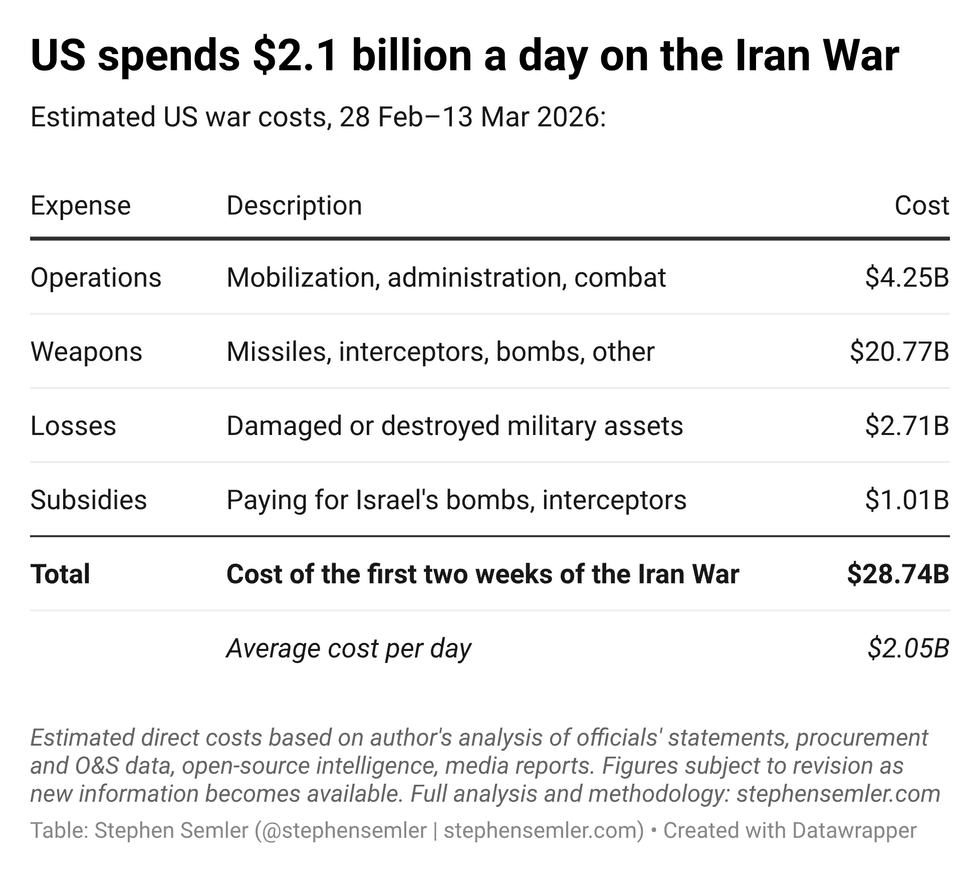
Independent policy analyst Stephen Semler has estimated that the US spent nearly $29 billion on the Iran war during just the first two weeks of the conflict—an average of $2.1 billion per day.
"Hegseth lied to Congress when he said the Iran war has cost $25 billion," Semler wrote Thursday on social media. "It cost more than that in the first two weeks."
On top of direct war spending, lawmakers and experts have pointed to indirect costs of war in the form of higher gas and food prices paid by American consumers.
US Rep. Ro Khanna (D-Calif.) said on the House floor on Thursday that the Iran war has cost Americans over $630 billion—or $5,000 per household on average—"because of the increase in the price of food, the price of gas, the price of electricity."
"We need to end this war now, and help the American people reduce costs," said Khanna.
Linda Bilmes, a public policy expert at the Harvard Kennedy School, said in early April that the Iran war's cost to the US is likely to exceed $1 trillion in the long-term, when accounting for veterans' care and other outlays.
"It is hard to measure the exact cost," said Bilmes. "But based on what we know now, it is costing about two billion dollars a day in short-term, upfront costs, which is the tip of the iceberg."
Iran's foreign minister on Friday accused the Pentagon of deliberately misleading the American public with its formal estimate that the war on Iran has so far cost the US $25 billion—a number that the chief Iranian diplomat said was a fourfold undercount of the conflict's true price tag.
"The Pentagon is lying," Iranian Foreign Minister Abbas Araghchi wrote on social media. "[Israeli Prime Minister Benjamin] Netanyahu's gamble has directly cost America $100 billion so far, four times what is claimed. Indirect costs for US taxpayers are FAR higher. Monthly bill for each American household is $500 and rising fast."
The Iranian diplomat's comments came days after the Pentagon's acting comptroller, Jules Hurst, told US lawmakers under oath that the Trump administration has thus far spent $25 billion on the historically unpopular war of choice. The New York Times observed that Hurst "did not elaborate on the figure, which was strikingly smaller than the $200 billion the Pentagon had initially requested for the conflict and suggested a major slowdown in expenditures since the start of the war, when officials estimated it had cost more than $11 billion in its first six days."
Outside analysts' estimates of the illegal war's total cost to American taxpayers have varied widely, but most put the number higher than the $25 billion offered by the Pentagon.
The Center for American Progress, a liberal think tank, estimated earlier this month that the Pentagon was likely to have spent more than $33 billion during the first 39 days of the conflict. An April 10 assessment released by the conservative American Enterprise Institute after the ceasefire began put the war's cost between $25 billion and $35 billion.
Independent policy analyst Stephen Semler has estimated that the US spent nearly $29 billion on the Iran war during just the first two weeks of the conflict—an average of $2.1 billion per day.
"Hegseth lied to Congress when he said the Iran war has cost $25 billion," Semler wrote Thursday on social media. "It cost more than that in the first two weeks."
On top of direct war spending, lawmakers and experts have pointed to indirect costs of war in the form of higher gas and food prices paid by American consumers.
US Rep. Ro Khanna (D-Calif.) said on the House floor on Thursday that the Iran war has cost Americans over $630 billion—or $5,000 per household on average—"because of the increase in the price of food, the price of gas, the price of electricity."
"We need to end this war now, and help the American people reduce costs," said Khanna.
Linda Bilmes, a public policy expert at the Harvard Kennedy School, said in early April that the Iran war's cost to the US is likely to exceed $1 trillion in the long-term, when accounting for veterans' care and other outlays.
"It is hard to measure the exact cost," said Bilmes. "But based on what we know now, it is costing about two billion dollars a day in short-term, upfront costs, which is the tip of the iceberg."
Iran's foreign minister on Friday accused the Pentagon of deliberately misleading the American public with its formal estimate that the war on Iran has so far cost the US $25 billion—a number that the chief Iranian diplomat said was a fourfold undercount of the conflict's true price tag.
"The Pentagon is lying," Iranian Foreign Minister Abbas Araghchi wrote on social media. "[Israeli Prime Minister Benjamin] Netanyahu's gamble has directly cost America $100 billion so far, four times what is claimed. Indirect costs for US taxpayers are FAR higher. Monthly bill for each American household is $500 and rising fast."
The Iranian diplomat's comments came days after the Pentagon's acting comptroller, Jules Hurst, told US lawmakers under oath that the Trump administration has thus far spent $25 billion on the historically unpopular war of choice. The New York Times observed that Hurst "did not elaborate on the figure, which was strikingly smaller than the $200 billion the Pentagon had initially requested for the conflict and suggested a major slowdown in expenditures since the start of the war, when officials estimated it had cost more than $11 billion in its first six days."
Outside analysts' estimates of the illegal war's total cost to American taxpayers have varied widely, but most put the number higher than the $25 billion offered by the Pentagon.
The Center for American Progress, a liberal think tank, estimated earlier this month that the Pentagon was likely to have spent more than $33 billion during the first 39 days of the conflict. An April 10 assessment released by the conservative American Enterprise Institute after the ceasefire began put the war's cost between $25 billion and $35 billion.
Independent policy analyst Stephen Semler has estimated that the US spent nearly $29 billion on the Iran war during just the first two weeks of the conflict—an average of $2.1 billion per day.
"Hegseth lied to Congress when he said the Iran war has cost $25 billion," Semler wrote Thursday on social media. "It cost more than that in the first two weeks."
On top of direct war spending, lawmakers and experts have pointed to indirect costs of war in the form of higher gas and food prices paid by American consumers.
US Rep. Ro Khanna (D-Calif.) said on the House floor on Thursday that the Iran war has cost Americans over $630 billion—or $5,000 per household on average—"because of the increase in the price of food, the price of gas, the price of electricity."
"We need to end this war now, and help the American people reduce costs," said Khanna.
Linda Bilmes, a public policy expert at the Harvard Kennedy School, said in early April that the Iran war's cost to the US is likely to exceed $1 trillion in the long-term, when accounting for veterans' care and other outlays.
"It is hard to measure the exact cost," said Bilmes. "But based on what we know now, it is costing about two billion dollars a day in short-term, upfront costs, which is the tip of the iceberg."