5
#000000
#FFFFFF
To donate by check, phone, or other method, see our More Ways to Give page.
Daily news & progressive opinion—funded by the people, not the corporations—delivered straight to your inbox.
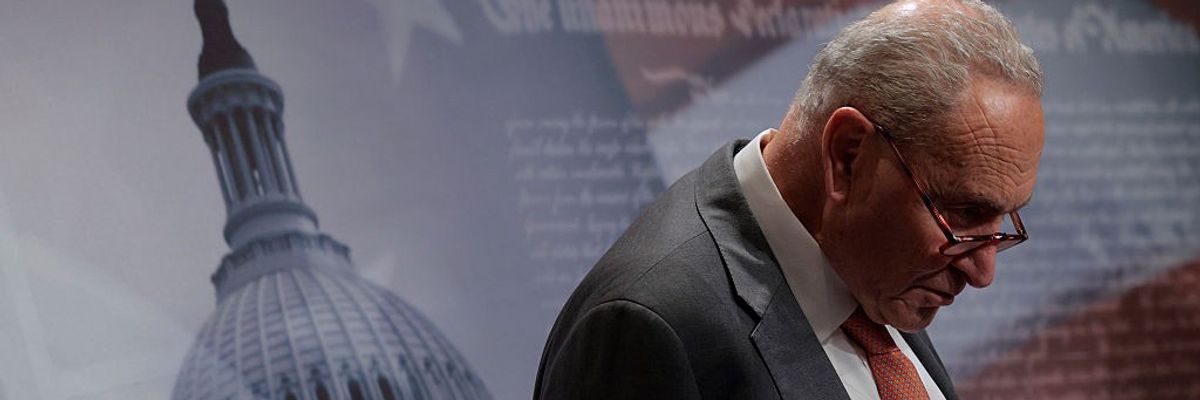
Senate Minority Leader Chuck Schumer (D-N.Y.) holds a news conference criticizing President Donald Trump's trade policy at the US Capitol on July 31, 2025, in Washington, DC.
"Voters have made their feelings clear," said the leader of Justice Democrats. "The majority do not see themselves in this party and do not believe in its leaders or many of its representatives."
A top progressive leader has given her prescription for how the Democratic Party can begin to retake power from US President Donald Trump: Ousting "corporate-funded" candidates.
Justice Democrats executive director Alexandra Rojas wrote Thursday in The Guardian that, "If the Democratic Party wants to win back power in 2028," its members need to begin to redefine themselves in the 2026 midterms.
"Voters have made their feelings clear, a majority do not see themselves in this party and do not believe in its leaders or many of its representatives," Rojas said. "They need a new generation of leaders with fresh faces and bold ideas, unbought by corporate super [political action committees] and billionaire donors, to give them a new path and vision to believe in."
Despite Trump's increasing unpopularity, a Gallup poll from July 31 found that the Democratic Party still has record-low approval across the country.
Rojas called for "working-class, progressive primary challenges to the overwhelming number of corporate Democratic incumbents who have rightfully been dubbed as do-nothing electeds."
According to a Reuters/Ipsos poll conducted in June, nearly two-thirds of self-identified Democrats said they desired new leadership, with many believing that the party did not share top priorities, like universal healthcare, affordable childcare, and higher taxes on the rich.
Young voters were especially dissatisfied with the current state of the party and were much less likely to believe the party shared their priorities.
Democrats have made some moves to address their "gerontocracy" problem—switching out the moribund then-President Joe Biden with Vice President Kamala Harris in the 2024 presidential race and swapping out longtime House Speaker Rep. Nancy Pelosi (Calif.) for the younger Rep. Hakeem Jeffries (N.Y.).
But Rojas says a face-lift for the party is not enough. They also need fresh ideas.
"Voters are also not simply seeking to replace their aging corporate shill representatives with younger corporate shills," she said. "More of the same from a younger generation is still more of the same."
Outside of a "small handful of outspoken progressives," she said the party has often been too eager to kowtow to Trump and tow the line of billionaire donors.
"Too many Democratic groups, and even some that call themselves progressive, are encouraging candidates' silence in the face of lobbies like [the America-Israel Public Affairs Committee] (AIPAC) and crypto's multimillion-dollar threats," she said.
A Public Citizen report found that in 2024, Democratic candidates and aligned PACs received millions of dollars from crypto firms like Coinbase, Ripple, and Andreesen Horowitz.
According to OpenSecrets, 58% of the 212 Democrats elected to the House in 2024—135 of them—received money from AIPAC, with an average contribution of $117,334. In the Senate, 17 Democrats who won their elections received donations—$195,015 on average.
The two top Democrats in Congress—Jeffries and Senate Minority Leader Chuck Schumer (D-N.Y.)—both have long histories of support from AIPAC, and embraced crypto with open arms after the industry flooded the 2024 campaign with cash.
"Too often, we hear from candidates and members who claim they are with us on the policy, but can't speak out on it because AIPAC or crypto will spend against them," Rojas said. "Silence is cowardice, and cowardice inspires no one."
Rojas noted Rep. Summer Lee (D-Pa.), who was elected in 2022 despite an onslaught of attacks from AIPAC and who has since gone on to introduce legislation to ban super PACs from federal elections, as an example of this model's success.
"The path to more Democratic victories," Rojas said, "is not around, behind, and under these lobbies, but it's right through them, taking them head-on and ridding them from our politics once and for all."
This country and this world are at a monumental crossroads. US voters have an opportunity to beat back the forces of fascism and confront the billionaires who are rigging the economy, our media system, and our democracy, making it increasingly impossible for ordinary people to get by. We’re not just talking about the election. We’re talking about what must be done once these fascist elements are vanquished from power. We need a bolder set of solutions than what either major party has so far been willing to offer and a working-class movement ready to fight like hell for it. Trump didn't emerge from nowhere. The conditions that fueled MAGA authoritarianism were created by decades of radical neoliberal economic policies and a corrupt political system dominated by corporate interests. They slashed taxes on the super-rich, promising that the benefits would trickle down. They said giveaways to the corporate titans would make life more affordable for the rest of us. It was all bullshit. And when a bitter, betrayed populace searches for someone to blame, right-wing demagogues have little trouble finding scapegoats. People know when they're being lied to, but you won't hear any of this from the corporate media. Only independent journalism—powered and funded by people who believe in building a better world—can deliver truly trustworthy daily news. If you share our vision, please contribute whatever you can to sustain our work. |
A top progressive leader has given her prescription for how the Democratic Party can begin to retake power from US President Donald Trump: Ousting "corporate-funded" candidates.
Justice Democrats executive director Alexandra Rojas wrote Thursday in The Guardian that, "If the Democratic Party wants to win back power in 2028," its members need to begin to redefine themselves in the 2026 midterms.
"Voters have made their feelings clear, a majority do not see themselves in this party and do not believe in its leaders or many of its representatives," Rojas said. "They need a new generation of leaders with fresh faces and bold ideas, unbought by corporate super [political action committees] and billionaire donors, to give them a new path and vision to believe in."
Despite Trump's increasing unpopularity, a Gallup poll from July 31 found that the Democratic Party still has record-low approval across the country.
Rojas called for "working-class, progressive primary challenges to the overwhelming number of corporate Democratic incumbents who have rightfully been dubbed as do-nothing electeds."
According to a Reuters/Ipsos poll conducted in June, nearly two-thirds of self-identified Democrats said they desired new leadership, with many believing that the party did not share top priorities, like universal healthcare, affordable childcare, and higher taxes on the rich.
Young voters were especially dissatisfied with the current state of the party and were much less likely to believe the party shared their priorities.
Democrats have made some moves to address their "gerontocracy" problem—switching out the moribund then-President Joe Biden with Vice President Kamala Harris in the 2024 presidential race and swapping out longtime House Speaker Rep. Nancy Pelosi (Calif.) for the younger Rep. Hakeem Jeffries (N.Y.).
But Rojas says a face-lift for the party is not enough. They also need fresh ideas.
"Voters are also not simply seeking to replace their aging corporate shill representatives with younger corporate shills," she said. "More of the same from a younger generation is still more of the same."
Outside of a "small handful of outspoken progressives," she said the party has often been too eager to kowtow to Trump and tow the line of billionaire donors.
"Too many Democratic groups, and even some that call themselves progressive, are encouraging candidates' silence in the face of lobbies like [the America-Israel Public Affairs Committee] (AIPAC) and crypto's multimillion-dollar threats," she said.
A Public Citizen report found that in 2024, Democratic candidates and aligned PACs received millions of dollars from crypto firms like Coinbase, Ripple, and Andreesen Horowitz.
According to OpenSecrets, 58% of the 212 Democrats elected to the House in 2024—135 of them—received money from AIPAC, with an average contribution of $117,334. In the Senate, 17 Democrats who won their elections received donations—$195,015 on average.
The two top Democrats in Congress—Jeffries and Senate Minority Leader Chuck Schumer (D-N.Y.)—both have long histories of support from AIPAC, and embraced crypto with open arms after the industry flooded the 2024 campaign with cash.
"Too often, we hear from candidates and members who claim they are with us on the policy, but can't speak out on it because AIPAC or crypto will spend against them," Rojas said. "Silence is cowardice, and cowardice inspires no one."
Rojas noted Rep. Summer Lee (D-Pa.), who was elected in 2022 despite an onslaught of attacks from AIPAC and who has since gone on to introduce legislation to ban super PACs from federal elections, as an example of this model's success.
"The path to more Democratic victories," Rojas said, "is not around, behind, and under these lobbies, but it's right through them, taking them head-on and ridding them from our politics once and for all."