5
#000000
#FFFFFF
To donate by check, phone, or other method, see our More Ways to Give page.
Daily news & progressive opinion—funded by the people, not the corporations—delivered straight to your inbox.
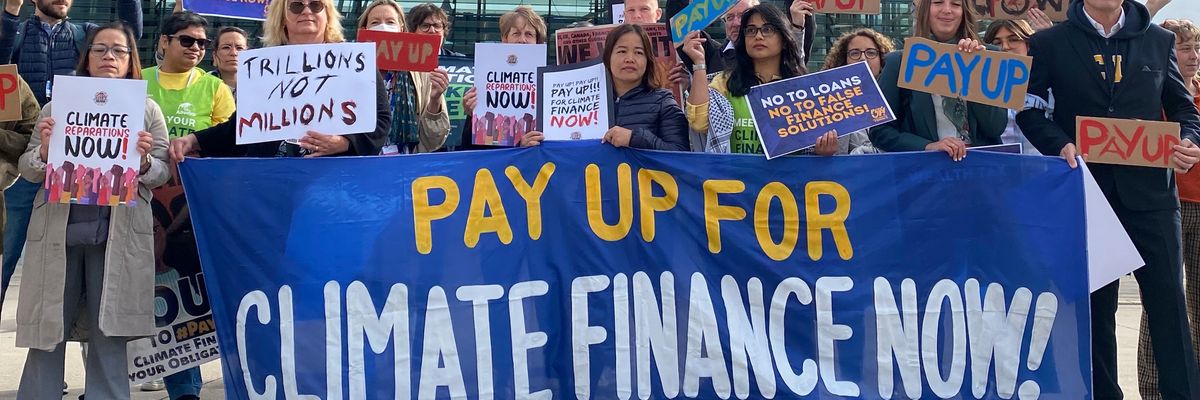
Climate justice advocates protest outside the Bonn Climate Change Conference in Germany on June 13, 2024.
"Developed countries are not even offering crumbs from the table and are blocking all progress," lamented one campaigner.
As the clock ticks down toward this November's COP29 climate summit in Azerbaijan, the Bonn Climate Change Conference in Germany ended in a stalemate Thursday as nations were unable to agree on the size and scope of loss and damage financing and other issues.
This week's talks in Bonn yielded no significant progress on climate financing as the industrialized nations that are most responsible for the planetary emergency continued to try and shirk what Global South countries say is their responsibility to compensate those who suffer most but have emitted the least greenhouse gases.
"Developing countries need trillions in new public finance for adaptation, loss and damage, and for a just transition away from fossil fuels. But developed countries are not even offering crumbs from the table and are blocking all progress," said Friends of the Earth climate justice and energy campaigner Sara Shaw.
Loss and damage refers to funding meant to compensate developing nations for the destruction caused by the fossil fuel-driven climate crisis the world's poor played little role in creating.
"They want developing countries to accept loans which will further fuel debt, and are pushing already discredited carbon market finance schemes, which causes grave harm in the Global South," Shaw added. "This is a disaster."
Crux of #SB60 #climate finance discussions in Bonn highlighted in my take at the recent @CANIntl press conference.
Thank you @LossandDamage for capturing it.@fossiltreaty #ClimateJustice #ClimateEmergency pic.twitter.com/ynVV2R4g5N
— Harjeet Singh (@harjeet11) June 11, 2024
Referring to the upcoming U.N. Climate Change Conference, the World Wide Fund for Nature (WWF) said Thursday that the Bonn stalemate is "undermining the momentum needed to ensure strong outcomes at COP29, to be held in Baku, Azerbaijan in November."
"Discussions on climate finance lacked the urgency required for one of the most critical decisions to be finalized at COP29," WWF said of the Bonn conference. "A new funding goal for the period 2025 to 2035 is set to be agreed, in line with the terms of the Paris agreement."
"But developed countries have not yet given clear indication what they are considering contributing to developing countries for climate action, nor where the money will come from," the group added. "Concurrently, calls for urgently needed funding for adaptation, mitigation, and loss and damage remain unfulfilled."
Greenpeace International climate politics expert Tracy Carty said in a statement Thursday that "rich developed countries talked at length about what they can't commit to and who else should pay, but failed to assure developing nations on their intent to significantly scale up financial support."
"Damning silence on what finance might be offered is stymying efforts to raise ambition and is a dereliction of duty to people battling climate-fueled storms, fires, and droughts," Carty added.
"Rich countries most responsible for this crisis must pay up for a fair fossil fuel phaseout and climate damages, without worsening unjust debts."
Developing nations have said they need around $400 billion annually for a loss and damage fund that they could tap to rebuild communities, restore crucial wildlife habitats, or relocate people displaced by the climate emergency. The United States has committed to a paltry $17.5 million for the global loss and damage fund. Developed nations have pledged approximately $661 million for loss and damage funding to date, according to the U.N. Development Program.
Laurie van der Burg, international public finance lead at Oil Change International, asserted that "the rich countries most responsible for this crisis must pay up for a fair fossil fuel phaseout and climate damages, without worsening unjust debts."
"We know they have more than enough money," van der Burg added. "It's just going to the wrong things."
This country and this world are at a monumental crossroads. US voters have an opportunity to beat back the forces of fascism and confront the billionaires who are rigging the economy, our media system, and our democracy, making it increasingly impossible for ordinary people to get by. We’re not just talking about the election. We’re talking about what must be done once these fascist elements are vanquished from power. We need a bolder set of solutions than what either major party has so far been willing to offer and a working-class movement ready to fight like hell for it. Trump didn't emerge from nowhere. The conditions that fueled MAGA authoritarianism were created by decades of radical neoliberal economic policies and a corrupt political system dominated by corporate interests. They slashed taxes on the super-rich, promising that the benefits would trickle down. They said giveaways to the corporate titans would make life more affordable for the rest of us. It was all bullshit. And when a bitter, betrayed populace searches for someone to blame, right-wing demagogues have little trouble finding scapegoats. People know when they're being lied to, but you won't hear any of this from the corporate media. Only independent journalism—powered and funded by people who believe in building a better world—can deliver truly trustworthy daily news. If you share our vision, please contribute whatever you can to sustain our work. |
As the clock ticks down toward this November's COP29 climate summit in Azerbaijan, the Bonn Climate Change Conference in Germany ended in a stalemate Thursday as nations were unable to agree on the size and scope of loss and damage financing and other issues.
This week's talks in Bonn yielded no significant progress on climate financing as the industrialized nations that are most responsible for the planetary emergency continued to try and shirk what Global South countries say is their responsibility to compensate those who suffer most but have emitted the least greenhouse gases.
"Developing countries need trillions in new public finance for adaptation, loss and damage, and for a just transition away from fossil fuels. But developed countries are not even offering crumbs from the table and are blocking all progress," said Friends of the Earth climate justice and energy campaigner Sara Shaw.
Loss and damage refers to funding meant to compensate developing nations for the destruction caused by the fossil fuel-driven climate crisis the world's poor played little role in creating.
"They want developing countries to accept loans which will further fuel debt, and are pushing already discredited carbon market finance schemes, which causes grave harm in the Global South," Shaw added. "This is a disaster."
Crux of #SB60 #climate finance discussions in Bonn highlighted in my take at the recent @CANIntl press conference.
Thank you @LossandDamage for capturing it.@fossiltreaty #ClimateJustice #ClimateEmergency pic.twitter.com/ynVV2R4g5N
— Harjeet Singh (@harjeet11) June 11, 2024
Referring to the upcoming U.N. Climate Change Conference, the World Wide Fund for Nature (WWF) said Thursday that the Bonn stalemate is "undermining the momentum needed to ensure strong outcomes at COP29, to be held in Baku, Azerbaijan in November."
"Discussions on climate finance lacked the urgency required for one of the most critical decisions to be finalized at COP29," WWF said of the Bonn conference. "A new funding goal for the period 2025 to 2035 is set to be agreed, in line with the terms of the Paris agreement."
"But developed countries have not yet given clear indication what they are considering contributing to developing countries for climate action, nor where the money will come from," the group added. "Concurrently, calls for urgently needed funding for adaptation, mitigation, and loss and damage remain unfulfilled."
Greenpeace International climate politics expert Tracy Carty said in a statement Thursday that "rich developed countries talked at length about what they can't commit to and who else should pay, but failed to assure developing nations on their intent to significantly scale up financial support."
"Damning silence on what finance might be offered is stymying efforts to raise ambition and is a dereliction of duty to people battling climate-fueled storms, fires, and droughts," Carty added.
"Rich countries most responsible for this crisis must pay up for a fair fossil fuel phaseout and climate damages, without worsening unjust debts."
Developing nations have said they need around $400 billion annually for a loss and damage fund that they could tap to rebuild communities, restore crucial wildlife habitats, or relocate people displaced by the climate emergency. The United States has committed to a paltry $17.5 million for the global loss and damage fund. Developed nations have pledged approximately $661 million for loss and damage funding to date, according to the U.N. Development Program.
Laurie van der Burg, international public finance lead at Oil Change International, asserted that "the rich countries most responsible for this crisis must pay up for a fair fossil fuel phaseout and climate damages, without worsening unjust debts."
"We know they have more than enough money," van der Burg added. "It's just going to the wrong things."