
SUBSCRIBE TO OUR FREE NEWSLETTER
Daily news & progressive opinion—funded by the people, not the corporations—delivered straight to your inbox.
5
#000000
#FFFFFF
To donate by check, phone, or other method, see our More Ways to Give page.


Daily news & progressive opinion—funded by the people, not the corporations—delivered straight to your inbox.
"Developed countries are not even offering crumbs from the table and are blocking all progress," lamented one campaigner.
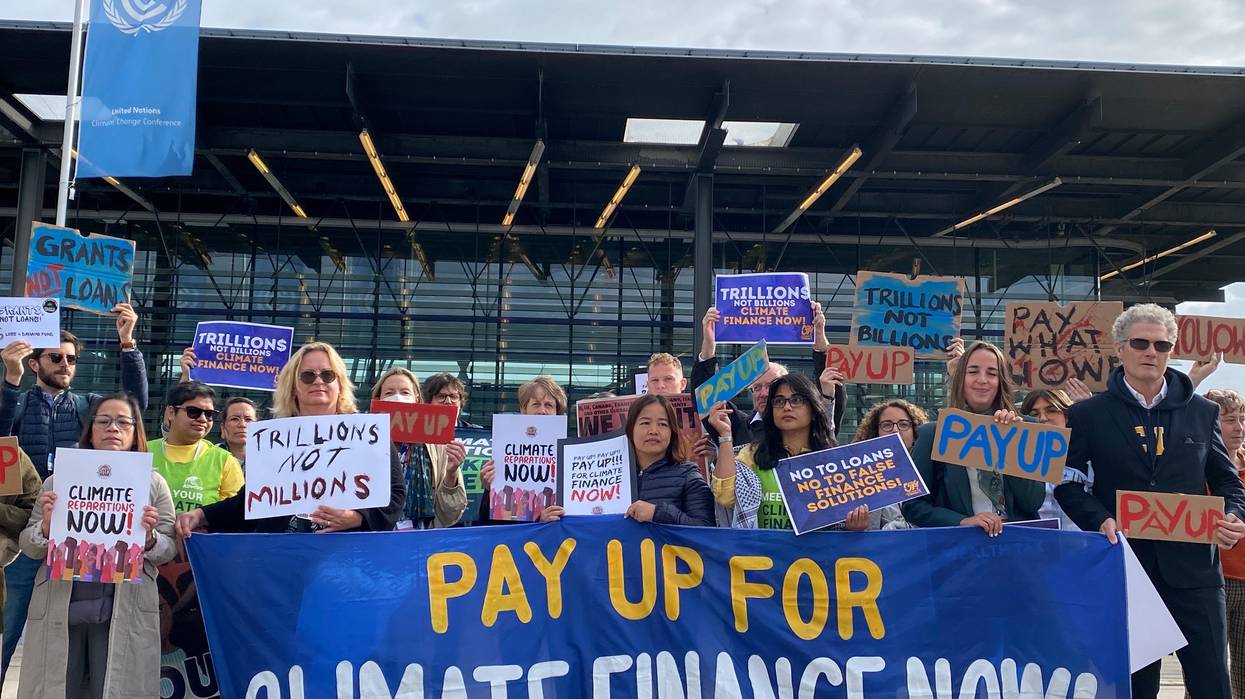
As the clock ticks down toward this November's COP29 climate summit in Azerbaijan, the Bonn Climate Change Conference in Germany ended in a stalemate Thursday as nations were unable to agree on the size and scope of loss and damage financing and other issues.
This week's talks in Bonn yielded no significant progress on climate financing as the industrialized nations that are most responsible for the planetary emergency continued to try and shirk what Global South countries say is their responsibility to compensate those who suffer most but have emitted the least greenhouse gases.
"Developing countries need trillions in new public finance for adaptation, loss and damage, and for a just transition away from fossil fuels. But developed countries are not even offering crumbs from the table and are blocking all progress," said Friends of the Earth climate justice and energy campaigner Sara Shaw.
Loss and damage refers to funding meant to compensate developing nations for the destruction caused by the fossil fuel-driven climate crisis the world's poor played little role in creating.
"They want developing countries to accept loans which will further fuel debt, and are pushing already discredited carbon market finance schemes, which causes grave harm in the Global South," Shaw added. "This is a disaster."
Crux of #SB60 #climate finance discussions in Bonn highlighted in my take at the recent @CANIntl press conference.
Thank you @LossandDamage for capturing it.@fossiltreaty #ClimateJustice #ClimateEmergency pic.twitter.com/ynVV2R4g5N
— Harjeet Singh (@harjeet11) June 11, 2024
Referring to the upcoming U.N. Climate Change Conference, the World Wide Fund for Nature (WWF) said Thursday that the Bonn stalemate is "undermining the momentum needed to ensure strong outcomes at COP29, to be held in Baku, Azerbaijan in November."
"Discussions on climate finance lacked the urgency required for one of the most critical decisions to be finalized at COP29," WWF said of the Bonn conference. "A new funding goal for the period 2025 to 2035 is set to be agreed, in line with the terms of the Paris agreement."
"But developed countries have not yet given clear indication what they are considering contributing to developing countries for climate action, nor where the money will come from," the group added. "Concurrently, calls for urgently needed funding for adaptation, mitigation, and loss and damage remain unfulfilled."
Greenpeace International climate politics expert Tracy Carty said in a statement Thursday that "rich developed countries talked at length about what they can't commit to and who else should pay, but failed to assure developing nations on their intent to significantly scale up financial support."
"Damning silence on what finance might be offered is stymying efforts to raise ambition and is a dereliction of duty to people battling climate-fueled storms, fires, and droughts," Carty added.
"Rich countries most responsible for this crisis must pay up for a fair fossil fuel phaseout and climate damages, without worsening unjust debts."
Developing nations have said they need around $400 billion annually for a loss and damage fund that they could tap to rebuild communities, restore crucial wildlife habitats, or relocate people displaced by the climate emergency. The United States has committed to a paltry $17.5 million for the global loss and damage fund. Developed nations have pledged approximately $661 million for loss and damage funding to date, according to the U.N. Development Program.
Laurie van der Burg, international public finance lead at Oil Change International, asserted that "the rich countries most responsible for this crisis must pay up for a fair fossil fuel phaseout and climate damages, without worsening unjust debts."
"We know they have more than enough money," van der Burg added. "It's just going to the wrong things."
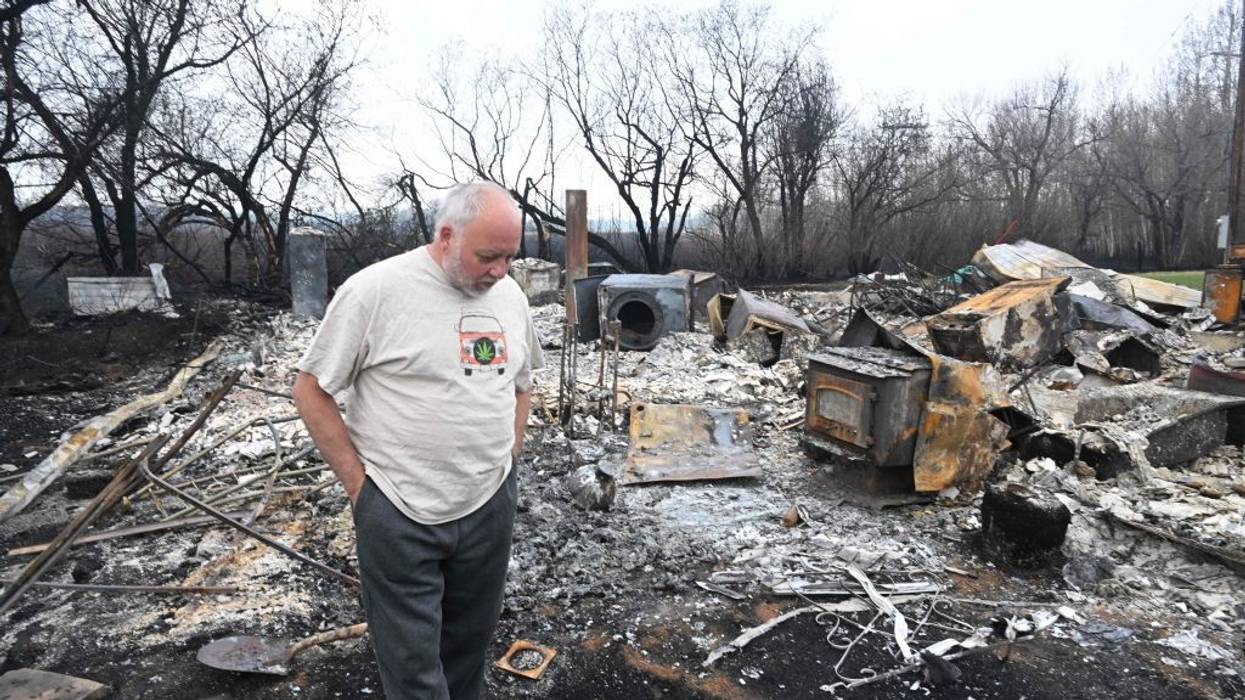
"Still we are not acting with the urgency and determination that is required," the U.N. High Commissioner for Human Rights said Monday.
As parts of the world from China to Texas bake under extreme heat, scientists and advocates are warning that world leaders are running out of time to take action on the climate crisis.
In a speech to a United Nations panel discussion on Monday,, U.N. High Commissioner for Human Rights Volker Türk cautioned that current policies put the planet on course for a "dystopian future."
"Yet still we are not acting with the urgency and determination that is required. Leaders perform the choreography of deciding to act and promising to act and then... get stuck in the short term," Türk said.
Türk's remarks came after Reuters ran an article highlighting recent weather extremes and land- and sea-temperature records. Scientists warn that the clock is running out on the chance of limiting global warming to 1.5°C above preindustrial levels.
"We've run out of time because change takes time," University of New South Wales climate scientist Sarah Perkins-Kirkpatrick told Reuters.
Early June 2023 was the hottest on record, with average temperatures even overshooting the 1.5°C mark for a few days. While this has happened before during the Northern Hemisphere winter, this was the first time it has happened during the Northern Hemisphere summer, according to Reuters.
At the same time, sea surface temperatures broke records in both April and May. Temperatures in the Indian and Pacific oceans could rise to 3°C warmer than normal by October, Australia's weather agency said, according to Reuters.
"We know that our environment is burning. It's melting. It's flooding. It's depleting. It's drying. It's dying."
University of Leeds professor of climate physics Piers Forster told Reuters that the climate crisis was predominantly to blame, but that El Niño, a drop in dust from the Sahara blowing over the ocean, and a turn to low-sulfur shipping fuels that reduced atmospheric particulates also contributed.
"So in all, oceans are being hit by a quadruple whammy," he said. "It's a sign of things to come."
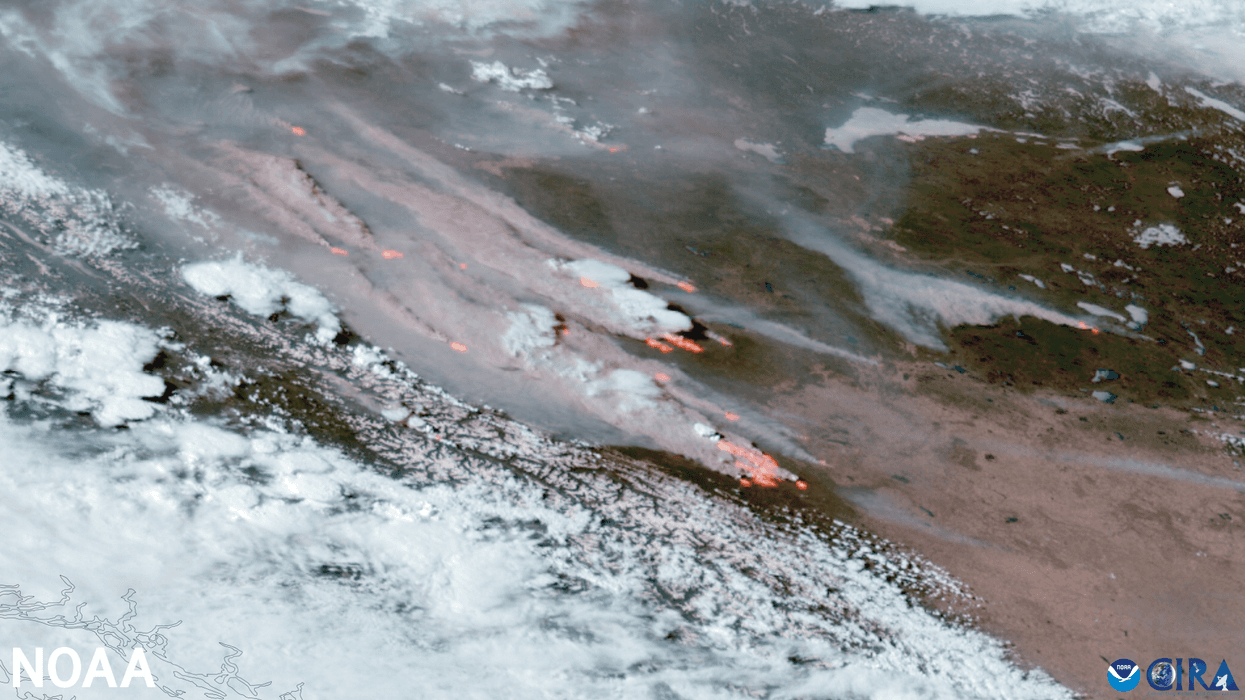
Other signs of things to come include the wildfires burning in Canada, which is in the midst of its worst fire season on record, as AFP reported June 28. The fires have displaced more than 100,000 people, sent toxic smoke spewing south and east, and released a record almost 600 million tons of carbon dioxide into the atmosphere.
Places from India to the southern U.S. have sweltered through deadly heat waves. On Thursday, several states in the South and Midwest had reached the highest threat level for their wet bulb temperature—the temperature of a thermometer covered in a wet cloth which is meant to simulate how the human body would react to a combination of heat and humidity in full sun, as The Hill reported. Studies have shown that the human body cannot sweat to cool down when heat and humidity reach certain levels—the most recent research points to a threshold of 88°F at 100% humidity.
On Sunday, Chinese authorities said that the country had broken records for the number of hot days during the first six months of the year, with Beijing breaking its all-time temperature record to hit a high of 41.1°C on Thursday, as CNN reported.
When the capital finally saw relief Monday, flooding displaced more than 10,000 people in Hunan province, and Shaanxi province's Zhenba county experienced its worst flooding in 50 years, according to the Independent.
"We know that our environment is burning. It's melting. It's flooding. It's depleting. It's drying. It's dying," Türk said during his remarks Monday.
Türk warned that conditions could get even more extreme if global temperatures rise to around 3°C, which current policies put them on track to do, according to the most recent report from the Intergovernmental Panel on Climate Change.
"Vast territories would disappear under rising oceans, or become effectively uninhabitable, due to heat and lack of water," he said.
Türk's speech was focused on the right to food specifically, and how the climate crisis would continue to interfere with it. Between 2000 and 2023, there had already been a 134% increase in climate and flood disasters, he said.
"More than 828 million people faced hunger in 2021," he said. "And climate change is projected to place up to 80 million more people at risk of hunger by the middle of this century—creating a truly terrifying scale of desperation and need."
Yet so far, political and corporate leaders are not responding to the situation with the urgency experts and advocates say it requires. The Bonn climate talks, which occurred amidst the record early June heat, ended with little progress.
"I am hoping that the sheer reality will help us change people's moves and change the politics."
"It was very detached from what was going on outside of the building in Bonn—I was very disappointed by that," Li Shuo, Greenpeace's senior climate adviser in Beijing, told Reuters.
The next major international climate conference—COP28—begins in the United Arab Emirates in late November, but campaigners are concerned by the fact that its president, Sultan Ahmed al-Jaber, is also the head of the UAE's state oil company.
Meanwhile, Li and Türk still expressed hope for 11th-hour progress.
"We are really getting to the moment of truth," Li told Reuters. "I am hoping that the sheer reality will help us change people's moves and change the politics."
Türk recommended a list of actions including an end to fossil fuel subsidies, a phaseout of fossil fuel use, and a "just transition to a green economy."
He also said that COP28 needed to be a "decisive game-changer."
"There is still time to act," he said. "But that time is now. We must not leave this for our children to fix—no matter how inspiring their activism. The people who must act—who have the responsibility to act—are our leaders, today."
Some scientists predict that 2023 could be the warmest year on record, as a developing El Niño exacerbates the impacts of the climate crisis.
Following a May of record ocean temperatures and a June of record air temperatures, scientists are warning that 2023 could be the hottest year on record.
For a brief period in June, average global air temperatures even topped 1.5°C above preindustrial levels, the temperature goal enshrined by the Paris climate agreement.
"The world has just experienced its warmest early June on record, following a month of May that was less than 0.1°C cooler than the warmest May on record," the European Union's Copernicus Climate Change Service (C3S) Deputy Director Samantha Burgess said in a statement. "Monitoring our climate is more important than ever to determine how often and for how long global temperatures are exceeding 1.5°C. Every single fraction of a degree matters to avoid even more severe consequences of the climate crisis."
Overall, global mean surface air temperatures for early June were higher than previous C3S data for the month "by a substantial margin," the service said. Between June 7 and 11, those temperatures were above 1.5°C, peaking at 1.69°C June 9, Agence France-Presse reported.
This is not the first time that averages have poked above the 1.5°C target for a limited time. In fact, ironically, the first time was around the negotiating of the Paris agreement in December 2015.
"As it happens, a strong El Niño was close to its peak at the time, and it is now estimated that for a few days the global mean temperature was more than 1.5°C higher than the preindustrial temperature for the month," C3S said. "This was probably the first time this had occurred in the industrial era."
"The global surface temperature anomaly is at or near record levels right now, and 2023 will almost certainly be the warmest year on record."
While there have been more incidents between 2015 and now, they were typically in the Northern Hemisphere winter and early spring. This is the first time averages have risen above 1.5°C in June.
The breach is a "stern warning sign that we are heading into very warm uncharted territory," Melissa Lazenby, a lecturer in climate change at Sussex University in the U.K., told Sky News.
It also comes amidst other concerning climate indicators. On Wednesday, the National Oceanic and Atmospheric Administration (NOAA) in the U.S. announced that average ocean surface temperatures for May reached a record high for the second month in a row. May 2023 overall was the third warmest May on record, and sea ice in Antarctica dwindled to record low levels for the month.
NOAA's findings came a week after it declared that El Niño conditions had arrived, which could exacerbate the impacts of the climate crisis to raise temperatures and fuel more extreme weather events.
"The global surface temperature anomaly is at or near record levels right now, and 2023 will almost certainly be the warmest year on record," University of Pennsylvania climate scientist Michael Mann told The Guardian. "That is likely to be true for just about every El Niño year in the future as well, as long as we continue to warm the planet with fossil fuel burning and carbon pollution."
Already this year, warm spring temperatures have had consequences, from unprecedented wildfires in Canada that smothered the Eastern and Midwestern U.S. in smoke to a fish die-off in the Gulf of Mexico.
"With climate change and global warming, it's been an interesting start to the season," NOAA climatologist Rocky Bilotta said during a press call reported by The New York Times.
University of California, Los Angeles climate scientist Daniel Swain told ABC News that the high ocean temperatures were caused by a mixture of the climate crisis, the developing El Niño, the 2022 Hunga Tonga-Hunga Ha'apai volcano eruption, and a reduction in shipping emissions that has removed cooling aerosols from the atmosphere.
If such warming persists, it could have serious consequences because warmer oceans fuel stronger tropical storms and a warmer atmosphere holds more moisture that can worsen flooding events. The World Meteorological Organization (WMO) warned in May that there was a 66% chance that El Niño would work with climate change to push at least one year's average temperature past 1.5°C above preindustrial levels between 2023 and 2027.
C3S noted that the 1.5°C and 2°C temperature targets were based on averages over 20 to 30 years. However, the service added, "as the global mean temperature continues to rise and more frequently exceed the 1.5°C limit, the cumulative effects of the exceedances will become increasingly serious."
Scientists and activists said these breaches, and other recent temperature anomalies and extreme weather events, should serve as a warning to policymakers to act quickly to phase out fossil fuels and reduce greenhouse gas emissions.
"Without stronger emission cuts, the changes we are seeing are just the start of the adverse impacts we can expect to see," Cornell University atmospheric scientist Natalie Mahowald told The Guardian. "This year and the extreme events we have seen so far should serve as a warning."
Activist Bill McKibben meanwhile said the scariest element of recent weather news was that "the world isn't reacting rationally to it."
"The rapid warming over the next couple of years is likely to be our last opportunity to really act coherently as a civilization to reduce the magnitude of this crisis, and so far we are blowing it," he wrote Thursday.
Indeed, U.N. climate talks in Bonn, Germany, which were intended to prepare the way for the COP28 climate conference in the United Arab Emirates in November and December, ended Thursday with an impasse between the E.U. and climate vulnerable countries who want faster emissions cuts and a fossil fuel phaseout, and developing countries that want more climate finance from the Global North, as AFP explained.
"The gap between the Bonn political performance and the harsh climate reality feels already absurd," Li Shuo, a senior global policy adviser at Greenpeace East Asia, told AFP. "Climate impacts stay no longer on paper. People are feeling and suffering from it now."
U.N. Secretary-General António Guterres warned during a press conference Thursday that current national policies put the world on track for 2.8°C of warming by 2100.
"That spells catastrophe," Guterres said. "Yet the collective response remains pitiful."
"The world must phase out fossil fuels in a just and equitable way—moving to leave oil, coal, and gas in the ground where they belong and massively boosting renewable investment in a just transition," António Guterres said.
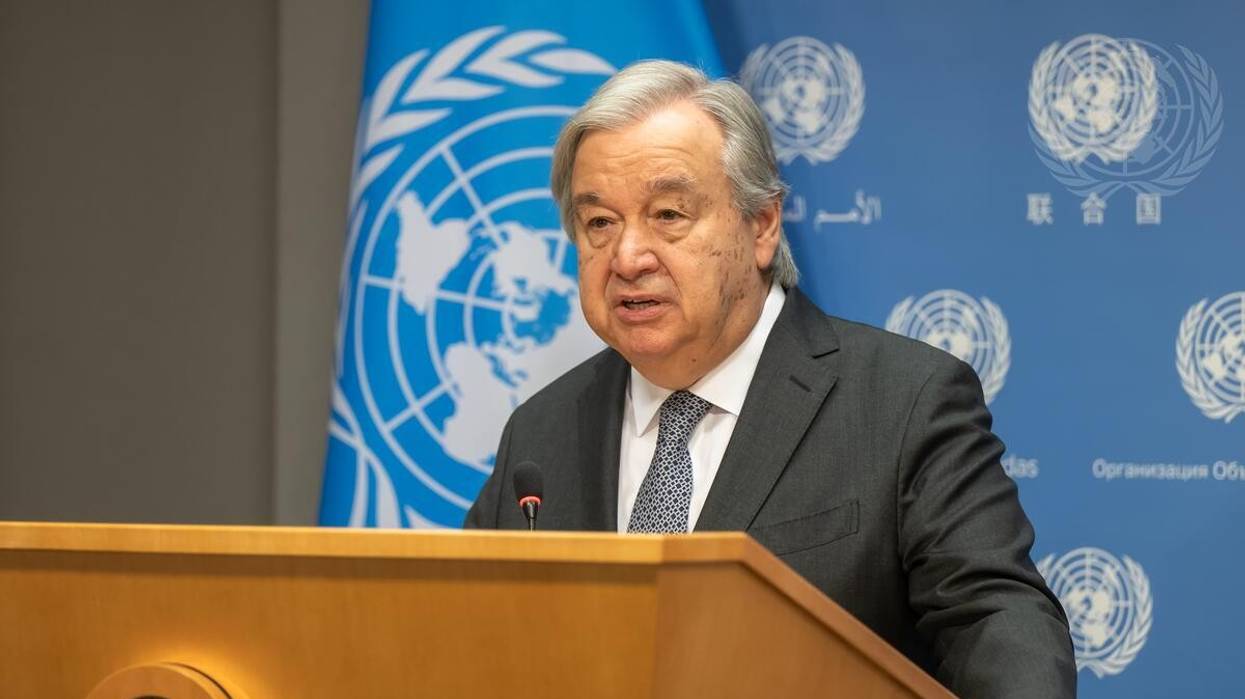
As United Nations climate talks came to a disappointing conclusion in Germany on Thursday, U.N. Secretary-General António Guterres delivered remarks in New York City targeting "the polluted heart of the climate crisis: the fossil fuel industry."
Guterres' comments came just after he met with civil society leaders and ahead of his September Climate Ambition Summit in NYC, which is set to be followed in November by the U.N. conference COP28, hosted by the United Arab Emirates in Dubai.
"Countries are far off track in meeting climate promises and commitments. I see a lack of ambition. A lack of trust. A lack of support. A lack of cooperation. And an abundance of problems around clarity and credibility," he said. "The climate agenda is being undermined. At a time when we should be accelerating action, there is backtracking. At a time when we should be filling gaps, those gaps are growing."
"Meanwhile, the human rights of climate activists are being trampled. The most vulnerable are suffering the most," Guterres continued, noting that current policies put the world on track for a 2.8°C temperature rise by the end of the century, nearly double the 2015 Paris climate agreement's more ambitious 1.5°C goal. Hitting the higher number, he said, "spells catastrophe."
"Yet the collective response remains pitiful. We are hurtling towards disaster, eyes wide open—with far too many willing [to bet it] all on wishful thinking, unproven technologies, and silver bullet solutions," he declared. "It's time to wake up and step up. It's time to rebuild trust based on climate justice. It's time to accelerate the just transition to a green economy."
"It's time to wake up and step up. It's time to rebuild trust based on climate justice. It's time to accelerate the just transition to a green economy."
While acknowledging the important roles of governments and financial institutions—particularly from the Global Noth—in the worldwide transition to renewables, Guterres also said that "the fossil fuel industry and its enablers have a special responsibility."
"The problem is not simply fossil fuel emissions. It's fossil fuels—period," he said in what was widely seen as a rebuke of recent remarks from Sultan Ahmed Al Jaber, whose selection as COP28's president-designate is controversial around the world given that he is also the UAE's industry minister and CEO of the country's Abu Dhabi National Oil Company.
"The solution is clear: The world must phase out fossil fuels in a just and equitable way—moving to leave oil, coal, and gas in the ground where they belong and massively boosting renewable investment in a just transition," Guterres asserted. However, just a tiny fraction of the oil and gas industry's record $4 trillion windfall last year was put toward a clean future.
Stressing that "the world needs the industry to apply its massive resources to drive, not obstruct, the global move from fossil fuels to renewables," Guterres called for "credible" transition plans "that chart a company's move to clean energy—and away from a product incompatible with human survival."
"Otherwise, they are just proposals to become more efficient planet-wreckers," he said. Condemning plans that "rely on dubious offsets," the U.N. leader said that they "must include reducing emissions from production, processing, transmission, refining, distribution, and use."
"Fossil fuel companies must also cease and desist influence peddling and legal threats designed to knee-cap progress," he added, specifically calling out the industry for abusing antitrust legislation for its own advantage.
While the press conference was far from the first time Guterres has called out the fossil fuel industry, his comments were lauded by campaigners preparing for a global mobilization in September, planned for just before the U.N. chief's summit.
"The U.N. secretary-general's speech echoes the call from people from across the world today demanding an end to the era of fossil fuels," said Alex Rafalowicz, executive director of the Fossil Fuel Nonproliferation Treaty Initiative. "The time for rhetoric, empty promises, and greenwashing is over."
"Governments must work together to put in place an action plan to move away from dependence on oil, gas, and coal in the fairest and fastest way possible," Rafalowicz added. "We will be on the streets to ensure peoples' demands are carried into the negotiation halls in September. Climate impacts are escalating, fossil fuel corporations are digging in, but people are stepping up to end fossil fuels; fair, fast, and forever."
Guterres' remarks came as negotiators finished gathering in the German city of Bonn to prepare for COP28.
Oil Change International (OCI) global policy lead Romain Ioualalen said Thursday that "this speech by the U.N. secretary-general is a wake-up call for the countries that wasted two weeks arguing over procedural matters at the Bonn climate conference instead of charting a path towards a COP28 decision to phase out fossil fuels."
"Countries must step up and fulfill the promises they made in Paris in 2015 to halt fossil fuel expansion and agree to a fair, fast, and full transition away from oil, gas, and coal and towards renewables," Ioualalen continued. "Over 70 countries have called for a COP28 decision on fossil fuel phaseout in Bonn. Countries like Colombia and the members of the Beyond Oil and Gas Alliance are doing the hard work of implementing measures to keep oil and gas in the ground."
"The contrast between this leadership and the actions of the world's biggest historic polluter, the United States, could not be more striking," he argued, adding that under President Joe Biden, "the U.S. has failed in its responsibility to lead a global and just transition away from fossil fuels and avert further climate disaster and has instead actively promoted fossil fuel expansion including with public money."
OCI was among over 500 groups that sent a letter Thursday to Biden and leaders of key U.S. federal agencies demanding executive action "to stop expanding oil, gas, and coal production, the core driver of the climate emergency," by the September summit.
"The climate crisis is escalating but so is the global movement for climate justice. We need all hands on deck to win this fight."
As the United Nations climate talks in Bonn, Germany became the latest in a string of high-profile negotiations to end with little substantive progress, a coalition of environmental groups on Thursday announced plans for a global mobilization that organizers say will bring millions into the streets to demand an end to planet-wrecking fossil fuel production.
The worldwide protests are set to take place on September 15 and 17, days ahead of U.N. Secretary-General António Guterres' September 20 Climate Ambition Summit in New York City and weeks before the crucial COP28 talks in the United Arab Emirates, which will be overseen by the CEO of one of the world's largest oil companies.
"The launch of today's escalation campaign to fight back against fossil fuels builds on the legacy of a diversity of resistance movements from across the world who have been leading the fight against the fossil industry and its pernicious influence," said Tasneem Essop, executive director of the Climate Action Network. "We expect all governments to implement a rapid, just, and equitable phaseout of fossil fuels together with a scaled-up phase-in of renewables."
"They have to signal that this is the end of the fossil fuel era," Essop added. "COP28 is a good place to start."
"We expect all governments to implement a rapid, just, and equitable phaseout of fossil fuels together with a scaled-up phase-in of renewables."
The coalition behind the mass mobilization invited people around the world to register local events and issued a list of straightforward demands that they say political leaders must embrace if there's to be any hope of curbing runaway warming.
"The climate crisis is escalating but so is the global movement for climate justice," the coalition says on its website. "We need all hands on deck to win this fight."
The six demands are as follows:
1. No new fossil fuels—no new finance public or private, no new approvals, licenses, permits, or extensions. The provision of sufficient, consensual climate funding to realize this commitment everywhere.
2. A rapid, just, and equitable phaseout of existing fossil fuel infrastructure in line with the 1.5°C temperature limit and a global plan, like a Fossil Fuel Treaty, to ensure that each country does its part.
3. New commitments for international cooperation to drastically scale up financial and technology transfers to ensure renewable energy access, economic diversification plans, and Just Transition processes so that every country and community can phase out fossil fuels.
4. Stop greenwashing and claiming that offsets, carbon capture and storage, or geoengineering are solutions to the climate crisis.
5. Hold polluters responsible for the damage they've caused and make sure it's coal, oil, and gas corporations that pay reparations for climate loss and damage and for local rehabilitation, remediation, and transition.
6. End fossil fuel corporate capture. No to corporations writing the rules of climate action, bankrolling climate talks, or undermining the global response to climate change.
Brenna TwoBears, coordinator of the Indigenous Environmental Network, said in a statement Thursday that "the time is now to end fossil fuels."
"This has been centuries in the making, when colonizers brought the first extractive systems to Turtle Island and commodified the land," she added. "But shutting down fossil fuels is only one strand among many to weave a basket to hold up the next seven generations. We need a just and equitable transition, where Indigenous people are leading. We need a culture shift to live in balance with our sky and land relatives. We need real solutions that address the problem at its root, not after the fact. A fossil fuel non-proliferation treaty is that real solution."
Plans for the global days of action come amid growing frustration and alarm among climate advocates and scientists over world leaders' continued failure to deliver any meaningful action to phase out fossil fuel use and production—the central driver of the planetary emergency—even as carbon emissions keep rising at a record pace and extreme weather wreaks havoc across the globe.COP27 in Egypt late last year did not yield any meaningful progress toward a global fossil fuel phaseout, and campaigners feel COP28 is also poised to fail given the still-pervasive influence of the oil and gas industry and rich nations' refusal to act.
Sultan Ahmed al-Jaber, COP28's president-designate, is the CEO of the UAE's state-owned Abu Dhabi National Oil Company.
The Guardian reported last week that "Majid Al Suwaidi, director-general of the COP28 climate talks for its host nation... said governments were not in agreement over whether the phaseout of fossil fuels should be on the agenda for the conference, which begins in November."
"Al Suwaidi said fossil fuels would form a key part of the discussions at COP28," the newspaper added, "but whether a phaseout would be discussed as part of the official agenda of the talks was still up for grabs."
Romain Ioualalen, the global policy lead for Oil Change International, emphasized Thursday that "there is no room for additional fossil fuel expansion while limiting global temperature rise to 1.5°C" and implored world leaders to "urgently lay the path for the end of oil, gas, and coal" at COP28.
"People around the world have been fighting against the fossil fuel industry for years and will escalate this fight this September at the United Nations in New York and beyond to secure a full, fair, fast, and funded fossil fuel phaseout and massive expansion of renewable energy," said Ioualalen.
The climate activist said that not phasing out fossil fuels "will be a death sentence to countless of people."
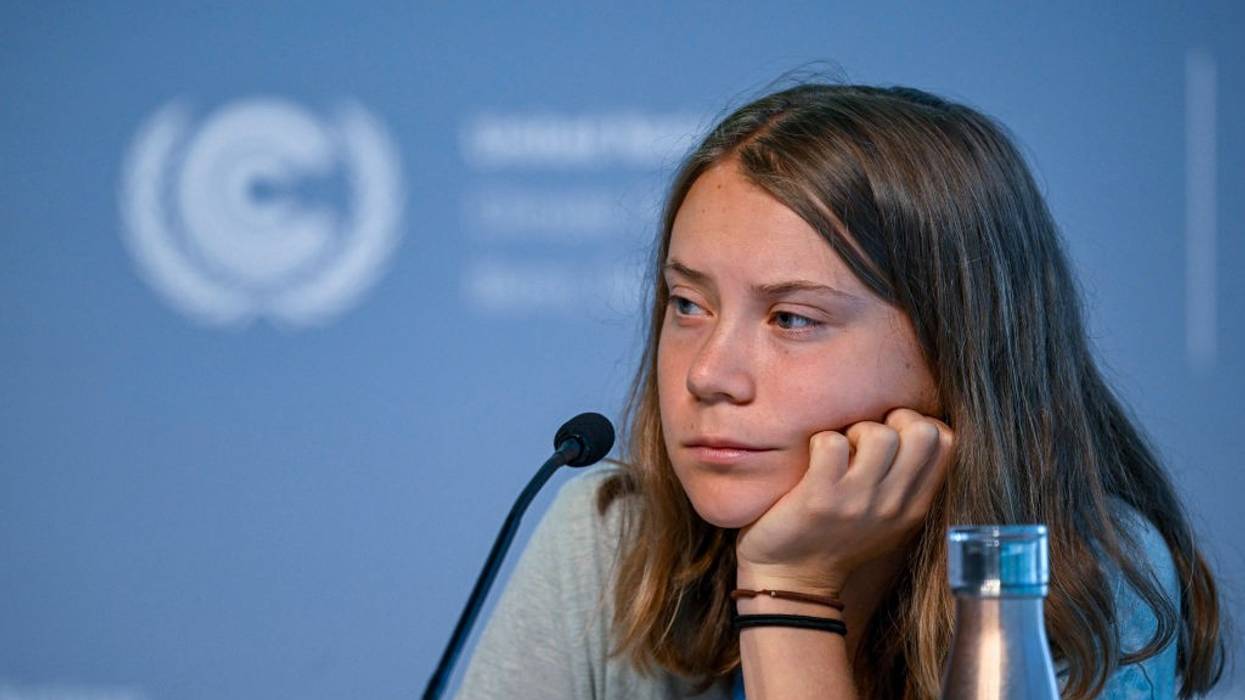
Climate activist Greta Thunberg issued an urgent warning at the U.N. climate conference in Bonn, Germany, Tuesday about what would happen if world leaders do not ensure a "rapid and equitable" phaseout of fossil fuels in line with limiting global warming to 1.5°C above pre-industrial levels.
Failing to do so, she said on a panel, "will be a death sentence to countless of people."
"It is already a death sentence to countless of people living on the front lines of the climate crisis today," she continued.
The Bonn climate talks are seen as a precursor to the COP28 U.N. climate conference scheduled to begin in the UAE in late November. The conference has already courted controversy stemming from the appointment of Sultan al-Jaber, CEO of the Abu Dhabi National Oil Company, to serve as its president, leading to concerns that negotiations will not advance a global phaseout of fossil fuels—by far the leading cause of climate warming emissions.
While al-Jaber has said that "the phasedown of fossil fuels is inevitable," he has not promised to put such a phase down on the official conference agenda, The Guardian pointed out.
Thunberg warned that failing to abandon fossil fuels would have devastating consequences.
"We're still rushing towards the cliff and we are at the verge of potential tipping points that once we pass them, there might be no going back."
"We're still rushing towards the cliff and we are at the verge of potential tipping points that once we pass them, there might be no going back," Thunberg said, as Reuters reported.
The news service also noted that a new report released at Bonn from Climate Analytics outlined how to avoid Thunberg's cliff and keep the 1.5 goal alive: increase new wind and solar capacity by a factor of five and reduce the production of fossil fuels by 6% each year until 2030.
The group said that renewables should generate 70% of global electricity by the end of the decade, while fossil fuel use should fall by 40% within the same time span.
"As we ramp up renewables, we can't forget the elephant in the negotiating room—fossil fuels," study author Claire Fyson said at a press conference reported by Reuters.
One solution advanced by some, especially in the oil and gas industry, is to continue burning fossil fuels but then remove their carbon dioxide emissions from the atmosphere through carbon capture and storage (CCS). However, the report found that this technology as it is now would be of minimal help this decade.
"When looking specifically at the power sector, we find that carbon capture and storage would be used for a maximum 0.1% of global electricity production in 2030," Fyson added.
Al-Jaber himself has come under fire for backing CCS despite the fact that its effectiveness remains uncertain.
In her speech, Thunberg said there was a lack of political will for true climate solutions.
"The people in power are spending their time looking for false solutions and finding and creating loopholes which maintains business as usual and keeps them in the position of power," she said.
She said the role of activists at international conferences was to call out world leaders and to tell the truth.
"The truth now is that these processes are failing," she said. "They are failing us here in this room, they are failing our children, they are failing all of humanity and the future generations to come."
Thunberg's remarks came as concerns grew that negotiators would conclude the talks without adopting an agenda, as Climate Home News reported. The conference is set to wrap up on June 15, and ending it without an agenda could make progress more difficult at COP28.
The current disagreement concerns climate finance. Some developing countries want to add an agenda item "urgently scaling up financial support from developed country parties." Developed countries promised $1 billion a year in climate finance to developing countries in 2009 by 2020, but the target still has not been met.
However, developed and some developing nations argue that finance is already included in the agenda and that the separate agenda item was proposed too late in the process. The second bloc wants to add an agenda item on talks to cut emissions in line with the 1.5 goal, but the first group won't agree to the second item unless their finance item is also added.
The co-chair of the Bonn talks, Nabeel Munir of Pakistan, criticized negotiators for acting like "a class of primary school" children, Climate Home News reported.
"A third of the country [is] under water and I go back and tell my people that we were fighting for agenda for two weeks," he said, referring to devastating, climate change-fueled floods in Pakistan in summer 2022 that impacted 33 million people. "Come on, is it worth it?" he asked.
As ten days of UN-sponsored climate talks came to an end in Bonn, Germany, on Thursday morning, global campaigners demanding far-reaching solutions to the crisis of a warming planet expressed dissatisfaction on multiple levels, charging that the continued foot-dragging of governments is sentencing future generations to unparalleled catastrophe even as scientists issue grave new warnings about the dangers of inaction.
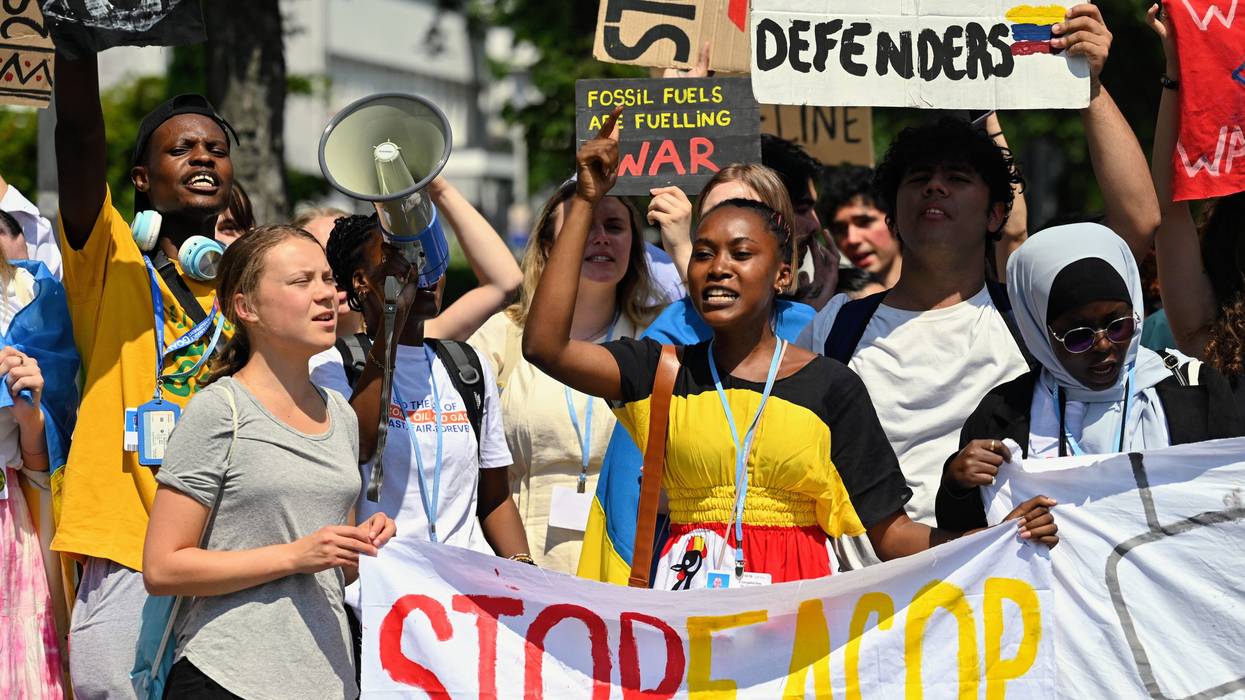
As the final sessions concluded and the latest draft texts emerged from the talks, activists staged protests inside and outside of the convention center, calling for bold action on climate and an "energy revolution" that would steer the world away from coal, oil, and gas and towards renewable sources like wind and solar.
Speaking on behalf of Friends of the Earth, Lucy Cadena, the group's climate justice and energy coordinator, said the among the deepest frustrations is that while solutions are available to stave off the worst impacts of climate change, Bonn has once again proven that leaders from the most developed countries are unwilling to buck the fossil fuel industry and make the urgent transition to renewable energy sources.
"Climate change is upon us, and every increase in temperature causes more heatwaves, droughts and floods, killing thousands of people," Cadena said. "If developed country governments continue to drag their feet at the UN negotiations instead of taking immediate action, millions of people will pay for it with their lives. People around the world are already implementing real, proven solutions--community-controlled, renewable energy systems. The energy revolution has come of age, and our politicians must help implement it or fade into obsolescence along with the dirty energy systems they cling to."
Payal Parekh, the managing director for 350.org's global climate campaign, said that though the negotiations are moving too slow on key issues, it is becoming increasingly clear that the status quo is untenable. "Negotiators need to pick up the pace," Parekh said. "The climate talks are still catching up with a new political reality-one where the fossil fuel industry is losing its stranglehold on our economy. Coal is already on the way out, and oil and gas must follow. The surging divestment campaign is changing the game, and the movement for climate action will only grow ahead of Paris."
Among the key issues that climate justice advocates say remain inadequately addressed: ambitious and binding emission-reduction targets for all nations, and the continued refusal of the most-developed nations to contribute financially to mechanisms that would see lesser-developed nations--where the people least responsible for climate change live--be compensated for the "loss and damage" they have suffered and will continue to experience in the future. As Gita Parihar, head of the legal team at Friends of the Earth-UK, explained in a blog post from Bonn, "This harm is becoming an everyday reality for developing countries, even though they are not responsible for the emissions causing it."
And as Harjeet Singh, a campaigner for ActionAid, explained, "Africa, small island states and the least developed countries have unequivocally demanded that 'loss and damage' be part of the Paris deal. Even if we have 100% renewable energy by 2050, the impacts will continue for another 100 years. The Paris deal has to tackle the increasing climate damages, and not just the causes."
"The G7 have set a powerful vision of a fossil fuel-free future, but this is at odds with their limited ambition to reduce emissions in the short term."
--Jan Kowalzig, Oxfam International
In a separate blog post, Singh expanded on this idea:
Rich nations, in particular the United States, Canada, Japan and Australia, have been brushing off the demands of developing countries and civil society to act according to their responsibility for and fair shares of planet-warming emissions.
For decades, they neither reduced greenhouse gas emissions at home, nor provided adequate resources to developing countries to transform their energy systems and build resilience.
Future mass-scale litigation by developing countries in the International Court of Justice is not an impossibility.
Demanding compensation and reparations for the loss and damage caused due to rich nations' inaction remains the only pivot to hold them to account. It will also drive action on mitigation and provide timely resources for adaptation to prevent further loss and damage.
"Negotiators avoided a show-down over crunch issues like finance and increasing near term emissions cuts, but they are only delaying the inevitable," said Jan Kowalzig, the climate change policy adviser for Oxfam International. "The G7 have set a powerful vision of a fossil fuel-free future, but this is at odds with their limited ambition to reduce emissions in the short term. They also need to bring developing countries on board by being clear that developed countries will be first movers in the fossil fuel phase out, as well as by putting financing on the table to enable them to follow suit."
And when it comes to temperature targets, observers of the Bonn talks are again lamenting the flimsy nature of the commitments made. Though world governments have previously agreed to keep global temperatures from rising more than 2degC this century, experts say that target is not possible given current trends or what nations have been willing to put on the table in terms of emissions cuts. As Bill McKibben, co-founder of 350.org, wrote at Grist on Thursday, "At the moment [world leaders] look set to ratify a global temperature increase of 3 or 4 degrees C -- that is, to lock us into a kind of slow-motion guaranteed catastrophe."
Speaking of catastrophe, the Bonn talks were also the scene of new climate warnings from the scientific community, including from researchers who have been looking closely at the threat of frozen methane-hydrates, currently trapped in the world's layer of permafrost. If unleashed, these methane-hydrates could trigger a severe greenhouse gas and climate feedback loop. As Agence France-Presse reported this week:
There may be 1,500 billion tonnes of carbon locked away in permafrost--perennially frozen ground covering about a quarter of exposed land in the Northern Hemisphere, said Susan Natali, a researcher with the Woods Hole Research Center in Massachusetts.
The carbon will be released incrementally as global temperatures rise on the back of soaring emissions from mankind's voracious burning of fossil fuels, making permafrost a vast and underestimated source of future greenhouse gas emissions, said Natali.
"By 2100 we expect 130 to 160 gigatons of carbon released into the atmosphere," Natali told journalists in Bonn. "That is on par with our current rate of US emissions as a result of fossil fuel and cement production." [...]
The amount of carbon stored in permafrost, where it has accumulated over tens of thousands of years, is estimated to be about twice as much as that in the atmosphere, she said.
Speaking on the sidelines of the Bonn talks, Natali told AFP, "The actions that we take now in terms of our fossil fuel emissions are going to have a significant impact on how much permafrost is lost and in turn how much carbon is released from permafrost."
She added, "While there is some uncertainty, we know that permafrost carbon losses will be substantial, they will be irreversible."