
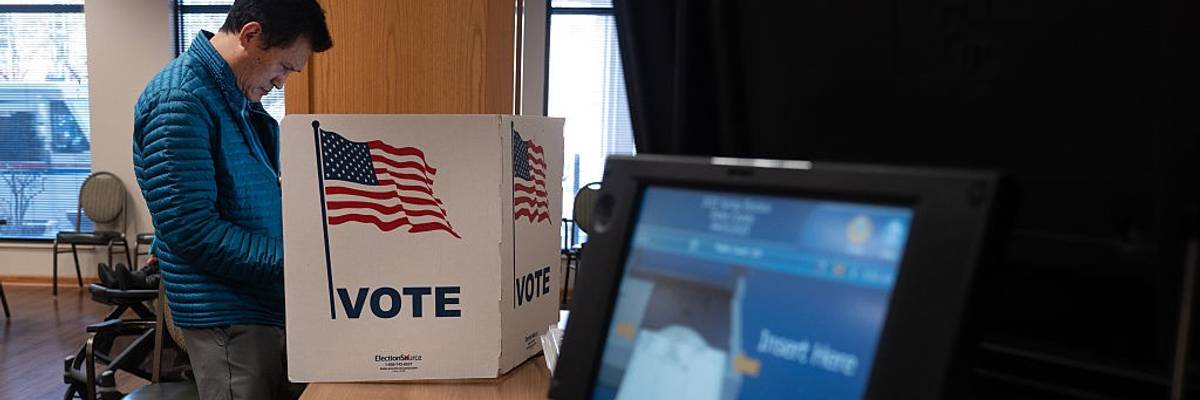
A resident votes at a polling place on April 1, 2025 in Madison, Wisconsin.
In 'Victory for the People,' Judge Blocks Parts of Trump's Attack on Voting Rights
"The president's attempted takeover of federal elections is a blatant overreach to seize power that doesn't belong to him," said lawyers for one coalition challenging the executive order.
Voting rights advocates on Thursday welcomed a federal judge's move to block some of U.S. President Donald Trump's "Preserving and Protecting the Integrity of American Elections" executive order, which critics called an "authoritarian power grab."
The temporary decision stems from a trio of legal challenges to Trump's March order: one from groups including the League of United Latin American Citizens; another from the Democratic National Committee and other party entities; and a third from organizations including the League of Women Voters (LWV) Education Fund.
Plaintiff coalitions "contend that under our Constitution and the relevant law, the president has no role in regulating federal elections," explained U.S. District Judge Colleen Kollar-Kotelly, an appointee of former President Bill Clinton.
"Their motions do not call upon the court to decide whether the president's executive order reflects good policy choices or even whether the policies it describes would be legal if implemented," she wrote. "Rather, this court's task is to decide whether the president can dictate those policies unilaterally, or whether that power is reserved to Congress and the states alone."
"The many defendants in these consolidated cases—federal officers and agencies—say little about that question," the Washington, D.C.-based judge noted. "They have offered almost no defense of the president's order on the merits. Instead, they argue that these suits have been brought by the wrong plaintiffs at the wrong time."
Kollar-Kotelly granted a preliminary injunction to pause provisions including the addition of a proof-of-citizenship requirement to the federal voter registration form. However, she declined to halt Trump's restrictions on voting by mail or his directive to the Department of Homeland Security and Department of Government Efficiency to review state voter lists.
"President Trump's attempt to impose a documentary proof of citizenship requirement on the federal voter registration form is an unconstitutional abuse of power," said Sophia Lin Lakin, director of the ACLU's Voting Rights Project, in a Thursday statement. "If implemented, it would place serious and unnecessary burdens on everyday Americans and strain already overburdened election officials."
"This executive order is part of a broader attack on our democratic elections by promoting baseless nativist conspiracy theories," she continued. "Today, the court blocked a key strategy of this attack. And we will keep fighting to ensure every eligible voter can make their voice heard without interference or intimidation."
The national and D.C. arms of the ACLU are among the legal groups representing the LWV coalition. In a joint statement, the lawyers said:
The court's decision today provides crucial protections for eligible voters, and the organizations that help them register to vote, while the fight continues against this illegal executive order. Millions of U.S. citizens lack easy access to a passport or other documents proving citizenship, and that shouldn't interfere with their ability to register to vote.
The president's attempted takeover of federal elections is a blatant overreach to seize power that doesn't belong to him. Under the Constitution, that power belongs to the U.S. Congress and states. The president lacks authority to rewrite the country's election rules on his own by weaponizing an independent, bipartisan commission to harm eligible voters. The order should ultimately be struck down.
Our clients are conducting voter registration using the federal form on an ongoing basis, including for elections scheduled for this summer and fall. Not only would our clients be harmed by the mandate to include this unnecessary and cumbersome requirement but the voters they serve would be too.
Other voting rights advocates also welcomed the development. Common Cause president and CEO Virginia Kase Solomón said in a statement that "today is a victory for the people in the ongoing fight to protect voting rights. We said in March that presidents don't set election law, and now a district judge has reaffirmed that fact."
"While today is a victory for the people, we know it is not the last battle in the fight for the ballot," she added. "Common Cause and our members will continue to protect the vote, whether attacks come from a president, Congress, or in the states. Voting is a right for the many, and we will fight for as long as we need to ensure it."
The Associated Press reported Thursday that "other lawsuits against Trump's order are still pending. In early April, 19 Democratic attorneys general asked the court to reject Trump's executive order. Washington and Oregon, which both hold all-mail elections, followed with their own lawsuit against the order."
We are at a crossroads
This country and this world are at a monumental crossroads. In a few short weeks, US voters will have an opportunity to beat back the forces of fascism and confront the billionaires who are rigging the economy, our media system, and our democracy, making it increasingly impossible for ordinary people to get by. We’re not just talking about the election. We’re talking about what must be done once these fascist elements are vanquished from power. We need a bolder set of solutions than what either major party has so far been willing to offer and a working-class movement ready to fight like hell for it. Trump didn't emerge from nowhere. The conditions that fueled MAGA authoritarianism were created by decades of radical neoliberal economic policies and a corrupt political system dominated by corporate interests. They slashed taxes on the super-rich, promising that the benefits would trickle down. They said giveaways to the corporate titans would make life more affordable for the rest of us. It was all bullshit. And when a bitter, betrayed populace searches for someone to blame, right-wing demagogues have little trouble finding scapegoats. People know when they're being lied to, but you won't hear any of this from the corporate media. Only independent journalism—powered and funded by people who believe in building a better world—can deliver truly trustworthy daily news. Our Fall Campaign is underway, and we need your help. To power our newsroom through the rest of the year, we need to raise $125,000 by midnight on October 31. So if you share our vision, please contribute whatever you can to sustain our work. |
Voting rights advocates on Thursday welcomed a federal judge's move to block some of U.S. President Donald Trump's "Preserving and Protecting the Integrity of American Elections" executive order, which critics called an "authoritarian power grab."
The temporary decision stems from a trio of legal challenges to Trump's March order: one from groups including the League of United Latin American Citizens; another from the Democratic National Committee and other party entities; and a third from organizations including the League of Women Voters (LWV) Education Fund.
Plaintiff coalitions "contend that under our Constitution and the relevant law, the president has no role in regulating federal elections," explained U.S. District Judge Colleen Kollar-Kotelly, an appointee of former President Bill Clinton.
"Their motions do not call upon the court to decide whether the president's executive order reflects good policy choices or even whether the policies it describes would be legal if implemented," she wrote. "Rather, this court's task is to decide whether the president can dictate those policies unilaterally, or whether that power is reserved to Congress and the states alone."
"The many defendants in these consolidated cases—federal officers and agencies—say little about that question," the Washington, D.C.-based judge noted. "They have offered almost no defense of the president's order on the merits. Instead, they argue that these suits have been brought by the wrong plaintiffs at the wrong time."
Kollar-Kotelly granted a preliminary injunction to pause provisions including the addition of a proof-of-citizenship requirement to the federal voter registration form. However, she declined to halt Trump's restrictions on voting by mail or his directive to the Department of Homeland Security and Department of Government Efficiency to review state voter lists.
"President Trump's attempt to impose a documentary proof of citizenship requirement on the federal voter registration form is an unconstitutional abuse of power," said Sophia Lin Lakin, director of the ACLU's Voting Rights Project, in a Thursday statement. "If implemented, it would place serious and unnecessary burdens on everyday Americans and strain already overburdened election officials."
"This executive order is part of a broader attack on our democratic elections by promoting baseless nativist conspiracy theories," she continued. "Today, the court blocked a key strategy of this attack. And we will keep fighting to ensure every eligible voter can make their voice heard without interference or intimidation."
The national and D.C. arms of the ACLU are among the legal groups representing the LWV coalition. In a joint statement, the lawyers said:
The court's decision today provides crucial protections for eligible voters, and the organizations that help them register to vote, while the fight continues against this illegal executive order. Millions of U.S. citizens lack easy access to a passport or other documents proving citizenship, and that shouldn't interfere with their ability to register to vote.
The president's attempted takeover of federal elections is a blatant overreach to seize power that doesn't belong to him. Under the Constitution, that power belongs to the U.S. Congress and states. The president lacks authority to rewrite the country's election rules on his own by weaponizing an independent, bipartisan commission to harm eligible voters. The order should ultimately be struck down.
Our clients are conducting voter registration using the federal form on an ongoing basis, including for elections scheduled for this summer and fall. Not only would our clients be harmed by the mandate to include this unnecessary and cumbersome requirement but the voters they serve would be too.
Other voting rights advocates also welcomed the development. Common Cause president and CEO Virginia Kase Solomón said in a statement that "today is a victory for the people in the ongoing fight to protect voting rights. We said in March that presidents don't set election law, and now a district judge has reaffirmed that fact."
"While today is a victory for the people, we know it is not the last battle in the fight for the ballot," she added. "Common Cause and our members will continue to protect the vote, whether attacks come from a president, Congress, or in the states. Voting is a right for the many, and we will fight for as long as we need to ensure it."
The Associated Press reported Thursday that "other lawsuits against Trump's order are still pending. In early April, 19 Democratic attorneys general asked the court to reject Trump's executive order. Washington and Oregon, which both hold all-mail elections, followed with their own lawsuit against the order."
- Pro-Voter Coalition Sues Over Trump Trying to 'Declare Election Rules by Executive Fiat' ›
- Trump Executive Order on Voting Denounced as 'Authoritarian Power Grab' ›
- Opinion | Trump Is Mounting an Authoritarian Takeover of Our Election System | Common Dreams ›
- Trump Voter ID Threat Condemned as 'Unconstitutional' | Common Dreams ›
- Lawsuits Expected After Trump Orders Creation of National Voter List, Mail-In Voting Crackdown | Common Dreams ›
- State AGs Applaud Court Blocking 'Unconstitutional' Trump Proof of Citizenship Voting Requirement | Common Dreams ›
- Judge Blocks 'Unconstitutional and Dangerous' Trump Order Designed to Derail Mail-In Voting | Common Dreams ›
- In 'Win for Voters,' Another Federal Court Blocks Trump Attack on Mailed Ballots | Common Dreams ›
- Opinion | Be Prepared to Protect Our Democracy in November From a Trumpian Plot | Common Dreams ›
Voting rights advocates on Thursday welcomed a federal judge's move to block some of U.S. President Donald Trump's "Preserving and Protecting the Integrity of American Elections" executive order, which critics called an "authoritarian power grab."
The temporary decision stems from a trio of legal challenges to Trump's March order: one from groups including the League of United Latin American Citizens; another from the Democratic National Committee and other party entities; and a third from organizations including the League of Women Voters (LWV) Education Fund.
Plaintiff coalitions "contend that under our Constitution and the relevant law, the president has no role in regulating federal elections," explained U.S. District Judge Colleen Kollar-Kotelly, an appointee of former President Bill Clinton.
"Their motions do not call upon the court to decide whether the president's executive order reflects good policy choices or even whether the policies it describes would be legal if implemented," she wrote. "Rather, this court's task is to decide whether the president can dictate those policies unilaterally, or whether that power is reserved to Congress and the states alone."
"The many defendants in these consolidated cases—federal officers and agencies—say little about that question," the Washington, D.C.-based judge noted. "They have offered almost no defense of the president's order on the merits. Instead, they argue that these suits have been brought by the wrong plaintiffs at the wrong time."
Kollar-Kotelly granted a preliminary injunction to pause provisions including the addition of a proof-of-citizenship requirement to the federal voter registration form. However, she declined to halt Trump's restrictions on voting by mail or his directive to the Department of Homeland Security and Department of Government Efficiency to review state voter lists.
"President Trump's attempt to impose a documentary proof of citizenship requirement on the federal voter registration form is an unconstitutional abuse of power," said Sophia Lin Lakin, director of the ACLU's Voting Rights Project, in a Thursday statement. "If implemented, it would place serious and unnecessary burdens on everyday Americans and strain already overburdened election officials."
"This executive order is part of a broader attack on our democratic elections by promoting baseless nativist conspiracy theories," she continued. "Today, the court blocked a key strategy of this attack. And we will keep fighting to ensure every eligible voter can make their voice heard without interference or intimidation."
The national and D.C. arms of the ACLU are among the legal groups representing the LWV coalition. In a joint statement, the lawyers said:
The court's decision today provides crucial protections for eligible voters, and the organizations that help them register to vote, while the fight continues against this illegal executive order. Millions of U.S. citizens lack easy access to a passport or other documents proving citizenship, and that shouldn't interfere with their ability to register to vote.
The president's attempted takeover of federal elections is a blatant overreach to seize power that doesn't belong to him. Under the Constitution, that power belongs to the U.S. Congress and states. The president lacks authority to rewrite the country's election rules on his own by weaponizing an independent, bipartisan commission to harm eligible voters. The order should ultimately be struck down.
Our clients are conducting voter registration using the federal form on an ongoing basis, including for elections scheduled for this summer and fall. Not only would our clients be harmed by the mandate to include this unnecessary and cumbersome requirement but the voters they serve would be too.
Other voting rights advocates also welcomed the development. Common Cause president and CEO Virginia Kase Solomón said in a statement that "today is a victory for the people in the ongoing fight to protect voting rights. We said in March that presidents don't set election law, and now a district judge has reaffirmed that fact."
"While today is a victory for the people, we know it is not the last battle in the fight for the ballot," she added. "Common Cause and our members will continue to protect the vote, whether attacks come from a president, Congress, or in the states. Voting is a right for the many, and we will fight for as long as we need to ensure it."
The Associated Press reported Thursday that "other lawsuits against Trump's order are still pending. In early April, 19 Democratic attorneys general asked the court to reject Trump's executive order. Washington and Oregon, which both hold all-mail elections, followed with their own lawsuit against the order."
- Pro-Voter Coalition Sues Over Trump Trying to 'Declare Election Rules by Executive Fiat' ›
- Trump Executive Order on Voting Denounced as 'Authoritarian Power Grab' ›
- Opinion | Trump Is Mounting an Authoritarian Takeover of Our Election System | Common Dreams ›
- Trump Voter ID Threat Condemned as 'Unconstitutional' | Common Dreams ›
- Lawsuits Expected After Trump Orders Creation of National Voter List, Mail-In Voting Crackdown | Common Dreams ›
- State AGs Applaud Court Blocking 'Unconstitutional' Trump Proof of Citizenship Voting Requirement | Common Dreams ›
- Judge Blocks 'Unconstitutional and Dangerous' Trump Order Designed to Derail Mail-In Voting | Common Dreams ›
- In 'Win for Voters,' Another Federal Court Blocks Trump Attack on Mailed Ballots | Common Dreams ›
- Opinion | Be Prepared to Protect Our Democracy in November From a Trumpian Plot | Common Dreams ›