SUBSCRIBE TO OUR FREE NEWSLETTER
Daily news & progressive opinion—funded by the people, not the corporations—delivered straight to your inbox.
5
#000000
#FFFFFF
To donate by check, phone, or other method, see our More Ways to Give page.
Daily news & progressive opinion—funded by the people, not the corporations—delivered straight to your inbox.
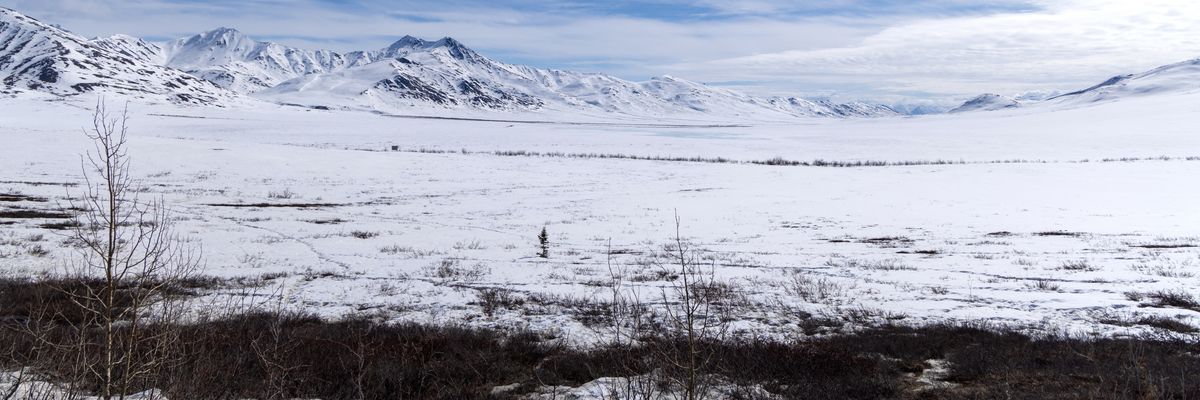
A general view of Brooks Range as seen from the Dalton Highway on May 10, 2024 in North Slope Borough, Alaska.
The study was published as President Donald Trump was blasted for an executive order that one critic said shows he wants to turn the Alaskan Arctic into the "the world's largest gas station."
For thousands of years, the land areas of the Arctic have served as a "carbon sink," storing potential carbon emissions in the permafrost. But according to a study published in the journal Nature Climate Change Tuesday, more than 34% of the Arctic is now a source of carbon to the atmosphere, as permafrost melts and the Arctic becomes greener.
"When emissions from fire were added, the percentage grew to 40%," according to the Woodwell Climate Research Center, which led the international team that conducted the research.
The study, which was first reported on by The Guardian, was released the day after President Donald Trump issued multiple presidential actions influencing the United States' ability to confront the climate crisis, which is primarily caused by fossil fuel emissions, including one directly impacting resource extraction in Alaska, a section of which is within the Arctic Circle.
Sue Natali, one of the researchers who worked on the study published in Nature Climate Change, told NPR in December (in reference to similar research) that the Arctic's warming "is not an issue of what party you support."
"This is something that impacts everyone," she said.
As the permafrost—ground that remains frozen for two or more years—holds less carbon, it releases CO2 into the atmosphere that could "considerably exacerbate climate change," according to the study.
"There is a load of carbon in the Arctic soils. It's close to half of the Earth's soil carbon pool. That's much more than there is in the atmosphere. There's a huge potential reservoir that should ideally stay in the ground," said Anna Virkkala, the lead author of the study, in an interview with The Guardian.
The dire warning was released on the heels of Trump's executive order titled "Unleashing the Alaska's Extraordinary Resource Potential" that calls for expedited "permitting and leasing of energy and natural resource projects in Alaska," as well as for the prioritization of "development of Alaska's liquefied natural gas (LNG) potential, including the sale and transportation of Alaskan LNG to other regions of the United States and allied nations within the Pacific region."
The order also rolls back a number of Biden-era restrictions on drilling and extraction in Alaska, which included protecting areas within the Arctic National Wildlife Refuge from oil and gas leasing.
"Alaska is warming four times faster than the rest of the planet, a trend that is wreaking havoc on communities, ecosystems, fish, wildlife, and ways of life that depend on healthy lands and waters," said Carole Holley, managing attorney for the Alaska Office of the environmental group Earthjustice, in a statement Monday.
"Earthjustice and its clients will not stand idly by while Trump once again forces a harmful industry-driven agenda on our state for political gain and the benefit of a wealthy few," she added.
Trump wants to turn the Alaskan Arctic into the "the world's largest gas station," said Athan Manuel, director of Sierra Club's Lands Protection Program, in a statement Monday. "Make no mistake, Trump's rushed and sloppy actions today are an existential threat to these lands and waters, and the communities and wildlife that depend on them."
Dear Common Dreams reader, It’s been nearly 30 years since I co-founded Common Dreams with my late wife, Lina Newhouser. We had the radical notion that journalism should serve the public good, not corporate profits. It was clear to us from the outset what it would take to build such a project. No paid advertisements. No corporate sponsors. No millionaire publisher telling us what to think or do. Many people said we wouldn't last a year, but we proved those doubters wrong. Together with a tremendous team of journalists and dedicated staff, we built an independent media outlet free from the constraints of profits and corporate control. Our mission has always been simple: To inform. To inspire. To ignite change for the common good. Building Common Dreams was not easy. Our survival was never guaranteed. When you take on the most powerful forces—Wall Street greed, fossil fuel industry destruction, Big Tech lobbyists, and uber-rich oligarchs who have spent billions upon billions rigging the economy and democracy in their favor—the only bulwark you have is supporters who believe in your work. But here’s the urgent message from me today. It's never been this bad out there. And it's never been this hard to keep us going. At the very moment Common Dreams is most needed, the threats we face are intensifying. We need your support now more than ever. We don't accept corporate advertising and never will. We don't have a paywall because we don't think people should be blocked from critical news based on their ability to pay. Everything we do is funded by the donations of readers like you. When everyone does the little they can afford, we are strong. But if that support retreats or dries up, so do we. Will you donate now to make sure Common Dreams not only survives but thrives? —Craig Brown, Co-founder |
For thousands of years, the land areas of the Arctic have served as a "carbon sink," storing potential carbon emissions in the permafrost. But according to a study published in the journal Nature Climate Change Tuesday, more than 34% of the Arctic is now a source of carbon to the atmosphere, as permafrost melts and the Arctic becomes greener.
"When emissions from fire were added, the percentage grew to 40%," according to the Woodwell Climate Research Center, which led the international team that conducted the research.
The study, which was first reported on by The Guardian, was released the day after President Donald Trump issued multiple presidential actions influencing the United States' ability to confront the climate crisis, which is primarily caused by fossil fuel emissions, including one directly impacting resource extraction in Alaska, a section of which is within the Arctic Circle.
Sue Natali, one of the researchers who worked on the study published in Nature Climate Change, told NPR in December (in reference to similar research) that the Arctic's warming "is not an issue of what party you support."
"This is something that impacts everyone," she said.
As the permafrost—ground that remains frozen for two or more years—holds less carbon, it releases CO2 into the atmosphere that could "considerably exacerbate climate change," according to the study.
"There is a load of carbon in the Arctic soils. It's close to half of the Earth's soil carbon pool. That's much more than there is in the atmosphere. There's a huge potential reservoir that should ideally stay in the ground," said Anna Virkkala, the lead author of the study, in an interview with The Guardian.
The dire warning was released on the heels of Trump's executive order titled "Unleashing the Alaska's Extraordinary Resource Potential" that calls for expedited "permitting and leasing of energy and natural resource projects in Alaska," as well as for the prioritization of "development of Alaska's liquefied natural gas (LNG) potential, including the sale and transportation of Alaskan LNG to other regions of the United States and allied nations within the Pacific region."
The order also rolls back a number of Biden-era restrictions on drilling and extraction in Alaska, which included protecting areas within the Arctic National Wildlife Refuge from oil and gas leasing.
"Alaska is warming four times faster than the rest of the planet, a trend that is wreaking havoc on communities, ecosystems, fish, wildlife, and ways of life that depend on healthy lands and waters," said Carole Holley, managing attorney for the Alaska Office of the environmental group Earthjustice, in a statement Monday.
"Earthjustice and its clients will not stand idly by while Trump once again forces a harmful industry-driven agenda on our state for political gain and the benefit of a wealthy few," she added.
Trump wants to turn the Alaskan Arctic into the "the world's largest gas station," said Athan Manuel, director of Sierra Club's Lands Protection Program, in a statement Monday. "Make no mistake, Trump's rushed and sloppy actions today are an existential threat to these lands and waters, and the communities and wildlife that depend on them."
For thousands of years, the land areas of the Arctic have served as a "carbon sink," storing potential carbon emissions in the permafrost. But according to a study published in the journal Nature Climate Change Tuesday, more than 34% of the Arctic is now a source of carbon to the atmosphere, as permafrost melts and the Arctic becomes greener.
"When emissions from fire were added, the percentage grew to 40%," according to the Woodwell Climate Research Center, which led the international team that conducted the research.
The study, which was first reported on by The Guardian, was released the day after President Donald Trump issued multiple presidential actions influencing the United States' ability to confront the climate crisis, which is primarily caused by fossil fuel emissions, including one directly impacting resource extraction in Alaska, a section of which is within the Arctic Circle.
Sue Natali, one of the researchers who worked on the study published in Nature Climate Change, told NPR in December (in reference to similar research) that the Arctic's warming "is not an issue of what party you support."
"This is something that impacts everyone," she said.
As the permafrost—ground that remains frozen for two or more years—holds less carbon, it releases CO2 into the atmosphere that could "considerably exacerbate climate change," according to the study.
"There is a load of carbon in the Arctic soils. It's close to half of the Earth's soil carbon pool. That's much more than there is in the atmosphere. There's a huge potential reservoir that should ideally stay in the ground," said Anna Virkkala, the lead author of the study, in an interview with The Guardian.
The dire warning was released on the heels of Trump's executive order titled "Unleashing the Alaska's Extraordinary Resource Potential" that calls for expedited "permitting and leasing of energy and natural resource projects in Alaska," as well as for the prioritization of "development of Alaska's liquefied natural gas (LNG) potential, including the sale and transportation of Alaskan LNG to other regions of the United States and allied nations within the Pacific region."
The order also rolls back a number of Biden-era restrictions on drilling and extraction in Alaska, which included protecting areas within the Arctic National Wildlife Refuge from oil and gas leasing.
"Alaska is warming four times faster than the rest of the planet, a trend that is wreaking havoc on communities, ecosystems, fish, wildlife, and ways of life that depend on healthy lands and waters," said Carole Holley, managing attorney for the Alaska Office of the environmental group Earthjustice, in a statement Monday.
"Earthjustice and its clients will not stand idly by while Trump once again forces a harmful industry-driven agenda on our state for political gain and the benefit of a wealthy few," she added.
Trump wants to turn the Alaskan Arctic into the "the world's largest gas station," said Athan Manuel, director of Sierra Club's Lands Protection Program, in a statement Monday. "Make no mistake, Trump's rushed and sloppy actions today are an existential threat to these lands and waters, and the communities and wildlife that depend on them."