SUBSCRIBE TO OUR FREE NEWSLETTER
Daily news & progressive opinion—funded by the people, not the corporations—delivered straight to your inbox.
5
#000000
#FFFFFF
To donate by check, phone, or other method, see our More Ways to Give page.
Daily news & progressive opinion—funded by the people, not the corporations—delivered straight to your inbox.
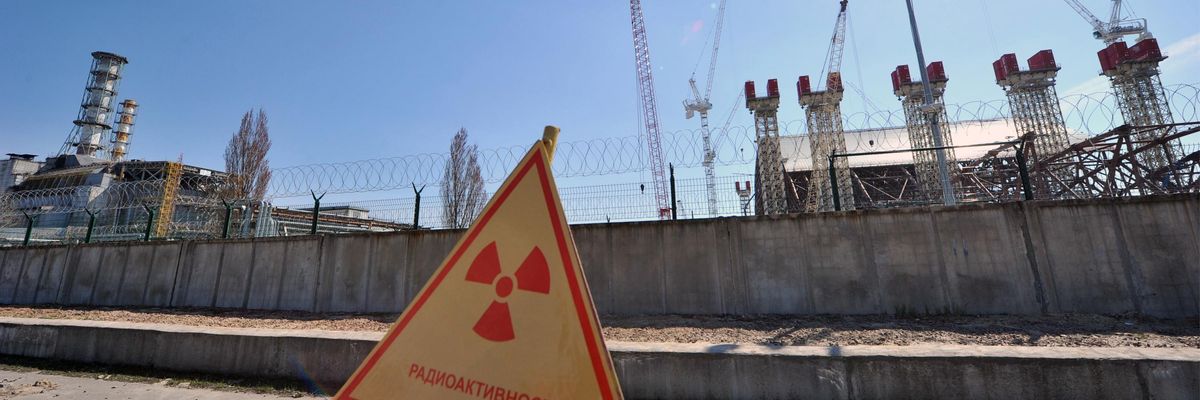
A photo shows the sections of a colossal arch-shaped structure that will cover the exploded reactor at the Chernobyl nuclear power station on April 23, 2013. (Photo: Genya Savilov/AFP via Getty Images)
A renowned organization comprised of U.S. and Russian physicians warned late Tuesday that a military conflict involving the two powers in Ukraine risks a nuclear "catastrophe" that could have horrific effects on all of Europe--and potentially the entire planet.
In a new statement, nuclear energy specialists joined members of the International Physicians for the Prevention of Nuclear War (IPPNW)--a coalition of medical groups that won the Nobel Peace Prize in 1985 for its non-proliferation work--in noting that while Ukraine does not possess nuclear weapons, it does maintain more than a dozen nuclear power reactors that could be in the line of fire should the current situation descend into all-out war.
"If even a single 100-kiloton nuclear weapon exploded over the Kremlin, it could kill a quarter of a million people."
Linda Pentz Gunter, founder of the advocacy group Beyond Nuclear, said a conflict in Ukraine could result in a disaster on par with--or even worse than--the devastating 1986 Chernobyl reactor crisis.
"No matter the genesis, the cause, or who started what, the reality remains that there are 15 operating nuclear reactors in Ukraine that, if conflict breaks out there, could be in peril," said Gunter. "If the reactors find themselves amidst a conflict or war, they cannot simply be abandoned by the workforce. This makes the prospects of a war in Ukraine all the more alarming, and the imperative to avoid this all the more urgent."
Additionally, physicians voiced concerns that the present crisis could ultimately escalate to the use of nuclear weaponry. While the U.S. and Russia--which together control more than 90% of the world's nuclear arsenal--signed a joint statement earlier this year affirming that "a nuclear war cannot be won and must never be fought," the military doctrines of both nations allow for the first use of nukes in conflict.
"If even a single 100-kiloton nuclear weapon exploded over the Kremlin, it could kill a quarter of a million people and injure a million more, completely overwhelming the disaster response capability of the Russian capital," said Dr. Ira Helfand, co-president of IPPNW. "A single 100 kiloton bomb detonated over the U.S. capital would kill over 170,000 people and injure nearly 400,000."
"But it is unlikely that an escalating nuclear conflict between the U.S. and Russia would involve single warheads over their respective capitals," Helfand added. "Rather it is more likely that there would be many weapons directed against many cities and many of these weapons would be substantially larger than 100 Kt."
Over the weekend, Dr. Olga Mironova--a cardiologist in Moscow and president of IPPNW's Russian affiliate--led an emergency discussion focused on the health impacts of a potential nuclear war involving the U.S. and Russia, which have roughly 6,000 nuclear warheads each.
The physicians' dire warnings came as tensions between Russia and the West continued to grow in the aftermath of President Vladimir Putin's decision Monday to send troops into breakaway regions of eastern Ukraine--a move that the U.S. and European countries met with a barrage of economic sanctions.
"The reactors present a daunting specter. If struck, the installations could effectively become radiological mines."
Citing Russia's deployment of troops into Ukraine, U.S. Secretary of State Antony Blinken announced late Tuesday that he canceled his planned meeting with Russian Foreign Minister Sergey Lavrov, a potential blow to diplomatic negotiations that peace groups say are the only way to step back from the brink of war.
In recent weeks, observers have lamented how little attention the possibility of a nuclear conflict has received from political leaders and the press relative to the threat it poses. Further heightening peace advocates' concerns was Russia's recent staging of nuclear drills, exercises that included practice launches of intercontinental ballistic missiles.
"Of all the obvious dangers that come with war, one of the most far-reaching in the current Russia-Ukraine conflict has been woefully underappreciated. Even if commanders took pains to avoid striking Ukraine's 15 nuclear power reactors, that might not be enough to avoid a catastrophe," Bennett Ramberg, an expert on nuclear weapons, wrote in an op-ed for Project Syndicate last week.
"The reactors present a daunting specter. If struck, the installations could effectively become radiological mines. And Russia itself would be a victim of the ensuing wind-borne radioactive debris," Ramberg observed. "Were a reactor core to melt, explosive gases or belching radioactive debris would exit the containment structure. Once in the atmosphere, the effluents would settle over thousands of miles, dumping light to very toxic radioactive elements on urban and rural landscapes. And spent nuclear fuel could cause further devastation if storage pools were set afire."
But Dr. Barry Levy, a leading expert on the health consequences of military conflicts, stressed Tuesday that even if a nuclear disaster is averted, "much death and illness could occur among noncombatant civilians from explosive weapons, population displacement, and damage to hospitals and clinics, water treatment plants, and the food supply system" in the case of a conventional war.
"As a result, children and pregnant women would suffer from malnutrition, more infants would be born prematurely, and more women would die during childbirth," said Levy. "More people would contract communicable diseases, including Covid-19. More older people, who comprise more than one-sixth of Ukraine's population, would develop complications of heart disease, lung disorders, and diabetes. And many Ukrainians would suffer from depression and posttraumatic stress disorder."
Dear Common Dreams reader, It’s been nearly 30 years since I co-founded Common Dreams with my late wife, Lina Newhouser. We had the radical notion that journalism should serve the public good, not corporate profits. It was clear to us from the outset what it would take to build such a project. No paid advertisements. No corporate sponsors. No millionaire publisher telling us what to think or do. Many people said we wouldn't last a year, but we proved those doubters wrong. Together with a tremendous team of journalists and dedicated staff, we built an independent media outlet free from the constraints of profits and corporate control. Our mission has always been simple: To inform. To inspire. To ignite change for the common good. Building Common Dreams was not easy. Our survival was never guaranteed. When you take on the most powerful forces—Wall Street greed, fossil fuel industry destruction, Big Tech lobbyists, and uber-rich oligarchs who have spent billions upon billions rigging the economy and democracy in their favor—the only bulwark you have is supporters who believe in your work. But here’s the urgent message from me today. It's never been this bad out there. And it's never been this hard to keep us going. At the very moment Common Dreams is most needed, the threats we face are intensifying. We need your support now more than ever. We don't accept corporate advertising and never will. We don't have a paywall because we don't think people should be blocked from critical news based on their ability to pay. Everything we do is funded by the donations of readers like you. When everyone does the little they can afford, we are strong. But if that support retreats or dries up, so do we. Will you donate now to make sure Common Dreams not only survives but thrives? —Craig Brown, Co-founder |
A renowned organization comprised of U.S. and Russian physicians warned late Tuesday that a military conflict involving the two powers in Ukraine risks a nuclear "catastrophe" that could have horrific effects on all of Europe--and potentially the entire planet.
In a new statement, nuclear energy specialists joined members of the International Physicians for the Prevention of Nuclear War (IPPNW)--a coalition of medical groups that won the Nobel Peace Prize in 1985 for its non-proliferation work--in noting that while Ukraine does not possess nuclear weapons, it does maintain more than a dozen nuclear power reactors that could be in the line of fire should the current situation descend into all-out war.
"If even a single 100-kiloton nuclear weapon exploded over the Kremlin, it could kill a quarter of a million people."
Linda Pentz Gunter, founder of the advocacy group Beyond Nuclear, said a conflict in Ukraine could result in a disaster on par with--or even worse than--the devastating 1986 Chernobyl reactor crisis.
"No matter the genesis, the cause, or who started what, the reality remains that there are 15 operating nuclear reactors in Ukraine that, if conflict breaks out there, could be in peril," said Gunter. "If the reactors find themselves amidst a conflict or war, they cannot simply be abandoned by the workforce. This makes the prospects of a war in Ukraine all the more alarming, and the imperative to avoid this all the more urgent."
Additionally, physicians voiced concerns that the present crisis could ultimately escalate to the use of nuclear weaponry. While the U.S. and Russia--which together control more than 90% of the world's nuclear arsenal--signed a joint statement earlier this year affirming that "a nuclear war cannot be won and must never be fought," the military doctrines of both nations allow for the first use of nukes in conflict.
"If even a single 100-kiloton nuclear weapon exploded over the Kremlin, it could kill a quarter of a million people and injure a million more, completely overwhelming the disaster response capability of the Russian capital," said Dr. Ira Helfand, co-president of IPPNW. "A single 100 kiloton bomb detonated over the U.S. capital would kill over 170,000 people and injure nearly 400,000."
"But it is unlikely that an escalating nuclear conflict between the U.S. and Russia would involve single warheads over their respective capitals," Helfand added. "Rather it is more likely that there would be many weapons directed against many cities and many of these weapons would be substantially larger than 100 Kt."
Over the weekend, Dr. Olga Mironova--a cardiologist in Moscow and president of IPPNW's Russian affiliate--led an emergency discussion focused on the health impacts of a potential nuclear war involving the U.S. and Russia, which have roughly 6,000 nuclear warheads each.
The physicians' dire warnings came as tensions between Russia and the West continued to grow in the aftermath of President Vladimir Putin's decision Monday to send troops into breakaway regions of eastern Ukraine--a move that the U.S. and European countries met with a barrage of economic sanctions.
"The reactors present a daunting specter. If struck, the installations could effectively become radiological mines."
Citing Russia's deployment of troops into Ukraine, U.S. Secretary of State Antony Blinken announced late Tuesday that he canceled his planned meeting with Russian Foreign Minister Sergey Lavrov, a potential blow to diplomatic negotiations that peace groups say are the only way to step back from the brink of war.
In recent weeks, observers have lamented how little attention the possibility of a nuclear conflict has received from political leaders and the press relative to the threat it poses. Further heightening peace advocates' concerns was Russia's recent staging of nuclear drills, exercises that included practice launches of intercontinental ballistic missiles.
"Of all the obvious dangers that come with war, one of the most far-reaching in the current Russia-Ukraine conflict has been woefully underappreciated. Even if commanders took pains to avoid striking Ukraine's 15 nuclear power reactors, that might not be enough to avoid a catastrophe," Bennett Ramberg, an expert on nuclear weapons, wrote in an op-ed for Project Syndicate last week.
"The reactors present a daunting specter. If struck, the installations could effectively become radiological mines. And Russia itself would be a victim of the ensuing wind-borne radioactive debris," Ramberg observed. "Were a reactor core to melt, explosive gases or belching radioactive debris would exit the containment structure. Once in the atmosphere, the effluents would settle over thousands of miles, dumping light to very toxic radioactive elements on urban and rural landscapes. And spent nuclear fuel could cause further devastation if storage pools were set afire."
But Dr. Barry Levy, a leading expert on the health consequences of military conflicts, stressed Tuesday that even if a nuclear disaster is averted, "much death and illness could occur among noncombatant civilians from explosive weapons, population displacement, and damage to hospitals and clinics, water treatment plants, and the food supply system" in the case of a conventional war.
"As a result, children and pregnant women would suffer from malnutrition, more infants would be born prematurely, and more women would die during childbirth," said Levy. "More people would contract communicable diseases, including Covid-19. More older people, who comprise more than one-sixth of Ukraine's population, would develop complications of heart disease, lung disorders, and diabetes. And many Ukrainians would suffer from depression and posttraumatic stress disorder."
A renowned organization comprised of U.S. and Russian physicians warned late Tuesday that a military conflict involving the two powers in Ukraine risks a nuclear "catastrophe" that could have horrific effects on all of Europe--and potentially the entire planet.
In a new statement, nuclear energy specialists joined members of the International Physicians for the Prevention of Nuclear War (IPPNW)--a coalition of medical groups that won the Nobel Peace Prize in 1985 for its non-proliferation work--in noting that while Ukraine does not possess nuclear weapons, it does maintain more than a dozen nuclear power reactors that could be in the line of fire should the current situation descend into all-out war.
"If even a single 100-kiloton nuclear weapon exploded over the Kremlin, it could kill a quarter of a million people."
Linda Pentz Gunter, founder of the advocacy group Beyond Nuclear, said a conflict in Ukraine could result in a disaster on par with--or even worse than--the devastating 1986 Chernobyl reactor crisis.
"No matter the genesis, the cause, or who started what, the reality remains that there are 15 operating nuclear reactors in Ukraine that, if conflict breaks out there, could be in peril," said Gunter. "If the reactors find themselves amidst a conflict or war, they cannot simply be abandoned by the workforce. This makes the prospects of a war in Ukraine all the more alarming, and the imperative to avoid this all the more urgent."
Additionally, physicians voiced concerns that the present crisis could ultimately escalate to the use of nuclear weaponry. While the U.S. and Russia--which together control more than 90% of the world's nuclear arsenal--signed a joint statement earlier this year affirming that "a nuclear war cannot be won and must never be fought," the military doctrines of both nations allow for the first use of nukes in conflict.
"If even a single 100-kiloton nuclear weapon exploded over the Kremlin, it could kill a quarter of a million people and injure a million more, completely overwhelming the disaster response capability of the Russian capital," said Dr. Ira Helfand, co-president of IPPNW. "A single 100 kiloton bomb detonated over the U.S. capital would kill over 170,000 people and injure nearly 400,000."
"But it is unlikely that an escalating nuclear conflict between the U.S. and Russia would involve single warheads over their respective capitals," Helfand added. "Rather it is more likely that there would be many weapons directed against many cities and many of these weapons would be substantially larger than 100 Kt."
Over the weekend, Dr. Olga Mironova--a cardiologist in Moscow and president of IPPNW's Russian affiliate--led an emergency discussion focused on the health impacts of a potential nuclear war involving the U.S. and Russia, which have roughly 6,000 nuclear warheads each.
The physicians' dire warnings came as tensions between Russia and the West continued to grow in the aftermath of President Vladimir Putin's decision Monday to send troops into breakaway regions of eastern Ukraine--a move that the U.S. and European countries met with a barrage of economic sanctions.
"The reactors present a daunting specter. If struck, the installations could effectively become radiological mines."
Citing Russia's deployment of troops into Ukraine, U.S. Secretary of State Antony Blinken announced late Tuesday that he canceled his planned meeting with Russian Foreign Minister Sergey Lavrov, a potential blow to diplomatic negotiations that peace groups say are the only way to step back from the brink of war.
In recent weeks, observers have lamented how little attention the possibility of a nuclear conflict has received from political leaders and the press relative to the threat it poses. Further heightening peace advocates' concerns was Russia's recent staging of nuclear drills, exercises that included practice launches of intercontinental ballistic missiles.
"Of all the obvious dangers that come with war, one of the most far-reaching in the current Russia-Ukraine conflict has been woefully underappreciated. Even if commanders took pains to avoid striking Ukraine's 15 nuclear power reactors, that might not be enough to avoid a catastrophe," Bennett Ramberg, an expert on nuclear weapons, wrote in an op-ed for Project Syndicate last week.
"The reactors present a daunting specter. If struck, the installations could effectively become radiological mines. And Russia itself would be a victim of the ensuing wind-borne radioactive debris," Ramberg observed. "Were a reactor core to melt, explosive gases or belching radioactive debris would exit the containment structure. Once in the atmosphere, the effluents would settle over thousands of miles, dumping light to very toxic radioactive elements on urban and rural landscapes. And spent nuclear fuel could cause further devastation if storage pools were set afire."
But Dr. Barry Levy, a leading expert on the health consequences of military conflicts, stressed Tuesday that even if a nuclear disaster is averted, "much death and illness could occur among noncombatant civilians from explosive weapons, population displacement, and damage to hospitals and clinics, water treatment plants, and the food supply system" in the case of a conventional war.
"As a result, children and pregnant women would suffer from malnutrition, more infants would be born prematurely, and more women would die during childbirth," said Levy. "More people would contract communicable diseases, including Covid-19. More older people, who comprise more than one-sixth of Ukraine's population, would develop complications of heart disease, lung disorders, and diabetes. And many Ukrainians would suffer from depression and posttraumatic stress disorder."