SUBSCRIBE TO OUR FREE NEWSLETTER
Daily news & progressive opinion—funded by the people, not the corporations—delivered straight to your inbox.
5
#000000
#FFFFFF
To donate by check, phone, or other method, see our More Ways to Give page.
Daily news & progressive opinion—funded by the people, not the corporations—delivered straight to your inbox.
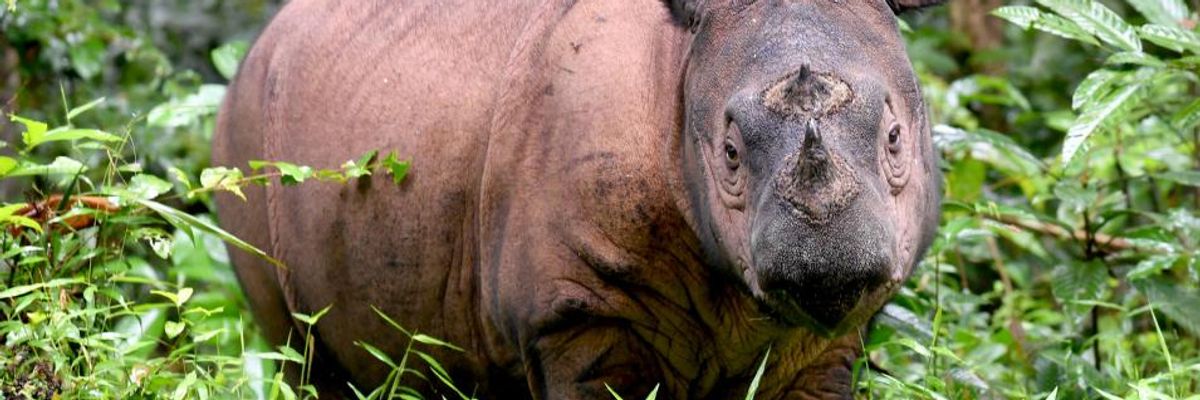
Andatu, a Sumatran rhino, one of the rarest large mammals on earth, is seen at the Rhino Sanctuary at Way Kambas National Park in eastern Sumatra November 8, 2016. (Photo: Goh Chai Hin/AFP via Getty Images)
After years of warnings from scientists that the world is witnessing Earth's sixth mass extinction, a new study concludes that the current crisis is not only "human caused and accelerating" but also "may be the most serious environmental threat to the persistence of civilization, because it is irreversible."
The study, published Monday in the journal Proceedings of the National Academy of Sciences, says that at least 543 land vertebrate species have disappeared since 1900 and around the same number could be lost within just the next few decades due to destructive human pressures such as climate change, habitat destruction, pollution, population growth, and wildlife trade, particularly in tropical and subtropical regions.
Lead author Gerardo Ceballos Gonzalez, a professor of ecology at the National Autonomous University of Mexico, told CNN that approximately 173 species went extinct between 2001 and 2014, which "is 25 times more extinct species than you would expect under the normal, background, extinction rate."
Compared with previous mass extinctions the Earth has experienced due to catastrophic events including volcanic eruptions or collision with an asteroid, the one that is happening now "is entirely our fault," Ceballos Gonzalez added.
Extinction has dire consequences not only for the species that are wiped out but also for humanity, including an increased risk of health threats like Covid-19, which has killed over 376,000 people worldwide and infected more than 6.3 million, coauthor and Stanford biologist Paul Ehrlich explained in a statement Monday.
"When humanity exterminates populations and species of other creatures, it is sawing off the limb on which it is sitting, destroying working parts of our own life-support system," said Ehrlich. "The conservation of endangered species should be elevated to a national and global emergency for governments and institutions, equal to climate disruption to which it is linked."
Ceballos Gonzalez and coauthor Peter Raven, president emeritus of the Missouri Botanical Garden, echoed Ehrlich's call for urgent action.
"What we do to deal with the current extinction crisis in the next two decades will define the fate of millions of species," warned Ceballos Gonzalez. "We are facing our final opportunity to ensure that the many services nature provides us do not get irretrievably sabotaged."
Raven said that "it's up to us to decide what kind of a world we want to leave to coming generations--a sustainable one, or a desolate one in which the civilization we have built disintegrates rather than builds on past successes."
The trio found that 515 amphibians, birds, mammals, and reptiles are on the brink of extinction, or have fewer than 1,000 individuals left; about half are down to fewer than 250. They also found that 84% of land vertebrate species with populations under 5,000 live in the same areas as those on the brink of extinction.
Given that "extinction breeds extinctions" and the consequences of such losses, the study recommends that the International Union for Conservation of Nature (IUCN) "immediately" classify all species with populations under 5,000 as critically endangered.
"It is... a scientific and moral imperative for scientists to take whatever actions they can to stop extinction," according to the study. In a statement Monday, the Center for Biological Diversity (CBD) noted that such comments are unusual for a scientific journal.
"This new study shows yet again that the very survival of humanity is at stake if we don't end the heartbreaking wildlife extinction crisis," said CBD senior scientist Tierra Curry. "We're no longer looking at the loss of obscure species that most people aren't interested in. We're looking at biological annihilation if we don't act to save life on Earth."
"Extinction is a political choice," Curry added. "We've reached a crossroads where our own future is at stake if we don't move away from fossil fuels and end wildlife exploitation, and at the same time, necessarily, address poverty and injustice. Meanwhile the tone-deaf Trump administration has gutted nearly 100 environmental regulations, including the Endangered Species Act."
In January, CBD released Saving Life on Earth: A Plan to Halt the Global Extinction Crisis (pdf), which urges the United States to become a global leader in the fight to protect wildlife with a national emergency declaration, a $100 billion investment, and a campaign to protect 50% of U.S. land by 2050. The proposal also calls for restoring the full power of the Endangered Species Act, cracking down on pollution, and tackling invasive species.
"The response to the coronavirus outbreak has shown us that rapid change is possible," said Curry, "and that funding is available to address the extinction crisis."
Dear Common Dreams reader, It’s been nearly 30 years since I co-founded Common Dreams with my late wife, Lina Newhouser. We had the radical notion that journalism should serve the public good, not corporate profits. It was clear to us from the outset what it would take to build such a project. No paid advertisements. No corporate sponsors. No millionaire publisher telling us what to think or do. Many people said we wouldn't last a year, but we proved those doubters wrong. Together with a tremendous team of journalists and dedicated staff, we built an independent media outlet free from the constraints of profits and corporate control. Our mission has always been simple: To inform. To inspire. To ignite change for the common good. Building Common Dreams was not easy. Our survival was never guaranteed. When you take on the most powerful forces—Wall Street greed, fossil fuel industry destruction, Big Tech lobbyists, and uber-rich oligarchs who have spent billions upon billions rigging the economy and democracy in their favor—the only bulwark you have is supporters who believe in your work. But here’s the urgent message from me today. It's never been this bad out there. And it's never been this hard to keep us going. At the very moment Common Dreams is most needed, the threats we face are intensifying. We need your support now more than ever. We don't accept corporate advertising and never will. We don't have a paywall because we don't think people should be blocked from critical news based on their ability to pay. Everything we do is funded by the donations of readers like you. When everyone does the little they can afford, we are strong. But if that support retreats or dries up, so do we. Will you donate now to make sure Common Dreams not only survives but thrives? —Craig Brown, Co-founder |
After years of warnings from scientists that the world is witnessing Earth's sixth mass extinction, a new study concludes that the current crisis is not only "human caused and accelerating" but also "may be the most serious environmental threat to the persistence of civilization, because it is irreversible."
The study, published Monday in the journal Proceedings of the National Academy of Sciences, says that at least 543 land vertebrate species have disappeared since 1900 and around the same number could be lost within just the next few decades due to destructive human pressures such as climate change, habitat destruction, pollution, population growth, and wildlife trade, particularly in tropical and subtropical regions.
Lead author Gerardo Ceballos Gonzalez, a professor of ecology at the National Autonomous University of Mexico, told CNN that approximately 173 species went extinct between 2001 and 2014, which "is 25 times more extinct species than you would expect under the normal, background, extinction rate."
Compared with previous mass extinctions the Earth has experienced due to catastrophic events including volcanic eruptions or collision with an asteroid, the one that is happening now "is entirely our fault," Ceballos Gonzalez added.
Extinction has dire consequences not only for the species that are wiped out but also for humanity, including an increased risk of health threats like Covid-19, which has killed over 376,000 people worldwide and infected more than 6.3 million, coauthor and Stanford biologist Paul Ehrlich explained in a statement Monday.
"When humanity exterminates populations and species of other creatures, it is sawing off the limb on which it is sitting, destroying working parts of our own life-support system," said Ehrlich. "The conservation of endangered species should be elevated to a national and global emergency for governments and institutions, equal to climate disruption to which it is linked."
Ceballos Gonzalez and coauthor Peter Raven, president emeritus of the Missouri Botanical Garden, echoed Ehrlich's call for urgent action.
"What we do to deal with the current extinction crisis in the next two decades will define the fate of millions of species," warned Ceballos Gonzalez. "We are facing our final opportunity to ensure that the many services nature provides us do not get irretrievably sabotaged."
Raven said that "it's up to us to decide what kind of a world we want to leave to coming generations--a sustainable one, or a desolate one in which the civilization we have built disintegrates rather than builds on past successes."
The trio found that 515 amphibians, birds, mammals, and reptiles are on the brink of extinction, or have fewer than 1,000 individuals left; about half are down to fewer than 250. They also found that 84% of land vertebrate species with populations under 5,000 live in the same areas as those on the brink of extinction.
Given that "extinction breeds extinctions" and the consequences of such losses, the study recommends that the International Union for Conservation of Nature (IUCN) "immediately" classify all species with populations under 5,000 as critically endangered.
"It is... a scientific and moral imperative for scientists to take whatever actions they can to stop extinction," according to the study. In a statement Monday, the Center for Biological Diversity (CBD) noted that such comments are unusual for a scientific journal.
"This new study shows yet again that the very survival of humanity is at stake if we don't end the heartbreaking wildlife extinction crisis," said CBD senior scientist Tierra Curry. "We're no longer looking at the loss of obscure species that most people aren't interested in. We're looking at biological annihilation if we don't act to save life on Earth."
"Extinction is a political choice," Curry added. "We've reached a crossroads where our own future is at stake if we don't move away from fossil fuels and end wildlife exploitation, and at the same time, necessarily, address poverty and injustice. Meanwhile the tone-deaf Trump administration has gutted nearly 100 environmental regulations, including the Endangered Species Act."
In January, CBD released Saving Life on Earth: A Plan to Halt the Global Extinction Crisis (pdf), which urges the United States to become a global leader in the fight to protect wildlife with a national emergency declaration, a $100 billion investment, and a campaign to protect 50% of U.S. land by 2050. The proposal also calls for restoring the full power of the Endangered Species Act, cracking down on pollution, and tackling invasive species.
"The response to the coronavirus outbreak has shown us that rapid change is possible," said Curry, "and that funding is available to address the extinction crisis."
After years of warnings from scientists that the world is witnessing Earth's sixth mass extinction, a new study concludes that the current crisis is not only "human caused and accelerating" but also "may be the most serious environmental threat to the persistence of civilization, because it is irreversible."
The study, published Monday in the journal Proceedings of the National Academy of Sciences, says that at least 543 land vertebrate species have disappeared since 1900 and around the same number could be lost within just the next few decades due to destructive human pressures such as climate change, habitat destruction, pollution, population growth, and wildlife trade, particularly in tropical and subtropical regions.
Lead author Gerardo Ceballos Gonzalez, a professor of ecology at the National Autonomous University of Mexico, told CNN that approximately 173 species went extinct between 2001 and 2014, which "is 25 times more extinct species than you would expect under the normal, background, extinction rate."
Compared with previous mass extinctions the Earth has experienced due to catastrophic events including volcanic eruptions or collision with an asteroid, the one that is happening now "is entirely our fault," Ceballos Gonzalez added.
Extinction has dire consequences not only for the species that are wiped out but also for humanity, including an increased risk of health threats like Covid-19, which has killed over 376,000 people worldwide and infected more than 6.3 million, coauthor and Stanford biologist Paul Ehrlich explained in a statement Monday.
"When humanity exterminates populations and species of other creatures, it is sawing off the limb on which it is sitting, destroying working parts of our own life-support system," said Ehrlich. "The conservation of endangered species should be elevated to a national and global emergency for governments and institutions, equal to climate disruption to which it is linked."
Ceballos Gonzalez and coauthor Peter Raven, president emeritus of the Missouri Botanical Garden, echoed Ehrlich's call for urgent action.
"What we do to deal with the current extinction crisis in the next two decades will define the fate of millions of species," warned Ceballos Gonzalez. "We are facing our final opportunity to ensure that the many services nature provides us do not get irretrievably sabotaged."
Raven said that "it's up to us to decide what kind of a world we want to leave to coming generations--a sustainable one, or a desolate one in which the civilization we have built disintegrates rather than builds on past successes."
The trio found that 515 amphibians, birds, mammals, and reptiles are on the brink of extinction, or have fewer than 1,000 individuals left; about half are down to fewer than 250. They also found that 84% of land vertebrate species with populations under 5,000 live in the same areas as those on the brink of extinction.
Given that "extinction breeds extinctions" and the consequences of such losses, the study recommends that the International Union for Conservation of Nature (IUCN) "immediately" classify all species with populations under 5,000 as critically endangered.
"It is... a scientific and moral imperative for scientists to take whatever actions they can to stop extinction," according to the study. In a statement Monday, the Center for Biological Diversity (CBD) noted that such comments are unusual for a scientific journal.
"This new study shows yet again that the very survival of humanity is at stake if we don't end the heartbreaking wildlife extinction crisis," said CBD senior scientist Tierra Curry. "We're no longer looking at the loss of obscure species that most people aren't interested in. We're looking at biological annihilation if we don't act to save life on Earth."
"Extinction is a political choice," Curry added. "We've reached a crossroads where our own future is at stake if we don't move away from fossil fuels and end wildlife exploitation, and at the same time, necessarily, address poverty and injustice. Meanwhile the tone-deaf Trump administration has gutted nearly 100 environmental regulations, including the Endangered Species Act."
In January, CBD released Saving Life on Earth: A Plan to Halt the Global Extinction Crisis (pdf), which urges the United States to become a global leader in the fight to protect wildlife with a national emergency declaration, a $100 billion investment, and a campaign to protect 50% of U.S. land by 2050. The proposal also calls for restoring the full power of the Endangered Species Act, cracking down on pollution, and tackling invasive species.
"The response to the coronavirus outbreak has shown us that rapid change is possible," said Curry, "and that funding is available to address the extinction crisis."