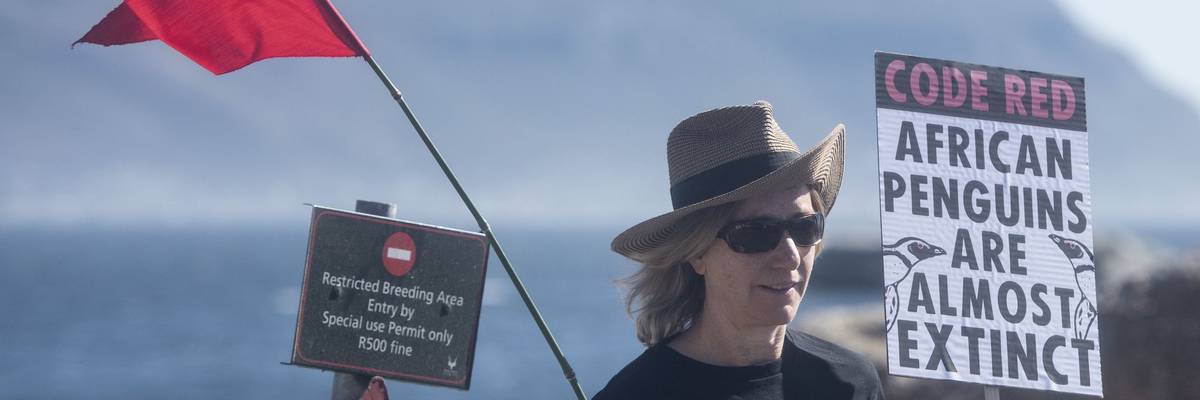
Protesters call for saving the African penguin from extinction at Boulders Beach in Simon's Town, South Africa, on March 18, 2025.
62,000 African Penguins Starving to Death Highlights Humanity-Driven Extinction Crisis
"If a species as iconic as the African penguin is struggling to survive," said one researcher, "it raises the question of how many other species are disappearing without us even noticing."
A study published this week about tens of thousands of starving African penguins is highlighting what scientists warn is the planet's sixth mass extinction event, driven by human activity, and efforts to save as many species as possible.
Researchers from the South African Department of Forestry, Fisheries, and the Environment (DFFE), the United Kingdom's University of Exeter, and other institutions examined a pair of breeding colonies north of Cape Town, South Africa, and published their findings Thursday in Ostrich: Journal of African Ornithology.
"These two sites are two of the most important breeding colonies historically—holding around 25,000 (Dassen) and around 9,000 (Robben) breeding pairs in the early 2000s. As such, they are also the locations of long-term monitoring programs," said study co-author Azwianewi Makhado from the DFFE in a statement.
As the study explains: "African Penguins moult annually, coming ashore and fasting for 21 days, when they shed and replace all their feathers. Failure to fatten sufficiently to moult, or to regain condition afterwards, results in death."
The team found that "between 2004 and 2011, the sardine stock off west South Africa was consistently below 25% of its peak abundance, and this appears to have caused severe food shortage for African penguins, leading to an estimated loss of about 62,000 breeding individuals," said co-author and Exeter associate professor Richard Sherley.
The paper notes that "although some adults moulted at a colony to the southeast, where food may have been more plentiful, much of the mortality likely resulted from failure of birds to fatten sufficiently to moult. The fishery exploitation rate of sardines west of Cape Agulhas was consistently above 20% between 2005 and 2010."
Sherley said that "high sardine exploitation rates—that briefly reached 80% in 2006—in a period when sardine was declining because of environmental changes likely worsened penguin mortality."
Humanity's reliance on fossil fuels is warming ocean water and impacting how salty it is. For the penguins' prey, said Sherley, "changes in the temperature and salinity of the spawning areas off the west and south coasts of South Africa made spawning in the historically important west coast spawning areas less successful, and spawning off the south coast more successful."
The researcher also stressed that "these declines are mirrored elsewhere," pointing out that the species' global population has dropped nearly 80% in the last three decades. With fewer than 10,000 breeding pairs left, the African penguin was uplisted to "critically endangered" on the International Union for Conservation of Nature (IUCN) Red List of Threatened Species last year.
Sherley told Mongabay at the time that the IUCN update "highlights a much bigger problem with the health of our environment."
"Despite being well-known and studied, these penguins are still facing extinction, showing just how severe the damage to our ecosystems has become," he said. "If a species as iconic as the African penguin is struggling to survive, it raises the question of how many other species are disappearing without us even noticing. We need to act now—not just for penguins, but to protect the broader biodiversity that is crucial for the planet's future."
Looks like the combined effects of climate change and over fishing are key factors in decimating the populations of these penguins.www.washingtonpost.com/climate-envi...
[image or embed]
— Margot Hodson (@margothodson.bsky.social) December 5, 2025 at 4:46 AM
Fearful that the iconic penguin species could be extinct within a decade, the conservation organizations BirdLife South Africa and the Southern African Foundation for the Conservation of Coastal Birds (SANCCOB) last year pursued a first-of-its-kind legal battle in the country, resulting in a settlement with the commercial fishing sector and DFFE.
The settlement, reached just days before a planned court hearing this past March, led to no-go zones for the commercial anchovy and sardine fishing vessels around six penguin breeding colonies: Stony Point, as well as Bird, Dassen, Dyer, Robben, and St. Croix islands.
"The threats facing the African penguin are complex and ongoing—and the order itself requires monitoring, enforcement, and continued cooperation from industry and the government processes which monitor and allocate sardine and anchovy populations for commercial purposes," Nicky Stander, head of conservation at SANCCOB, said in March.
The study also acknowledges hopes that "the revised closures—which will operate year-round until at least 2033—will decrease mortality of African penguins and improve their breeding success at the six colonies around which they have been implemented."
"However," it adds, "in the face of the ongoing impact of climate change on the abundance and distribution of their key prey, other interventions are likely to be needed."
Lorien Pichegru, a marine biology professor at South Africa's Nelson Mandela University who was not involved in the study, called the findings "extremely concerning" and warned the Guardian that the low fish numbers require urgent action "not only for African penguins but also for other endemic species depending on these stocks."
We are at a crossroads
This country and this world are at a monumental crossroads. In a few short weeks, US voters will have an opportunity to beat back the forces of fascism and confront the billionaires who are rigging the economy, our media system, and our democracy, making it increasingly impossible for ordinary people to get by. We’re not just talking about the election. We’re talking about what must be done once these fascist elements are vanquished from power. We need a bolder set of solutions than what either major party has so far been willing to offer and a working-class movement ready to fight like hell for it. Trump didn't emerge from nowhere. The conditions that fueled MAGA authoritarianism were created by decades of radical neoliberal economic policies and a corrupt political system dominated by corporate interests. They slashed taxes on the super-rich, promising that the benefits would trickle down. They said giveaways to the corporate titans would make life more affordable for the rest of us. It was all bullshit. And when a bitter, betrayed populace searches for someone to blame, right-wing demagogues have little trouble finding scapegoats. People know when they're being lied to, but you won't hear any of this from the corporate media. Only independent journalism—powered and funded by people who believe in building a better world—can deliver truly trustworthy daily news. Our Fall Campaign is underway, and we need your help. To power our newsroom through the rest of the year, we need to raise $125,000 by midnight on October 31. So if you share our vision, please contribute whatever you can to sustain our work. |
A study published this week about tens of thousands of starving African penguins is highlighting what scientists warn is the planet's sixth mass extinction event, driven by human activity, and efforts to save as many species as possible.
Researchers from the South African Department of Forestry, Fisheries, and the Environment (DFFE), the United Kingdom's University of Exeter, and other institutions examined a pair of breeding colonies north of Cape Town, South Africa, and published their findings Thursday in Ostrich: Journal of African Ornithology.
"These two sites are two of the most important breeding colonies historically—holding around 25,000 (Dassen) and around 9,000 (Robben) breeding pairs in the early 2000s. As such, they are also the locations of long-term monitoring programs," said study co-author Azwianewi Makhado from the DFFE in a statement.
As the study explains: "African Penguins moult annually, coming ashore and fasting for 21 days, when they shed and replace all their feathers. Failure to fatten sufficiently to moult, or to regain condition afterwards, results in death."
The team found that "between 2004 and 2011, the sardine stock off west South Africa was consistently below 25% of its peak abundance, and this appears to have caused severe food shortage for African penguins, leading to an estimated loss of about 62,000 breeding individuals," said co-author and Exeter associate professor Richard Sherley.
The paper notes that "although some adults moulted at a colony to the southeast, where food may have been more plentiful, much of the mortality likely resulted from failure of birds to fatten sufficiently to moult. The fishery exploitation rate of sardines west of Cape Agulhas was consistently above 20% between 2005 and 2010."
Sherley said that "high sardine exploitation rates—that briefly reached 80% in 2006—in a period when sardine was declining because of environmental changes likely worsened penguin mortality."
Humanity's reliance on fossil fuels is warming ocean water and impacting how salty it is. For the penguins' prey, said Sherley, "changes in the temperature and salinity of the spawning areas off the west and south coasts of South Africa made spawning in the historically important west coast spawning areas less successful, and spawning off the south coast more successful."
The researcher also stressed that "these declines are mirrored elsewhere," pointing out that the species' global population has dropped nearly 80% in the last three decades. With fewer than 10,000 breeding pairs left, the African penguin was uplisted to "critically endangered" on the International Union for Conservation of Nature (IUCN) Red List of Threatened Species last year.
Sherley told Mongabay at the time that the IUCN update "highlights a much bigger problem with the health of our environment."
"Despite being well-known and studied, these penguins are still facing extinction, showing just how severe the damage to our ecosystems has become," he said. "If a species as iconic as the African penguin is struggling to survive, it raises the question of how many other species are disappearing without us even noticing. We need to act now—not just for penguins, but to protect the broader biodiversity that is crucial for the planet's future."
Looks like the combined effects of climate change and over fishing are key factors in decimating the populations of these penguins.www.washingtonpost.com/climate-envi...
[image or embed]
— Margot Hodson (@margothodson.bsky.social) December 5, 2025 at 4:46 AM
Fearful that the iconic penguin species could be extinct within a decade, the conservation organizations BirdLife South Africa and the Southern African Foundation for the Conservation of Coastal Birds (SANCCOB) last year pursued a first-of-its-kind legal battle in the country, resulting in a settlement with the commercial fishing sector and DFFE.
The settlement, reached just days before a planned court hearing this past March, led to no-go zones for the commercial anchovy and sardine fishing vessels around six penguin breeding colonies: Stony Point, as well as Bird, Dassen, Dyer, Robben, and St. Croix islands.
"The threats facing the African penguin are complex and ongoing—and the order itself requires monitoring, enforcement, and continued cooperation from industry and the government processes which monitor and allocate sardine and anchovy populations for commercial purposes," Nicky Stander, head of conservation at SANCCOB, said in March.
The study also acknowledges hopes that "the revised closures—which will operate year-round until at least 2033—will decrease mortality of African penguins and improve their breeding success at the six colonies around which they have been implemented."
"However," it adds, "in the face of the ongoing impact of climate change on the abundance and distribution of their key prey, other interventions are likely to be needed."
Lorien Pichegru, a marine biology professor at South Africa's Nelson Mandela University who was not involved in the study, called the findings "extremely concerning" and warned the Guardian that the low fish numbers require urgent action "not only for African penguins but also for other endemic species depending on these stocks."
- 'Grim' Report Warns 40% of US Animals at Risk of Extinction ›
- Updated Extinction Assessment Drives Fresh Call to 'Save Life on Earth' ›
- In Decline "Invariably of Humanity's Making," 1 in 8 of World's Bird Species Threatened by Extinction ›
- 'Extinction Is a Political Choice,' Scientist Says After Study Warns of Threat to Civilization From Humans Destroying Wildlife ›
- Trump Proposal to Weaken Endangered Species Act Will 'Accelerate the Extinction Crisis,' Green Groups Warn ›
A study published this week about tens of thousands of starving African penguins is highlighting what scientists warn is the planet's sixth mass extinction event, driven by human activity, and efforts to save as many species as possible.
Researchers from the South African Department of Forestry, Fisheries, and the Environment (DFFE), the United Kingdom's University of Exeter, and other institutions examined a pair of breeding colonies north of Cape Town, South Africa, and published their findings Thursday in Ostrich: Journal of African Ornithology.
"These two sites are two of the most important breeding colonies historically—holding around 25,000 (Dassen) and around 9,000 (Robben) breeding pairs in the early 2000s. As such, they are also the locations of long-term monitoring programs," said study co-author Azwianewi Makhado from the DFFE in a statement.
As the study explains: "African Penguins moult annually, coming ashore and fasting for 21 days, when they shed and replace all their feathers. Failure to fatten sufficiently to moult, or to regain condition afterwards, results in death."
The team found that "between 2004 and 2011, the sardine stock off west South Africa was consistently below 25% of its peak abundance, and this appears to have caused severe food shortage for African penguins, leading to an estimated loss of about 62,000 breeding individuals," said co-author and Exeter associate professor Richard Sherley.
The paper notes that "although some adults moulted at a colony to the southeast, where food may have been more plentiful, much of the mortality likely resulted from failure of birds to fatten sufficiently to moult. The fishery exploitation rate of sardines west of Cape Agulhas was consistently above 20% between 2005 and 2010."
Sherley said that "high sardine exploitation rates—that briefly reached 80% in 2006—in a period when sardine was declining because of environmental changes likely worsened penguin mortality."
Humanity's reliance on fossil fuels is warming ocean water and impacting how salty it is. For the penguins' prey, said Sherley, "changes in the temperature and salinity of the spawning areas off the west and south coasts of South Africa made spawning in the historically important west coast spawning areas less successful, and spawning off the south coast more successful."
The researcher also stressed that "these declines are mirrored elsewhere," pointing out that the species' global population has dropped nearly 80% in the last three decades. With fewer than 10,000 breeding pairs left, the African penguin was uplisted to "critically endangered" on the International Union for Conservation of Nature (IUCN) Red List of Threatened Species last year.
Sherley told Mongabay at the time that the IUCN update "highlights a much bigger problem with the health of our environment."
"Despite being well-known and studied, these penguins are still facing extinction, showing just how severe the damage to our ecosystems has become," he said. "If a species as iconic as the African penguin is struggling to survive, it raises the question of how many other species are disappearing without us even noticing. We need to act now—not just for penguins, but to protect the broader biodiversity that is crucial for the planet's future."
Looks like the combined effects of climate change and over fishing are key factors in decimating the populations of these penguins.www.washingtonpost.com/climate-envi...
[image or embed]
— Margot Hodson (@margothodson.bsky.social) December 5, 2025 at 4:46 AM
Fearful that the iconic penguin species could be extinct within a decade, the conservation organizations BirdLife South Africa and the Southern African Foundation for the Conservation of Coastal Birds (SANCCOB) last year pursued a first-of-its-kind legal battle in the country, resulting in a settlement with the commercial fishing sector and DFFE.
The settlement, reached just days before a planned court hearing this past March, led to no-go zones for the commercial anchovy and sardine fishing vessels around six penguin breeding colonies: Stony Point, as well as Bird, Dassen, Dyer, Robben, and St. Croix islands.
"The threats facing the African penguin are complex and ongoing—and the order itself requires monitoring, enforcement, and continued cooperation from industry and the government processes which monitor and allocate sardine and anchovy populations for commercial purposes," Nicky Stander, head of conservation at SANCCOB, said in March.
The study also acknowledges hopes that "the revised closures—which will operate year-round until at least 2033—will decrease mortality of African penguins and improve their breeding success at the six colonies around which they have been implemented."
"However," it adds, "in the face of the ongoing impact of climate change on the abundance and distribution of their key prey, other interventions are likely to be needed."
Lorien Pichegru, a marine biology professor at South Africa's Nelson Mandela University who was not involved in the study, called the findings "extremely concerning" and warned the Guardian that the low fish numbers require urgent action "not only for African penguins but also for other endemic species depending on these stocks."
- 'Grim' Report Warns 40% of US Animals at Risk of Extinction ›
- Updated Extinction Assessment Drives Fresh Call to 'Save Life on Earth' ›
- In Decline "Invariably of Humanity's Making," 1 in 8 of World's Bird Species Threatened by Extinction ›
- 'Extinction Is a Political Choice,' Scientist Says After Study Warns of Threat to Civilization From Humans Destroying Wildlife ›
- Trump Proposal to Weaken Endangered Species Act Will 'Accelerate the Extinction Crisis,' Green Groups Warn ›