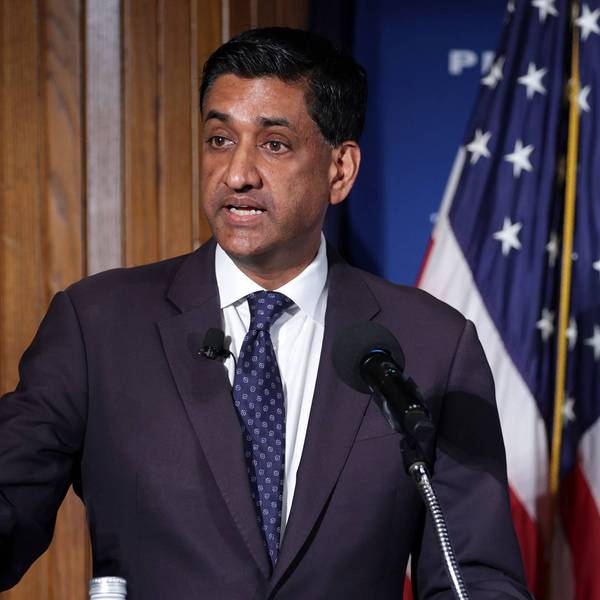
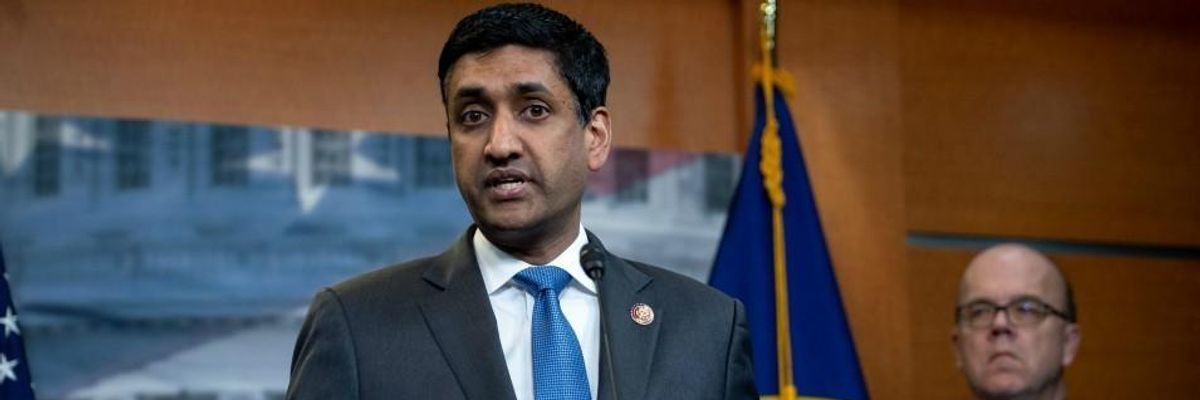
Rep. Ro Khanna (D-Calif.) (L) speaks during a press conference on Capitol Hill in Washington, D.C. on April 4, 2019. (Photo: Saul Loeb/AFP/Getty Images)
Rep. Khanna Introduces 'Visionary' Bill to Take On Big Ag, Strengthen Family Farms
"Mega meatpackers have extracted profits from farmers, workers, and consumers for too long."
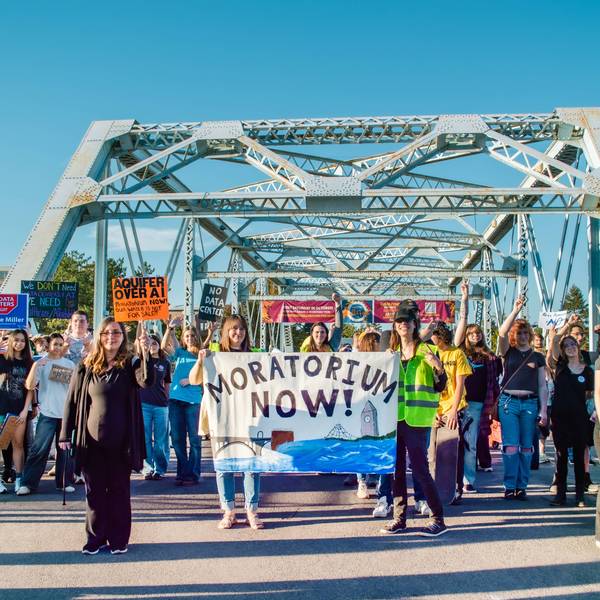
Rep. Ro Khanna on Thursday introduced legislation to overhaul the nation's agricultural system including by tackling massive corporate consolidation and enacting a moratorium on factory farms.
"Multinational corporations have concentrated our food system to its breaking point," said Jake Davis, a Missouri farmer, and national policy director at Family Farm Action, in a statement backing the measure. "Mega meatpackers have extracted profits from farmers, workers, and consumers for too long," he said. "This pandemic has shined a bright light on those abuses."
The legislation from the California Democrat represents a companion measure to The Farm System Reform Act, which was introduced in the Senate in December by Sen. Cory Booker (D-N.J.).
"If we had a food system with fair competition, independent and diversified producers would provide a dependable and sustainable food supply," Khanna said in a statement. "Folks deserve to know where their animal products are really coming from, and farmers deserve a fair shot in their own business."
Booker on Thursday pointed to President Donald Trump's executive order last month keeping meatpacking plants open in the face of increased worker and food safety concerns as evidence of a long "broken" system sorely in need of reform.
"Our food system was not broken by the pandemic and it was not broken by independent family farmers," said Booker. "It was broken by large, multinational corporations like Tyson, Smithfield, and JBS that, because of their buying power and size, have undue influence over the marketplace and over public policy. That undue influence was on full display with President Trump's recent executive order prioritizing meatpacker profits over the health and safety of workers."
"We need to fix this broken system," Booker continued. "That means protecting family farmers and food system workers and holding corporate integrators responsible for the harm they are causing. Large factory farms are harmful to rural communities, public health, and the environment and we must immediately begin to transition to a more sustainable and humane system."
As a statement from Khanna's office explains, the proposed legislation would:
- Place an immediate moratorium on new and expanding large CAFOs, and transition by 2040 the largest CAFOs as defined by the Environmental Protection Agency
- Provide a voluntary buyout for farmers who want to transition out of operating a CAFO
- Hold corporate integrators responsible for pollution and other harm caused by CAFOs
- Strengthen the Packers and Stockyards Act to protect family farmers and ranchers, including:
Prohibit the use of unfair tournament or ranking systems for paying contract growers
Protect livestock and poultry farmers from retaliation
Create market transparency and protect farmers and ranchers from predatory purchasing practices
- Restore mandatory country-of-origin labeling requirements for beef and pork and expand it to dairy products
- Prohibit the United States Department of Agriculture (USDA) from labeling foreign imported meat products as "Product of USA"
Sen. Elizabeth Warren, who co-sponsored the Senate legislation, echoed her colleague Booker's criticism of a longstanding problem.
"For years, regulators looked the other way while giant multinational corporations crushed competition in the agriculture sector and seized control over key markets," said Warren. "The COVID-19 crisis will make it easier for Big Ag to get even bigger, gobble up smaller farms, and lead to fewer choices for consumers. We need to attack this consolidation head-on and give workers, farmers, and consumers bargaining power in our farm and food system."
The new legislation was welcomed by Food & Water Watch, with the advocacy group's executive director Wenonah Hauter calling it a "visionary bill that finally reverses decades of consolidated and predatory corporate agriculture."
We are at a crossroads
This country and this world are at a monumental crossroads. In a few short weeks, US voters will have an opportunity to beat back the forces of fascism and confront the billionaires who are rigging the economy, our media system, and our democracy, making it increasingly impossible for ordinary people to get by. We’re not just talking about the election. We’re talking about what must be done once these fascist elements are vanquished from power. We need a bolder set of solutions than what either major party has so far been willing to offer and a working-class movement ready to fight like hell for it. Trump didn't emerge from nowhere. The conditions that fueled MAGA authoritarianism were created by decades of radical neoliberal economic policies and a corrupt political system dominated by corporate interests. They slashed taxes on the super-rich, promising that the benefits would trickle down. They said giveaways to the corporate titans would make life more affordable for the rest of us. It was all bullshit. And when a bitter, betrayed populace searches for someone to blame, right-wing demagogues have little trouble finding scapegoats. People know when they're being lied to, but you won't hear any of this from the corporate media. Only independent journalism—powered and funded by people who believe in building a better world—can deliver truly trustworthy daily news. Our Fall Campaign is underway, and we need your help. To power our newsroom through the rest of the year, we need to raise $125,000 by midnight on October 31. So if you share our vision, please contribute whatever you can to sustain our work. |
Rep. Ro Khanna on Thursday introduced legislation to overhaul the nation's agricultural system including by tackling massive corporate consolidation and enacting a moratorium on factory farms.
"Multinational corporations have concentrated our food system to its breaking point," said Jake Davis, a Missouri farmer, and national policy director at Family Farm Action, in a statement backing the measure. "Mega meatpackers have extracted profits from farmers, workers, and consumers for too long," he said. "This pandemic has shined a bright light on those abuses."
The legislation from the California Democrat represents a companion measure to The Farm System Reform Act, which was introduced in the Senate in December by Sen. Cory Booker (D-N.J.).
"If we had a food system with fair competition, independent and diversified producers would provide a dependable and sustainable food supply," Khanna said in a statement. "Folks deserve to know where their animal products are really coming from, and farmers deserve a fair shot in their own business."
Booker on Thursday pointed to President Donald Trump's executive order last month keeping meatpacking plants open in the face of increased worker and food safety concerns as evidence of a long "broken" system sorely in need of reform.
"Our food system was not broken by the pandemic and it was not broken by independent family farmers," said Booker. "It was broken by large, multinational corporations like Tyson, Smithfield, and JBS that, because of their buying power and size, have undue influence over the marketplace and over public policy. That undue influence was on full display with President Trump's recent executive order prioritizing meatpacker profits over the health and safety of workers."
"We need to fix this broken system," Booker continued. "That means protecting family farmers and food system workers and holding corporate integrators responsible for the harm they are causing. Large factory farms are harmful to rural communities, public health, and the environment and we must immediately begin to transition to a more sustainable and humane system."
As a statement from Khanna's office explains, the proposed legislation would:
- Place an immediate moratorium on new and expanding large CAFOs, and transition by 2040 the largest CAFOs as defined by the Environmental Protection Agency
- Provide a voluntary buyout for farmers who want to transition out of operating a CAFO
- Hold corporate integrators responsible for pollution and other harm caused by CAFOs
- Strengthen the Packers and Stockyards Act to protect family farmers and ranchers, including:
Prohibit the use of unfair tournament or ranking systems for paying contract growers
Protect livestock and poultry farmers from retaliation
Create market transparency and protect farmers and ranchers from predatory purchasing practices
- Restore mandatory country-of-origin labeling requirements for beef and pork and expand it to dairy products
- Prohibit the United States Department of Agriculture (USDA) from labeling foreign imported meat products as "Product of USA"
Sen. Elizabeth Warren, who co-sponsored the Senate legislation, echoed her colleague Booker's criticism of a longstanding problem.
"For years, regulators looked the other way while giant multinational corporations crushed competition in the agriculture sector and seized control over key markets," said Warren. "The COVID-19 crisis will make it easier for Big Ag to get even bigger, gobble up smaller farms, and lead to fewer choices for consumers. We need to attack this consolidation head-on and give workers, farmers, and consumers bargaining power in our farm and food system."
The new legislation was welcomed by Food & Water Watch, with the advocacy group's executive director Wenonah Hauter calling it a "visionary bill that finally reverses decades of consolidated and predatory corporate agriculture."
Rep. Ro Khanna on Thursday introduced legislation to overhaul the nation's agricultural system including by tackling massive corporate consolidation and enacting a moratorium on factory farms.
"Multinational corporations have concentrated our food system to its breaking point," said Jake Davis, a Missouri farmer, and national policy director at Family Farm Action, in a statement backing the measure. "Mega meatpackers have extracted profits from farmers, workers, and consumers for too long," he said. "This pandemic has shined a bright light on those abuses."
The legislation from the California Democrat represents a companion measure to The Farm System Reform Act, which was introduced in the Senate in December by Sen. Cory Booker (D-N.J.).
"If we had a food system with fair competition, independent and diversified producers would provide a dependable and sustainable food supply," Khanna said in a statement. "Folks deserve to know where their animal products are really coming from, and farmers deserve a fair shot in their own business."
Booker on Thursday pointed to President Donald Trump's executive order last month keeping meatpacking plants open in the face of increased worker and food safety concerns as evidence of a long "broken" system sorely in need of reform.
"Our food system was not broken by the pandemic and it was not broken by independent family farmers," said Booker. "It was broken by large, multinational corporations like Tyson, Smithfield, and JBS that, because of their buying power and size, have undue influence over the marketplace and over public policy. That undue influence was on full display with President Trump's recent executive order prioritizing meatpacker profits over the health and safety of workers."
"We need to fix this broken system," Booker continued. "That means protecting family farmers and food system workers and holding corporate integrators responsible for the harm they are causing. Large factory farms are harmful to rural communities, public health, and the environment and we must immediately begin to transition to a more sustainable and humane system."
As a statement from Khanna's office explains, the proposed legislation would:
- Place an immediate moratorium on new and expanding large CAFOs, and transition by 2040 the largest CAFOs as defined by the Environmental Protection Agency
- Provide a voluntary buyout for farmers who want to transition out of operating a CAFO
- Hold corporate integrators responsible for pollution and other harm caused by CAFOs
- Strengthen the Packers and Stockyards Act to protect family farmers and ranchers, including:
Prohibit the use of unfair tournament or ranking systems for paying contract growers
Protect livestock and poultry farmers from retaliation
Create market transparency and protect farmers and ranchers from predatory purchasing practices
- Restore mandatory country-of-origin labeling requirements for beef and pork and expand it to dairy products
- Prohibit the United States Department of Agriculture (USDA) from labeling foreign imported meat products as "Product of USA"
Sen. Elizabeth Warren, who co-sponsored the Senate legislation, echoed her colleague Booker's criticism of a longstanding problem.
"For years, regulators looked the other way while giant multinational corporations crushed competition in the agriculture sector and seized control over key markets," said Warren. "The COVID-19 crisis will make it easier for Big Ag to get even bigger, gobble up smaller farms, and lead to fewer choices for consumers. We need to attack this consolidation head-on and give workers, farmers, and consumers bargaining power in our farm and food system."
The new legislation was welcomed by Food & Water Watch, with the advocacy group's executive director Wenonah Hauter calling it a "visionary bill that finally reverses decades of consolidated and predatory corporate agriculture."