SUBSCRIBE TO OUR FREE NEWSLETTER
Daily news & progressive opinion—funded by the people, not the corporations—delivered straight to your inbox.
5
#000000
#FFFFFF
To donate by check, phone, or other method, see our More Ways to Give page.
Daily news & progressive opinion—funded by the people, not the corporations—delivered straight to your inbox.
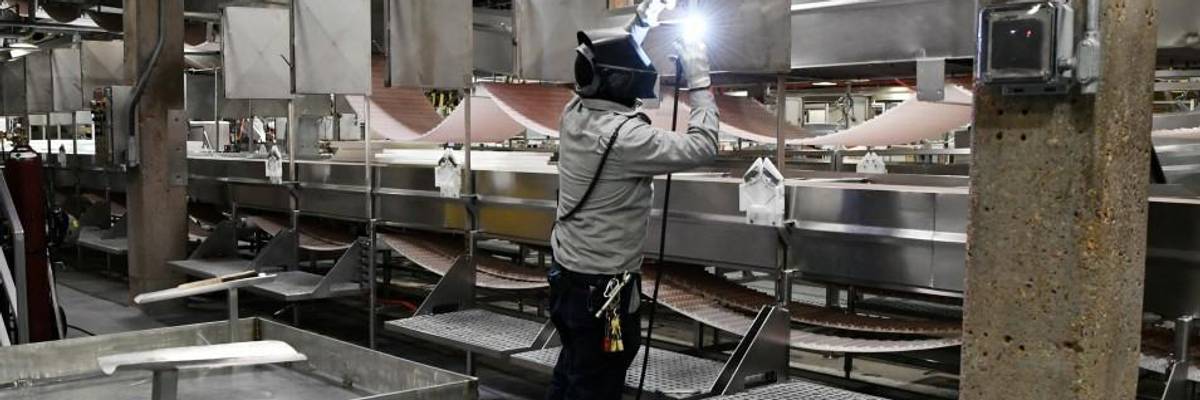
A minimum of 20 meatpacking workers have died from the coronavirus and 6,500 have tested positive or been quarantined, according to the United Food and Commercial Workers union. (Photo: Andy Cross/MediaNews Group/The Denver Post via Getty Images)
In the past several days, the Trump Administration has made it crystal clear that it views workers and their families vulnerable to COVID-19 as faceless, replaceable, and an obstacle to maximum profitability.
Trump officially declared meat--not safety gear--as worthy of an official order.
Faced with overwhelming evidence that meatpacking plants in Sioux Falls, South Dakota, and elsewhere--each operated by a tiny cartel of producers--have become major breeding grounds for the coronavirus, Trump finally invoked the National Defense Production Act, as he has been urged to do for weeks.
But the President's aim was not to direct corporations to produce more badly needed safety equipment, or to impose more safety measures which might involve closing some plants. On the contrary, the purpose of Trump's order is to try to force meat-processing plants to stay open without regard for workers' safety. Let that sink in: Trump officially declared meat--not safety gear--as worthy of an official order.
Trump shows no comprehension of the reality of meatpacking plants. A minimum of 20 meatpacking workers have died from the coronavirus and 6,500 have tested positive or been quarantined, according to the United Food and Commercial Workers union. Shockingly, even the provision of protective masks has been neglected by some corporations up until now. The U.S. Chamber of Commerce wants to "relieve employers from a need to provide masks or train employees in how to properly use them."
Yes, the Occupational Safety and Health Administration and the Centers for Disease Control and Prevention have issued safety standards for meatpacking plants. But these are strictly recommendations, not requirements. For an industry with a record of callousness that dates back to Upton Sinclair's 1906 book The Jungle, this lack of strict oversight is indefensible.
Further, rather than extend enforceable standards for worker safety, the Trump Administration is pressing for measures which would provide legal immunity against lawsuits by workers exposed to dangerous conditions where they may contract COVID-19. Several governors whose states house meatpacking plants have threatened to deny unemployment benefits to workers who fear the disease and stay home from work.
Reflecting the same narrow corporate interests, the Trump Administration is extending to Mexico its obsession with safeguarding profits rather than safeguarding workers. U.S.-based corporations have already been documented engaging in horrific practices at their Mexican subsidiaries. Cooper Lighting, for example, placed chains on its doors to prevent workers from leaving, according to a top Mexican official in the state of Baja California.
In short, "the United States is urging Mexico to allow exemptions for workers whose services are essential--not to Mexico, but to the United States," The New York Times reported.
The imperious--and imperialist--outlook of the Trump Administration was revealed in a statement by Ambassador Christopher Landau. Landau repeated the familiar threat of corporate relocation, which is that if workers don't accede to their demands, the permanent loss of jobs to other low-wage nations could occur en masse.
"You don't have 'workers' if you close all the companies and they move elsewhere," the Ambassador warned on Twitter. "Of course, health comes first, but to me it seems myopic to suggest that economic effects don't matter."
"If workers in these plants are as essential as our elected leaders say, then it's about time that our elected leaders provide them with the essential protections they need."
However, the U.S. demands are being countered by Mexican health officials stressing the vulnerability of Mexican workers. "If we don't take these actions, our public health system will collapse," a government official warned.
Meanwhile, on both sides of the Rio Grande, workers are under enormous duress to choose between supporting their families or facing sickness and death. "I'm worried about making my parents sick," explained Mexican automotive worker Jair Garcia. "My mom tells me to take care of myself, but also to keep my job. Without a job, I can't eat."
With both workers and the broader population sharing a common interest in halting the spread of the virus in meatpacking, the crisis provides a critical moment for labor to exert its power as a force for the public good. In the U.S., the United Food and Commercial Workers has demanded more safety gear, social distancing, paid sick leave, and a badly-needed slowdown in the speed of production lines--an area where the Trump administration has significantly exacerbated the situation by speeding up production. Based on what we have seen thus far, the Trump Administration's voluntary guidelines are utterly worthless without totally different aims.
"America's food processing and meatpacking workers are in extreme danger, and our nation's food supply faces a direct threat from the coronavirus outbreak," said United Food and Commercial Workers President Marc Perrone. "If workers in these plants are as essential as our elected leaders say, then it's about time that our elected leaders provide them with the essential protections they need."
Unlike many other situations faced by labor in modern times, the UFCW now has some real leverage over the meatpacking corporations. "You can't force workers to come to work," argues Perrone. "If they aren't feeling safe, they aren't going to show up."
Minnesota Governor Tim Walz, unlike other Midwest colleagues in South Dakota, Nebraska, and Iowa, recognizes the severity of the workers' position. Walz firmly states that Trump's order will remain utterly meaningless until workers feel genuinely safe. "No executive order is going to get those hogs produced if the people who know how to do it are sick.
"The only way we do that is to ensure worker safety.": A reality that Trump and allied Midwest governors will recognize only when faced by UFCW's unyielding resistance on behalf of themselves and the American people.
Dear Common Dreams reader, It’s been nearly 30 years since I co-founded Common Dreams with my late wife, Lina Newhouser. We had the radical notion that journalism should serve the public good, not corporate profits. It was clear to us from the outset what it would take to build such a project. No paid advertisements. No corporate sponsors. No millionaire publisher telling us what to think or do. Many people said we wouldn't last a year, but we proved those doubters wrong. Together with a tremendous team of journalists and dedicated staff, we built an independent media outlet free from the constraints of profits and corporate control. Our mission has always been simple: To inform. To inspire. To ignite change for the common good. Building Common Dreams was not easy. Our survival was never guaranteed. When you take on the most powerful forces—Wall Street greed, fossil fuel industry destruction, Big Tech lobbyists, and uber-rich oligarchs who have spent billions upon billions rigging the economy and democracy in their favor—the only bulwark you have is supporters who believe in your work. But here’s the urgent message from me today. It's never been this bad out there. And it's never been this hard to keep us going. At the very moment Common Dreams is most needed, the threats we face are intensifying. We need your support now more than ever. We don't accept corporate advertising and never will. We don't have a paywall because we don't think people should be blocked from critical news based on their ability to pay. Everything we do is funded by the donations of readers like you. When everyone does the little they can afford, we are strong. But if that support retreats or dries up, so do we. Will you donate now to make sure Common Dreams not only survives but thrives? —Craig Brown, Co-founder |
In the past several days, the Trump Administration has made it crystal clear that it views workers and their families vulnerable to COVID-19 as faceless, replaceable, and an obstacle to maximum profitability.
Trump officially declared meat--not safety gear--as worthy of an official order.
Faced with overwhelming evidence that meatpacking plants in Sioux Falls, South Dakota, and elsewhere--each operated by a tiny cartel of producers--have become major breeding grounds for the coronavirus, Trump finally invoked the National Defense Production Act, as he has been urged to do for weeks.
But the President's aim was not to direct corporations to produce more badly needed safety equipment, or to impose more safety measures which might involve closing some plants. On the contrary, the purpose of Trump's order is to try to force meat-processing plants to stay open without regard for workers' safety. Let that sink in: Trump officially declared meat--not safety gear--as worthy of an official order.
Trump shows no comprehension of the reality of meatpacking plants. A minimum of 20 meatpacking workers have died from the coronavirus and 6,500 have tested positive or been quarantined, according to the United Food and Commercial Workers union. Shockingly, even the provision of protective masks has been neglected by some corporations up until now. The U.S. Chamber of Commerce wants to "relieve employers from a need to provide masks or train employees in how to properly use them."
Yes, the Occupational Safety and Health Administration and the Centers for Disease Control and Prevention have issued safety standards for meatpacking plants. But these are strictly recommendations, not requirements. For an industry with a record of callousness that dates back to Upton Sinclair's 1906 book The Jungle, this lack of strict oversight is indefensible.
Further, rather than extend enforceable standards for worker safety, the Trump Administration is pressing for measures which would provide legal immunity against lawsuits by workers exposed to dangerous conditions where they may contract COVID-19. Several governors whose states house meatpacking plants have threatened to deny unemployment benefits to workers who fear the disease and stay home from work.
Reflecting the same narrow corporate interests, the Trump Administration is extending to Mexico its obsession with safeguarding profits rather than safeguarding workers. U.S.-based corporations have already been documented engaging in horrific practices at their Mexican subsidiaries. Cooper Lighting, for example, placed chains on its doors to prevent workers from leaving, according to a top Mexican official in the state of Baja California.
In short, "the United States is urging Mexico to allow exemptions for workers whose services are essential--not to Mexico, but to the United States," The New York Times reported.
The imperious--and imperialist--outlook of the Trump Administration was revealed in a statement by Ambassador Christopher Landau. Landau repeated the familiar threat of corporate relocation, which is that if workers don't accede to their demands, the permanent loss of jobs to other low-wage nations could occur en masse.
"You don't have 'workers' if you close all the companies and they move elsewhere," the Ambassador warned on Twitter. "Of course, health comes first, but to me it seems myopic to suggest that economic effects don't matter."
"If workers in these plants are as essential as our elected leaders say, then it's about time that our elected leaders provide them with the essential protections they need."
However, the U.S. demands are being countered by Mexican health officials stressing the vulnerability of Mexican workers. "If we don't take these actions, our public health system will collapse," a government official warned.
Meanwhile, on both sides of the Rio Grande, workers are under enormous duress to choose between supporting their families or facing sickness and death. "I'm worried about making my parents sick," explained Mexican automotive worker Jair Garcia. "My mom tells me to take care of myself, but also to keep my job. Without a job, I can't eat."
With both workers and the broader population sharing a common interest in halting the spread of the virus in meatpacking, the crisis provides a critical moment for labor to exert its power as a force for the public good. In the U.S., the United Food and Commercial Workers has demanded more safety gear, social distancing, paid sick leave, and a badly-needed slowdown in the speed of production lines--an area where the Trump administration has significantly exacerbated the situation by speeding up production. Based on what we have seen thus far, the Trump Administration's voluntary guidelines are utterly worthless without totally different aims.
"America's food processing and meatpacking workers are in extreme danger, and our nation's food supply faces a direct threat from the coronavirus outbreak," said United Food and Commercial Workers President Marc Perrone. "If workers in these plants are as essential as our elected leaders say, then it's about time that our elected leaders provide them with the essential protections they need."
Unlike many other situations faced by labor in modern times, the UFCW now has some real leverage over the meatpacking corporations. "You can't force workers to come to work," argues Perrone. "If they aren't feeling safe, they aren't going to show up."
Minnesota Governor Tim Walz, unlike other Midwest colleagues in South Dakota, Nebraska, and Iowa, recognizes the severity of the workers' position. Walz firmly states that Trump's order will remain utterly meaningless until workers feel genuinely safe. "No executive order is going to get those hogs produced if the people who know how to do it are sick.
"The only way we do that is to ensure worker safety.": A reality that Trump and allied Midwest governors will recognize only when faced by UFCW's unyielding resistance on behalf of themselves and the American people.
In the past several days, the Trump Administration has made it crystal clear that it views workers and their families vulnerable to COVID-19 as faceless, replaceable, and an obstacle to maximum profitability.
Trump officially declared meat--not safety gear--as worthy of an official order.
Faced with overwhelming evidence that meatpacking plants in Sioux Falls, South Dakota, and elsewhere--each operated by a tiny cartel of producers--have become major breeding grounds for the coronavirus, Trump finally invoked the National Defense Production Act, as he has been urged to do for weeks.
But the President's aim was not to direct corporations to produce more badly needed safety equipment, or to impose more safety measures which might involve closing some plants. On the contrary, the purpose of Trump's order is to try to force meat-processing plants to stay open without regard for workers' safety. Let that sink in: Trump officially declared meat--not safety gear--as worthy of an official order.
Trump shows no comprehension of the reality of meatpacking plants. A minimum of 20 meatpacking workers have died from the coronavirus and 6,500 have tested positive or been quarantined, according to the United Food and Commercial Workers union. Shockingly, even the provision of protective masks has been neglected by some corporations up until now. The U.S. Chamber of Commerce wants to "relieve employers from a need to provide masks or train employees in how to properly use them."
Yes, the Occupational Safety and Health Administration and the Centers for Disease Control and Prevention have issued safety standards for meatpacking plants. But these are strictly recommendations, not requirements. For an industry with a record of callousness that dates back to Upton Sinclair's 1906 book The Jungle, this lack of strict oversight is indefensible.
Further, rather than extend enforceable standards for worker safety, the Trump Administration is pressing for measures which would provide legal immunity against lawsuits by workers exposed to dangerous conditions where they may contract COVID-19. Several governors whose states house meatpacking plants have threatened to deny unemployment benefits to workers who fear the disease and stay home from work.
Reflecting the same narrow corporate interests, the Trump Administration is extending to Mexico its obsession with safeguarding profits rather than safeguarding workers. U.S.-based corporations have already been documented engaging in horrific practices at their Mexican subsidiaries. Cooper Lighting, for example, placed chains on its doors to prevent workers from leaving, according to a top Mexican official in the state of Baja California.
In short, "the United States is urging Mexico to allow exemptions for workers whose services are essential--not to Mexico, but to the United States," The New York Times reported.
The imperious--and imperialist--outlook of the Trump Administration was revealed in a statement by Ambassador Christopher Landau. Landau repeated the familiar threat of corporate relocation, which is that if workers don't accede to their demands, the permanent loss of jobs to other low-wage nations could occur en masse.
"You don't have 'workers' if you close all the companies and they move elsewhere," the Ambassador warned on Twitter. "Of course, health comes first, but to me it seems myopic to suggest that economic effects don't matter."
"If workers in these plants are as essential as our elected leaders say, then it's about time that our elected leaders provide them with the essential protections they need."
However, the U.S. demands are being countered by Mexican health officials stressing the vulnerability of Mexican workers. "If we don't take these actions, our public health system will collapse," a government official warned.
Meanwhile, on both sides of the Rio Grande, workers are under enormous duress to choose between supporting their families or facing sickness and death. "I'm worried about making my parents sick," explained Mexican automotive worker Jair Garcia. "My mom tells me to take care of myself, but also to keep my job. Without a job, I can't eat."
With both workers and the broader population sharing a common interest in halting the spread of the virus in meatpacking, the crisis provides a critical moment for labor to exert its power as a force for the public good. In the U.S., the United Food and Commercial Workers has demanded more safety gear, social distancing, paid sick leave, and a badly-needed slowdown in the speed of production lines--an area where the Trump administration has significantly exacerbated the situation by speeding up production. Based on what we have seen thus far, the Trump Administration's voluntary guidelines are utterly worthless without totally different aims.
"America's food processing and meatpacking workers are in extreme danger, and our nation's food supply faces a direct threat from the coronavirus outbreak," said United Food and Commercial Workers President Marc Perrone. "If workers in these plants are as essential as our elected leaders say, then it's about time that our elected leaders provide them with the essential protections they need."
Unlike many other situations faced by labor in modern times, the UFCW now has some real leverage over the meatpacking corporations. "You can't force workers to come to work," argues Perrone. "If they aren't feeling safe, they aren't going to show up."
Minnesota Governor Tim Walz, unlike other Midwest colleagues in South Dakota, Nebraska, and Iowa, recognizes the severity of the workers' position. Walz firmly states that Trump's order will remain utterly meaningless until workers feel genuinely safe. "No executive order is going to get those hogs produced if the people who know how to do it are sick.
"The only way we do that is to ensure worker safety.": A reality that Trump and allied Midwest governors will recognize only when faced by UFCW's unyielding resistance on behalf of themselves and the American people.