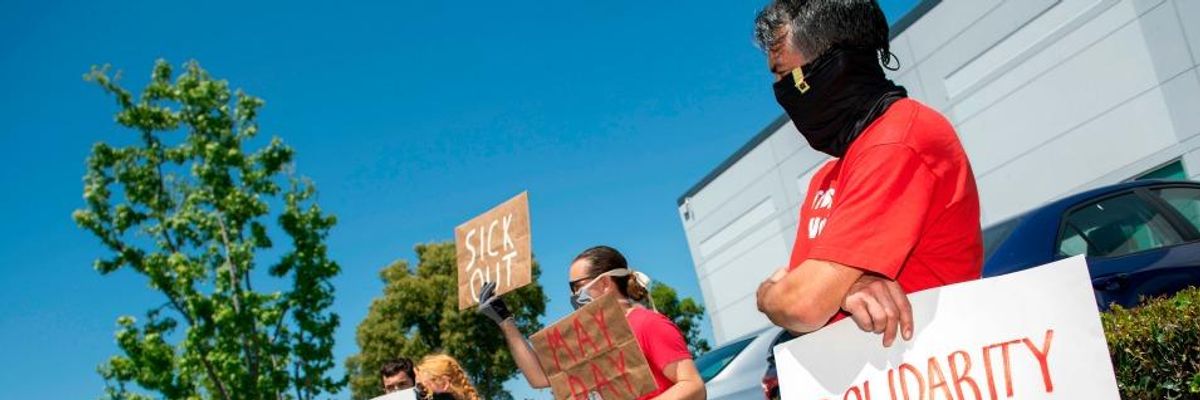
Workers protest against the failure from their employers to provide adequate protections in the workplace of the Amazon delivery hub on National May Day Walkout/Sickout by workers at Amazon, Whole Foods, Innstacart and Shipt amid the Covid-19 pandemic on May 1, 2020, in Hawthorne, California. (Photo: Valerie Macon/AFP via Getty Images)
Citing 'Vein of Toxicity' and Firing of Whistleblowers, Amazon VP Resigns in Disgust
"This is a really big deal. This kind of courage is what we need right now, in every workplace and walk of life."
Amazon vice president Tim Bray won praise from labor rights advocates on Monday after resigning from the company over its treatment of whistleblowers during the Covid-19 pandemic, publishing a "scathing" letter on his personal blog explaining the decision.
After more than five years as a vice president at the company, Bray wrote that he was quitting "in dismay at Amazon firing whistleblowers who were making noise about warehouse employees frightened of Covid-19."
In the letter, Bray defended Amazon workers including Staten Island warehouse employee Chris Smalls and Amazon Employees for Climate Justice (AECJ) organizers Emily Cunningham and Maren Costa, all of whom were fired after leading petitions and protests over unsafe conditions in the retailer's warehouses as the pandemic continues to spread across the United States.
"Firing whistleblowers isn't just a side-effect of macroeconomic forces, nor is it intrinsic to the function of free markets," wrote Bray, who was a "distinguished engineer" and is now the highest-ranking Amazon employee to speak out about the company's conduct during the pandemic. "It is evidence of a vein of toxicity running through the company culture. I choose neither to serve nor drink that poison."
Smalls, Costa, and Cunningham were among those who thanked Bray for speaking out.
Other advocates noted the significance of Bray's stand against the powerful company.
"This is a really big deal," wrote author Naomi Klein. "This kind of courage is what we need right now, in every workplace and walk of life."
Bray said he brought his concerns to company executives in April after Cunningham and Costa were fired after starting a petition on behalf of the warehouse workers. He formally resigned and published the open letter after his complaints went unheeded.
Amazon's actions in recent weeks--including its attempted smear campaign against Smalls, who organized a walkout over a lack of social distancing protocols and transparency at the Staten Island facility--were "designed to create a climate of fear," wrote Bray, who also slammed his former employer as "chickenshit."
Bray acknowledged in his post that Amazon says it is taking precautions to protect workers in its warehouses, but wrote, "The big problem isn't the specifics of Covid-19 response. It's that Amazon treats the humans in the warehouses as fungible units of pick-and-pack potential. Only that's not just Amazon, it's how 21st-century capitalism is done."
The former company executive pointed out that the e-commerce giant, while a formidable power in the U.S., has been reined in elsewhere. In France, where Amazon workers are represented by unions, a court last month ruled that the company must only complete deliveries of essential products while its warehouses' safety measures are being investigated.
"If we don't like certain things Amazon is doing, we need to put legal guardrails in place to stop those things," Bray wrote. "We don't need to invent anything new; a combination of antitrust and living-wage and worker-empowerment legislation, rigorously enforced, offers a clear path forward. Don't say it can't be done, because France is doing it."
Bray's letter comes three days after employees at Amazon were joined by workers at Trader Joe's, FedEx, Whole Foods, and Instacart in a May Day strike over wages, public health precautions, and working conditions.
Increasing low-wage workers' influence over decision-making at huge companies will require sustained pressure campaigns with widespread support, particularly from those in positions of power, suggested Bray.
"At the end of the day, it's all about power balances," Bray wrote. "The warehouse workers are weak and getting weaker, what with mass unemployment and (in the U.S.) job-linked health insurance. So they're gonna get treated like crap, because capitalism. Any plausible solution has to start with increasing their collective strength."
We are at a crossroads
This country and this world are at a monumental crossroads. In a few short weeks, US voters will have an opportunity to beat back the forces of fascism and confront the billionaires who are rigging the economy, our media system, and our democracy, making it increasingly impossible for ordinary people to get by. We’re not just talking about the election. We’re talking about what must be done once these fascist elements are vanquished from power. We need a bolder set of solutions than what either major party has so far been willing to offer and a working-class movement ready to fight like hell for it. Trump didn't emerge from nowhere. The conditions that fueled MAGA authoritarianism were created by decades of radical neoliberal economic policies and a corrupt political system dominated by corporate interests. They slashed taxes on the super-rich, promising that the benefits would trickle down. They said giveaways to the corporate titans would make life more affordable for the rest of us. It was all bullshit. And when a bitter, betrayed populace searches for someone to blame, right-wing demagogues have little trouble finding scapegoats. People know when they're being lied to, but you won't hear any of this from the corporate media. Only independent journalism—powered and funded by people who believe in building a better world—can deliver truly trustworthy daily news. Our Fall Campaign is underway, and we need your help. To power our newsroom through the rest of the year, we need to raise $125,000 by midnight on October 31. So if you share our vision, please contribute whatever you can to sustain our work. |
Amazon vice president Tim Bray won praise from labor rights advocates on Monday after resigning from the company over its treatment of whistleblowers during the Covid-19 pandemic, publishing a "scathing" letter on his personal blog explaining the decision.
After more than five years as a vice president at the company, Bray wrote that he was quitting "in dismay at Amazon firing whistleblowers who were making noise about warehouse employees frightened of Covid-19."
In the letter, Bray defended Amazon workers including Staten Island warehouse employee Chris Smalls and Amazon Employees for Climate Justice (AECJ) organizers Emily Cunningham and Maren Costa, all of whom were fired after leading petitions and protests over unsafe conditions in the retailer's warehouses as the pandemic continues to spread across the United States.
"Firing whistleblowers isn't just a side-effect of macroeconomic forces, nor is it intrinsic to the function of free markets," wrote Bray, who was a "distinguished engineer" and is now the highest-ranking Amazon employee to speak out about the company's conduct during the pandemic. "It is evidence of a vein of toxicity running through the company culture. I choose neither to serve nor drink that poison."
Smalls, Costa, and Cunningham were among those who thanked Bray for speaking out.
Other advocates noted the significance of Bray's stand against the powerful company.
"This is a really big deal," wrote author Naomi Klein. "This kind of courage is what we need right now, in every workplace and walk of life."
Bray said he brought his concerns to company executives in April after Cunningham and Costa were fired after starting a petition on behalf of the warehouse workers. He formally resigned and published the open letter after his complaints went unheeded.
Amazon's actions in recent weeks--including its attempted smear campaign against Smalls, who organized a walkout over a lack of social distancing protocols and transparency at the Staten Island facility--were "designed to create a climate of fear," wrote Bray, who also slammed his former employer as "chickenshit."
Bray acknowledged in his post that Amazon says it is taking precautions to protect workers in its warehouses, but wrote, "The big problem isn't the specifics of Covid-19 response. It's that Amazon treats the humans in the warehouses as fungible units of pick-and-pack potential. Only that's not just Amazon, it's how 21st-century capitalism is done."
The former company executive pointed out that the e-commerce giant, while a formidable power in the U.S., has been reined in elsewhere. In France, where Amazon workers are represented by unions, a court last month ruled that the company must only complete deliveries of essential products while its warehouses' safety measures are being investigated.
"If we don't like certain things Amazon is doing, we need to put legal guardrails in place to stop those things," Bray wrote. "We don't need to invent anything new; a combination of antitrust and living-wage and worker-empowerment legislation, rigorously enforced, offers a clear path forward. Don't say it can't be done, because France is doing it."
Bray's letter comes three days after employees at Amazon were joined by workers at Trader Joe's, FedEx, Whole Foods, and Instacart in a May Day strike over wages, public health precautions, and working conditions.
Increasing low-wage workers' influence over decision-making at huge companies will require sustained pressure campaigns with widespread support, particularly from those in positions of power, suggested Bray.
"At the end of the day, it's all about power balances," Bray wrote. "The warehouse workers are weak and getting weaker, what with mass unemployment and (in the U.S.) job-linked health insurance. So they're gonna get treated like crap, because capitalism. Any plausible solution has to start with increasing their collective strength."
Amazon vice president Tim Bray won praise from labor rights advocates on Monday after resigning from the company over its treatment of whistleblowers during the Covid-19 pandemic, publishing a "scathing" letter on his personal blog explaining the decision.
After more than five years as a vice president at the company, Bray wrote that he was quitting "in dismay at Amazon firing whistleblowers who were making noise about warehouse employees frightened of Covid-19."
In the letter, Bray defended Amazon workers including Staten Island warehouse employee Chris Smalls and Amazon Employees for Climate Justice (AECJ) organizers Emily Cunningham and Maren Costa, all of whom were fired after leading petitions and protests over unsafe conditions in the retailer's warehouses as the pandemic continues to spread across the United States.
"Firing whistleblowers isn't just a side-effect of macroeconomic forces, nor is it intrinsic to the function of free markets," wrote Bray, who was a "distinguished engineer" and is now the highest-ranking Amazon employee to speak out about the company's conduct during the pandemic. "It is evidence of a vein of toxicity running through the company culture. I choose neither to serve nor drink that poison."
Smalls, Costa, and Cunningham were among those who thanked Bray for speaking out.
Other advocates noted the significance of Bray's stand against the powerful company.
"This is a really big deal," wrote author Naomi Klein. "This kind of courage is what we need right now, in every workplace and walk of life."
Bray said he brought his concerns to company executives in April after Cunningham and Costa were fired after starting a petition on behalf of the warehouse workers. He formally resigned and published the open letter after his complaints went unheeded.
Amazon's actions in recent weeks--including its attempted smear campaign against Smalls, who organized a walkout over a lack of social distancing protocols and transparency at the Staten Island facility--were "designed to create a climate of fear," wrote Bray, who also slammed his former employer as "chickenshit."
Bray acknowledged in his post that Amazon says it is taking precautions to protect workers in its warehouses, but wrote, "The big problem isn't the specifics of Covid-19 response. It's that Amazon treats the humans in the warehouses as fungible units of pick-and-pack potential. Only that's not just Amazon, it's how 21st-century capitalism is done."
The former company executive pointed out that the e-commerce giant, while a formidable power in the U.S., has been reined in elsewhere. In France, where Amazon workers are represented by unions, a court last month ruled that the company must only complete deliveries of essential products while its warehouses' safety measures are being investigated.
"If we don't like certain things Amazon is doing, we need to put legal guardrails in place to stop those things," Bray wrote. "We don't need to invent anything new; a combination of antitrust and living-wage and worker-empowerment legislation, rigorously enforced, offers a clear path forward. Don't say it can't be done, because France is doing it."
Bray's letter comes three days after employees at Amazon were joined by workers at Trader Joe's, FedEx, Whole Foods, and Instacart in a May Day strike over wages, public health precautions, and working conditions.
Increasing low-wage workers' influence over decision-making at huge companies will require sustained pressure campaigns with widespread support, particularly from those in positions of power, suggested Bray.
"At the end of the day, it's all about power balances," Bray wrote. "The warehouse workers are weak and getting weaker, what with mass unemployment and (in the U.S.) job-linked health insurance. So they're gonna get treated like crap, because capitalism. Any plausible solution has to start with increasing their collective strength."