SUBSCRIBE TO OUR FREE NEWSLETTER
Daily news & progressive opinion—funded by the people, not the corporations—delivered straight to your inbox.
5
#000000
#FFFFFF
To donate by check, phone, or other method, see our More Ways to Give page.
Daily news & progressive opinion—funded by the people, not the corporations—delivered straight to your inbox.
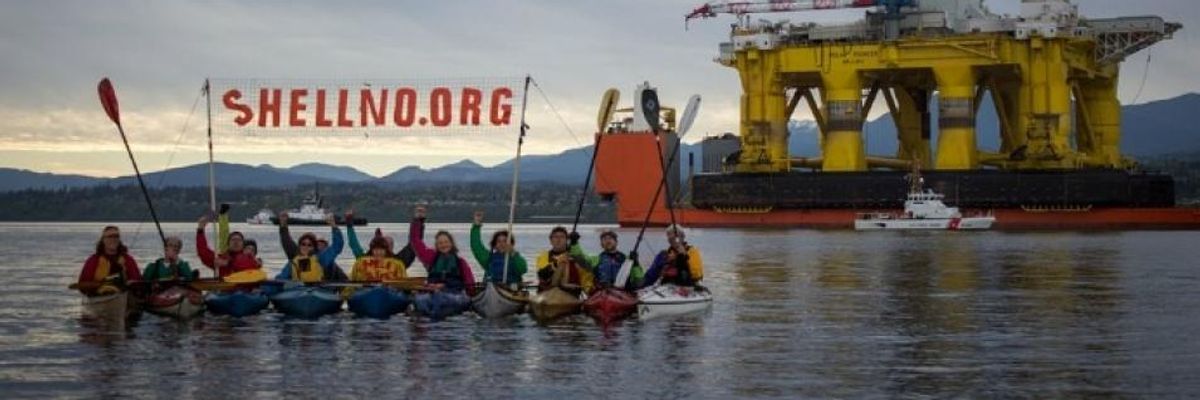
Ignoring climate scientists and campaigners, oil and gas companies have undermined global efforts to stem the climate crisis by continuing to make huge investments in offshore drilling and pipeline projects. (Photo: Backbone Campaign/flickr/cc)
Despite outward claims from the fossil fuel industry that it shares the public's concern over the rapidly warming planet, a new study shows that oil and gas companies are actively and aggressively undermining climate targets agreed to by world governments.
The thinktank Carbon Tracker released a report entitled "Breaking the Habit" on Thursday, detailing the immense investments powerful companies like ExxonMobil, Shell, Chevron, and BP have continued to make in offshore drilling, tar sands, and fracking projects in the years after nearly 200 countries agreed that the warming of the globe must be limited to 1.5 degrees Celsius.
The companies have invested $50 billion in climate-warming fossil fuel projects since the beginning of 2018, according to the report.
"Every oil major is betting heavily against a 1.5C world and investing in projects that are contrary to the Paris goals," report author Andrew Grant told The Guardian.
Author and 350.org co-founder Bill McKibben shared The Guardian's report on the study on social media, saying its findings detail the "insane greed" of the fossil fuel industry at the expense of the planet.
At least 30 percent of the companies' investments over the past two years have gone towards the kinds of energy projects that have been found to pump as much as 37 billion tons of carbon into the atmosphere per year as well as endangering marine life, drinking water sources, and people who live near fracking and pipeline projects.
"Last year, all of the major oil companies sanctioned projects that fall outside a 'well below two degrees' budget on cost grounds," the report reads, referring to the goal of keeping global warming under 2 degrees Celsius above pre-industrial levels--and more ambitiously, under 1.5 degrees.
"These will not deliver adequate returns in a low-carbon world," Carbon Tracker said.
The continued investments in new fossil fuel projects come three years after the Paris climate agreement entered into force, when the E.U. pledged to reduce carbon emissions by 40 percent compared to its 1990 levels and the U.S. agreed to slash its emissions by 28 percent below 2005 levels by 2030.
Since the agreement was forged fossil fuel companies have claimed to be working towards reducing their emissions.
"We agree that the world is not moving fast enough to tackle climate change," a spokesperson for Shell told The Guardian. "As the energy system evolves, so is our business."
Critics on social media said Friday that Carbon Tracker's report demonstrates how, with Shell's plans for a $13 billion natural gas investment and plans by BP and ExxonMobil to invest in an offshore project in Angola, profits still trump preserving the planet for powerful companies--priorities which will cause suffering for communities that have contributed the least to the climate crisis.
"None of the largest oil and gas companies are making investment decisions in line with the global climate goals," tweeted the group End Water Poverty.
Grant suggested that shareholders at Exxon, Shell, and other oil and gas companies must urge executives to shift away from emission-causing projects.
"Investors should challenge companies' spending on new fossil fuel production," Grant told The Guardian.
But others on social media said the power to stop companies and their wealthy investors lies with policymakers who need the political will to bring the fossil fuel sector to heel.
"These dirty fossil fuel companies are not getting the message, let alone acting on the urgency of the climate crisis," wrote British Green Party co-leader Jonathan Bartley. "But it is governments who must hold them to account, and end the subsidies that are funding their environmental destruction."
Dear Common Dreams reader, It’s been nearly 30 years since I co-founded Common Dreams with my late wife, Lina Newhouser. We had the radical notion that journalism should serve the public good, not corporate profits. It was clear to us from the outset what it would take to build such a project. No paid advertisements. No corporate sponsors. No millionaire publisher telling us what to think or do. Many people said we wouldn't last a year, but we proved those doubters wrong. Together with a tremendous team of journalists and dedicated staff, we built an independent media outlet free from the constraints of profits and corporate control. Our mission has always been simple: To inform. To inspire. To ignite change for the common good. Building Common Dreams was not easy. Our survival was never guaranteed. When you take on the most powerful forces—Wall Street greed, fossil fuel industry destruction, Big Tech lobbyists, and uber-rich oligarchs who have spent billions upon billions rigging the economy and democracy in their favor—the only bulwark you have is supporters who believe in your work. But here’s the urgent message from me today. It's never been this bad out there. And it's never been this hard to keep us going. At the very moment Common Dreams is most needed, the threats we face are intensifying. We need your support now more than ever. We don't accept corporate advertising and never will. We don't have a paywall because we don't think people should be blocked from critical news based on their ability to pay. Everything we do is funded by the donations of readers like you. When everyone does the little they can afford, we are strong. But if that support retreats or dries up, so do we. Will you donate now to make sure Common Dreams not only survives but thrives? —Craig Brown, Co-founder |
Despite outward claims from the fossil fuel industry that it shares the public's concern over the rapidly warming planet, a new study shows that oil and gas companies are actively and aggressively undermining climate targets agreed to by world governments.
The thinktank Carbon Tracker released a report entitled "Breaking the Habit" on Thursday, detailing the immense investments powerful companies like ExxonMobil, Shell, Chevron, and BP have continued to make in offshore drilling, tar sands, and fracking projects in the years after nearly 200 countries agreed that the warming of the globe must be limited to 1.5 degrees Celsius.
The companies have invested $50 billion in climate-warming fossil fuel projects since the beginning of 2018, according to the report.
"Every oil major is betting heavily against a 1.5C world and investing in projects that are contrary to the Paris goals," report author Andrew Grant told The Guardian.
Author and 350.org co-founder Bill McKibben shared The Guardian's report on the study on social media, saying its findings detail the "insane greed" of the fossil fuel industry at the expense of the planet.
At least 30 percent of the companies' investments over the past two years have gone towards the kinds of energy projects that have been found to pump as much as 37 billion tons of carbon into the atmosphere per year as well as endangering marine life, drinking water sources, and people who live near fracking and pipeline projects.
"Last year, all of the major oil companies sanctioned projects that fall outside a 'well below two degrees' budget on cost grounds," the report reads, referring to the goal of keeping global warming under 2 degrees Celsius above pre-industrial levels--and more ambitiously, under 1.5 degrees.
"These will not deliver adequate returns in a low-carbon world," Carbon Tracker said.
The continued investments in new fossil fuel projects come three years after the Paris climate agreement entered into force, when the E.U. pledged to reduce carbon emissions by 40 percent compared to its 1990 levels and the U.S. agreed to slash its emissions by 28 percent below 2005 levels by 2030.
Since the agreement was forged fossil fuel companies have claimed to be working towards reducing their emissions.
"We agree that the world is not moving fast enough to tackle climate change," a spokesperson for Shell told The Guardian. "As the energy system evolves, so is our business."
Critics on social media said Friday that Carbon Tracker's report demonstrates how, with Shell's plans for a $13 billion natural gas investment and plans by BP and ExxonMobil to invest in an offshore project in Angola, profits still trump preserving the planet for powerful companies--priorities which will cause suffering for communities that have contributed the least to the climate crisis.
"None of the largest oil and gas companies are making investment decisions in line with the global climate goals," tweeted the group End Water Poverty.
Grant suggested that shareholders at Exxon, Shell, and other oil and gas companies must urge executives to shift away from emission-causing projects.
"Investors should challenge companies' spending on new fossil fuel production," Grant told The Guardian.
But others on social media said the power to stop companies and their wealthy investors lies with policymakers who need the political will to bring the fossil fuel sector to heel.
"These dirty fossil fuel companies are not getting the message, let alone acting on the urgency of the climate crisis," wrote British Green Party co-leader Jonathan Bartley. "But it is governments who must hold them to account, and end the subsidies that are funding their environmental destruction."
Despite outward claims from the fossil fuel industry that it shares the public's concern over the rapidly warming planet, a new study shows that oil and gas companies are actively and aggressively undermining climate targets agreed to by world governments.
The thinktank Carbon Tracker released a report entitled "Breaking the Habit" on Thursday, detailing the immense investments powerful companies like ExxonMobil, Shell, Chevron, and BP have continued to make in offshore drilling, tar sands, and fracking projects in the years after nearly 200 countries agreed that the warming of the globe must be limited to 1.5 degrees Celsius.
The companies have invested $50 billion in climate-warming fossil fuel projects since the beginning of 2018, according to the report.
"Every oil major is betting heavily against a 1.5C world and investing in projects that are contrary to the Paris goals," report author Andrew Grant told The Guardian.
Author and 350.org co-founder Bill McKibben shared The Guardian's report on the study on social media, saying its findings detail the "insane greed" of the fossil fuel industry at the expense of the planet.
At least 30 percent of the companies' investments over the past two years have gone towards the kinds of energy projects that have been found to pump as much as 37 billion tons of carbon into the atmosphere per year as well as endangering marine life, drinking water sources, and people who live near fracking and pipeline projects.
"Last year, all of the major oil companies sanctioned projects that fall outside a 'well below two degrees' budget on cost grounds," the report reads, referring to the goal of keeping global warming under 2 degrees Celsius above pre-industrial levels--and more ambitiously, under 1.5 degrees.
"These will not deliver adequate returns in a low-carbon world," Carbon Tracker said.
The continued investments in new fossil fuel projects come three years after the Paris climate agreement entered into force, when the E.U. pledged to reduce carbon emissions by 40 percent compared to its 1990 levels and the U.S. agreed to slash its emissions by 28 percent below 2005 levels by 2030.
Since the agreement was forged fossil fuel companies have claimed to be working towards reducing their emissions.
"We agree that the world is not moving fast enough to tackle climate change," a spokesperson for Shell told The Guardian. "As the energy system evolves, so is our business."
Critics on social media said Friday that Carbon Tracker's report demonstrates how, with Shell's plans for a $13 billion natural gas investment and plans by BP and ExxonMobil to invest in an offshore project in Angola, profits still trump preserving the planet for powerful companies--priorities which will cause suffering for communities that have contributed the least to the climate crisis.
"None of the largest oil and gas companies are making investment decisions in line with the global climate goals," tweeted the group End Water Poverty.
Grant suggested that shareholders at Exxon, Shell, and other oil and gas companies must urge executives to shift away from emission-causing projects.
"Investors should challenge companies' spending on new fossil fuel production," Grant told The Guardian.
But others on social media said the power to stop companies and their wealthy investors lies with policymakers who need the political will to bring the fossil fuel sector to heel.
"These dirty fossil fuel companies are not getting the message, let alone acting on the urgency of the climate crisis," wrote British Green Party co-leader Jonathan Bartley. "But it is governments who must hold them to account, and end the subsidies that are funding their environmental destruction."