

SUBSCRIBE TO OUR FREE NEWSLETTER
Daily news & progressive opinion—funded by the people, not the corporations—delivered straight to your inbox.
5
#000000
#FFFFFF
To donate by check, phone, or other method, see our More Ways to Give page.
Daily news & progressive opinion—funded by the people, not the corporations—delivered straight to your inbox.
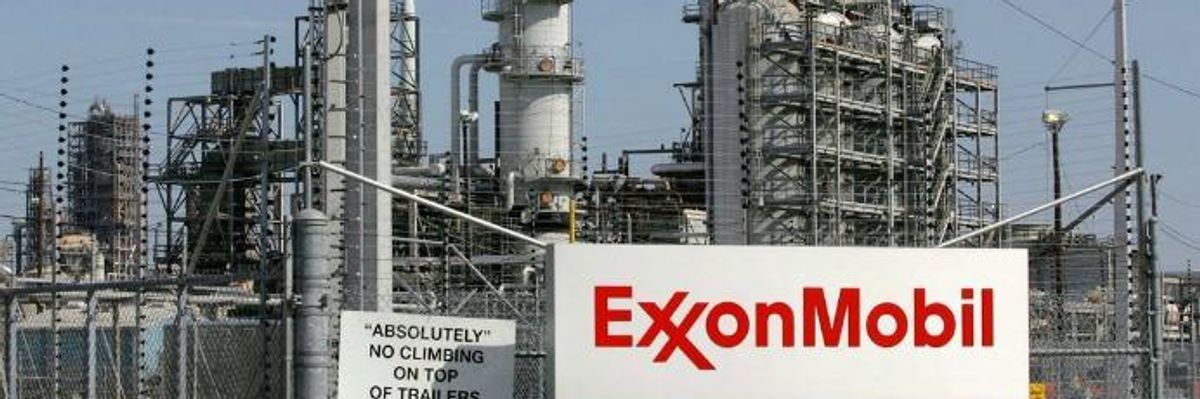
An ExxonMobil refinery in Baytown, Texas. (Photo: Jessica Rinaldi/Reuters)
As corporations in the United States and around the world continue to reap record profits thanks to enormous tax cuts, widespread tax avoidance schemes, and business-friendly trade and investment policies, an analysis by Global Justice Now (GJN) published Wednesday found that the world's most profitable companies are raking in revenue "far in excess of most governments," giving them unprecendented power to influence policy in their favor and skirt accountability.
"The vast wealth and power of corporations is at the heart of so many of the world's problems--like inequality and climate change."
--Nick Dearden, Global Justice NowMeasured by 2017 revenue, 69 of the top 100 economic entities in the world are corporations, GJN found in its report, which was released as part of an effort to pressure the U.K. government to advance a binding United Nations treaty that would hold transnational corporations to account for human rights violations.
"When it comes to the top 200 entities, the gap between corporations and governments gets even more pronounced: 157 are corporations," GJN notes. "Walmart, Apple, and Shell all accrued more wealth than even fairly rich countries like Russia, Belgium, Sweden."
In a statement accompanying the striking new figures, GJN director Nick Dearden denounced Britain's Tory government for eagerly assisting this "rise in corporate power--through tax structures, trade deals, and even aid programs that help big business."
"The vast wealth and power of corporations is at the heart of so many of the world's problems--like inequality and climate change," Dearden noted. "The drive for short-term profits today seems to trump basic human rights for millions of people on the planet. Yet there are very few ways that citizens can hold these corporations to account for their behavior. Rather, through trade and investment deals, it is corporations which are able to demand that governments do their bidding."
"Many corporations are richer and more powerful than the states that seek to regulate them."
-- Friends of the Earth Asia Pacific
Denouncing powerful governments for "routinely" opposing "the call of developing countries to hold corporations to account for their human rights impacts at the U.N.," Dearden said his group is "joining campaigns from across the world to tell the British government not to block this international demand for justice."
Despite continued efforts by the international business lobby to squash them, negotiations on the U.N. Binding Treaty on Human Rights and Transnational Corporations began on Monday in The Hague.
"From a coal mine in Bangladesh that threatens to destroy one of the world's largest mangrove ecosystems to hundreds of people at risk of displacement from a mega-sugar plantation in Sri Lanka, corporations and big business are often implicated in human rights abuses across Asia" and the world, Friends of the Earth Asia Pacific noted in a blog post on Wednesday, describing the U.N. treaty as a potential "game-changer."
"Companies are able to evade responsibility by operating between different national jurisdictions and taking advantage of corruption in local legal systems, not to mention the fact that many corporations are richer and more powerful than the states that seek to regulate them," Friends of the Earth concluded. "We must right this wrong."
Dear Common Dreams reader, It’s been nearly 30 years since I co-founded Common Dreams with my late wife, Lina Newhouser. We had the radical notion that journalism should serve the public good, not corporate profits. It was clear to us from the outset what it would take to build such a project. No paid advertisements. No corporate sponsors. No millionaire publisher telling us what to think or do. Many people said we wouldn't last a year, but we proved those doubters wrong. Together with a tremendous team of journalists and dedicated staff, we built an independent media outlet free from the constraints of profits and corporate control. Our mission has always been simple: To inform. To inspire. To ignite change for the common good. Building Common Dreams was not easy. Our survival was never guaranteed. When you take on the most powerful forces—Wall Street greed, fossil fuel industry destruction, Big Tech lobbyists, and uber-rich oligarchs who have spent billions upon billions rigging the economy and democracy in their favor—the only bulwark you have is supporters who believe in your work. But here’s the urgent message from me today. It's never been this bad out there. And it's never been this hard to keep us going. At the very moment Common Dreams is most needed, the threats we face are intensifying. We need your support now more than ever. We don't accept corporate advertising and never will. We don't have a paywall because we don't think people should be blocked from critical news based on their ability to pay. Everything we do is funded by the donations of readers like you. When everyone does the little they can afford, we are strong. But if that support retreats or dries up, so do we. Will you donate now to make sure Common Dreams not only survives but thrives? —Craig Brown, Co-founder |
As corporations in the United States and around the world continue to reap record profits thanks to enormous tax cuts, widespread tax avoidance schemes, and business-friendly trade and investment policies, an analysis by Global Justice Now (GJN) published Wednesday found that the world's most profitable companies are raking in revenue "far in excess of most governments," giving them unprecendented power to influence policy in their favor and skirt accountability.
"The vast wealth and power of corporations is at the heart of so many of the world's problems--like inequality and climate change."
--Nick Dearden, Global Justice NowMeasured by 2017 revenue, 69 of the top 100 economic entities in the world are corporations, GJN found in its report, which was released as part of an effort to pressure the U.K. government to advance a binding United Nations treaty that would hold transnational corporations to account for human rights violations.
"When it comes to the top 200 entities, the gap between corporations and governments gets even more pronounced: 157 are corporations," GJN notes. "Walmart, Apple, and Shell all accrued more wealth than even fairly rich countries like Russia, Belgium, Sweden."
In a statement accompanying the striking new figures, GJN director Nick Dearden denounced Britain's Tory government for eagerly assisting this "rise in corporate power--through tax structures, trade deals, and even aid programs that help big business."
"The vast wealth and power of corporations is at the heart of so many of the world's problems--like inequality and climate change," Dearden noted. "The drive for short-term profits today seems to trump basic human rights for millions of people on the planet. Yet there are very few ways that citizens can hold these corporations to account for their behavior. Rather, through trade and investment deals, it is corporations which are able to demand that governments do their bidding."
"Many corporations are richer and more powerful than the states that seek to regulate them."
-- Friends of the Earth Asia Pacific
Denouncing powerful governments for "routinely" opposing "the call of developing countries to hold corporations to account for their human rights impacts at the U.N.," Dearden said his group is "joining campaigns from across the world to tell the British government not to block this international demand for justice."
Despite continued efforts by the international business lobby to squash them, negotiations on the U.N. Binding Treaty on Human Rights and Transnational Corporations began on Monday in The Hague.
"From a coal mine in Bangladesh that threatens to destroy one of the world's largest mangrove ecosystems to hundreds of people at risk of displacement from a mega-sugar plantation in Sri Lanka, corporations and big business are often implicated in human rights abuses across Asia" and the world, Friends of the Earth Asia Pacific noted in a blog post on Wednesday, describing the U.N. treaty as a potential "game-changer."
"Companies are able to evade responsibility by operating between different national jurisdictions and taking advantage of corruption in local legal systems, not to mention the fact that many corporations are richer and more powerful than the states that seek to regulate them," Friends of the Earth concluded. "We must right this wrong."
As corporations in the United States and around the world continue to reap record profits thanks to enormous tax cuts, widespread tax avoidance schemes, and business-friendly trade and investment policies, an analysis by Global Justice Now (GJN) published Wednesday found that the world's most profitable companies are raking in revenue "far in excess of most governments," giving them unprecendented power to influence policy in their favor and skirt accountability.
"The vast wealth and power of corporations is at the heart of so many of the world's problems--like inequality and climate change."
--Nick Dearden, Global Justice NowMeasured by 2017 revenue, 69 of the top 100 economic entities in the world are corporations, GJN found in its report, which was released as part of an effort to pressure the U.K. government to advance a binding United Nations treaty that would hold transnational corporations to account for human rights violations.
"When it comes to the top 200 entities, the gap between corporations and governments gets even more pronounced: 157 are corporations," GJN notes. "Walmart, Apple, and Shell all accrued more wealth than even fairly rich countries like Russia, Belgium, Sweden."
In a statement accompanying the striking new figures, GJN director Nick Dearden denounced Britain's Tory government for eagerly assisting this "rise in corporate power--through tax structures, trade deals, and even aid programs that help big business."
"The vast wealth and power of corporations is at the heart of so many of the world's problems--like inequality and climate change," Dearden noted. "The drive for short-term profits today seems to trump basic human rights for millions of people on the planet. Yet there are very few ways that citizens can hold these corporations to account for their behavior. Rather, through trade and investment deals, it is corporations which are able to demand that governments do their bidding."
"Many corporations are richer and more powerful than the states that seek to regulate them."
-- Friends of the Earth Asia Pacific
Denouncing powerful governments for "routinely" opposing "the call of developing countries to hold corporations to account for their human rights impacts at the U.N.," Dearden said his group is "joining campaigns from across the world to tell the British government not to block this international demand for justice."
Despite continued efforts by the international business lobby to squash them, negotiations on the U.N. Binding Treaty on Human Rights and Transnational Corporations began on Monday in The Hague.
"From a coal mine in Bangladesh that threatens to destroy one of the world's largest mangrove ecosystems to hundreds of people at risk of displacement from a mega-sugar plantation in Sri Lanka, corporations and big business are often implicated in human rights abuses across Asia" and the world, Friends of the Earth Asia Pacific noted in a blog post on Wednesday, describing the U.N. treaty as a potential "game-changer."
"Companies are able to evade responsibility by operating between different national jurisdictions and taking advantage of corruption in local legal systems, not to mention the fact that many corporations are richer and more powerful than the states that seek to regulate them," Friends of the Earth concluded. "We must right this wrong."

