

SUBSCRIBE TO OUR FREE NEWSLETTER
Daily news & progressive opinion—funded by the people, not the corporations—delivered straight to your inbox.
5
#000000
#FFFFFF
To donate by check, phone, or other method, see our More Ways to Give page.
Daily news & progressive opinion—funded by the people, not the corporations—delivered straight to your inbox.
Shannon Andrea, National Parks Conservation Association, 202.454.3371
This week, as the National Park Service commemorates its 94th
anniversary, the National Parks Conservation Association (NPCA) today
released a comprehensive report that highlights the opportunities and
challenges facing Grand Canyon National Park, as well as policy
recommendations for preserving and protecting this national treasure in
the future.
This week, as the National Park Service commemorates its 94th
anniversary, the National Parks Conservation Association (NPCA) today
released a comprehensive report that highlights the opportunities and
challenges facing Grand Canyon National Park, as well as policy
recommendations for preserving and protecting this national treasure in
the future.
The Grand Canyon is a place visited by nearly 5 million visitors a
year - a place that is not only a national icon but is famous around the
world. More than 1.2 million acres, Grand Canyon National Park is a
magnificent and threatened landscape - one that reflects the challenges
facing many of the 392 national park sites across the country.
"National parks connect Americans to our national heritage and
protect the natural landscapes that help to define us," said NPCA's
Southwest Regional Director David Nimkin. "Our new report highlights the
challenges facing the Grand Canyon, many of which also affect other
national park sites nationwide."
NPCA's new Center for State of the Parks report finds that external
threats and funding shortfalls at the Grand Canyon are creating
significant problems that if not addressed will complicate and
compromise resource protection and management. Key report findings and
recommendations include:
"National parks face many challenges - the impacts of climate change,
multiple sources of air pollution, competition for water, loss of
habitat, and insufficient funding to support basic park operations,"
said Ron Tipton, NPCA's Senior Vice President for Policy. "We must
ensure our American treasures are preserved and protected, unimpaired,
for future generations to enjoy."
"Grand Canyon National Park is a global icon and the many challenges
found at the park are reflected in all our national parks," said Roger
Clark of the Grand Canyon Trust.
With the upcoming centennial of the National Park System in 2016, the
new assessment reflects the important role national parks play in
preserving lands, protecting wildlife, and providing recreational and
educational opportunities for Americans. NPCA believes the Obama
Administration's America's Great Outdoors Initiative can provide the
opportunity for collaborative work by federal, regional, state, and
local agencies, as well as private landowners and citizens, to ensure
our national parks and outdoor legacy are preserved. To learn more,
visit: www.npca.org/americasgreatoutdoors.
"Our national parks provide all Americans with a place to reconnect
with families, our shared heritage, and the traditional American values
that make this nation great," said Nimkin. "An investment in our
national parks is an investment in the nation's people and our future."
NPCA is a non-profit, private organization dedicated to protecting, preserving, and enhancing the U.S. National Park System.

"Is the secretary of state worried because he knows US personnel committed war crimes in Iran?"
US Secretary of State Marco Rubio on Monday announced what he characterized as a "campaign to dismantle" the International Criminal Court, the Hague-based tribunal tasked with investigating and charging individuals with war crimes and other violations.
In a video posted to social media, Rubio accused the international court of "waging a war against our country—not with bullets or missiles, but with statutes, compacts, and the force of so-called international law." The top American diplomat threatened that the US "will teach the ICC the full meaning of American resolve."
The US State Department said in a statement that Rubio's new campaign against the ICC would "feature a whole-of-government response to systematically disable" the court's "ability to operate, target American servicemen or officials, or otherwise threaten American sovereignty." The US is not party to the Rome Statute, the 1998 treaty that established the ICC.
US President Donald Trump and his subordinates, who have been accused of myriad violations of international law, have adopted an increasingly aggressive posture toward the ICC since taking power last January.
In a February 6, 2025 executive order, Trump declared "a national emergency to address" the purported "threat" posed by the ICC and announced sanctions against court officials, including its judges. The president's order cited the ICC's "investigations concerning personnel of the United States and certain of its allies, including Israel," which is also not party to the Rome Statute.
In November 2024, the ICC issued arrest warrants against Israeli Prime Minister Benjamin Netanyahu and his former defense minister, Yoav Gallant, for alleged war crimes committed in the Gaza Strip.
Rubio warned in an op-ed in The Wall Street Journal on Monday that US officials accused of international crimes could be next to face ICC action.
"Border Patrol agents working to remove violent criminals from our country, US Marines risking their lives to restore order in the Western Hemisphere, federal prosecutors working to dismantle terror networks plotting attacks on the American homeland—all would face the constant risk of persecution for the 'crime' of defending our country," Rubio wrote. "Using all the tools at our government’s disposal, working beside every ally with whom we can make common cause, we will dismantle the ICC—brick by brick, if necessary."
Raed Jarrar, advocacy director of the human rights group Democracy for the Arab World Now (DAWN), said in response to Rubio's op-ed that "when the world’s most powerful country aims to dismantle the world’s only permanent international court, it sends the message that the powerful are above the law."
"It is not the ICC that Rubio is dismantling brick by brick, but the rules-based international order that grew out of the ashes of World War II,” said Jarrar. "Rubio’s attack doesn't just underscore US hypocrisy, but undermines access to justice across the globe, from Ukraine to Sudan and could amount to obstruction of justice, a crime under the Rome Statute in and of itself."
In his op-ed, Rubio pointed to DAWN's call earlier this year for Iran and other Middle East nations to grant the ICC jurisdiction to investigate apparent war crimes committed during the conflict launched in late February by Trump and Netanyahu.
Omar Shakir, DAWN's executive director, said Monday that Rubio mischaracterized the group's call as focusing solely on actions by US personnel. That move, said Shakir, "begs the question: Is the secretary of state worried because he knows US personnel committed war crimes in Iran?"
Under Rubio's plan, the State Department is threatening to impose "increased sanctions against the ICC and affiliated organizations," hit court personnel with "visa revocations and travel bans," and pressure other nations that aren't party to the Rome Statute to "leverage their diplomatic networks to take similar actions alongside" the Trump administration.
Kenneth Roth, the former executive director of Human Rights Watch who has demanded international accountability for the Trump administration over its illegal assault on Iran, wrote Monday that Rubio "can't even make an honest case for attacking the International Criminal Court."
"He makes it sound like the ICC acts out of the blue anywhere it wants when in fact it acts only against crimes committed on the territory of states that have invited it," Roth wrote. "He never explains why the United States should be able to commit crimes on the territory of those states with impunity, contrary to the desire of their sovereign governments for an international backstop to reinforce justice for such crimes."

“This is not a grant reform—it is a blueprint for a spoils system applied to federal science funding."
An environmental watchdog group is calling on the White House Office of Management and Budget to withdraw a proposal that it said will give President Donald Trump and his allies unchecked power to control over a trillion dollars worth of federal grants.
Monday marked the end of the public comment period for a proposal from the OMB, spearheaded by Project 2025 architect Russell Vought and issued in late May, that would require all discretionary federal grants to “demonstrably advance the president’s policy priorities.”
As Elizabeth Kolbert explained in The New Yorker:
It would replace the current guidance for signing off on government grants, which generally leaves the task to civil servants and peer-review panels.
Instead, the final say would go to political appointees. All discretionary awards from the federal government would have to be assessed by senior administration officials, who could deny them on the [grounds] that they didn’t fit the President’s agenda. Grants could also be terminated at any time for the same reason.
The rules would affect hundreds of billions of dollars in funding disbursed by agencies ranging from the National Endowment for the Arts to the Transportation Department, to pay for everything from local dance performances to massive infrastructure projects.
Public Employees for Environmental Responsibility (PEER) filed a formal comment on Monday urging the OMB to withdraw the proposal.
"The scale of what is proposed is staggering," the group said. "This rule would institutionalize corruption and cronyism in the distribution of over a trillion dollars in annual federal funds."
The comment noted the proposal's language forbidding political appointees from deferring to peer review, which the group said will lead grants to be awarded based on ideological conformity rather than scientific merit.
"This language makes clear that the rule's purpose is not to add accountability over expert review but to replace expert judgment with political judgment entirely," the comment says. "Researchers would learn quickly to propose only work likely to survive ideological screening, while federal program officers, many of whom are being stripped of civil service protections, would face pressure to recommend or approve grants to preserve their jobs. "
“This would corrupt scientific judgment at every level of the process,” it adds, noting the Trump administration’s concerted effort to strip away funding for research on health and environmental issues that conflict with his political agenda, including climate science, vaccine safety, chemical safety, and emerging infectious diseases.
Since last year, the administration has terminated or frozen nearly 8,000 research grants and has effectively slashed the budget of the National Science Foundation by refusing to disburse funds appropriated by Congress. The agency is on track to issue the fewest grants in more than half a century, according to a report last month from Grant Witness.
The proposal would also allow agency heads to keep grants from being posted publicly whenever they determine that doing so would be contrary to the "national interest," which the rule does not define.
PEER said this change "permits agencies to offer grants by invitation only among preferred recipients with no requirement to explain or justify the determination."
The group pointed to the Trump administration’s pattern of directing no-bid contracts to the president’s family, friends, and supporters.
Trump megadonor and former Department of Government Efficiency (DOGE) head Elon Musk, the comment notes, was allowed to oversee the cancellation of the contracts for numerous vendors while never touching any of the more than $19 billion his businesses held in federal contracts.
“This is not a grant reform—it is a blueprint for a spoils system applied to federal science funding,” said Tim Whitehouse, executive director of PEER.
PEER's comment is one of nearly 342,000 OMB has received about the proposal in just over a month, of which 52,000 are publicly posted. The office is hoping to finalize the proposal by October 1 and has denied requests from watchdog organizations to extend the public comment period.
If that happens, Whitehouse has said it would upend the systems of accountability and transparency for scientific funding that have been in place for decades.
“Grant money has historically been distributed through programs authorized by Congress using statutory, regulatory, formula-based, or competitive criteria rather than direct tests of political loyalty,” added Whitehouse. “Placing all scientific research funding under the unreviewable discretion of political appointees is not an administrative reform; it is a recipe for corruption on a scale not seen even in this administration.”
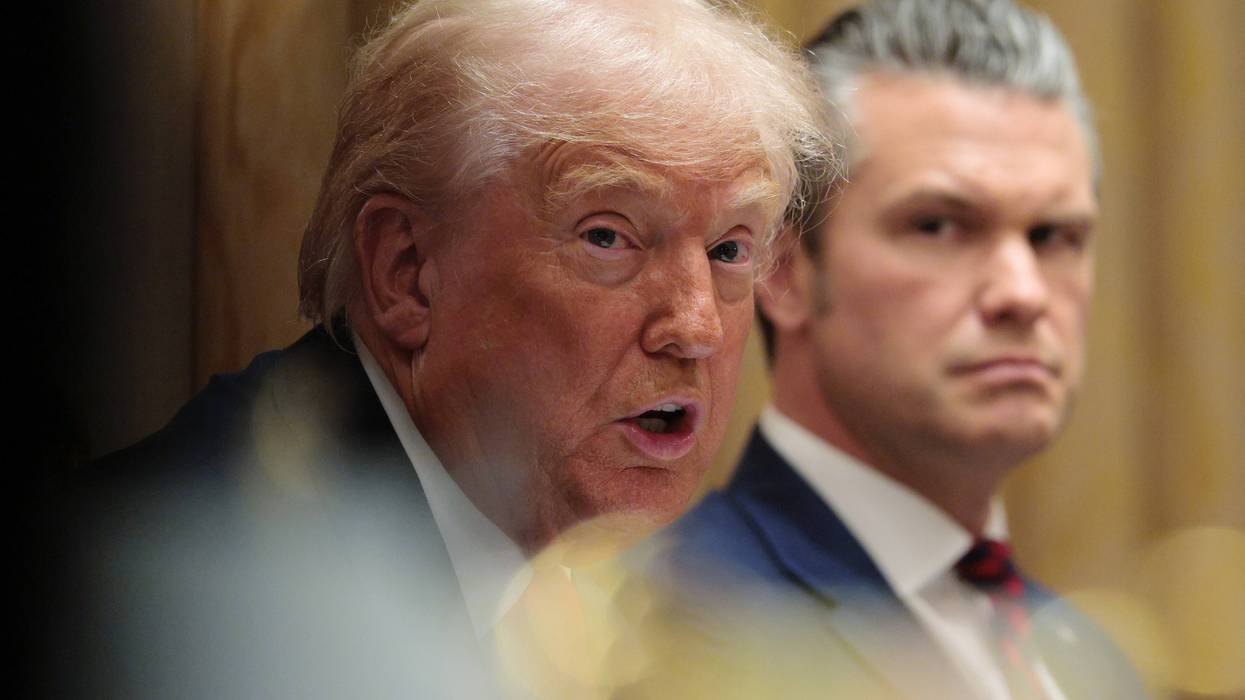
“The $1.5 trillion Pentagon budget request represents more than $9,000 per individual taxpayer."
As the Republican-controlled US Congress advances President Donald Trump's requested $1.5 trillion budget for "rebuilding" a military that's already more powerful than any armed force in human history, a group of former national security officials is urging Americans to challenge "out of control" Pentagon spending.
On Monday, the Eisenhower Media Network published a full-page advertisement in USA Today written by EMN executive director and retired Maj. Gen. Dennis Laich decrying what he called a military budget "of the Pentagon, by the Congress, and for the War Profiteers."
Invoking Thomas Paine's 1776 essay "Common Sense" and former Republican President Dwight D. Eisenhower's repeated warnings about the dangers of the then-burgeoning military-industrial complex, the ad asserts that "time and reason strongly suggest that the US 'defense' budget is out of control, unsustainable, and absent of accountability."
"Only the American people can rein it in," Laich argued.
The advertisement notes that the US military budget is already "larger than the next eight nations (most of whom are allies) in the world combined, while American citizens lack healthcare, childcare, and other basic needs."
The ad continues:
The defense industry’s lobbyists team up with US politicians, who receive campaign financing from the industry, to draft the annual National Defense Authorization Act, which sets military policy, the expensive weaponry to be purchased, and the overall military budget. The industry takes the ensuing windfall and puts it toward stock buybacks, which increase the share price, making the rich richer; dividend payments for shareholders; eight-figure annual compensation packages for corporate executives; and the continual political graft (campaign contributions and lobbyists) that keeps the wheel spinning. Incredibly, some contracts stipulate that only the contractor may repair and maintain equipment. The most embarrassing example of this practice is the F-35 stealth fighter, which is grossly over budget, behind schedule, and is only 25% fully mission capable.
"Money talks in America, but few members of Congress choose to talk about the $39 trillion national debt to which military spending is a major contributor," Laich wrote.
"Additionally, the Pentagon cannot tell the American taxpayer where the money went, since it is unable to pass a financial audit as required by law—something every other department of the federal government is able to do," the ad notes. "Now, they are requesting a 50% increase in the defense budget to $1.5 trillion. This is equivalent to your child asking for more money a day after receiving his/her allowance. When you ask what happened to the money he/she received yesterday, the child can’t answer the question, but yougive him/her more money regardless."
Laich accused "uniformed bureaucrats" of lacking "the courage to stand up against a draft dodger and a Rambo-wannabe," an apparent swipe at Trump and, perhaps, Defense Secretary Pete Hegseth.
Meanwhile, despite having the best-funded and most powerful military on paper, the ad points out that since World War II, "the US has won one war (the first Gulf War), lost four (Vietnam, Iraq, Afghanistan, and Iran), and tied one (Korea). Iran may be as much an embarrassment as a loss. The United States has failed to achieve its stated objectives in any recent war."
The ad asks, "What football coach could keep his job with a 1-4-1 record?"
"The $1.5 trillion Pentagon budget request represents more than $9,000 per individual taxpayer," EMN said. "If we Americans are tired of seeing our tax dollars spent on endless wars, bombing campaigns, and military excess while our own communities struggle with the costs of healthcare, childcare, education, and infrastructure, then the time has come to do what Thomas Paine asked Americans to do 250 years ago: challenge the assumptions that have become accepted simply because they are old."
"The courage required today is not to defeat an empire abroad, but to confront one at home—the military-industrial-congressional complex—and reclaim a government that serves the American people rather than the interests of perpetual war," the ad concludes.
EMN's advertisement follows an ad released by Hegseth in May touting Trump's $1.5 trillion proposal, which would add nearly $7 trillion to the US national debt over the next decade, according to the nonpartisan watchdog group Committee for a Responsible Federal Budget.
A survey conducted in May by ReThink Media and the Costs of War Project at Brown University's Watson Institute for International and Public Affairs revealed that nearly 60% of Americans believe the proposed Pentagon budget is too large, including 40% who say $1.5 trillion is “much too high” to spend on the military.
Last month, US Sen. Ed Markey (D-Mass.) introduced the Slash the Pentagon Act, which would set a hard cap of $750 billion on the amount Congress could authorize for national defense spending in fiscal year 2027.
"As Americans struggle to pay for healthcare, rent, electricity, groceries, and gas... Trump has spent over $100 billion on his expensive, dangerous, and unnecessary war with Iran," Markey said at a Capitol Hill press conference introducing the legislation. “We should invest in our hospitals, schools, affordable housing, and the real security American families need right now—not expensive wars and weapons that make us less safe.”