SUBSCRIBE TO OUR FREE NEWSLETTER
Daily news & progressive opinion—funded by the people, not the corporations—delivered straight to your inbox.
5
#000000
#FFFFFF
To donate by check, phone, or other method, see our More Ways to Give page.


Daily news & progressive opinion—funded by the people, not the corporations—delivered straight to your inbox.

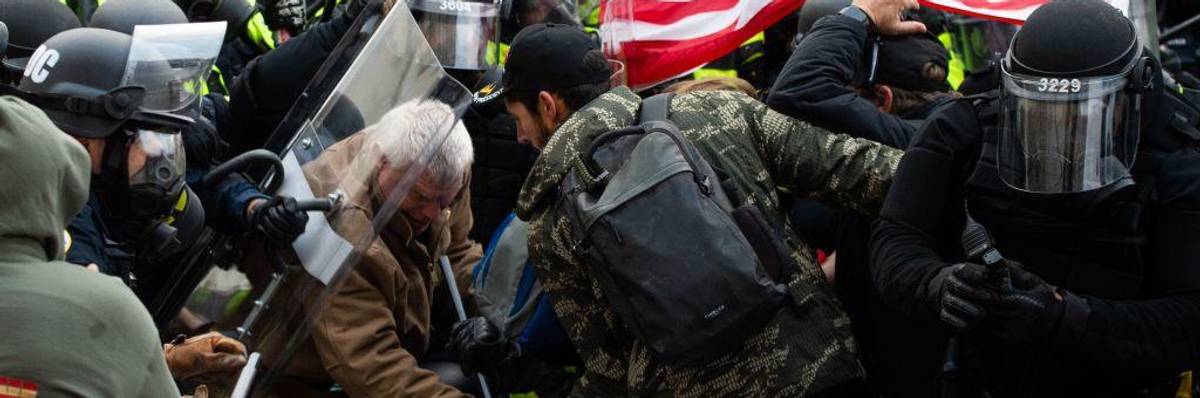
Supporters of U.S. President Donald Trump fight with riot police outside the U.S. Capitol on January 6, 2021 in Washington, D.C.
The United States appears to have entered a new cold war with both China and Russia. And U.S. leaders' portrayal of the confrontation as one between democracy and authoritarianism fails the smell test, especially at a time when the same leaders are actively courting a systematic human-rights abuser like Saudi Arabia. Such hypocrisy suggests that it is at least partly global hegemony, not values, that is really at stake.
In seeking the world's favor, the U.S. will have to make up a lot of lost ground.
For two decades after the fall of the Iron Curtain, the U.S. was clearly number one. But then came disastrously misguided wars in the Middle East, the 2008 financial crash, rising inequality, the opioid epidemic, and other crises that seemed to cast doubt on the superiority of America's economic model. Moreover, between Donald Trump's election, the attempted coup at the U.S. Capitol, numerous mass shootings, a Republican Party bent on voter suppression, and the rise of conspiracy cults like QAnon, there is more than enough evidence to suggest that some aspects of American political and social life have become deeply pathological.
Of course, America does not want to be dethroned. But it is simply inevitable that China will outstrip the U.S. economically, regardless of what official indicator one uses. Not only is its population four times larger than America's; its economy also has been growing three times faster for many years (indeed, it already surpassed the U.S. in purchasing-power-parity terms back in 2015).
While China has not done anything to declare itself as a strategic threat to America, the writing is on the wall. In Washington, there is a bipartisan consensus that China could pose a strategic threat, and that the least the U.S. should do to mitigate the risk is to stop helping the Chinese economy grow. According to this view, preemptive action is warranted, even if it means violating the World Trade Organization rules that the U.S. itself did so much to write and promote.
This front in the new cold war opened well before Russia invaded Ukraine. And senior U.S. officials have since warned that the war must not divert attention from the real long-term threat: China. Given that Russia's economy is around the same size as Spain's, its "no limits" partnership with China hardly seems to matter economically (though its willingness to engage in disruptive activities around the world could prove useful to its larger southern neighbor).
But a country at "war" needs a strategy, and the U.S. cannot win a new great-power contest by itself; it needs friends. Its natural allies are Europe and the other developed democracies around the world. But Trump did everything he could to alienate those countries, and the Republicans--still wholly beholden to him--have provided ample reason to question whether the U.S. is a reliable partner. Moreover, the U.S. also must win the hearts and minds of billions of people in the world's developing countries and emerging markets--not just to have numbers on its side, but also to secure access to critical resources.
In seeking the world's favor, the U.S. will have to make up a lot of lost ground. Its long history of exploiting other countries does not help, and nor does its deeply embedded racism--a force that Trump expertly and cynically channels. Most recently, U.S. policymakers contributed to global "vaccine apartheid," whereby rich countries got all the shots they needed while people in poorer countries were left to their fates. Meanwhile, America's new cold war opponents have made their vaccines readily available to others at or below cost, while also helping countries develop their own vaccine-production facilities.
The credibility gap is even wider when it comes to climate change, which disproportionately affects those in the Global South who have the least ability to cope. While major emerging markets have become the leading sources of greenhouse-gas emissions today, U.S. cumulative emissions are still the largest by far. Developed countries continue to add to them, and, worse, have not even delivered on their meager promises to help poor countries manage the effects of the climate crisis that the rich world caused. Instead, U.S. banks contribute to looming debt crises in many countries, often revealing a depraved indifference to the suffering that results.
Europe and America excel at lecturing others on what is morally right and economically sensible. But the message that usually comes through--as the persistence of U.S. and European agricultural subsidies makes clear--is "do what I say, not what I do." Especially after the Trump years, America no longer holds any claim to the moral high ground, nor does it have the credibility to dispense advice. Neoliberalism and trickle-down economics were never widely embraced in the Global South, and now they are going out of fashion everywhere.
The U.S. might know how to make the world's best bombers and missile systems, but they will not help us here.
At the same time, China has excelled not at delivering lectures but at furnishing poor countries with hard infrastructure. Yes, these countries are often left deeply in debt; but, given Western banks' own behavior as creditors in the developing world, the U.S. and others are hardly in a position to point the finger.
I could go on, but the point should be clear: If the U.S. is going to embark on a new cold war, it had better understand what it will take to win. Cold wars ultimately are won with the soft power of attraction and persuasion. To come out on top, we must convince the rest of the world to buy not just our products, but also the social, political, and economic system we're selling.
The U.S. might know how to make the world's best bombers and missile systems, but they will not help us here. Instead, we must offer concrete help to developing and emerging-market countries, starting with a waiver on all Covid-related intellectual property so that they can produce vaccines and treatments for themselves.
Equally important, the West must once again make our economic, social, and political systems the envy of the world. In the U.S., that starts with reducing gun violence, improving environmental regulations, combating inequality and racism, and protecting women's reproductive rights. Until we have proven ourselves worthy to lead, we cannot expect others to march to our drum.

Dear Common Dreams reader, It’s been nearly 30 years since I co-founded Common Dreams with my late wife, Lina Newhouser. We had the radical notion that journalism should serve the public good, not corporate profits. It was clear to us from the outset what it would take to build such a project. No paid advertisements. No corporate sponsors. No millionaire publisher telling us what to think or do. Many people said we wouldn't last a year, but we proved those doubters wrong. Together with a tremendous team of journalists and dedicated staff, we built an independent media outlet free from the constraints of profits and corporate control. Our mission has always been simple: To inform. To inspire. To ignite change for the common good. Building Common Dreams was not easy. Our survival was never guaranteed. When you take on the most powerful forces—Wall Street greed, fossil fuel industry destruction, Big Tech lobbyists, and uber-rich oligarchs who have spent billions upon billions rigging the economy and democracy in their favor—the only bulwark you have is supporters who believe in your work. But here’s the urgent message from me today. It's never been this bad out there. And it's never been this hard to keep us going. At the very moment Common Dreams is most needed, the threats we face are intensifying. We need your support now more than ever. We don't accept corporate advertising and never will. We don't have a paywall because we don't think people should be blocked from critical news based on their ability to pay. Everything we do is funded by the donations of readers like you. When everyone does the little they can afford, we are strong. But if that support retreats or dries up, so do we. Will you donate now to make sure Common Dreams not only survives but thrives? —Craig Brown, Co-founder |
The United States appears to have entered a new cold war with both China and Russia. And U.S. leaders' portrayal of the confrontation as one between democracy and authoritarianism fails the smell test, especially at a time when the same leaders are actively courting a systematic human-rights abuser like Saudi Arabia. Such hypocrisy suggests that it is at least partly global hegemony, not values, that is really at stake.
In seeking the world's favor, the U.S. will have to make up a lot of lost ground.
For two decades after the fall of the Iron Curtain, the U.S. was clearly number one. But then came disastrously misguided wars in the Middle East, the 2008 financial crash, rising inequality, the opioid epidemic, and other crises that seemed to cast doubt on the superiority of America's economic model. Moreover, between Donald Trump's election, the attempted coup at the U.S. Capitol, numerous mass shootings, a Republican Party bent on voter suppression, and the rise of conspiracy cults like QAnon, there is more than enough evidence to suggest that some aspects of American political and social life have become deeply pathological.
Of course, America does not want to be dethroned. But it is simply inevitable that China will outstrip the U.S. economically, regardless of what official indicator one uses. Not only is its population four times larger than America's; its economy also has been growing three times faster for many years (indeed, it already surpassed the U.S. in purchasing-power-parity terms back in 2015).
While China has not done anything to declare itself as a strategic threat to America, the writing is on the wall. In Washington, there is a bipartisan consensus that China could pose a strategic threat, and that the least the U.S. should do to mitigate the risk is to stop helping the Chinese economy grow. According to this view, preemptive action is warranted, even if it means violating the World Trade Organization rules that the U.S. itself did so much to write and promote.
This front in the new cold war opened well before Russia invaded Ukraine. And senior U.S. officials have since warned that the war must not divert attention from the real long-term threat: China. Given that Russia's economy is around the same size as Spain's, its "no limits" partnership with China hardly seems to matter economically (though its willingness to engage in disruptive activities around the world could prove useful to its larger southern neighbor).
But a country at "war" needs a strategy, and the U.S. cannot win a new great-power contest by itself; it needs friends. Its natural allies are Europe and the other developed democracies around the world. But Trump did everything he could to alienate those countries, and the Republicans--still wholly beholden to him--have provided ample reason to question whether the U.S. is a reliable partner. Moreover, the U.S. also must win the hearts and minds of billions of people in the world's developing countries and emerging markets--not just to have numbers on its side, but also to secure access to critical resources.
In seeking the world's favor, the U.S. will have to make up a lot of lost ground. Its long history of exploiting other countries does not help, and nor does its deeply embedded racism--a force that Trump expertly and cynically channels. Most recently, U.S. policymakers contributed to global "vaccine apartheid," whereby rich countries got all the shots they needed while people in poorer countries were left to their fates. Meanwhile, America's new cold war opponents have made their vaccines readily available to others at or below cost, while also helping countries develop their own vaccine-production facilities.
The credibility gap is even wider when it comes to climate change, which disproportionately affects those in the Global South who have the least ability to cope. While major emerging markets have become the leading sources of greenhouse-gas emissions today, U.S. cumulative emissions are still the largest by far. Developed countries continue to add to them, and, worse, have not even delivered on their meager promises to help poor countries manage the effects of the climate crisis that the rich world caused. Instead, U.S. banks contribute to looming debt crises in many countries, often revealing a depraved indifference to the suffering that results.
Europe and America excel at lecturing others on what is morally right and economically sensible. But the message that usually comes through--as the persistence of U.S. and European agricultural subsidies makes clear--is "do what I say, not what I do." Especially after the Trump years, America no longer holds any claim to the moral high ground, nor does it have the credibility to dispense advice. Neoliberalism and trickle-down economics were never widely embraced in the Global South, and now they are going out of fashion everywhere.
The U.S. might know how to make the world's best bombers and missile systems, but they will not help us here.
At the same time, China has excelled not at delivering lectures but at furnishing poor countries with hard infrastructure. Yes, these countries are often left deeply in debt; but, given Western banks' own behavior as creditors in the developing world, the U.S. and others are hardly in a position to point the finger.
I could go on, but the point should be clear: If the U.S. is going to embark on a new cold war, it had better understand what it will take to win. Cold wars ultimately are won with the soft power of attraction and persuasion. To come out on top, we must convince the rest of the world to buy not just our products, but also the social, political, and economic system we're selling.
The U.S. might know how to make the world's best bombers and missile systems, but they will not help us here. Instead, we must offer concrete help to developing and emerging-market countries, starting with a waiver on all Covid-related intellectual property so that they can produce vaccines and treatments for themselves.
Equally important, the West must once again make our economic, social, and political systems the envy of the world. In the U.S., that starts with reducing gun violence, improving environmental regulations, combating inequality and racism, and protecting women's reproductive rights. Until we have proven ourselves worthy to lead, we cannot expect others to march to our drum.

The United States appears to have entered a new cold war with both China and Russia. And U.S. leaders' portrayal of the confrontation as one between democracy and authoritarianism fails the smell test, especially at a time when the same leaders are actively courting a systematic human-rights abuser like Saudi Arabia. Such hypocrisy suggests that it is at least partly global hegemony, not values, that is really at stake.
In seeking the world's favor, the U.S. will have to make up a lot of lost ground.
For two decades after the fall of the Iron Curtain, the U.S. was clearly number one. But then came disastrously misguided wars in the Middle East, the 2008 financial crash, rising inequality, the opioid epidemic, and other crises that seemed to cast doubt on the superiority of America's economic model. Moreover, between Donald Trump's election, the attempted coup at the U.S. Capitol, numerous mass shootings, a Republican Party bent on voter suppression, and the rise of conspiracy cults like QAnon, there is more than enough evidence to suggest that some aspects of American political and social life have become deeply pathological.
Of course, America does not want to be dethroned. But it is simply inevitable that China will outstrip the U.S. economically, regardless of what official indicator one uses. Not only is its population four times larger than America's; its economy also has been growing three times faster for many years (indeed, it already surpassed the U.S. in purchasing-power-parity terms back in 2015).
While China has not done anything to declare itself as a strategic threat to America, the writing is on the wall. In Washington, there is a bipartisan consensus that China could pose a strategic threat, and that the least the U.S. should do to mitigate the risk is to stop helping the Chinese economy grow. According to this view, preemptive action is warranted, even if it means violating the World Trade Organization rules that the U.S. itself did so much to write and promote.
This front in the new cold war opened well before Russia invaded Ukraine. And senior U.S. officials have since warned that the war must not divert attention from the real long-term threat: China. Given that Russia's economy is around the same size as Spain's, its "no limits" partnership with China hardly seems to matter economically (though its willingness to engage in disruptive activities around the world could prove useful to its larger southern neighbor).
But a country at "war" needs a strategy, and the U.S. cannot win a new great-power contest by itself; it needs friends. Its natural allies are Europe and the other developed democracies around the world. But Trump did everything he could to alienate those countries, and the Republicans--still wholly beholden to him--have provided ample reason to question whether the U.S. is a reliable partner. Moreover, the U.S. also must win the hearts and minds of billions of people in the world's developing countries and emerging markets--not just to have numbers on its side, but also to secure access to critical resources.
In seeking the world's favor, the U.S. will have to make up a lot of lost ground. Its long history of exploiting other countries does not help, and nor does its deeply embedded racism--a force that Trump expertly and cynically channels. Most recently, U.S. policymakers contributed to global "vaccine apartheid," whereby rich countries got all the shots they needed while people in poorer countries were left to their fates. Meanwhile, America's new cold war opponents have made their vaccines readily available to others at or below cost, while also helping countries develop their own vaccine-production facilities.
The credibility gap is even wider when it comes to climate change, which disproportionately affects those in the Global South who have the least ability to cope. While major emerging markets have become the leading sources of greenhouse-gas emissions today, U.S. cumulative emissions are still the largest by far. Developed countries continue to add to them, and, worse, have not even delivered on their meager promises to help poor countries manage the effects of the climate crisis that the rich world caused. Instead, U.S. banks contribute to looming debt crises in many countries, often revealing a depraved indifference to the suffering that results.
Europe and America excel at lecturing others on what is morally right and economically sensible. But the message that usually comes through--as the persistence of U.S. and European agricultural subsidies makes clear--is "do what I say, not what I do." Especially after the Trump years, America no longer holds any claim to the moral high ground, nor does it have the credibility to dispense advice. Neoliberalism and trickle-down economics were never widely embraced in the Global South, and now they are going out of fashion everywhere.
The U.S. might know how to make the world's best bombers and missile systems, but they will not help us here.
At the same time, China has excelled not at delivering lectures but at furnishing poor countries with hard infrastructure. Yes, these countries are often left deeply in debt; but, given Western banks' own behavior as creditors in the developing world, the U.S. and others are hardly in a position to point the finger.
I could go on, but the point should be clear: If the U.S. is going to embark on a new cold war, it had better understand what it will take to win. Cold wars ultimately are won with the soft power of attraction and persuasion. To come out on top, we must convince the rest of the world to buy not just our products, but also the social, political, and economic system we're selling.
The U.S. might know how to make the world's best bombers and missile systems, but they will not help us here. Instead, we must offer concrete help to developing and emerging-market countries, starting with a waiver on all Covid-related intellectual property so that they can produce vaccines and treatments for themselves.
Equally important, the West must once again make our economic, social, and political systems the envy of the world. In the U.S., that starts with reducing gun violence, improving environmental regulations, combating inequality and racism, and protecting women's reproductive rights. Until we have proven ourselves worthy to lead, we cannot expect others to march to our drum.