

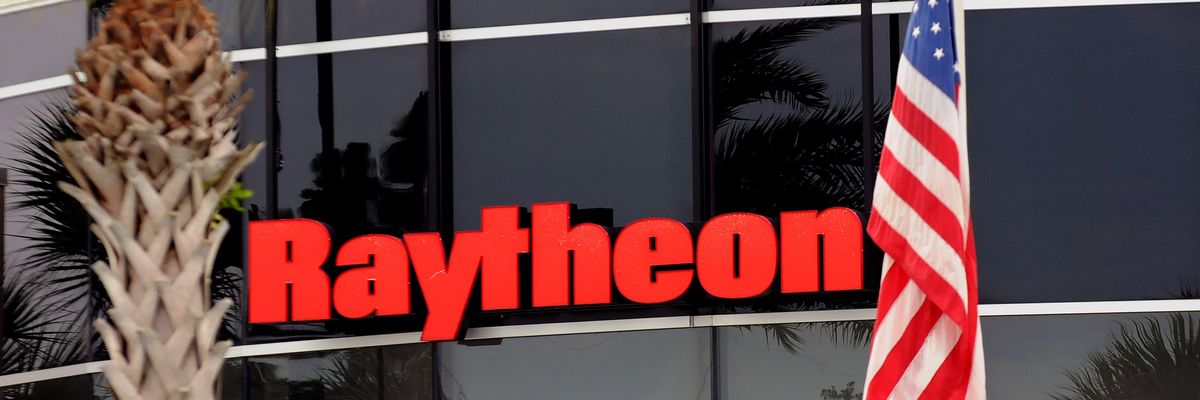
A Raytheon facility is seen on June 10, 2019 in Orlando, Florida. The Raytheon Co. and United Technologies Corp. have announced a merger, creating a new defense and aerospace company called Raytheon Technologies Corp. (Photo: Paul Hennessy/NurPhoto via Getty Images)
War Is (Still) A Racket: Corporate Power and the Russian Invasion of Ukraine
This is more than a political war. It's a resource war.
Move to Amend condemns Russia's invasion of Ukraine. There must be an immediate ceasefire, withdrawal of troops, humanitarian aid, and diplomacy.
There are many reasons for Russia's invasion. Some concern politics, history, culture, and territory--including preventing NATO expansion. Not often mentioned, however, is that this small country has 5% of the earth's natural and mineral resources, including coal, oil, natural gas (2nd most in Europe), lithium (for batteries), iron ore (for industry), titanium (20% of proven world reserves, for aerospace) and gallium (2nd most in world, for electronics). Ukraine is also incredibly rich agriculturally--1st in Europe in arable land and 25% of the world's volume of black soil --capable of meeting the food needs of 600 million people.
U.S. military contractors--Raytheon and Lockheed Martin corporations--are telling their investors the tensions are good for business, while General Dynamics corporation boasts that past such disputes have expanded their bottom line.
This is more than a political war. It's a resource war.
Immense resources translate to immense wealth--and power. Russia wants control over them. So do western nations and transnational corporations--including energy, mining, and agricultural companies. U.S. military contractors--Raytheon and Lockheed Martin corporations--are telling their investors the tensions are good for business, while General Dynamics corporation boasts that past such disputes have expanded their bottom line.
The U.S. has committed more than $3 billion in military assistance to Ukraine since 2014, including $350 million worth of weapons recently authorized by President Biden. Lobbying and political campaign contributions by the weapons industry will surely be a factor in continuing the flow of arms. To the degree that energy, mining, and agricultural corporations believe they can eventually grab a piece of Ukrainian resources, they too will use their never-intended First Amendment corporate constitutional rights to press Congress for more funding.
Shockingly, some past U.S. funding to Ukraine appears to have ended up training the Azov Batalion, a neo-nazi militia group that's incorporated into the Ukrainian National Guard. Those in Congress proposing more military funding don't seem concerned about this prospect.
Wars are not only, in general, profitable to weapons makers and corporations that directly benefit from occupations and any eventual access to raw materials and cheap labor. Justification for a "permanent war economy" (which best describes our national economic policy) also greatly benefits other corporations.
Financial corporations (part of the largest single sector of campaign contributions to federal candidates and parties) profit from war. They facilitate the selling of U.S. Treasury debt bonds to foreign nations (since most military spending increases the nation's debt). They also provide loans internationally to rebuild war-torn nations and domestically to communities (via purchasing municipal bonds with high yields) to fill the gap of declining public funding. Past and current military spending equals 48% of all spent federal tax dollars.
Relatedly, federal spending priorities favoring militarism over funding to states and communities have placed greater pressure on them to provide basic human and community needs--from programs addressing poverty, health care, education, hunger, homelessness, the environment and physical infrastructure. Privatization/corporatization of public assets--roads, water/sewer systems, utilities, prisons, schools, airports, rail/bus services, medical services--is increasingly the result, much to the delight of slews of corporate entities more than willing to monetize and profit from what formerly had been publicly funded public services.
Smedley Butler, a retired U.S. Marine Corp Major General, gave a speech in 1935 entitled "War is a Racket." In it, he said, "I spent thirty-three years and four months in active military service as a member of this country's most agile military force, the Marine Corps...I spent most of my time being a high class muscle-man for Big Business, for Wall Street and for the Bankers. In short, I was a racketeer, a gangster for capitalism..."
There's no single way to stop "gangsters for capitalism"--individuals acting as surrogates for "Big Business, for Wall Street and for the Bankers."
Diplomacy, whether with Russia over Ukraine or anywhere else, simply isn't profitable. It also doesn't justify continuation of the largest military presence the world has ever seen.
The military industrial empire--which includes military contractors--prefers perpetual conflict, if not wars, over diplomacy and peace and will continue to use their so-called "constitutional rights" to literally "weaponize" any tensions and conflicts by calling for more arms sales and transfers and construction/maintenance of 750 bases and installations in more than 80 countries and territories.
Constitutionalizing the "rights" of military contractors and other corporate entities (as separate entities apart from any individuals) and political money as free speech represent a different, but no less lethal, war against the right of We the People--all the people--to self-governance.
This makes our We the People Amendment, HJR 48--asserting that artificial entities like corporations do not have constitutional rights and that money is not free speech--so important to build a people's movement to enact.
We are at a crossroads
This country and this world are at a monumental crossroads. In a few short weeks, US voters will have an opportunity to beat back the forces of fascism and confront the billionaires who are rigging the economy, our media system, and our democracy, making it increasingly impossible for ordinary people to get by. We’re not just talking about the election. We’re talking about what must be done once these fascist elements are vanquished from power. We need a bolder set of solutions than what either major party has so far been willing to offer and a working-class movement ready to fight like hell for it. Trump didn't emerge from nowhere. The conditions that fueled MAGA authoritarianism were created by decades of radical neoliberal economic policies and a corrupt political system dominated by corporate interests. They slashed taxes on the super-rich, promising that the benefits would trickle down. They said giveaways to the corporate titans would make life more affordable for the rest of us. It was all bullshit. And when a bitter, betrayed populace searches for someone to blame, right-wing demagogues have little trouble finding scapegoats. People know when they're being lied to, but you won't hear any of this from the corporate media. Only independent journalism—powered and funded by people who believe in building a better world—can deliver truly trustworthy daily news. Our Fall Campaign is underway, and we need your help. To power our newsroom through the rest of the year, we need to raise $125,000 by midnight on October 31. So if you share our vision, please contribute whatever you can to sustain our work. |
Move to Amend condemns Russia's invasion of Ukraine. There must be an immediate ceasefire, withdrawal of troops, humanitarian aid, and diplomacy.
There are many reasons for Russia's invasion. Some concern politics, history, culture, and territory--including preventing NATO expansion. Not often mentioned, however, is that this small country has 5% of the earth's natural and mineral resources, including coal, oil, natural gas (2nd most in Europe), lithium (for batteries), iron ore (for industry), titanium (20% of proven world reserves, for aerospace) and gallium (2nd most in world, for electronics). Ukraine is also incredibly rich agriculturally--1st in Europe in arable land and 25% of the world's volume of black soil --capable of meeting the food needs of 600 million people.
U.S. military contractors--Raytheon and Lockheed Martin corporations--are telling their investors the tensions are good for business, while General Dynamics corporation boasts that past such disputes have expanded their bottom line.
This is more than a political war. It's a resource war.
Immense resources translate to immense wealth--and power. Russia wants control over them. So do western nations and transnational corporations--including energy, mining, and agricultural companies. U.S. military contractors--Raytheon and Lockheed Martin corporations--are telling their investors the tensions are good for business, while General Dynamics corporation boasts that past such disputes have expanded their bottom line.
The U.S. has committed more than $3 billion in military assistance to Ukraine since 2014, including $350 million worth of weapons recently authorized by President Biden. Lobbying and political campaign contributions by the weapons industry will surely be a factor in continuing the flow of arms. To the degree that energy, mining, and agricultural corporations believe they can eventually grab a piece of Ukrainian resources, they too will use their never-intended First Amendment corporate constitutional rights to press Congress for more funding.
Shockingly, some past U.S. funding to Ukraine appears to have ended up training the Azov Batalion, a neo-nazi militia group that's incorporated into the Ukrainian National Guard. Those in Congress proposing more military funding don't seem concerned about this prospect.
Wars are not only, in general, profitable to weapons makers and corporations that directly benefit from occupations and any eventual access to raw materials and cheap labor. Justification for a "permanent war economy" (which best describes our national economic policy) also greatly benefits other corporations.
Financial corporations (part of the largest single sector of campaign contributions to federal candidates and parties) profit from war. They facilitate the selling of U.S. Treasury debt bonds to foreign nations (since most military spending increases the nation's debt). They also provide loans internationally to rebuild war-torn nations and domestically to communities (via purchasing municipal bonds with high yields) to fill the gap of declining public funding. Past and current military spending equals 48% of all spent federal tax dollars.
Relatedly, federal spending priorities favoring militarism over funding to states and communities have placed greater pressure on them to provide basic human and community needs--from programs addressing poverty, health care, education, hunger, homelessness, the environment and physical infrastructure. Privatization/corporatization of public assets--roads, water/sewer systems, utilities, prisons, schools, airports, rail/bus services, medical services--is increasingly the result, much to the delight of slews of corporate entities more than willing to monetize and profit from what formerly had been publicly funded public services.
Smedley Butler, a retired U.S. Marine Corp Major General, gave a speech in 1935 entitled "War is a Racket." In it, he said, "I spent thirty-three years and four months in active military service as a member of this country's most agile military force, the Marine Corps...I spent most of my time being a high class muscle-man for Big Business, for Wall Street and for the Bankers. In short, I was a racketeer, a gangster for capitalism..."
There's no single way to stop "gangsters for capitalism"--individuals acting as surrogates for "Big Business, for Wall Street and for the Bankers."
Diplomacy, whether with Russia over Ukraine or anywhere else, simply isn't profitable. It also doesn't justify continuation of the largest military presence the world has ever seen.
The military industrial empire--which includes military contractors--prefers perpetual conflict, if not wars, over diplomacy and peace and will continue to use their so-called "constitutional rights" to literally "weaponize" any tensions and conflicts by calling for more arms sales and transfers and construction/maintenance of 750 bases and installations in more than 80 countries and territories.
Constitutionalizing the "rights" of military contractors and other corporate entities (as separate entities apart from any individuals) and political money as free speech represent a different, but no less lethal, war against the right of We the People--all the people--to self-governance.
This makes our We the People Amendment, HJR 48--asserting that artificial entities like corporations do not have constitutional rights and that money is not free speech--so important to build a people's movement to enact.