SUBSCRIBE TO OUR FREE NEWSLETTER
Daily news & progressive opinion—funded by the people, not the corporations—delivered straight to your inbox.
5
#000000
#FFFFFF
To donate by check, phone, or other method, see our More Ways to Give page.
Daily news & progressive opinion—funded by the people, not the corporations—delivered straight to your inbox.
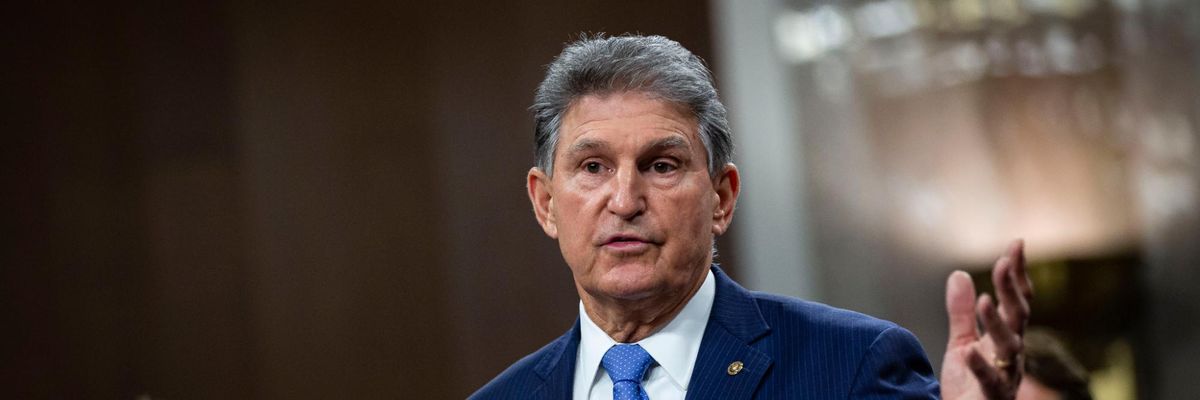
Sen. Joe Manchin (D-W.Va.) speaks during a news conference with a bipartisan group of lawmakers on December 14, 2020 in Washington, D.C. (Photo: Al Drago for the Washington Post via Getty Images)
At the end of September, Sen. Joe Manchin (D-W.V.) told reporters he would not support President Joe Biden's $3.5 trillion Build Back Better Act--a generational investment in social programs, including public funding for childcare and paid family leave--because, "I cannot accept our economy or basically our society moving toward an entitlement mentality."
The high level of inequality in the United States isn't just because of capitalism--it is also what the corporate takeover of government has done to the ability of our democracy to function.
Manchin likes to say he wants to help the needy, but not those who can help themselves. In his home state of West Virginia, 16% of the population lives in poverty, according to federal data. To put this number in perspective, in 2020, the federal poverty line for a family of four was just $26,200--about one third of what a West Virginian family of four actually needs to achieve what the Economic Policy Institute calls a "modest yet adequate standard of living." Nationwide, more than half of all U.S. families earn less than $35,000 a year.
Families need help, and they need it now.
I have witnessed up close how government inaction leads to anger and frustration among low-wage workers. As a sociologist, I spent four years researching and writing about low-income communities in the United States. In cities and towns from Oakland, Calif., to Appalachia, I met hundreds of working people from widely diverse racial groups who feel betrayed by their government as they struggle, every day, to keep food on the table and bills paid.
In rural Tennessee, Tommy, a white man in his mid-60s, bit back his anger: "We made Oshkosh clothing here. They made children's clothing, some of the best clothing in the country. It was known for quality. Those jobs were sent to Mexico. So where were all of these politicians that were representing the little guy?"
For decades, neither political party seems to have cared to keep rural--or urban--communities from sinking more deeply into poverty. Too often, they seemed willing to push these communities right over the edge.
Many working people are fed up and increasingly trying to make their voices heard.
Late in September, a group of self-described "kayaktivists" from West Virginia surrounded Manchin's luxury yacht docked in Washington, D.C., on the Potomac River, calling on him to support a massive investment in social programs. Their voices echoed polls showing up to 64% of all registered voters support the Build Back Better Act. In a country where low-wage work prevails, social infrastructure is sorely needed, including childcare, universal pre-K, an expanded Child Tax Credit and reduced prescription drug prices--which is exactly what the legislation would provide. And of course, workers deserve to be paid a living wage. Earlier this year, however, Manchin was among those who sided with Republicans and business interests by refusing to raise the minimum wage to $15 an hour.
Manchin did eventually make an appearance for the kayaktivists, but not to talk. Instead, he leaned over the deck of his $700,000 yacht to reiterate that he would not support the bill. He might as well have yelled, "Let them eat cake."
Over my years of interviews, low-wage workers across the country have expressed a deep sense of betrayal--a sentiment that never seems to get old because establishment politicians behave so predictably.
In Oakland, Tom Sam, a 30-something Indigenous man with a young family, told me: "I'm a firm believer that the two-party system is a [failed] system. You have a Republican-Democrat bottleneck. In reality, [the parties] have the same interests and end goal, which is to make the rich richer, to keep the poor working."
He is not alone in his critique of the U.S. political system being skewed to benefit the wealthy. In 2020, the richest 0.1% of American households owned almost as much wealth as the bottom 90% of households combined.
At Standing Rock Reservation in North Dakota, Two Lance Woman told me the reason there is an environmental justice movement is "because there is no concern with justice in the government or corporations. Imagine living in your ancestral homelands and you see fracking and uranium mining. The agencies that are supposed to protect us don't think about our exposure to toxins. Our views are not held as valid or as important. We live in a sacrifice zone."
It would be fair to say the coal industry has turned much of West Virginia into a sacrifice zone as well. Capitalism, racism, poverty and climate change are all connected. In Manchin's home state of West Virginia, the climate crisis is now delivering catastrophic flooding.
Meanwhile, Manchin claims he worries about an "entitlement mentality." And there is an entitlement problem, but it's not the one he's referring to among struggling families.
It is the entitlement mentality of Manchin and his colleague Sen. Kyrsten Sinema (D-Ariz.) as they attempt to block or water down the Build Back Better Act in order to protect the coal and pharmaceutical industries that have bankrolled their campaigns and lined their pockets.
The high level of inequality in the United States isn't just because of capitalism--it is also what the corporate takeover of government has done to the ability of our democracy to function. Powerful people in government have now become incredibly rich by supporting corporations and their lobbyists. Nowhere is that more clear than in Joe Manchin and Kyrsten Sinema, politicians acting in opposition to the interests of the very people who voted for them.
Dear Common Dreams reader, It’s been nearly 30 years since I co-founded Common Dreams with my late wife, Lina Newhouser. We had the radical notion that journalism should serve the public good, not corporate profits. It was clear to us from the outset what it would take to build such a project. No paid advertisements. No corporate sponsors. No millionaire publisher telling us what to think or do. Many people said we wouldn't last a year, but we proved those doubters wrong. Together with a tremendous team of journalists and dedicated staff, we built an independent media outlet free from the constraints of profits and corporate control. Our mission has always been simple: To inform. To inspire. To ignite change for the common good. Building Common Dreams was not easy. Our survival was never guaranteed. When you take on the most powerful forces—Wall Street greed, fossil fuel industry destruction, Big Tech lobbyists, and uber-rich oligarchs who have spent billions upon billions rigging the economy and democracy in their favor—the only bulwark you have is supporters who believe in your work. But here’s the urgent message from me today. It's never been this bad out there. And it's never been this hard to keep us going. At the very moment Common Dreams is most needed, the threats we face are intensifying. We need your support now more than ever. We don't accept corporate advertising and never will. We don't have a paywall because we don't think people should be blocked from critical news based on their ability to pay. Everything we do is funded by the donations of readers like you. When everyone does the little they can afford, we are strong. But if that support retreats or dries up, so do we. Will you donate now to make sure Common Dreams not only survives but thrives? —Craig Brown, Co-founder |
At the end of September, Sen. Joe Manchin (D-W.V.) told reporters he would not support President Joe Biden's $3.5 trillion Build Back Better Act--a generational investment in social programs, including public funding for childcare and paid family leave--because, "I cannot accept our economy or basically our society moving toward an entitlement mentality."
The high level of inequality in the United States isn't just because of capitalism--it is also what the corporate takeover of government has done to the ability of our democracy to function.
Manchin likes to say he wants to help the needy, but not those who can help themselves. In his home state of West Virginia, 16% of the population lives in poverty, according to federal data. To put this number in perspective, in 2020, the federal poverty line for a family of four was just $26,200--about one third of what a West Virginian family of four actually needs to achieve what the Economic Policy Institute calls a "modest yet adequate standard of living." Nationwide, more than half of all U.S. families earn less than $35,000 a year.
Families need help, and they need it now.
I have witnessed up close how government inaction leads to anger and frustration among low-wage workers. As a sociologist, I spent four years researching and writing about low-income communities in the United States. In cities and towns from Oakland, Calif., to Appalachia, I met hundreds of working people from widely diverse racial groups who feel betrayed by their government as they struggle, every day, to keep food on the table and bills paid.
In rural Tennessee, Tommy, a white man in his mid-60s, bit back his anger: "We made Oshkosh clothing here. They made children's clothing, some of the best clothing in the country. It was known for quality. Those jobs were sent to Mexico. So where were all of these politicians that were representing the little guy?"
For decades, neither political party seems to have cared to keep rural--or urban--communities from sinking more deeply into poverty. Too often, they seemed willing to push these communities right over the edge.
Many working people are fed up and increasingly trying to make their voices heard.
Late in September, a group of self-described "kayaktivists" from West Virginia surrounded Manchin's luxury yacht docked in Washington, D.C., on the Potomac River, calling on him to support a massive investment in social programs. Their voices echoed polls showing up to 64% of all registered voters support the Build Back Better Act. In a country where low-wage work prevails, social infrastructure is sorely needed, including childcare, universal pre-K, an expanded Child Tax Credit and reduced prescription drug prices--which is exactly what the legislation would provide. And of course, workers deserve to be paid a living wage. Earlier this year, however, Manchin was among those who sided with Republicans and business interests by refusing to raise the minimum wage to $15 an hour.
Manchin did eventually make an appearance for the kayaktivists, but not to talk. Instead, he leaned over the deck of his $700,000 yacht to reiterate that he would not support the bill. He might as well have yelled, "Let them eat cake."
Over my years of interviews, low-wage workers across the country have expressed a deep sense of betrayal--a sentiment that never seems to get old because establishment politicians behave so predictably.
In Oakland, Tom Sam, a 30-something Indigenous man with a young family, told me: "I'm a firm believer that the two-party system is a [failed] system. You have a Republican-Democrat bottleneck. In reality, [the parties] have the same interests and end goal, which is to make the rich richer, to keep the poor working."
He is not alone in his critique of the U.S. political system being skewed to benefit the wealthy. In 2020, the richest 0.1% of American households owned almost as much wealth as the bottom 90% of households combined.
At Standing Rock Reservation in North Dakota, Two Lance Woman told me the reason there is an environmental justice movement is "because there is no concern with justice in the government or corporations. Imagine living in your ancestral homelands and you see fracking and uranium mining. The agencies that are supposed to protect us don't think about our exposure to toxins. Our views are not held as valid or as important. We live in a sacrifice zone."
It would be fair to say the coal industry has turned much of West Virginia into a sacrifice zone as well. Capitalism, racism, poverty and climate change are all connected. In Manchin's home state of West Virginia, the climate crisis is now delivering catastrophic flooding.
Meanwhile, Manchin claims he worries about an "entitlement mentality." And there is an entitlement problem, but it's not the one he's referring to among struggling families.
It is the entitlement mentality of Manchin and his colleague Sen. Kyrsten Sinema (D-Ariz.) as they attempt to block or water down the Build Back Better Act in order to protect the coal and pharmaceutical industries that have bankrolled their campaigns and lined their pockets.
The high level of inequality in the United States isn't just because of capitalism--it is also what the corporate takeover of government has done to the ability of our democracy to function. Powerful people in government have now become incredibly rich by supporting corporations and their lobbyists. Nowhere is that more clear than in Joe Manchin and Kyrsten Sinema, politicians acting in opposition to the interests of the very people who voted for them.
At the end of September, Sen. Joe Manchin (D-W.V.) told reporters he would not support President Joe Biden's $3.5 trillion Build Back Better Act--a generational investment in social programs, including public funding for childcare and paid family leave--because, "I cannot accept our economy or basically our society moving toward an entitlement mentality."
The high level of inequality in the United States isn't just because of capitalism--it is also what the corporate takeover of government has done to the ability of our democracy to function.
Manchin likes to say he wants to help the needy, but not those who can help themselves. In his home state of West Virginia, 16% of the population lives in poverty, according to federal data. To put this number in perspective, in 2020, the federal poverty line for a family of four was just $26,200--about one third of what a West Virginian family of four actually needs to achieve what the Economic Policy Institute calls a "modest yet adequate standard of living." Nationwide, more than half of all U.S. families earn less than $35,000 a year.
Families need help, and they need it now.
I have witnessed up close how government inaction leads to anger and frustration among low-wage workers. As a sociologist, I spent four years researching and writing about low-income communities in the United States. In cities and towns from Oakland, Calif., to Appalachia, I met hundreds of working people from widely diverse racial groups who feel betrayed by their government as they struggle, every day, to keep food on the table and bills paid.
In rural Tennessee, Tommy, a white man in his mid-60s, bit back his anger: "We made Oshkosh clothing here. They made children's clothing, some of the best clothing in the country. It was known for quality. Those jobs were sent to Mexico. So where were all of these politicians that were representing the little guy?"
For decades, neither political party seems to have cared to keep rural--or urban--communities from sinking more deeply into poverty. Too often, they seemed willing to push these communities right over the edge.
Many working people are fed up and increasingly trying to make their voices heard.
Late in September, a group of self-described "kayaktivists" from West Virginia surrounded Manchin's luxury yacht docked in Washington, D.C., on the Potomac River, calling on him to support a massive investment in social programs. Their voices echoed polls showing up to 64% of all registered voters support the Build Back Better Act. In a country where low-wage work prevails, social infrastructure is sorely needed, including childcare, universal pre-K, an expanded Child Tax Credit and reduced prescription drug prices--which is exactly what the legislation would provide. And of course, workers deserve to be paid a living wage. Earlier this year, however, Manchin was among those who sided with Republicans and business interests by refusing to raise the minimum wage to $15 an hour.
Manchin did eventually make an appearance for the kayaktivists, but not to talk. Instead, he leaned over the deck of his $700,000 yacht to reiterate that he would not support the bill. He might as well have yelled, "Let them eat cake."
Over my years of interviews, low-wage workers across the country have expressed a deep sense of betrayal--a sentiment that never seems to get old because establishment politicians behave so predictably.
In Oakland, Tom Sam, a 30-something Indigenous man with a young family, told me: "I'm a firm believer that the two-party system is a [failed] system. You have a Republican-Democrat bottleneck. In reality, [the parties] have the same interests and end goal, which is to make the rich richer, to keep the poor working."
He is not alone in his critique of the U.S. political system being skewed to benefit the wealthy. In 2020, the richest 0.1% of American households owned almost as much wealth as the bottom 90% of households combined.
At Standing Rock Reservation in North Dakota, Two Lance Woman told me the reason there is an environmental justice movement is "because there is no concern with justice in the government or corporations. Imagine living in your ancestral homelands and you see fracking and uranium mining. The agencies that are supposed to protect us don't think about our exposure to toxins. Our views are not held as valid or as important. We live in a sacrifice zone."
It would be fair to say the coal industry has turned much of West Virginia into a sacrifice zone as well. Capitalism, racism, poverty and climate change are all connected. In Manchin's home state of West Virginia, the climate crisis is now delivering catastrophic flooding.
Meanwhile, Manchin claims he worries about an "entitlement mentality." And there is an entitlement problem, but it's not the one he's referring to among struggling families.
It is the entitlement mentality of Manchin and his colleague Sen. Kyrsten Sinema (D-Ariz.) as they attempt to block or water down the Build Back Better Act in order to protect the coal and pharmaceutical industries that have bankrolled their campaigns and lined their pockets.
The high level of inequality in the United States isn't just because of capitalism--it is also what the corporate takeover of government has done to the ability of our democracy to function. Powerful people in government have now become incredibly rich by supporting corporations and their lobbyists. Nowhere is that more clear than in Joe Manchin and Kyrsten Sinema, politicians acting in opposition to the interests of the very people who voted for them.