SUBSCRIBE TO OUR FREE NEWSLETTER
Daily news & progressive opinion—funded by the people, not the corporations—delivered straight to your inbox.
5
#000000
#FFFFFF
To donate by check, phone, or other method, see our More Ways to Give page.
Daily news & progressive opinion—funded by the people, not the corporations—delivered straight to your inbox.
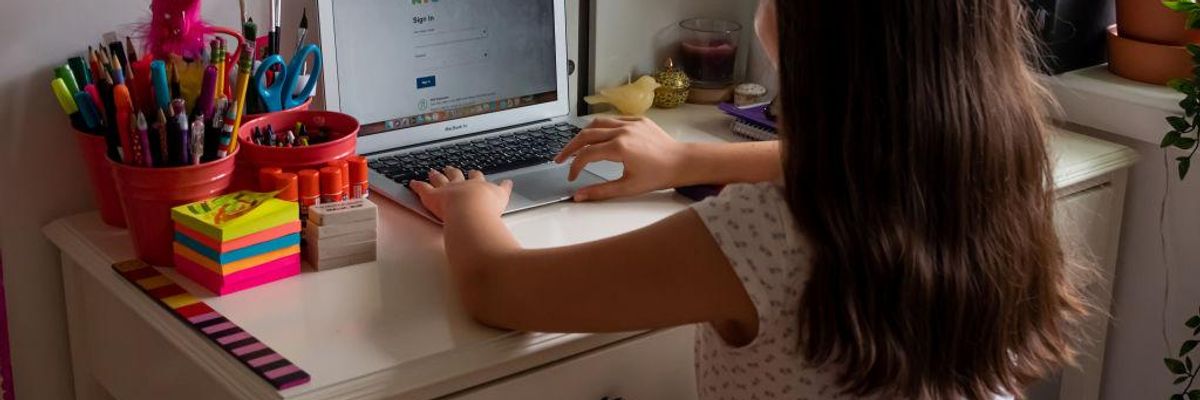
A kid sits in front of her computer as she does homeschooling at her home as the city continues Phase 4 of re-opening following restrictions imposed to slow the spread of coronavirus on September 27, 2020 in New York City. (Photo by Noam Galai/Getty Images)
In the summer of 2020, former President Donald Trump infamously threatened to force the Centers for Disease Control and Prevention to loosen its school reopening guidelines and to withhold federal funding from educational institutions that refused to resume in-person instruction. On his first day in office, President Joe Biden stated that, unlike the former administration, he would not politicize the pandemic, noting that his experts would "make decisions strictly based on . . .science and health alone, not what the political consequences are." As the CDC--under the leadership of Rochelle P. Walensky--was developing guidelines for the reopening of the nation's K-12 schools (which were released earlier this month), the politicization of schools and science began in earnest again, but this time it also was (and is) emanating from Biden's centrist allies.
President Biden has set a goal of reopening most K-12 schools within the first 100 days of his presidency. This is a goal that many Americans surely support, including teachers. As a professor of education, I can attest that many of my students (most of whom are teachers or pre-service teachers) desperately want to return to their classrooms. But, they want to return when it is relatively safe to do so. Despite the false characterization that teachers' unions are keeping their members out of the classroom because of teachers' irrational fears about their own risk, teachers, in my view, are just as concerned about their students' health--and the health of students' families, many of who are multigenerational--as their own.
The science on whether or not K-12 schools facilitate the spread of the virus is somewhat inconclusive, quite sparse, and greatly exaggerated.
My students' absolutely reasonable desire for safe classrooms for their students and themselves is at the heart of this new politicization of schools and science. Biden's reopening of schools within his first 100 days is a case in point. Despite the promise of letting science drive the Covid response, there is no scientific data that can clearly determine if most schools can safely reopen within that seemingly arbitrary timeframe because, to be quite frank, there is no exact way to predict the course of the pandemic in the coming months: Superbowl Sunday--like other gatherings of friends and families--or the more-contagious variants of the virus could cause a major surge in cases in the coming weeks.
Despite the inability to determine the course of the virus during the next few months, Democratic leaders, such as Mayor Lori Lightfoot and Governor Gretchen Whitmer, and some Biden administration officials, notably CDC Director Walensky, are arguing there is scientific data to "suggest that schools can safely reopen" now (or very soon). But, the science on whether or not K-12 schools facilitate the spread of the virus is somewhat inconclusive, quite sparse, and greatly exaggerated.
A few correlational studies have received a fair amount of attention and have been used to support the assertion that opening schools is relatively safe. A Michigan State University study examined whether or not in-person schooling contributed to increased rates of infection in Michigan and Washington. Despite media reports that stated the study "proves" that the virus "isn't spreading inside the building," it "proved" no such thing. What the study actually found was that when there were low rates of infection in the community in-person schooling did not appear to facilitate an increase in community spread. However, it also noted that "in-person schooling is predicted to lead to community COVID spread when preexisting case rates in the counties in which school districts are located are high." Similarly, a study from the National Center for Research on Education Access and Choice--an initiative funded under former Secretary of Education Betsy DeVos to study school choice--examined hospitalization rates in areas of the nation where K-12 schools were open. It found that in-person schooling did not increase hospitalizations when cases counts were low, but "[f]or counties that had higher rates of hospitalizations . . .our results were inconclusive."
No study has been referenced more to argue for the reopening of schools than the so-called "Wisconsin Study" in the Department of Health and Human Service's Morbidity and Mortality Weekly Report. The study argued that when safety protocols were in place--social distancing, mandatory mask usage, etc.--very little in-school transmission occurred. However, the study's authors did not test students and faculty to determine the extent of virus in the 17 schools they examined, nor did they perform any contact tracing. Instead, when a member of the school community became ill, the researchers relied on school administrators and the local health departments to determine the origin of the infection. What that likely means is that when students or teachers tested positive for Covid-19, a health department official contacted them and asked them about their potential contacts during the period preceding the positive test. If they had been to other locations during that period (such as the grocery store), contact tracers surely could not assign the source of infections to the schools with absolute certainty. Moreover, because asymptomatic infection is more common among young people, the amount of in-school transmission was likely undercounted. The authors even state that "this study was unable to rule out asymptomatic transmission within the school setting because surveillance testing was not conducted."
Science is more than a few correlational studies (which, by their nature, cannot determine causation). Nevertheless, political leaders--armed with those very limited studies--are arguing that "science" demonstrates that in-person schooling is safe. It does not! Such claims are simply exaggerating the conclusions of the studies and politicizing schools and science, again.
Schools are essential; no one can dispute that. But, unlike other essential functions--such emergency medical care--schooling can, although not perfectly, be accomplished remotely. To be brutally honest, I often get the impression that political leaders want schools to reopen for in-person instruction because they need childcare for workers in order to jump start the economy, not because they are suddenly concerned about "learning loss" or the "mental health" of low-income students. Suggesting that, in essence, "babysitting" is the most valuable contribution of the nation's highly skilled and educated teachers is beyond offensive to those very professionals who, from the beginning of the outbreak, quickly and creatively figured out ways to educate youngsters via Zoom and other video conferencing platforms in order to slow the spread of the virus. Although the data cannot yet tell us to what extent, remote learning surely is saving some lives--of students' elderly family members and vulnerable teachers--which, in a pandemic, should take priority over political--even economic--concerns.
Dear Common Dreams reader, It’s been nearly 30 years since I co-founded Common Dreams with my late wife, Lina Newhouser. We had the radical notion that journalism should serve the public good, not corporate profits. It was clear to us from the outset what it would take to build such a project. No paid advertisements. No corporate sponsors. No millionaire publisher telling us what to think or do. Many people said we wouldn't last a year, but we proved those doubters wrong. Together with a tremendous team of journalists and dedicated staff, we built an independent media outlet free from the constraints of profits and corporate control. Our mission has always been simple: To inform. To inspire. To ignite change for the common good. Building Common Dreams was not easy. Our survival was never guaranteed. When you take on the most powerful forces—Wall Street greed, fossil fuel industry destruction, Big Tech lobbyists, and uber-rich oligarchs who have spent billions upon billions rigging the economy and democracy in their favor—the only bulwark you have is supporters who believe in your work. But here’s the urgent message from me today. It's never been this bad out there. And it's never been this hard to keep us going. At the very moment Common Dreams is most needed, the threats we face are intensifying. We need your support now more than ever. We don't accept corporate advertising and never will. We don't have a paywall because we don't think people should be blocked from critical news based on their ability to pay. Everything we do is funded by the donations of readers like you. When everyone does the little they can afford, we are strong. But if that support retreats or dries up, so do we. Will you donate now to make sure Common Dreams not only survives but thrives? —Craig Brown, Co-founder |
In the summer of 2020, former President Donald Trump infamously threatened to force the Centers for Disease Control and Prevention to loosen its school reopening guidelines and to withhold federal funding from educational institutions that refused to resume in-person instruction. On his first day in office, President Joe Biden stated that, unlike the former administration, he would not politicize the pandemic, noting that his experts would "make decisions strictly based on . . .science and health alone, not what the political consequences are." As the CDC--under the leadership of Rochelle P. Walensky--was developing guidelines for the reopening of the nation's K-12 schools (which were released earlier this month), the politicization of schools and science began in earnest again, but this time it also was (and is) emanating from Biden's centrist allies.
President Biden has set a goal of reopening most K-12 schools within the first 100 days of his presidency. This is a goal that many Americans surely support, including teachers. As a professor of education, I can attest that many of my students (most of whom are teachers or pre-service teachers) desperately want to return to their classrooms. But, they want to return when it is relatively safe to do so. Despite the false characterization that teachers' unions are keeping their members out of the classroom because of teachers' irrational fears about their own risk, teachers, in my view, are just as concerned about their students' health--and the health of students' families, many of who are multigenerational--as their own.
The science on whether or not K-12 schools facilitate the spread of the virus is somewhat inconclusive, quite sparse, and greatly exaggerated.
My students' absolutely reasonable desire for safe classrooms for their students and themselves is at the heart of this new politicization of schools and science. Biden's reopening of schools within his first 100 days is a case in point. Despite the promise of letting science drive the Covid response, there is no scientific data that can clearly determine if most schools can safely reopen within that seemingly arbitrary timeframe because, to be quite frank, there is no exact way to predict the course of the pandemic in the coming months: Superbowl Sunday--like other gatherings of friends and families--or the more-contagious variants of the virus could cause a major surge in cases in the coming weeks.
Despite the inability to determine the course of the virus during the next few months, Democratic leaders, such as Mayor Lori Lightfoot and Governor Gretchen Whitmer, and some Biden administration officials, notably CDC Director Walensky, are arguing there is scientific data to "suggest that schools can safely reopen" now (or very soon). But, the science on whether or not K-12 schools facilitate the spread of the virus is somewhat inconclusive, quite sparse, and greatly exaggerated.
A few correlational studies have received a fair amount of attention and have been used to support the assertion that opening schools is relatively safe. A Michigan State University study examined whether or not in-person schooling contributed to increased rates of infection in Michigan and Washington. Despite media reports that stated the study "proves" that the virus "isn't spreading inside the building," it "proved" no such thing. What the study actually found was that when there were low rates of infection in the community in-person schooling did not appear to facilitate an increase in community spread. However, it also noted that "in-person schooling is predicted to lead to community COVID spread when preexisting case rates in the counties in which school districts are located are high." Similarly, a study from the National Center for Research on Education Access and Choice--an initiative funded under former Secretary of Education Betsy DeVos to study school choice--examined hospitalization rates in areas of the nation where K-12 schools were open. It found that in-person schooling did not increase hospitalizations when cases counts were low, but "[f]or counties that had higher rates of hospitalizations . . .our results were inconclusive."
No study has been referenced more to argue for the reopening of schools than the so-called "Wisconsin Study" in the Department of Health and Human Service's Morbidity and Mortality Weekly Report. The study argued that when safety protocols were in place--social distancing, mandatory mask usage, etc.--very little in-school transmission occurred. However, the study's authors did not test students and faculty to determine the extent of virus in the 17 schools they examined, nor did they perform any contact tracing. Instead, when a member of the school community became ill, the researchers relied on school administrators and the local health departments to determine the origin of the infection. What that likely means is that when students or teachers tested positive for Covid-19, a health department official contacted them and asked them about their potential contacts during the period preceding the positive test. If they had been to other locations during that period (such as the grocery store), contact tracers surely could not assign the source of infections to the schools with absolute certainty. Moreover, because asymptomatic infection is more common among young people, the amount of in-school transmission was likely undercounted. The authors even state that "this study was unable to rule out asymptomatic transmission within the school setting because surveillance testing was not conducted."
Science is more than a few correlational studies (which, by their nature, cannot determine causation). Nevertheless, political leaders--armed with those very limited studies--are arguing that "science" demonstrates that in-person schooling is safe. It does not! Such claims are simply exaggerating the conclusions of the studies and politicizing schools and science, again.
Schools are essential; no one can dispute that. But, unlike other essential functions--such emergency medical care--schooling can, although not perfectly, be accomplished remotely. To be brutally honest, I often get the impression that political leaders want schools to reopen for in-person instruction because they need childcare for workers in order to jump start the economy, not because they are suddenly concerned about "learning loss" or the "mental health" of low-income students. Suggesting that, in essence, "babysitting" is the most valuable contribution of the nation's highly skilled and educated teachers is beyond offensive to those very professionals who, from the beginning of the outbreak, quickly and creatively figured out ways to educate youngsters via Zoom and other video conferencing platforms in order to slow the spread of the virus. Although the data cannot yet tell us to what extent, remote learning surely is saving some lives--of students' elderly family members and vulnerable teachers--which, in a pandemic, should take priority over political--even economic--concerns.
In the summer of 2020, former President Donald Trump infamously threatened to force the Centers for Disease Control and Prevention to loosen its school reopening guidelines and to withhold federal funding from educational institutions that refused to resume in-person instruction. On his first day in office, President Joe Biden stated that, unlike the former administration, he would not politicize the pandemic, noting that his experts would "make decisions strictly based on . . .science and health alone, not what the political consequences are." As the CDC--under the leadership of Rochelle P. Walensky--was developing guidelines for the reopening of the nation's K-12 schools (which were released earlier this month), the politicization of schools and science began in earnest again, but this time it also was (and is) emanating from Biden's centrist allies.
President Biden has set a goal of reopening most K-12 schools within the first 100 days of his presidency. This is a goal that many Americans surely support, including teachers. As a professor of education, I can attest that many of my students (most of whom are teachers or pre-service teachers) desperately want to return to their classrooms. But, they want to return when it is relatively safe to do so. Despite the false characterization that teachers' unions are keeping their members out of the classroom because of teachers' irrational fears about their own risk, teachers, in my view, are just as concerned about their students' health--and the health of students' families, many of who are multigenerational--as their own.
The science on whether or not K-12 schools facilitate the spread of the virus is somewhat inconclusive, quite sparse, and greatly exaggerated.
My students' absolutely reasonable desire for safe classrooms for their students and themselves is at the heart of this new politicization of schools and science. Biden's reopening of schools within his first 100 days is a case in point. Despite the promise of letting science drive the Covid response, there is no scientific data that can clearly determine if most schools can safely reopen within that seemingly arbitrary timeframe because, to be quite frank, there is no exact way to predict the course of the pandemic in the coming months: Superbowl Sunday--like other gatherings of friends and families--or the more-contagious variants of the virus could cause a major surge in cases in the coming weeks.
Despite the inability to determine the course of the virus during the next few months, Democratic leaders, such as Mayor Lori Lightfoot and Governor Gretchen Whitmer, and some Biden administration officials, notably CDC Director Walensky, are arguing there is scientific data to "suggest that schools can safely reopen" now (or very soon). But, the science on whether or not K-12 schools facilitate the spread of the virus is somewhat inconclusive, quite sparse, and greatly exaggerated.
A few correlational studies have received a fair amount of attention and have been used to support the assertion that opening schools is relatively safe. A Michigan State University study examined whether or not in-person schooling contributed to increased rates of infection in Michigan and Washington. Despite media reports that stated the study "proves" that the virus "isn't spreading inside the building," it "proved" no such thing. What the study actually found was that when there were low rates of infection in the community in-person schooling did not appear to facilitate an increase in community spread. However, it also noted that "in-person schooling is predicted to lead to community COVID spread when preexisting case rates in the counties in which school districts are located are high." Similarly, a study from the National Center for Research on Education Access and Choice--an initiative funded under former Secretary of Education Betsy DeVos to study school choice--examined hospitalization rates in areas of the nation where K-12 schools were open. It found that in-person schooling did not increase hospitalizations when cases counts were low, but "[f]or counties that had higher rates of hospitalizations . . .our results were inconclusive."
No study has been referenced more to argue for the reopening of schools than the so-called "Wisconsin Study" in the Department of Health and Human Service's Morbidity and Mortality Weekly Report. The study argued that when safety protocols were in place--social distancing, mandatory mask usage, etc.--very little in-school transmission occurred. However, the study's authors did not test students and faculty to determine the extent of virus in the 17 schools they examined, nor did they perform any contact tracing. Instead, when a member of the school community became ill, the researchers relied on school administrators and the local health departments to determine the origin of the infection. What that likely means is that when students or teachers tested positive for Covid-19, a health department official contacted them and asked them about their potential contacts during the period preceding the positive test. If they had been to other locations during that period (such as the grocery store), contact tracers surely could not assign the source of infections to the schools with absolute certainty. Moreover, because asymptomatic infection is more common among young people, the amount of in-school transmission was likely undercounted. The authors even state that "this study was unable to rule out asymptomatic transmission within the school setting because surveillance testing was not conducted."
Science is more than a few correlational studies (which, by their nature, cannot determine causation). Nevertheless, political leaders--armed with those very limited studies--are arguing that "science" demonstrates that in-person schooling is safe. It does not! Such claims are simply exaggerating the conclusions of the studies and politicizing schools and science, again.
Schools are essential; no one can dispute that. But, unlike other essential functions--such emergency medical care--schooling can, although not perfectly, be accomplished remotely. To be brutally honest, I often get the impression that political leaders want schools to reopen for in-person instruction because they need childcare for workers in order to jump start the economy, not because they are suddenly concerned about "learning loss" or the "mental health" of low-income students. Suggesting that, in essence, "babysitting" is the most valuable contribution of the nation's highly skilled and educated teachers is beyond offensive to those very professionals who, from the beginning of the outbreak, quickly and creatively figured out ways to educate youngsters via Zoom and other video conferencing platforms in order to slow the spread of the virus. Although the data cannot yet tell us to what extent, remote learning surely is saving some lives--of students' elderly family members and vulnerable teachers--which, in a pandemic, should take priority over political--even economic--concerns.