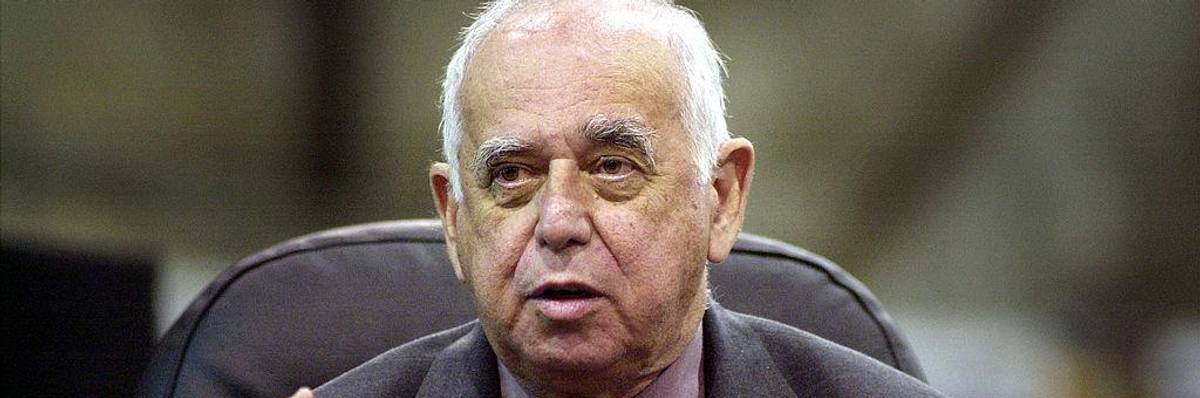
S. David Freeman, Chief Energy Advisor, State of California, appears as the keynote speaker at the "Energy Summit" panel discussion, June 2, 2001 in Los Angeles, CA. (Photo by David McNew/Getty Images)
S. David Freeman: Seven Decades of Participating in Power for All of Us
Freeman mocked the foolish embrace of fossil fuels and warned all who would listen about the deadly impact of coal, oil, and natural gas consumption on our environment.
If the planet Earth were animate, it would have shuddered at the news that S. David Freeman passed away this month. Freeman was that important to Earth's future. In his 94th year, he inspired all he met with his burning passion, relentless energy, and keen intellect.
Freeman, an engineer and a lawyer, knew where decisions were being made or ignored regarding our energy future. He mocked the foolish embrace of fossil fuels and warned all who would listen about the deadly impact of coal, oil, and natural gas consumption on our environment. This humble son of an immigrant umbrella repair man made the most of his formidable talents over seven decades and helped steer mankind toward renewables and energy efficiency. Freeman worked to prevent the perilous use of fossil and nuclear fuels.
Freeman was one of the first environmentalists to warn us of the dangers posed by fossil fuels and he was one of the first to offer practical remedies. He started his career in the 1950s as an engineer with the Tennessee Valley Authority (TVA) before holding a series of positions with the Federal Power Commission (FPC) and the Johnson White House. In 1974 Freeman authored the Ford Foundation's groundbreaking report "A Time to Choose: America's Energy Future." He was an adviser to President Jimmy Carter, who appointed him chairman of the giant TVA in 1978.
At the TVA, Freeman managed with a no-nonsense, down-to-earth, results-focused approach to reform. Using what he learned at TVA, Freeman became known for turning around hidebound giant utilities that were unable to process evidence contrary to their wasteful ways and environmental destructiveness. The tenacious Tennessean had no patience for self-serving talk that avoided obvious solutions. Freeman was a serious advocate who used humor, wit, and charm to make his case in the court of public opinion and the corridors of power. "Mother Nature doesn't care what we say, Mother Nature only cares about what we do," he would remind bloviators!
Freeman had that unparalleled combination of managerial experience, scholarly knowledge, and programmatic urgency in confronting the climate crisis.
Freeman shut down or suspended construction of half a dozen nuclear reactors at the TVA, scoring them as dangerous, uneconomical, and unnecessary. He liked "free" sources of energy, such as solar and wind, instead of lethal coal, gas, oil, and uranium that had to be ripped perilously from the bowels of the Earth. As for vast opportunities afforded by energy efficient sources, he paraphrased Benjamin Franklin, saying a megawatt of energy that isn't wasted is a megawatt you don't have to produce.
In between his clearheaded impact on conferences around the world, advising presidents, governors, members of Congress and parliaments, and many cogent writings, Freeman ran three other giant utilities (other than TVA, Freeman ran utilities in California, Texas, and New York). At Sacramento Municipal Utility District (SMUD), he implemented a public vote against the troubled Rancho Seco Nuclear Generating Station, replacing its energy with conservation and renewables.
In the decades I knew David, he always made the changes he implemented look easy because he so deftly and honestly used evidence, facts, and economics-- sometimes to rectify his previous positions. He used his knowledge to serve the public that was too often shoved aside by bureaucratic and corporate vested interests.
Freeman had that unparalleled combination of managerial experience, scholarly knowledge, and programmatic urgency in confronting the climate crisis. We would invite him for brown bag lunches with younger leaders working on energy transition. He would "out urgent" them, mocking dilatory cap and trade ideas while demanding mandatory reduction in fossil fuels and ending nuclear power, and replacing them with job producing energy conservation, retrofitting homes and buildings as solar and wind ramp up. Freeman said, "We need to pass a law that says that every utility in this country must reduce their greenhouse gas emissions by 5% of 2020 emissions every year, starting now, and until we get down to zero."
You may be wondering why you haven't seen Freeman on television or read about his urgent proposals, as a doer, covering the crisis of climate and regular air water soil safeguards from ruinous extractive fuels.
Certainly, the mass media has devoted many hours and pages to these subjects, interviewing far lesser and often conflicted people on NPR, PBS, commercial networks, and major newspapers. I made many calls to energy and environmental reporters about David's availability, but to no avail.
Was it ageism? Which is rampant. Was it his free-thinking challenges to named influential corporations? Was it that he was seen as no longer an adviser to powerful officials? At age 93 he was flying to California negotiating the closure of the last nuke plant there with Pacific Gas Electric. He co-authored a book All-Electric America: A Climate Solution and the Hopeful Future with Leah Y. Parks in 2018 and his human interest memoir The Green Cowboy: An Energetic Life in 2016. Recently he was meeting with the pro-"Green New Deal" members of Congress.
But the media wasn't calling. Until, that is, David's "energetic" life came to an end and the obituary pages gave him his due in the Washington Post, the New York Times, and other outlets. Unlike celebrity entertainers and athletes, however, he didn't make page one. But his prescient legacy is an enduring example of how we can save our green planet and brighten our future. Biographers may wish to wrap their minds around this functional, enlightened life of such immense productivity.
We are at a crossroads
This country and this world are at a monumental crossroads. In a few short weeks, US voters will have an opportunity to beat back the forces of fascism and confront the billionaires who are rigging the economy, our media system, and our democracy, making it increasingly impossible for ordinary people to get by. We’re not just talking about the election. We’re talking about what must be done once these fascist elements are vanquished from power. We need a bolder set of solutions than what either major party has so far been willing to offer and a working-class movement ready to fight like hell for it. Trump didn't emerge from nowhere. The conditions that fueled MAGA authoritarianism were created by decades of radical neoliberal economic policies and a corrupt political system dominated by corporate interests. They slashed taxes on the super-rich, promising that the benefits would trickle down. They said giveaways to the corporate titans would make life more affordable for the rest of us. It was all bullshit. And when a bitter, betrayed populace searches for someone to blame, right-wing demagogues have little trouble finding scapegoats. People know when they're being lied to, but you won't hear any of this from the corporate media. Only independent journalism—powered and funded by people who believe in building a better world—can deliver truly trustworthy daily news. Our Fall Campaign is underway, and we need your help. To power our newsroom through the rest of the year, we need to raise $125,000 by midnight on October 31. So if you share our vision, please contribute whatever you can to sustain our work. |
If the planet Earth were animate, it would have shuddered at the news that S. David Freeman passed away this month. Freeman was that important to Earth's future. In his 94th year, he inspired all he met with his burning passion, relentless energy, and keen intellect.
Freeman, an engineer and a lawyer, knew where decisions were being made or ignored regarding our energy future. He mocked the foolish embrace of fossil fuels and warned all who would listen about the deadly impact of coal, oil, and natural gas consumption on our environment. This humble son of an immigrant umbrella repair man made the most of his formidable talents over seven decades and helped steer mankind toward renewables and energy efficiency. Freeman worked to prevent the perilous use of fossil and nuclear fuels.
Freeman was one of the first environmentalists to warn us of the dangers posed by fossil fuels and he was one of the first to offer practical remedies. He started his career in the 1950s as an engineer with the Tennessee Valley Authority (TVA) before holding a series of positions with the Federal Power Commission (FPC) and the Johnson White House. In 1974 Freeman authored the Ford Foundation's groundbreaking report "A Time to Choose: America's Energy Future." He was an adviser to President Jimmy Carter, who appointed him chairman of the giant TVA in 1978.
At the TVA, Freeman managed with a no-nonsense, down-to-earth, results-focused approach to reform. Using what he learned at TVA, Freeman became known for turning around hidebound giant utilities that were unable to process evidence contrary to their wasteful ways and environmental destructiveness. The tenacious Tennessean had no patience for self-serving talk that avoided obvious solutions. Freeman was a serious advocate who used humor, wit, and charm to make his case in the court of public opinion and the corridors of power. "Mother Nature doesn't care what we say, Mother Nature only cares about what we do," he would remind bloviators!
Freeman had that unparalleled combination of managerial experience, scholarly knowledge, and programmatic urgency in confronting the climate crisis.
Freeman shut down or suspended construction of half a dozen nuclear reactors at the TVA, scoring them as dangerous, uneconomical, and unnecessary. He liked "free" sources of energy, such as solar and wind, instead of lethal coal, gas, oil, and uranium that had to be ripped perilously from the bowels of the Earth. As for vast opportunities afforded by energy efficient sources, he paraphrased Benjamin Franklin, saying a megawatt of energy that isn't wasted is a megawatt you don't have to produce.
In between his clearheaded impact on conferences around the world, advising presidents, governors, members of Congress and parliaments, and many cogent writings, Freeman ran three other giant utilities (other than TVA, Freeman ran utilities in California, Texas, and New York). At Sacramento Municipal Utility District (SMUD), he implemented a public vote against the troubled Rancho Seco Nuclear Generating Station, replacing its energy with conservation and renewables.
In the decades I knew David, he always made the changes he implemented look easy because he so deftly and honestly used evidence, facts, and economics-- sometimes to rectify his previous positions. He used his knowledge to serve the public that was too often shoved aside by bureaucratic and corporate vested interests.
Freeman had that unparalleled combination of managerial experience, scholarly knowledge, and programmatic urgency in confronting the climate crisis. We would invite him for brown bag lunches with younger leaders working on energy transition. He would "out urgent" them, mocking dilatory cap and trade ideas while demanding mandatory reduction in fossil fuels and ending nuclear power, and replacing them with job producing energy conservation, retrofitting homes and buildings as solar and wind ramp up. Freeman said, "We need to pass a law that says that every utility in this country must reduce their greenhouse gas emissions by 5% of 2020 emissions every year, starting now, and until we get down to zero."
You may be wondering why you haven't seen Freeman on television or read about his urgent proposals, as a doer, covering the crisis of climate and regular air water soil safeguards from ruinous extractive fuels.
Certainly, the mass media has devoted many hours and pages to these subjects, interviewing far lesser and often conflicted people on NPR, PBS, commercial networks, and major newspapers. I made many calls to energy and environmental reporters about David's availability, but to no avail.
Was it ageism? Which is rampant. Was it his free-thinking challenges to named influential corporations? Was it that he was seen as no longer an adviser to powerful officials? At age 93 he was flying to California negotiating the closure of the last nuke plant there with Pacific Gas Electric. He co-authored a book All-Electric America: A Climate Solution and the Hopeful Future with Leah Y. Parks in 2018 and his human interest memoir The Green Cowboy: An Energetic Life in 2016. Recently he was meeting with the pro-"Green New Deal" members of Congress.
But the media wasn't calling. Until, that is, David's "energetic" life came to an end and the obituary pages gave him his due in the Washington Post, the New York Times, and other outlets. Unlike celebrity entertainers and athletes, however, he didn't make page one. But his prescient legacy is an enduring example of how we can save our green planet and brighten our future. Biographers may wish to wrap their minds around this functional, enlightened life of such immense productivity.