SUBSCRIBE TO OUR FREE NEWSLETTER
Daily news & progressive opinion—funded by the people, not the corporations—delivered straight to your inbox.
5
#000000
#FFFFFF
To donate by check, phone, or other method, see our More Ways to Give page.
Daily news & progressive opinion—funded by the people, not the corporations—delivered straight to your inbox.
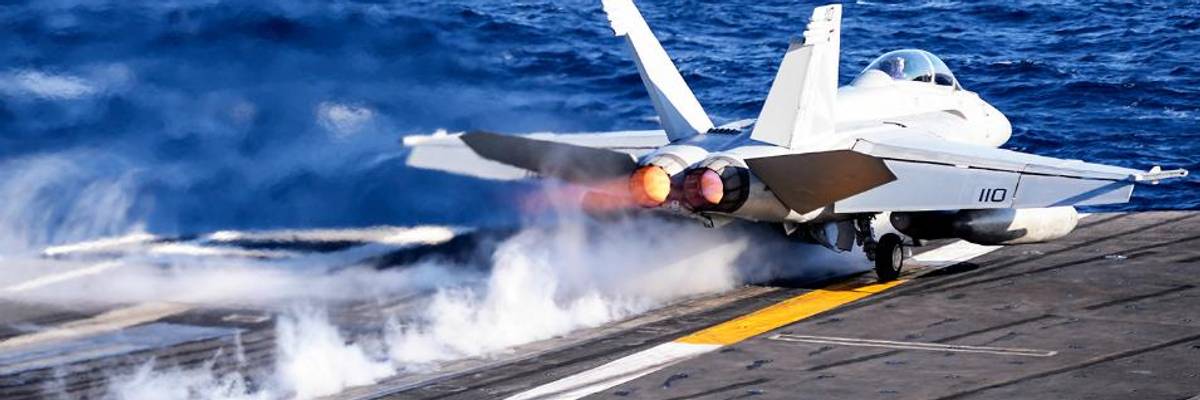
An F/A-18F Super Hornet launches from the aircraft carrier USS Nimitz. (Photo: Stocktrek Images/Getty Images)
The U.S. military's carbon bootprint is enormous. Like corporate supply chains, it relies upon an extensive global network of container ships, trucks, and cargo planes to supply its operations with everything from bombs to humanitarian aid and hydrocarbon fuels. Our new study calculated the contribution of this vast infrastructure to climate change.
If the U.S. military were a country, its fuel usage alone would make it the 47th largest emitter of greenhouse gases in the world, sitting between Peru and Portugal.
Greenhouse gas emission accounting usually focuses on how much energy and fuel civilians use. But recent work, including our own, shows that the U.S. military is one of the largest polluters in history, consuming more liquid fuels and emitting more climate-changing gases than most medium-sized countries. If the U.S. military were a country, its fuel usage alone would make it the 47th largest emitter of greenhouse gases in the world, sitting between Peru and Portugal.
In 2017, the U.S. military bought about 269,230 barrels of oil a day and emitted more than 25,000 kilotonnes of carbon dioxide by burning those fuels. The U.S. Air Force purchased $4.9 billion worth of fuel, and the Navy $2.8 billion, followed by the Army at $947 million and the Marines at $36 million.
It's no coincidence that U.S. military emissions tend to be overlooked in climate change studies. It's very difficult to get consistent data from the Pentagon and across U.S. government departments. In fact, the United States insisted on an exemption for reporting military emissions in the 1997 Kyoto Protocol. This loophole was closed by the Paris climate accord, but with the Trump administration due to withdrawal from the accord in 2020, this gap will will return.
Our study is based on data retrieved from multiple Freedom of Information Act requests to the U.S. Defense Logistics Agency, the massive bureaucratic agency tasked with managing the U.S. military's supply chains, including its hydrocarbon fuel purchases and distribution.
The U.S. military has long understood that it isn't immune from the potential consequences of climate change--recognizing it as a "threat multiplier" that can exacerbate other risks. Many, though not all, military bases have been preparing for climate change impacts like sea level rise. Nor has the military ignored its own contribution to the problem. As we have previously shown, the military has invested in developing alternative energy sources like biofuels, but these constitute only a tiny fraction of spending on fuels.
The American military's climate policy remains contradictory. There have been attempts to "green" aspects of its operations by increasing renewable electricity generation on bases, but it remains the single largest institutional consumer of hydrocarbons in the world. It has also locked itself into hydrocarbon-based weapons systems for years to come, by depending on existing aircraft and warships for open-ended operations.
Climate change has become a hot-button topic on the campaign trail for the 2020 presidential election. Leading Democratic candidates, such as Sen. Elizabeth Warren, and members of Congress like Rep. Alexandria Ocasio-Cortez are calling for major climate initiatives like the Green New Deal. For any of that to be effective, the U.S. military's carbon bootprint must be addressed in domestic policy and international climate treaties.
There are few activities on Earth as environmentally catastrophic as waging war.
Our study shows that action on climate change demands shuttering vast sections of the military machine. There are few activities on Earth as environmentally catastrophic as waging war. Significant reductions to the Pentagon's budget and shrinking its capacity to wage war would cause a huge drop in demand from the biggest consumer of liquid fuels in the world.
It does no good tinkering around the edges of the war machine's environmental impact. The money spent procuring and distributing fuel across the U.S. empire could instead be spent as a peace dividend, helping to fund a Green New Deal in whatever form it might take. There is no shortage of policy priorities that could use a funding bump. Any of these options would be better than fueling one of the largest military forces in history.
This article was originally published by The Conversation. It has been edited for YES! Magazine.
This country and this world are at a monumental crossroads. US voters have an opportunity to beat back the forces of fascism and confront the billionaires who are rigging the economy, our media system, and our democracy, making it increasingly impossible for ordinary people to get by. We’re not just talking about the election. We’re talking about what must be done once these fascist elements are vanquished from power. We need a bolder set of solutions than what either major party has so far been willing to offer and a working-class movement ready to fight like hell for it. Trump didn't emerge from nowhere. The conditions that fueled MAGA authoritarianism were created by decades of radical neoliberal economic policies and a corrupt political system dominated by corporate interests. They slashed taxes on the super-rich, promising that the benefits would trickle down. They said giveaways to the corporate titans would make life more affordable for the rest of us. It was all bullshit. And when a bitter, betrayed populace searches for someone to blame, right-wing demagogues have little trouble finding scapegoats. People know when they're being lied to, but you won't hear any of this from the corporate media. Only independent journalism—powered and funded by people who believe in building a better world—can deliver truly trustworthy daily news. If you share our vision, please contribute whatever you can to sustain our work. |
The U.S. military's carbon bootprint is enormous. Like corporate supply chains, it relies upon an extensive global network of container ships, trucks, and cargo planes to supply its operations with everything from bombs to humanitarian aid and hydrocarbon fuels. Our new study calculated the contribution of this vast infrastructure to climate change.
If the U.S. military were a country, its fuel usage alone would make it the 47th largest emitter of greenhouse gases in the world, sitting between Peru and Portugal.
Greenhouse gas emission accounting usually focuses on how much energy and fuel civilians use. But recent work, including our own, shows that the U.S. military is one of the largest polluters in history, consuming more liquid fuels and emitting more climate-changing gases than most medium-sized countries. If the U.S. military were a country, its fuel usage alone would make it the 47th largest emitter of greenhouse gases in the world, sitting between Peru and Portugal.
In 2017, the U.S. military bought about 269,230 barrels of oil a day and emitted more than 25,000 kilotonnes of carbon dioxide by burning those fuels. The U.S. Air Force purchased $4.9 billion worth of fuel, and the Navy $2.8 billion, followed by the Army at $947 million and the Marines at $36 million.
It's no coincidence that U.S. military emissions tend to be overlooked in climate change studies. It's very difficult to get consistent data from the Pentagon and across U.S. government departments. In fact, the United States insisted on an exemption for reporting military emissions in the 1997 Kyoto Protocol. This loophole was closed by the Paris climate accord, but with the Trump administration due to withdrawal from the accord in 2020, this gap will will return.
Our study is based on data retrieved from multiple Freedom of Information Act requests to the U.S. Defense Logistics Agency, the massive bureaucratic agency tasked with managing the U.S. military's supply chains, including its hydrocarbon fuel purchases and distribution.
The U.S. military has long understood that it isn't immune from the potential consequences of climate change--recognizing it as a "threat multiplier" that can exacerbate other risks. Many, though not all, military bases have been preparing for climate change impacts like sea level rise. Nor has the military ignored its own contribution to the problem. As we have previously shown, the military has invested in developing alternative energy sources like biofuels, but these constitute only a tiny fraction of spending on fuels.
The American military's climate policy remains contradictory. There have been attempts to "green" aspects of its operations by increasing renewable electricity generation on bases, but it remains the single largest institutional consumer of hydrocarbons in the world. It has also locked itself into hydrocarbon-based weapons systems for years to come, by depending on existing aircraft and warships for open-ended operations.
Climate change has become a hot-button topic on the campaign trail for the 2020 presidential election. Leading Democratic candidates, such as Sen. Elizabeth Warren, and members of Congress like Rep. Alexandria Ocasio-Cortez are calling for major climate initiatives like the Green New Deal. For any of that to be effective, the U.S. military's carbon bootprint must be addressed in domestic policy and international climate treaties.
There are few activities on Earth as environmentally catastrophic as waging war.
Our study shows that action on climate change demands shuttering vast sections of the military machine. There are few activities on Earth as environmentally catastrophic as waging war. Significant reductions to the Pentagon's budget and shrinking its capacity to wage war would cause a huge drop in demand from the biggest consumer of liquid fuels in the world.
It does no good tinkering around the edges of the war machine's environmental impact. The money spent procuring and distributing fuel across the U.S. empire could instead be spent as a peace dividend, helping to fund a Green New Deal in whatever form it might take. There is no shortage of policy priorities that could use a funding bump. Any of these options would be better than fueling one of the largest military forces in history.
This article was originally published by The Conversation. It has been edited for YES! Magazine.