
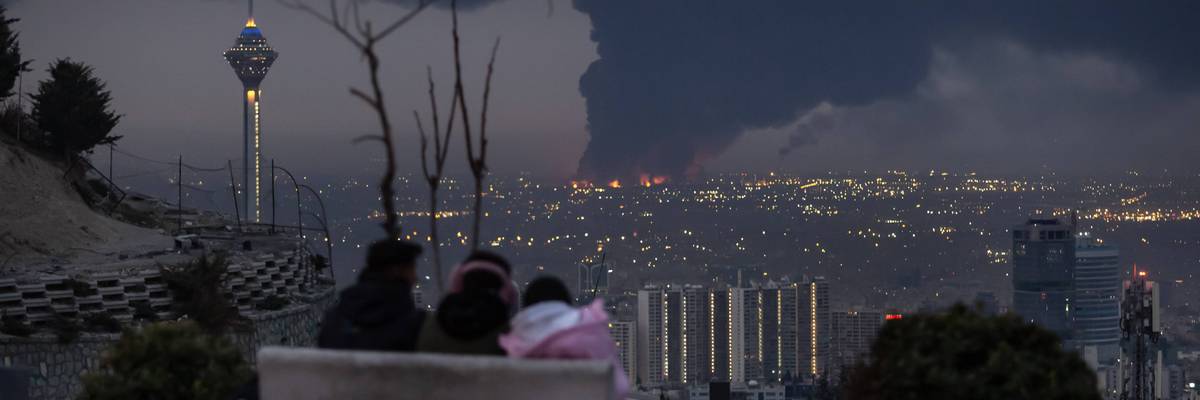
Smoke rises from Shahran oil depot after US and Israeli attacks, leaving numerous fuel tankers and vehicles in the area unusable in Tehran, Iran on March 8, 2026.
War Is Hell for People and the Earth
Given the increasing violence across the world, it is essential that the international community more seriously address the environmental impacts of war as a persistent threat to the biosphere.
By any measure, Homo sapiens is one of the most violent animals on Earth. At any one time today, humans are engaged in over 100 armed conflicts and wars across the world, many with a resource component—oil, diamonds, gold, timber, territory, water. In the 20th century alone, over 130 million people were killed directly in war, 210 million if including government killings in non-war situations. The United Nations now reports that the world is entering “a new era” of increasing violence and conflict, and that “unresolved regional tensions, a breakdown in the rule of law, absent or co-opted state institutions, illicit economic gain, and the scarcity of resources exacerbated by climate change, have become dominant drivers of conflict.” Such extraordinary intraspecific violence seems to be unique to humans.
Strict economic losses from war exceed $1 trillion each year, and global military spending continues to rise, now approaching $3 trillion annually, compared to roughly $5 billion (0.2%) per year spent on peacekeeping. Global arms sales now exceed $150 billion each year, and there are over 500 million military assault weapons in circulation.
And often overlooked in assessing the toll of war is that, in addition to its humanitarian and economic cost, war often causes severe, long-lasting impacts on the natural environment.
War significantly impacts every part of the environment—air, water, land, habitat, biodiversity. This includes massive oil spills (e.g. enormous amounts of oil and other hazardous substances spilled from thousands of ships sunk in war, Iraqi forces during the 1990-1991 Persian Gulf War intentionally releasing over 4 million barrels of oil into the Gulf and setting wellheads ablaze, the 2006 Israeli bombing of fuel depots in Lebanon causing the large Eastern Mediterranean oil spill, and millions of barrels of oil spilled in the Niger Delta conflict); air pollution from explosive detonations and fires; land contamination; wildfires; deforestation (the loss of millions of hectares of forests in Vietnam from the spraying millions of gallons of the toxic defoliant “Agent Orange,” and vast areas burned by incendiary napalm); habitat destruction (thousands of hectares of mangroves lost in Vietnam); physical impacts to land (erosion, compaction) from war machinery; and mortality of wildlife (killing tens of thousands of Norwegian reindeer during WWII, and thousands of camels killed during the 1990-1991 Gulf war). Fuel use and carbon emissions during war, and in preparation for war, are enormous, and the US military is the world’s largest institutional user of petroleum.
War and environment are reciprocal drivers of decline—environmental degradation leads to war, and war leads to environmental degradation.
But perhaps the most troubling aspect of modern civilization is the development and threatened use of nuclear weapons, now numbering roughly 14,000 across the world, with a combined explosive yield more than 360,000 times that of the Hiroshima detonation. This global nuclear weapons stockpile, many of which are on a hair-trigger ready to launch, creates significant risk of accidental launch, as well as unsecured weapons (“loose nukes”) being acquired and used by malevolent actors.
The environmental effects of full-scale nuclear war would put at risk much of human civilization and the planetary biosphere. Firestorms from a full-scale nuclear war would suspend millions of tons of black soot into the upper atmosphere, leading to abrupt and unprecedented climate impacts including “nuclear winter,” with global cooling and reduced photosynthesis, causing years of crop failures, famine, and ecological collapse.
As nuclear tensions have risen, the Bulletin of Atomic Scientists has now set its “Doomsday Clock” at 85 seconds to midnight, closer than ever in history to nuclear annihilation, a move it says “should be taken as an indication of extreme danger and an unmistakable warning that every second of delay in reversing course increases the probability of global disaster.”
We are, and must be, better than this.
UN secretaries general have called the environmental consequences of war widespread, devastating, and debilitating, prompting the initiation of the United Nations’ International Day for Preventing the Exploitation of the Environment in War and Armed Conflict (November 6).
Theoretically, all nations are governed by international rules of war, and those rules specifically prohibit inflicting unnecessary environmental harm.
For instance, Paragraph 18 of the Geneva Conventions stipulates that:
All armed forces, whether regular or irregular, should continue to observe the principles and rules of international environmental and humanitarian law to which the parties to the conflict are bound in times of peace. Natural and cultural resources shall not be pillaged under any circumstances.
In Additional Protocol I, Article 35 states:
It is prohibited to employ methods or means of warfare which are intended, or may be expected, to cause widespread, long-term, and severe damage to the natural environment.
And Protocol I, Article 55—Protection of the Natural Environment—states:
1. Care shall be taken in warfare to protect the natural environment against widespread, long-term, and severe damage. This protection includes a prohibition of the use of methods or means of warfare which are intended or may be expected to cause such damage to the natural environment and thereby to prejudice the health or survival of the population.
2. Attacks against the natural environment by way of reprisals are prohibited.
It is notable that while the US has signed, but not ratified, Protocol I, it is generally felt that the Protocol has achieved status as Customary International Law that is to be abided by all nations, irrespective of ratification.
As well, the Statute of the International Criminal Court (ICC), established by the 1998 Rome Statute, stipulates in Article 8(2)(b)(iv) that the following constitutes a war crime:
Intentionally launching an attack in the knowledge that such an attack will cause incidental loss of life or injury to civilians or damage to civilian objects or widespread, long-term, and severe damage to the natural environment which would be clearly excessive in relation to the concrete and direct overall military advantage anticipated.
While there are 129 nation-state members to the ICC-Rome Statute, several countries with significant military activities are not, and thus do not abide by its rules—e.g., the US, China, Russia, India, Israel, Egypt, Sudan, Iran, and Syria.
And unfortunately, the laudable provisions cited above are often ignored by both state actors and non-state actors, without consequence. The terms widespread, long-term, and severe are not specifically defined. And the ICC statute requires evidence of intent and knowledge in order to prosecute violators, as such, it has yet to be employed due to this high threshold. Perhaps most importantly, these rules of war lack clarity regarding accidental or collateral environmental damage, which is by far the largest environmental impact of war.
War and environment are reciprocal drivers of decline—environmental degradation leads to war, and war leads to environmental degradation. Put simply, war and environment don’t mix—war is hell on people and the natural environment.
Given the increasing violence across the world, it is essential that the international community more seriously address the environmental impacts of war as a persistent threat to the biosphere. The Geneva Conventions must be updated to specifically and unambiguously define their environmental protections; to establish an international legal mechanism—independent of nation-states—to arbitrate and prosecute claims of environmental damage from war and to impose sufficient consequences for violators; and to hold the perpetrators of conflict financially liable for environmental damage and restoration post conflict.
For now, all combatants, including those in the current Persian Gulf war, must abide by these agreed environmental protections during conflict.
An Urgent Message From Our Co-Founder
Dear Common Dreams reader, It’s been nearly 30 years since I co-founded Common Dreams with my late wife, Lina Newhouser. We had the radical notion that journalism should serve the public good, not corporate profits. It was clear to us from the outset what it would take to build such a project. No paid advertisements. No corporate sponsors. No millionaire publisher telling us what to think or do. Many people said we wouldn't last a year, but we proved those doubters wrong. Together with a tremendous team of journalists and dedicated staff, we built an independent media outlet free from the constraints of profits and corporate control. Our mission has always been simple: To inform. To inspire. To ignite change for the common good. Building Common Dreams was not easy. Our survival was never guaranteed. When you take on the most powerful forces—Wall Street greed, fossil fuel industry destruction, Big Tech lobbyists, and uber-rich oligarchs who have spent billions upon billions rigging the economy and democracy in their favor—the only bulwark you have is supporters who believe in your work. But here’s the urgent message from me today. It's never been this bad out there. And it's never been this hard to keep us going. At the very moment Common Dreams is most needed, the threats we face are intensifying. We need your support now more than ever. We don't accept corporate advertising and never will. We don't have a paywall because we don't think people should be blocked from critical news based on their ability to pay. Everything we do is funded by the donations of readers like you. When everyone does the little they can afford, we are strong. But if that support retreats or dries up, so do we. Will you donate now to make sure Common Dreams not only survives but thrives? —Craig Brown, Co-founder |
By any measure, Homo sapiens is one of the most violent animals on Earth. At any one time today, humans are engaged in over 100 armed conflicts and wars across the world, many with a resource component—oil, diamonds, gold, timber, territory, water. In the 20th century alone, over 130 million people were killed directly in war, 210 million if including government killings in non-war situations. The United Nations now reports that the world is entering “a new era” of increasing violence and conflict, and that “unresolved regional tensions, a breakdown in the rule of law, absent or co-opted state institutions, illicit economic gain, and the scarcity of resources exacerbated by climate change, have become dominant drivers of conflict.” Such extraordinary intraspecific violence seems to be unique to humans.
Strict economic losses from war exceed $1 trillion each year, and global military spending continues to rise, now approaching $3 trillion annually, compared to roughly $5 billion (0.2%) per year spent on peacekeeping. Global arms sales now exceed $150 billion each year, and there are over 500 million military assault weapons in circulation.
And often overlooked in assessing the toll of war is that, in addition to its humanitarian and economic cost, war often causes severe, long-lasting impacts on the natural environment.
War significantly impacts every part of the environment—air, water, land, habitat, biodiversity. This includes massive oil spills (e.g. enormous amounts of oil and other hazardous substances spilled from thousands of ships sunk in war, Iraqi forces during the 1990-1991 Persian Gulf War intentionally releasing over 4 million barrels of oil into the Gulf and setting wellheads ablaze, the 2006 Israeli bombing of fuel depots in Lebanon causing the large Eastern Mediterranean oil spill, and millions of barrels of oil spilled in the Niger Delta conflict); air pollution from explosive detonations and fires; land contamination; wildfires; deforestation (the loss of millions of hectares of forests in Vietnam from the spraying millions of gallons of the toxic defoliant “Agent Orange,” and vast areas burned by incendiary napalm); habitat destruction (thousands of hectares of mangroves lost in Vietnam); physical impacts to land (erosion, compaction) from war machinery; and mortality of wildlife (killing tens of thousands of Norwegian reindeer during WWII, and thousands of camels killed during the 1990-1991 Gulf war). Fuel use and carbon emissions during war, and in preparation for war, are enormous, and the US military is the world’s largest institutional user of petroleum.
War and environment are reciprocal drivers of decline—environmental degradation leads to war, and war leads to environmental degradation.
But perhaps the most troubling aspect of modern civilization is the development and threatened use of nuclear weapons, now numbering roughly 14,000 across the world, with a combined explosive yield more than 360,000 times that of the Hiroshima detonation. This global nuclear weapons stockpile, many of which are on a hair-trigger ready to launch, creates significant risk of accidental launch, as well as unsecured weapons (“loose nukes”) being acquired and used by malevolent actors.
The environmental effects of full-scale nuclear war would put at risk much of human civilization and the planetary biosphere. Firestorms from a full-scale nuclear war would suspend millions of tons of black soot into the upper atmosphere, leading to abrupt and unprecedented climate impacts including “nuclear winter,” with global cooling and reduced photosynthesis, causing years of crop failures, famine, and ecological collapse.
As nuclear tensions have risen, the Bulletin of Atomic Scientists has now set its “Doomsday Clock” at 85 seconds to midnight, closer than ever in history to nuclear annihilation, a move it says “should be taken as an indication of extreme danger and an unmistakable warning that every second of delay in reversing course increases the probability of global disaster.”
We are, and must be, better than this.
UN secretaries general have called the environmental consequences of war widespread, devastating, and debilitating, prompting the initiation of the United Nations’ International Day for Preventing the Exploitation of the Environment in War and Armed Conflict (November 6).
Theoretically, all nations are governed by international rules of war, and those rules specifically prohibit inflicting unnecessary environmental harm.
For instance, Paragraph 18 of the Geneva Conventions stipulates that:
All armed forces, whether regular or irregular, should continue to observe the principles and rules of international environmental and humanitarian law to which the parties to the conflict are bound in times of peace. Natural and cultural resources shall not be pillaged under any circumstances.
In Additional Protocol I, Article 35 states:
It is prohibited to employ methods or means of warfare which are intended, or may be expected, to cause widespread, long-term, and severe damage to the natural environment.
And Protocol I, Article 55—Protection of the Natural Environment—states:
1. Care shall be taken in warfare to protect the natural environment against widespread, long-term, and severe damage. This protection includes a prohibition of the use of methods or means of warfare which are intended or may be expected to cause such damage to the natural environment and thereby to prejudice the health or survival of the population.
2. Attacks against the natural environment by way of reprisals are prohibited.
It is notable that while the US has signed, but not ratified, Protocol I, it is generally felt that the Protocol has achieved status as Customary International Law that is to be abided by all nations, irrespective of ratification.
As well, the Statute of the International Criminal Court (ICC), established by the 1998 Rome Statute, stipulates in Article 8(2)(b)(iv) that the following constitutes a war crime:
Intentionally launching an attack in the knowledge that such an attack will cause incidental loss of life or injury to civilians or damage to civilian objects or widespread, long-term, and severe damage to the natural environment which would be clearly excessive in relation to the concrete and direct overall military advantage anticipated.
While there are 129 nation-state members to the ICC-Rome Statute, several countries with significant military activities are not, and thus do not abide by its rules—e.g., the US, China, Russia, India, Israel, Egypt, Sudan, Iran, and Syria.
And unfortunately, the laudable provisions cited above are often ignored by both state actors and non-state actors, without consequence. The terms widespread, long-term, and severe are not specifically defined. And the ICC statute requires evidence of intent and knowledge in order to prosecute violators, as such, it has yet to be employed due to this high threshold. Perhaps most importantly, these rules of war lack clarity regarding accidental or collateral environmental damage, which is by far the largest environmental impact of war.
War and environment are reciprocal drivers of decline—environmental degradation leads to war, and war leads to environmental degradation. Put simply, war and environment don’t mix—war is hell on people and the natural environment.
Given the increasing violence across the world, it is essential that the international community more seriously address the environmental impacts of war as a persistent threat to the biosphere. The Geneva Conventions must be updated to specifically and unambiguously define their environmental protections; to establish an international legal mechanism—independent of nation-states—to arbitrate and prosecute claims of environmental damage from war and to impose sufficient consequences for violators; and to hold the perpetrators of conflict financially liable for environmental damage and restoration post conflict.
For now, all combatants, including those in the current Persian Gulf war, must abide by these agreed environmental protections during conflict.
- 'Earth's Greatest Enemy' Shows Us We Have No Choice ›
- When Peace Collapses, So Does Climate: A Call for Peace Ecology ›
- Why We Can't Ignore U.S. Military Emissions ›
- At COP29, Let’s Demand Accountability From the Military-Industrial Complex ›
- More Environmental Justice Organizations Must Join the Call for a Militarism-Free Future ›
- War Is More Than What You Think It Is ›
- Opinion | Clearing the Ground Beneath Our Feet: Why Demining Is the Ultimate Environmental Act | Common Dreams ›
- Opinion | In a World at War, the Biggest Loser Is Climate | Common Dreams ›
By any measure, Homo sapiens is one of the most violent animals on Earth. At any one time today, humans are engaged in over 100 armed conflicts and wars across the world, many with a resource component—oil, diamonds, gold, timber, territory, water. In the 20th century alone, over 130 million people were killed directly in war, 210 million if including government killings in non-war situations. The United Nations now reports that the world is entering “a new era” of increasing violence and conflict, and that “unresolved regional tensions, a breakdown in the rule of law, absent or co-opted state institutions, illicit economic gain, and the scarcity of resources exacerbated by climate change, have become dominant drivers of conflict.” Such extraordinary intraspecific violence seems to be unique to humans.
Strict economic losses from war exceed $1 trillion each year, and global military spending continues to rise, now approaching $3 trillion annually, compared to roughly $5 billion (0.2%) per year spent on peacekeeping. Global arms sales now exceed $150 billion each year, and there are over 500 million military assault weapons in circulation.
And often overlooked in assessing the toll of war is that, in addition to its humanitarian and economic cost, war often causes severe, long-lasting impacts on the natural environment.
War significantly impacts every part of the environment—air, water, land, habitat, biodiversity. This includes massive oil spills (e.g. enormous amounts of oil and other hazardous substances spilled from thousands of ships sunk in war, Iraqi forces during the 1990-1991 Persian Gulf War intentionally releasing over 4 million barrels of oil into the Gulf and setting wellheads ablaze, the 2006 Israeli bombing of fuel depots in Lebanon causing the large Eastern Mediterranean oil spill, and millions of barrels of oil spilled in the Niger Delta conflict); air pollution from explosive detonations and fires; land contamination; wildfires; deforestation (the loss of millions of hectares of forests in Vietnam from the spraying millions of gallons of the toxic defoliant “Agent Orange,” and vast areas burned by incendiary napalm); habitat destruction (thousands of hectares of mangroves lost in Vietnam); physical impacts to land (erosion, compaction) from war machinery; and mortality of wildlife (killing tens of thousands of Norwegian reindeer during WWII, and thousands of camels killed during the 1990-1991 Gulf war). Fuel use and carbon emissions during war, and in preparation for war, are enormous, and the US military is the world’s largest institutional user of petroleum.
War and environment are reciprocal drivers of decline—environmental degradation leads to war, and war leads to environmental degradation.
But perhaps the most troubling aspect of modern civilization is the development and threatened use of nuclear weapons, now numbering roughly 14,000 across the world, with a combined explosive yield more than 360,000 times that of the Hiroshima detonation. This global nuclear weapons stockpile, many of which are on a hair-trigger ready to launch, creates significant risk of accidental launch, as well as unsecured weapons (“loose nukes”) being acquired and used by malevolent actors.
The environmental effects of full-scale nuclear war would put at risk much of human civilization and the planetary biosphere. Firestorms from a full-scale nuclear war would suspend millions of tons of black soot into the upper atmosphere, leading to abrupt and unprecedented climate impacts including “nuclear winter,” with global cooling and reduced photosynthesis, causing years of crop failures, famine, and ecological collapse.
As nuclear tensions have risen, the Bulletin of Atomic Scientists has now set its “Doomsday Clock” at 85 seconds to midnight, closer than ever in history to nuclear annihilation, a move it says “should be taken as an indication of extreme danger and an unmistakable warning that every second of delay in reversing course increases the probability of global disaster.”
We are, and must be, better than this.
UN secretaries general have called the environmental consequences of war widespread, devastating, and debilitating, prompting the initiation of the United Nations’ International Day for Preventing the Exploitation of the Environment in War and Armed Conflict (November 6).
Theoretically, all nations are governed by international rules of war, and those rules specifically prohibit inflicting unnecessary environmental harm.
For instance, Paragraph 18 of the Geneva Conventions stipulates that:
All armed forces, whether regular or irregular, should continue to observe the principles and rules of international environmental and humanitarian law to which the parties to the conflict are bound in times of peace. Natural and cultural resources shall not be pillaged under any circumstances.
In Additional Protocol I, Article 35 states:
It is prohibited to employ methods or means of warfare which are intended, or may be expected, to cause widespread, long-term, and severe damage to the natural environment.
And Protocol I, Article 55—Protection of the Natural Environment—states:
1. Care shall be taken in warfare to protect the natural environment against widespread, long-term, and severe damage. This protection includes a prohibition of the use of methods or means of warfare which are intended or may be expected to cause such damage to the natural environment and thereby to prejudice the health or survival of the population.
2. Attacks against the natural environment by way of reprisals are prohibited.
It is notable that while the US has signed, but not ratified, Protocol I, it is generally felt that the Protocol has achieved status as Customary International Law that is to be abided by all nations, irrespective of ratification.
As well, the Statute of the International Criminal Court (ICC), established by the 1998 Rome Statute, stipulates in Article 8(2)(b)(iv) that the following constitutes a war crime:
Intentionally launching an attack in the knowledge that such an attack will cause incidental loss of life or injury to civilians or damage to civilian objects or widespread, long-term, and severe damage to the natural environment which would be clearly excessive in relation to the concrete and direct overall military advantage anticipated.
While there are 129 nation-state members to the ICC-Rome Statute, several countries with significant military activities are not, and thus do not abide by its rules—e.g., the US, China, Russia, India, Israel, Egypt, Sudan, Iran, and Syria.
And unfortunately, the laudable provisions cited above are often ignored by both state actors and non-state actors, without consequence. The terms widespread, long-term, and severe are not specifically defined. And the ICC statute requires evidence of intent and knowledge in order to prosecute violators, as such, it has yet to be employed due to this high threshold. Perhaps most importantly, these rules of war lack clarity regarding accidental or collateral environmental damage, which is by far the largest environmental impact of war.
War and environment are reciprocal drivers of decline—environmental degradation leads to war, and war leads to environmental degradation. Put simply, war and environment don’t mix—war is hell on people and the natural environment.
Given the increasing violence across the world, it is essential that the international community more seriously address the environmental impacts of war as a persistent threat to the biosphere. The Geneva Conventions must be updated to specifically and unambiguously define their environmental protections; to establish an international legal mechanism—independent of nation-states—to arbitrate and prosecute claims of environmental damage from war and to impose sufficient consequences for violators; and to hold the perpetrators of conflict financially liable for environmental damage and restoration post conflict.
For now, all combatants, including those in the current Persian Gulf war, must abide by these agreed environmental protections during conflict.
- 'Earth's Greatest Enemy' Shows Us We Have No Choice ›
- When Peace Collapses, So Does Climate: A Call for Peace Ecology ›
- Why We Can't Ignore U.S. Military Emissions ›
- At COP29, Let’s Demand Accountability From the Military-Industrial Complex ›
- More Environmental Justice Organizations Must Join the Call for a Militarism-Free Future ›
- War Is More Than What You Think It Is ›
- Opinion | Clearing the Ground Beneath Our Feet: Why Demining Is the Ultimate Environmental Act | Common Dreams ›
- Opinion | In a World at War, the Biggest Loser Is Climate | Common Dreams ›