SUBSCRIBE TO OUR FREE NEWSLETTER
Daily news & progressive opinion—funded by the people, not the corporations—delivered straight to your inbox.
5
#000000
#FFFFFF
To donate by check, phone, or other method, see our More Ways to Give page.
Daily news & progressive opinion—funded by the people, not the corporations—delivered straight to your inbox.
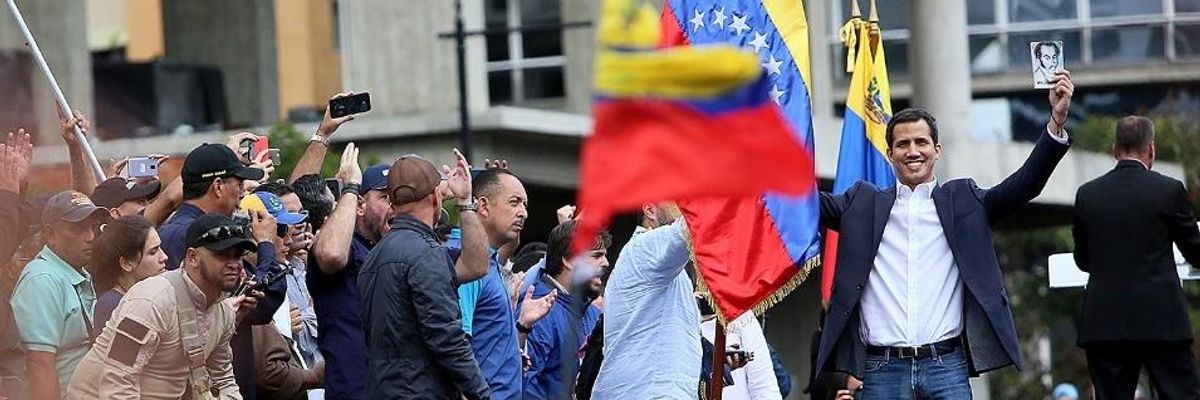
With the backing of the Trump administration, opposition leader Juan Guaido declared himself "interim president" earlier this year. (Photo: Edilzon Gamez/Getty Images)
The following is a response to this "Open Letter to the Washington Office on Latin America About Its Stance on the US Effort to Overthrow Venezuelan Government," signed by more than 120 academics and Latin American experts published earlier this week on Common Dreams.
In our 45-year history, the Washington Office on Latin America (WOLA) has built a long trajectory of criticizing both U.S. military intervention and violations of democracy and human rights in our hemisphere. In the case of Venezuela, we were one of the first U.S. human rights organizations to condemn the 2002 coup attempt in Venezuela, and have been critical of U.S. unilateral policies towards the country. We have opposed, and we continue to oppose, foreign military intervention in Venezuela.
At the same time, we have consistently denounced the accelerated attacks on Venezuela's democratic institutions and repeated human rights violations carried out in recent years by the Maduro government, including violence against protesters, crackdown on dissent, and assaults on the democratically-elected National Assembly. We have been clear that the May 2018 electoral process that Nicolas Maduro used to claim a new term lacked the fundamental guarantees of a free and fair process.
In the face of a deep political and humanitarian crisis in Venezuela, WOLA supports a non-violent, negotiated, and democratic solution to the conflict among Venezuelans, with the support of multilateral actors.
In a letter sent to us several days ago and posted on Common Dreams, a number of academic colleagues criticized our positions on Venezuela. We appreciate their concern and their willingness to engage in a principled dialogue on an issue that too often descends into personal attacks. The issues are important and it is essential that progressive activists, policymakers, and analysts be proactive in speaking about Venezuela's crisis.
That said, the letter makes numerous false or misleading assertions about the Venezuelan crisis and WOLA's positions that must be corrected. We welcome the opportunity to do so.
At the same time, it is clear that any solution to the current crisis must involve some form of negotiation between stakeholders. What we believe is much more likely to succeed is shuttle diplomacy between the two sides in which an agreement can be brokered through intermediaries, which is what the International Contact Group is doing.
Our most fundamental disagreement, and probably the one that explains our difference with the signatories of the letter, is in how we frame the problem. For the signers, this is about the United States. The letter mentions the United States twice as many time as it mentions Venezuela. What is more, the letter's mentions of Venezuela are almost exclusively as a passive subject receiving action. The only real actor mentioned in the text is the Trump administration. Most specifically, there are no descriptions of the Maduro government's assault on democratic institutions and violations of basic human rights.
For WOLA, this is about Venezuela. As a human rights organization, WOLA's central focus is on the Venezuelan people and their rights. We engage many key power players--from the Maduro government to the opposition, from the European Union to the Lima Group, and from the U.S. administration to the U.S. Congress--to cultivate and push for policies that will strengthen fulfillment of the basic rights of Venezuelans, including their democratic rights. We applaud these actors when they are constructive; we criticize them when they are not. Our goal is always to further the rights of the Venezuelan people and we take great pains to analyze Venezuela's complex reality, embedded in international context, on WOLA's Venezuela blog.
In sum, we share the letter signers' concern with U.S. foreign policy. But we believe that flattening out Venezuela's complex reality and instrumentalizing it as a chess piece in a political struggle against the Trump administration risks dehumanizing Venezuelans and desensitizing everyone to their situation.
This country and this world are at a monumental crossroads. US voters have an opportunity to beat back the forces of fascism and confront the billionaires who are rigging the economy, our media system, and our democracy, making it increasingly impossible for ordinary people to get by. We’re not just talking about the election. We’re talking about what must be done once these fascist elements are vanquished from power. We need a bolder set of solutions than what either major party has so far been willing to offer and a working-class movement ready to fight like hell for it. Trump didn't emerge from nowhere. The conditions that fueled MAGA authoritarianism were created by decades of radical neoliberal economic policies and a corrupt political system dominated by corporate interests. They slashed taxes on the super-rich, promising that the benefits would trickle down. They said giveaways to the corporate titans would make life more affordable for the rest of us. It was all bullshit. And when a bitter, betrayed populace searches for someone to blame, right-wing demagogues have little trouble finding scapegoats. People know when they're being lied to, but you won't hear any of this from the corporate media. Only independent journalism—powered and funded by people who believe in building a better world—can deliver truly trustworthy daily news. If you share our vision, please contribute whatever you can to sustain our work. |
The following is a response to this "Open Letter to the Washington Office on Latin America About Its Stance on the US Effort to Overthrow Venezuelan Government," signed by more than 120 academics and Latin American experts published earlier this week on Common Dreams.
In our 45-year history, the Washington Office on Latin America (WOLA) has built a long trajectory of criticizing both U.S. military intervention and violations of democracy and human rights in our hemisphere. In the case of Venezuela, we were one of the first U.S. human rights organizations to condemn the 2002 coup attempt in Venezuela, and have been critical of U.S. unilateral policies towards the country. We have opposed, and we continue to oppose, foreign military intervention in Venezuela.
At the same time, we have consistently denounced the accelerated attacks on Venezuela's democratic institutions and repeated human rights violations carried out in recent years by the Maduro government, including violence against protesters, crackdown on dissent, and assaults on the democratically-elected National Assembly. We have been clear that the May 2018 electoral process that Nicolas Maduro used to claim a new term lacked the fundamental guarantees of a free and fair process.
In the face of a deep political and humanitarian crisis in Venezuela, WOLA supports a non-violent, negotiated, and democratic solution to the conflict among Venezuelans, with the support of multilateral actors.
In a letter sent to us several days ago and posted on Common Dreams, a number of academic colleagues criticized our positions on Venezuela. We appreciate their concern and their willingness to engage in a principled dialogue on an issue that too often descends into personal attacks. The issues are important and it is essential that progressive activists, policymakers, and analysts be proactive in speaking about Venezuela's crisis.
That said, the letter makes numerous false or misleading assertions about the Venezuelan crisis and WOLA's positions that must be corrected. We welcome the opportunity to do so.
At the same time, it is clear that any solution to the current crisis must involve some form of negotiation between stakeholders. What we believe is much more likely to succeed is shuttle diplomacy between the two sides in which an agreement can be brokered through intermediaries, which is what the International Contact Group is doing.
Our most fundamental disagreement, and probably the one that explains our difference with the signatories of the letter, is in how we frame the problem. For the signers, this is about the United States. The letter mentions the United States twice as many time as it mentions Venezuela. What is more, the letter's mentions of Venezuela are almost exclusively as a passive subject receiving action. The only real actor mentioned in the text is the Trump administration. Most specifically, there are no descriptions of the Maduro government's assault on democratic institutions and violations of basic human rights.
For WOLA, this is about Venezuela. As a human rights organization, WOLA's central focus is on the Venezuelan people and their rights. We engage many key power players--from the Maduro government to the opposition, from the European Union to the Lima Group, and from the U.S. administration to the U.S. Congress--to cultivate and push for policies that will strengthen fulfillment of the basic rights of Venezuelans, including their democratic rights. We applaud these actors when they are constructive; we criticize them when they are not. Our goal is always to further the rights of the Venezuelan people and we take great pains to analyze Venezuela's complex reality, embedded in international context, on WOLA's Venezuela blog.
In sum, we share the letter signers' concern with U.S. foreign policy. But we believe that flattening out Venezuela's complex reality and instrumentalizing it as a chess piece in a political struggle against the Trump administration risks dehumanizing Venezuelans and desensitizing everyone to their situation.