SUBSCRIBE TO OUR FREE NEWSLETTER
Daily news & progressive opinion—funded by the people, not the corporations—delivered straight to your inbox.
5
#000000
#FFFFFF
To donate by check, phone, or other method, see our More Ways to Give page.
Daily news & progressive opinion—funded by the people, not the corporations—delivered straight to your inbox.
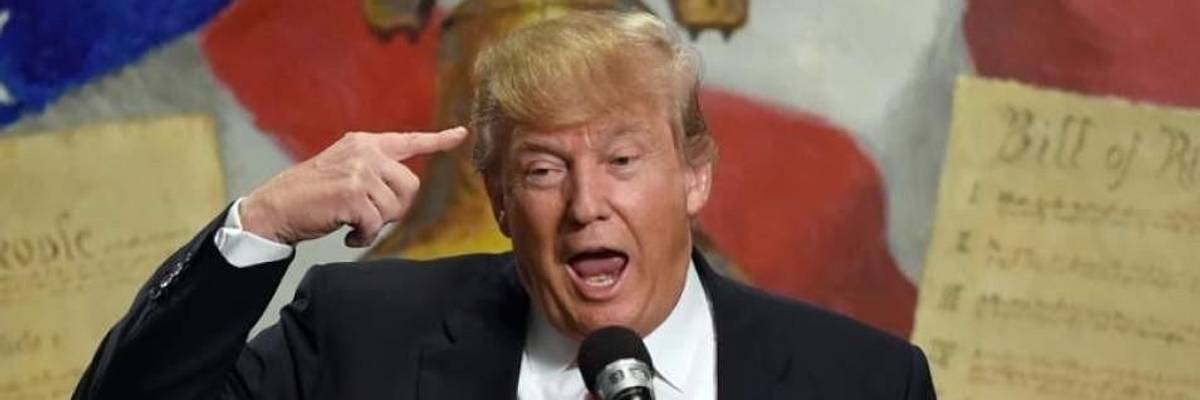
Trump thrives on divisiveness. It's how he keeps himself the center of attention, fuels his base and ensures that no matter what facts are revealed, his followers will stick by him. (Photo: AFP/Timothy A. Clary)
Donald Trump says his State of the Union address on Tuesday evening will be about "unification." But Trump discussing the state of the union is like pyromaniac discussing lighter fluids. His goal is, and has always been, disunion.
The man thrives on divisiveness. It's how he keeps himself the center of attention, fuels his base and ensures that no matter what facts are revealed, his followers will stick by him.
The man thrives on divisiveness. It's how he keeps himself the center of attention, fuels his base and ensures that no matter what facts are revealed, his followers will stick by him.
There's another reason Trump aims to divide - and why he pours salt into the nation's deepest wounds over ethnicity, immigration, race and gender.
He wants to distract attention from the biggest and most threatening divide of all: the widening imbalance of wealth and power between the vast majority, who have little or none, and a tiny minority who are accumulating just about all.
"Divide and conquer" is one of the oldest strategies in the demagogic playbook: keep the public angry at each other so they don't unite against those who are running off with the goods.
Over the last four decades, the median wage has barely budged. But the incomes of the richest 0.1% have soared by more than 300% and the incomes of the top 0.001% (the 2,300 richest Americans), by more than 600%. The net worth of the wealthiest 0.1% of Americans almost equals that of the bottom 90% combined.
This grotesque imbalance is undermining American democracy.
"The preferences of the average American appear to have only a minuscule, near-zero, statistically non-significant impact upon public policy," Martin Gilens of Princeton and Benjamin Page of Northwestern concluded a few years ago, after analyzing 1,799 policy issues that came before Congress. Lawmakers respond to the demands of wealthy individuals and moneyed business interests.
No secret here. In fact, Trump campaigned as a populist - exploiting the public's justifiable sense that the game is rigged against them. But he never attacked the American oligarchy and his divide-and-conquer strategy as president has disguised his efforts to make it even stronger.
The real question is whether, and to what extent, Pelosi and other Democrats will also unblinkingly take on America's increasing concentration of wealth and power.
His tax cuts, his evisceration of labor laws, his filling his cabinet and sub-cabinet with corporate shills, his rollbacks of health, safety, environmental and financial regulations: all have made the super-rich far richer, at the expense of average Americans.
Meanwhile, he and his fellow Republicans continue to suppress votes. Last week, the Senate Republican leader, Mitch McConnell, denounced Democratic proposals to increase turnout, even calling the idea of making election day a federal holiday "a power grab". Of course, it was a power grab - for the people.
Sitting behind Trump's left shoulder on Tuesday night when he delivers his State of the Union will be a Democratic speaker of the House, Nancy Pelosi, who refused to blink when Trump closed the government in an attempt to fund his wall at the Mexican border.
Has Trump met his match? The real question is whether, and to what extent, Pelosi and other Democrats will also unblinkingly take on America's increasing concentration of wealth and power.
In recent weeks, senators Elizabeth Warren and Bernie Sanders, both eyeing the White House, have with 29-year-old freshman congresswoman Alexandria Ocasio-Cortez called for sharp increases in taxes on the super-rich. Democratic presidential hopefuls are also proposing to expand access to health insurance by creating Medicare for all.
Polls show strong public support but the corporate Democrats who bankroll much of the party are not happy with this drift to the putative "left".
Michael Bloomberg, the billionaire former New York mayor now considering a presidential run as a Democrat, warns that when you try to redistribute wealth, you get "Venezuela". Howard Schultz, the billionaire former Starbucks chief executive who is considering an independent bid, calls Warren's plan "ridiculous."
Trump, along with the Republicans and perhaps some corporate Democrats, would rather opponents focus on the ethnic, racial and gender differences he uses to divide and conquer.
But Democratic leaders and candidates appear to understand that the largest threat to the state of the union - one that trumps all others, rendering it all but impossible to address anything else - is the deepening divide of wealth and power between the many and the few.
Dear Common Dreams reader, It’s been nearly 30 years since I co-founded Common Dreams with my late wife, Lina Newhouser. We had the radical notion that journalism should serve the public good, not corporate profits. It was clear to us from the outset what it would take to build such a project. No paid advertisements. No corporate sponsors. No millionaire publisher telling us what to think or do. Many people said we wouldn't last a year, but we proved those doubters wrong. Together with a tremendous team of journalists and dedicated staff, we built an independent media outlet free from the constraints of profits and corporate control. Our mission has always been simple: To inform. To inspire. To ignite change for the common good. Building Common Dreams was not easy. Our survival was never guaranteed. When you take on the most powerful forces—Wall Street greed, fossil fuel industry destruction, Big Tech lobbyists, and uber-rich oligarchs who have spent billions upon billions rigging the economy and democracy in their favor—the only bulwark you have is supporters who believe in your work. But here’s the urgent message from me today. It's never been this bad out there. And it's never been this hard to keep us going. At the very moment Common Dreams is most needed, the threats we face are intensifying. We need your support now more than ever. We don't accept corporate advertising and never will. We don't have a paywall because we don't think people should be blocked from critical news based on their ability to pay. Everything we do is funded by the donations of readers like you. When everyone does the little they can afford, we are strong. But if that support retreats or dries up, so do we. Will you donate now to make sure Common Dreams not only survives but thrives? —Craig Brown, Co-founder |
Donald Trump says his State of the Union address on Tuesday evening will be about "unification." But Trump discussing the state of the union is like pyromaniac discussing lighter fluids. His goal is, and has always been, disunion.
The man thrives on divisiveness. It's how he keeps himself the center of attention, fuels his base and ensures that no matter what facts are revealed, his followers will stick by him.
The man thrives on divisiveness. It's how he keeps himself the center of attention, fuels his base and ensures that no matter what facts are revealed, his followers will stick by him.
There's another reason Trump aims to divide - and why he pours salt into the nation's deepest wounds over ethnicity, immigration, race and gender.
He wants to distract attention from the biggest and most threatening divide of all: the widening imbalance of wealth and power between the vast majority, who have little or none, and a tiny minority who are accumulating just about all.
"Divide and conquer" is one of the oldest strategies in the demagogic playbook: keep the public angry at each other so they don't unite against those who are running off with the goods.
Over the last four decades, the median wage has barely budged. But the incomes of the richest 0.1% have soared by more than 300% and the incomes of the top 0.001% (the 2,300 richest Americans), by more than 600%. The net worth of the wealthiest 0.1% of Americans almost equals that of the bottom 90% combined.
This grotesque imbalance is undermining American democracy.
"The preferences of the average American appear to have only a minuscule, near-zero, statistically non-significant impact upon public policy," Martin Gilens of Princeton and Benjamin Page of Northwestern concluded a few years ago, after analyzing 1,799 policy issues that came before Congress. Lawmakers respond to the demands of wealthy individuals and moneyed business interests.
No secret here. In fact, Trump campaigned as a populist - exploiting the public's justifiable sense that the game is rigged against them. But he never attacked the American oligarchy and his divide-and-conquer strategy as president has disguised his efforts to make it even stronger.
The real question is whether, and to what extent, Pelosi and other Democrats will also unblinkingly take on America's increasing concentration of wealth and power.
His tax cuts, his evisceration of labor laws, his filling his cabinet and sub-cabinet with corporate shills, his rollbacks of health, safety, environmental and financial regulations: all have made the super-rich far richer, at the expense of average Americans.
Meanwhile, he and his fellow Republicans continue to suppress votes. Last week, the Senate Republican leader, Mitch McConnell, denounced Democratic proposals to increase turnout, even calling the idea of making election day a federal holiday "a power grab". Of course, it was a power grab - for the people.
Sitting behind Trump's left shoulder on Tuesday night when he delivers his State of the Union will be a Democratic speaker of the House, Nancy Pelosi, who refused to blink when Trump closed the government in an attempt to fund his wall at the Mexican border.
Has Trump met his match? The real question is whether, and to what extent, Pelosi and other Democrats will also unblinkingly take on America's increasing concentration of wealth and power.
In recent weeks, senators Elizabeth Warren and Bernie Sanders, both eyeing the White House, have with 29-year-old freshman congresswoman Alexandria Ocasio-Cortez called for sharp increases in taxes on the super-rich. Democratic presidential hopefuls are also proposing to expand access to health insurance by creating Medicare for all.
Polls show strong public support but the corporate Democrats who bankroll much of the party are not happy with this drift to the putative "left".
Michael Bloomberg, the billionaire former New York mayor now considering a presidential run as a Democrat, warns that when you try to redistribute wealth, you get "Venezuela". Howard Schultz, the billionaire former Starbucks chief executive who is considering an independent bid, calls Warren's plan "ridiculous."
Trump, along with the Republicans and perhaps some corporate Democrats, would rather opponents focus on the ethnic, racial and gender differences he uses to divide and conquer.
But Democratic leaders and candidates appear to understand that the largest threat to the state of the union - one that trumps all others, rendering it all but impossible to address anything else - is the deepening divide of wealth and power between the many and the few.
Donald Trump says his State of the Union address on Tuesday evening will be about "unification." But Trump discussing the state of the union is like pyromaniac discussing lighter fluids. His goal is, and has always been, disunion.
The man thrives on divisiveness. It's how he keeps himself the center of attention, fuels his base and ensures that no matter what facts are revealed, his followers will stick by him.
The man thrives on divisiveness. It's how he keeps himself the center of attention, fuels his base and ensures that no matter what facts are revealed, his followers will stick by him.
There's another reason Trump aims to divide - and why he pours salt into the nation's deepest wounds over ethnicity, immigration, race and gender.
He wants to distract attention from the biggest and most threatening divide of all: the widening imbalance of wealth and power between the vast majority, who have little or none, and a tiny minority who are accumulating just about all.
"Divide and conquer" is one of the oldest strategies in the demagogic playbook: keep the public angry at each other so they don't unite against those who are running off with the goods.
Over the last four decades, the median wage has barely budged. But the incomes of the richest 0.1% have soared by more than 300% and the incomes of the top 0.001% (the 2,300 richest Americans), by more than 600%. The net worth of the wealthiest 0.1% of Americans almost equals that of the bottom 90% combined.
This grotesque imbalance is undermining American democracy.
"The preferences of the average American appear to have only a minuscule, near-zero, statistically non-significant impact upon public policy," Martin Gilens of Princeton and Benjamin Page of Northwestern concluded a few years ago, after analyzing 1,799 policy issues that came before Congress. Lawmakers respond to the demands of wealthy individuals and moneyed business interests.
No secret here. In fact, Trump campaigned as a populist - exploiting the public's justifiable sense that the game is rigged against them. But he never attacked the American oligarchy and his divide-and-conquer strategy as president has disguised his efforts to make it even stronger.
The real question is whether, and to what extent, Pelosi and other Democrats will also unblinkingly take on America's increasing concentration of wealth and power.
His tax cuts, his evisceration of labor laws, his filling his cabinet and sub-cabinet with corporate shills, his rollbacks of health, safety, environmental and financial regulations: all have made the super-rich far richer, at the expense of average Americans.
Meanwhile, he and his fellow Republicans continue to suppress votes. Last week, the Senate Republican leader, Mitch McConnell, denounced Democratic proposals to increase turnout, even calling the idea of making election day a federal holiday "a power grab". Of course, it was a power grab - for the people.
Sitting behind Trump's left shoulder on Tuesday night when he delivers his State of the Union will be a Democratic speaker of the House, Nancy Pelosi, who refused to blink when Trump closed the government in an attempt to fund his wall at the Mexican border.
Has Trump met his match? The real question is whether, and to what extent, Pelosi and other Democrats will also unblinkingly take on America's increasing concentration of wealth and power.
In recent weeks, senators Elizabeth Warren and Bernie Sanders, both eyeing the White House, have with 29-year-old freshman congresswoman Alexandria Ocasio-Cortez called for sharp increases in taxes on the super-rich. Democratic presidential hopefuls are also proposing to expand access to health insurance by creating Medicare for all.
Polls show strong public support but the corporate Democrats who bankroll much of the party are not happy with this drift to the putative "left".
Michael Bloomberg, the billionaire former New York mayor now considering a presidential run as a Democrat, warns that when you try to redistribute wealth, you get "Venezuela". Howard Schultz, the billionaire former Starbucks chief executive who is considering an independent bid, calls Warren's plan "ridiculous."
Trump, along with the Republicans and perhaps some corporate Democrats, would rather opponents focus on the ethnic, racial and gender differences he uses to divide and conquer.
But Democratic leaders and candidates appear to understand that the largest threat to the state of the union - one that trumps all others, rendering it all but impossible to address anything else - is the deepening divide of wealth and power between the many and the few.