SUBSCRIBE TO OUR FREE NEWSLETTER
Daily news & progressive opinion—funded by the people, not the corporations—delivered straight to your inbox.
5
#000000
#FFFFFF
To donate by check, phone, or other method, see our More Ways to Give page.
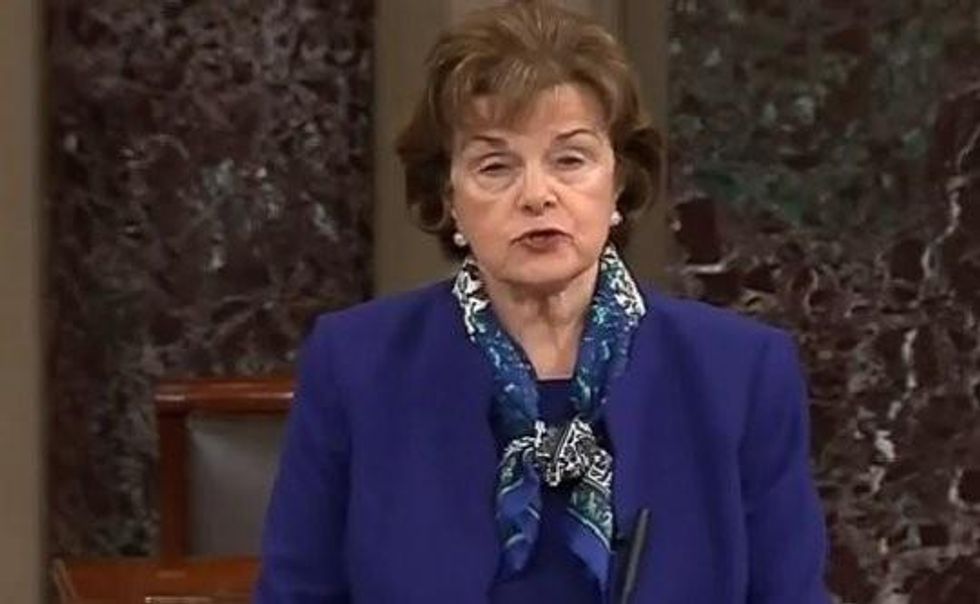
A truthful answer to that question could not possibly be "whistleblower." It may already be a historic fact that Senator Feinstein's speech on March 11, 2014 blew a whistle on CIA surveillance of the Senate intelligence committee, which she chairs. But if that makes her a whistleblower, then Colonel Sanders is a vegetarian evangelist.
"With few exceptions, what bonds those at peaks of power routinely trumps what divides them. It takes a massive and sustained uproar to really fracture the perversity of elite cohesion."
In her blockbuster Tuesday speech on the Senate floor, Feinstein charged that the CIA's intrusions on her committee's computers quite possibly "violated the Fourth Amendment." You know, that's the precious amendment that Feinstein--more than any other senator--has powerfully treated like dirt, worthy only of sweeping under the congressional rug.
A tidy defender of the NSA's Orwellian programs, Feinstein went on the attack against Edward Snowden from the outset of his revelations last June. Within days, she denounced his brave whistleblowing as "an act of treason"--a position she has maintained.
Snowden and other genuine whistleblowers actually take risks to defend the civil liberties and human rights of others, including the most vulnerable among us. Real whistleblowers choose to expose serious wrongdoing. And, if applicable, they renounce their own past complicity in doing those wrongs.
Dianne Feinstein remains in a very different place. She's 180 degrees from a whistleblower orientation; her moral compass is magnetized with solipsism as a leading guardian of the surveillance state.
This week, Feinstein stepped forward to tweak her tap dance--insisting that intrusive surveillance, so vile when directed at her and colleagues with august stature, must only be directed at others.
A huge problem is that for the USA's top movers and shakers in media and politics, nothing rises to the level of constitutional crisis unless their noble oxen start to get gored. It doesn't seem to dawn on the likes of Senator Feinstein that Fourth Amendment protections for the few are not Fourth Amendment protections at all.
More than 40 years ago, under the Nixon administration--when the U.S. government was breaking into the offices of the Socialist Workers Party, busting into the homes of members of the Black Panther Party in the middle of night with guns firing, and widely shredding the civil liberties of anti-war activists--few among ruling elites seemed to give a damn. But when news emerged that one of the two big political parties had severely transgressed against the other with a break-in at the Watergate office of the Democratic National Committee on June 17, 1972, the Republican White House had gone too far.
As spring 2014 gets underway, we might be nearing a pivotal moment when major sectors of the establishment feel compelled to recognize the arrival of a constitutional crisis. Consider how the New York Times editorialized in its Wednesday edition, declaring that Feinstein "has provided stark and convincing evidence that the CIA may have committed crimes to prevent the exposure of interrogations that she said were 'far different and far more harsh' than anything the agency had described to Congress."
In the euphemism lexicon of official Washington, "far different and far more harsh" refers to outright torture by the U.S. government.
At the surveillance-state garrison known as The Washington Post, where cognitive dissonance must be something fierce right now, quickly out of the box was conventional-wisdom columnist Dana Milbank, who portrayed Feinstein as a savvy and angelic force to be reckoned with. The adulatory logic was classic for journalists who like to conflate complicity with credibility.
Noting Feinstein's record as "an ally of Obama and a staunch defender of the administration during the controversy over the National Security Agency's surveillance programs," Milbank wrote: "So her credibility could not be questioned when she went public, reluctantly, to accuse Obama's CIA of illegal and unconstitutional actions: violating the separation of powers by searching the committee's computers and intimidating congressional staffers with bogus legal threats."
News media accounts are filled with such statements right now. On the surface, they make sense--but there's a pernicious undertow. With the underlying logic, the only time we could become sure that Wall Street malfeasance was a real problem would be if someone with the stature of Bernie Madoff stepped up to condemn it in no uncertain terms.
History tells us that we'd be deluded to depend on entrenched elites to opt for principle rather than continuity of the status quo. With few exceptions, what bonds those at peaks of power routinely trumps what divides them. It takes a massive and sustained uproar to really fracture the perversity of elite cohesion.
Consider the fact that the CIA, under the current Democratic administration, has gone to extraordinary lengths to transgress against a CIA-friendly Democratic-controlled Senate intelligence committee, in an effort to prevent anyone from being held accountable for crimes of torture committed under and by the Republican Bush administration.
While Dianne Feinstein has a long and putrid record as an enemy of civil liberties, transparency and accountability, it's also true that thieves sometimes fall out--and so do violators of the most basic democratic safeguards in the Bill of Rights. Some powerful "intelligence" scoundrels are now at each other's throats, even while continuing to brandish daggers at the heart of democracy with their contempt for such ideals as a free press, privacy and due process. The responsibility for all this goes to the very top: President Obama.
A truthful answer to that question could not possibly be "whistleblower." It may already be a historic fact that Senator Feinstein's speech on March 11, 2014 blew a whistle on CIA surveillance of the Senate intelligence committee, which she chairs. But if that makes her a whistleblower, then Colonel Sanders is a vegetarian evangelist.
"With few exceptions, what bonds those at peaks of power routinely trumps what divides them. It takes a massive and sustained uproar to really fracture the perversity of elite cohesion."
In her blockbuster Tuesday speech on the Senate floor, Feinstein charged that the CIA's intrusions on her committee's computers quite possibly "violated the Fourth Amendment." You know, that's the precious amendment that Feinstein--more than any other senator--has powerfully treated like dirt, worthy only of sweeping under the congressional rug.
A tidy defender of the NSA's Orwellian programs, Feinstein went on the attack against Edward Snowden from the outset of his revelations last June. Within days, she denounced his brave whistleblowing as "an act of treason"--a position she has maintained.
Snowden and other genuine whistleblowers actually take risks to defend the civil liberties and human rights of others, including the most vulnerable among us. Real whistleblowers choose to expose serious wrongdoing. And, if applicable, they renounce their own past complicity in doing those wrongs.
Dianne Feinstein remains in a very different place. She's 180 degrees from a whistleblower orientation; her moral compass is magnetized with solipsism as a leading guardian of the surveillance state.
This week, Feinstein stepped forward to tweak her tap dance--insisting that intrusive surveillance, so vile when directed at her and colleagues with august stature, must only be directed at others.
A huge problem is that for the USA's top movers and shakers in media and politics, nothing rises to the level of constitutional crisis unless their noble oxen start to get gored. It doesn't seem to dawn on the likes of Senator Feinstein that Fourth Amendment protections for the few are not Fourth Amendment protections at all.
More than 40 years ago, under the Nixon administration--when the U.S. government was breaking into the offices of the Socialist Workers Party, busting into the homes of members of the Black Panther Party in the middle of night with guns firing, and widely shredding the civil liberties of anti-war activists--few among ruling elites seemed to give a damn. But when news emerged that one of the two big political parties had severely transgressed against the other with a break-in at the Watergate office of the Democratic National Committee on June 17, 1972, the Republican White House had gone too far.
As spring 2014 gets underway, we might be nearing a pivotal moment when major sectors of the establishment feel compelled to recognize the arrival of a constitutional crisis. Consider how the New York Times editorialized in its Wednesday edition, declaring that Feinstein "has provided stark and convincing evidence that the CIA may have committed crimes to prevent the exposure of interrogations that she said were 'far different and far more harsh' than anything the agency had described to Congress."
In the euphemism lexicon of official Washington, "far different and far more harsh" refers to outright torture by the U.S. government.
At the surveillance-state garrison known as The Washington Post, where cognitive dissonance must be something fierce right now, quickly out of the box was conventional-wisdom columnist Dana Milbank, who portrayed Feinstein as a savvy and angelic force to be reckoned with. The adulatory logic was classic for journalists who like to conflate complicity with credibility.
Noting Feinstein's record as "an ally of Obama and a staunch defender of the administration during the controversy over the National Security Agency's surveillance programs," Milbank wrote: "So her credibility could not be questioned when she went public, reluctantly, to accuse Obama's CIA of illegal and unconstitutional actions: violating the separation of powers by searching the committee's computers and intimidating congressional staffers with bogus legal threats."
News media accounts are filled with such statements right now. On the surface, they make sense--but there's a pernicious undertow. With the underlying logic, the only time we could become sure that Wall Street malfeasance was a real problem would be if someone with the stature of Bernie Madoff stepped up to condemn it in no uncertain terms.
History tells us that we'd be deluded to depend on entrenched elites to opt for principle rather than continuity of the status quo. With few exceptions, what bonds those at peaks of power routinely trumps what divides them. It takes a massive and sustained uproar to really fracture the perversity of elite cohesion.
Consider the fact that the CIA, under the current Democratic administration, has gone to extraordinary lengths to transgress against a CIA-friendly Democratic-controlled Senate intelligence committee, in an effort to prevent anyone from being held accountable for crimes of torture committed under and by the Republican Bush administration.
While Dianne Feinstein has a long and putrid record as an enemy of civil liberties, transparency and accountability, it's also true that thieves sometimes fall out--and so do violators of the most basic democratic safeguards in the Bill of Rights. Some powerful "intelligence" scoundrels are now at each other's throats, even while continuing to brandish daggers at the heart of democracy with their contempt for such ideals as a free press, privacy and due process. The responsibility for all this goes to the very top: President Obama.
A truthful answer to that question could not possibly be "whistleblower." It may already be a historic fact that Senator Feinstein's speech on March 11, 2014 blew a whistle on CIA surveillance of the Senate intelligence committee, which she chairs. But if that makes her a whistleblower, then Colonel Sanders is a vegetarian evangelist.
"With few exceptions, what bonds those at peaks of power routinely trumps what divides them. It takes a massive and sustained uproar to really fracture the perversity of elite cohesion."
In her blockbuster Tuesday speech on the Senate floor, Feinstein charged that the CIA's intrusions on her committee's computers quite possibly "violated the Fourth Amendment." You know, that's the precious amendment that Feinstein--more than any other senator--has powerfully treated like dirt, worthy only of sweeping under the congressional rug.
A tidy defender of the NSA's Orwellian programs, Feinstein went on the attack against Edward Snowden from the outset of his revelations last June. Within days, she denounced his brave whistleblowing as "an act of treason"--a position she has maintained.
Snowden and other genuine whistleblowers actually take risks to defend the civil liberties and human rights of others, including the most vulnerable among us. Real whistleblowers choose to expose serious wrongdoing. And, if applicable, they renounce their own past complicity in doing those wrongs.
Dianne Feinstein remains in a very different place. She's 180 degrees from a whistleblower orientation; her moral compass is magnetized with solipsism as a leading guardian of the surveillance state.
This week, Feinstein stepped forward to tweak her tap dance--insisting that intrusive surveillance, so vile when directed at her and colleagues with august stature, must only be directed at others.
A huge problem is that for the USA's top movers and shakers in media and politics, nothing rises to the level of constitutional crisis unless their noble oxen start to get gored. It doesn't seem to dawn on the likes of Senator Feinstein that Fourth Amendment protections for the few are not Fourth Amendment protections at all.
More than 40 years ago, under the Nixon administration--when the U.S. government was breaking into the offices of the Socialist Workers Party, busting into the homes of members of the Black Panther Party in the middle of night with guns firing, and widely shredding the civil liberties of anti-war activists--few among ruling elites seemed to give a damn. But when news emerged that one of the two big political parties had severely transgressed against the other with a break-in at the Watergate office of the Democratic National Committee on June 17, 1972, the Republican White House had gone too far.
As spring 2014 gets underway, we might be nearing a pivotal moment when major sectors of the establishment feel compelled to recognize the arrival of a constitutional crisis. Consider how the New York Times editorialized in its Wednesday edition, declaring that Feinstein "has provided stark and convincing evidence that the CIA may have committed crimes to prevent the exposure of interrogations that she said were 'far different and far more harsh' than anything the agency had described to Congress."
In the euphemism lexicon of official Washington, "far different and far more harsh" refers to outright torture by the U.S. government.
At the surveillance-state garrison known as The Washington Post, where cognitive dissonance must be something fierce right now, quickly out of the box was conventional-wisdom columnist Dana Milbank, who portrayed Feinstein as a savvy and angelic force to be reckoned with. The adulatory logic was classic for journalists who like to conflate complicity with credibility.
Noting Feinstein's record as "an ally of Obama and a staunch defender of the administration during the controversy over the National Security Agency's surveillance programs," Milbank wrote: "So her credibility could not be questioned when she went public, reluctantly, to accuse Obama's CIA of illegal and unconstitutional actions: violating the separation of powers by searching the committee's computers and intimidating congressional staffers with bogus legal threats."
News media accounts are filled with such statements right now. On the surface, they make sense--but there's a pernicious undertow. With the underlying logic, the only time we could become sure that Wall Street malfeasance was a real problem would be if someone with the stature of Bernie Madoff stepped up to condemn it in no uncertain terms.
History tells us that we'd be deluded to depend on entrenched elites to opt for principle rather than continuity of the status quo. With few exceptions, what bonds those at peaks of power routinely trumps what divides them. It takes a massive and sustained uproar to really fracture the perversity of elite cohesion.
Consider the fact that the CIA, under the current Democratic administration, has gone to extraordinary lengths to transgress against a CIA-friendly Democratic-controlled Senate intelligence committee, in an effort to prevent anyone from being held accountable for crimes of torture committed under and by the Republican Bush administration.
While Dianne Feinstein has a long and putrid record as an enemy of civil liberties, transparency and accountability, it's also true that thieves sometimes fall out--and so do violators of the most basic democratic safeguards in the Bill of Rights. Some powerful "intelligence" scoundrels are now at each other's throats, even while continuing to brandish daggers at the heart of democracy with their contempt for such ideals as a free press, privacy and due process. The responsibility for all this goes to the very top: President Obama.