SUBSCRIBE TO OUR FREE NEWSLETTER
Daily news & progressive opinion—funded by the people, not the corporations—delivered straight to your inbox.
5
#000000
#FFFFFF
To donate by check, phone, or other method, see our More Ways to Give page.
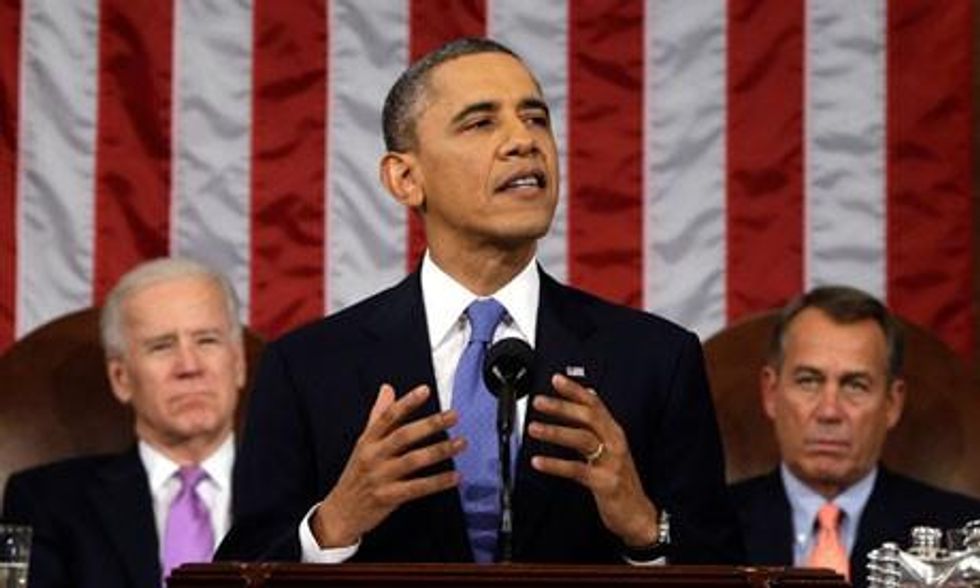
President Obama's State of the Union Address provided some solace to progressives on some issues, but left a lot to be desired on others.
He was right to point out that we can't keep "drifting from one manufactured crisis to the next"--a good, clean shot at Republican obstructionism on the fiscal cliff and sequestration.
But for the longest time in the first part of his speech, he focused on deficit reduction, which is an exaggerated problem. He said that "economists" say we need $2 trillion more in deficit reduction "to stabilize our finances." Which economists was he talking about? Not Nobel Prize-winners Joseph Stiglitz and Paul Krugman, who have urged him not to focus so much on deficit reduction but rather on job creation.
And in his discussion of deficit reduction, Obama hinted that most people are going to suffer. "We can't ask senior citizens and working families to shoulder the entire burden of deficit reduction while asking nothing more from the wealthiest and most powerful," he said. That doesn't sound like he's making a good bargain to me. Instead, it sounds like he's going to ask "senior citizens and working families" to shoulder a big part of the deficit burden, which they can't afford to do.
"[The speech] was lukewarm liberalism at home coupled with Bush-league justifications for lawlessness and hypocrisy abroad."
His endorsement of universal pre-kindergarten was a positive step. But he acted like that would even the playing field by itself, saying, "Let's . . . make sure none of our children start the race of life already behind." Actually, children in poverty are already behind, so how about tackling poverty in America? But Obama didn't talk about eliminating poverty in the American context, only in the global context.
And as for high schools, he boasted about Race to the Top, which has been a nightmare, and said he now wanted to "redesign America's high schools" so they can give students "the skills today's employers are looking for." What about giving students the skills to be engaged learners or thoughtful citizens?
On the positive side, he did come out for raising the minimum wage to $9 an hour. But why $9 an hour instead of the $10 an hour that Ralph Nader has been calling for?
He did give some welcome shout outs to LGBTS and women and the cause of equality for all.
He did come out strongly for a fairer tax code, for gun control, and for protecting voting rights.
And he spoke forcefully for action on global warming, though he favored a "market-based solution."
He proposed to rebuild the nation's infrastructure, which was welcome.
And he said he wanted to fix the housing market by allowing "every responsible homeowner in America" to refinance at today's rates. The problem is, he seems to be calling anyone who ever missed a payment an irresponsible homeowner, when they may have been unable to pay because they got sick or got laid off. Is he not going to help them at all?
He talked about comprehensive immigration reform and a pathway to citizenship, as he did in his Inaugural address. Fortunately, he added the need to "cut waiting periods," which can be 20 years or longer right now. Some people will die on that path to citizenship.
On foreign and military policy, he was the most disappointing. He threatened Iran again, saying, "Now is the time for a diplomatic solution," and warning: "We will do what is necessary to prevent them from getting a nuclear weapon."
He was blatantly one-sided on the Israel-Palestinian issue, saying, "We will stand steadfast with Israel in pursuit of security and a lasting peace." He didn't even bother to mention the Palestinians at all.
And appallingly, he defended his drone warfare and assassination policy. "Where necessary, through a range of capabilities, we will continue to take direct action against those terrorists who pose the gravest threat to Americans," he said. And in the very next sentence, he had the chutzpah to add: "As we do, we must enlist our values in the fight."
He said his Administration "has worked tirelessly to forge a durable legal and policy framework to guide our counterterrorism operations." But is it "legal" just because he and his Justice Department say it is?
He also said, in a bald-faced lie, that "throughout, we have kept Congress fully informed of our efforts." Try running that past Sen. Ron Wyden, who for months has been trying to get his questions answered on the Administration's assassination doctrine.
He also sang from the hymnal of American exceptionalism. "America must remain a beacon to all who seek freedom during this period of historic change," he said. "In the Middle East, we will stand with citizens as they demand their universal rights." Tell that to the people of Bahrain.
This was neither Obama's most eloquent defense of an affirmative role for government, nor was it close to his most honest discussion of U.S. foreign policy.
Instead, it was lukewarm liberalism at home coupled with Bush-league justifications for lawlessness and hypocrisy abroad.
President Obama's State of the Union Address provided some solace to progressives on some issues, but left a lot to be desired on others.
He was right to point out that we can't keep "drifting from one manufactured crisis to the next"--a good, clean shot at Republican obstructionism on the fiscal cliff and sequestration.
But for the longest time in the first part of his speech, he focused on deficit reduction, which is an exaggerated problem. He said that "economists" say we need $2 trillion more in deficit reduction "to stabilize our finances." Which economists was he talking about? Not Nobel Prize-winners Joseph Stiglitz and Paul Krugman, who have urged him not to focus so much on deficit reduction but rather on job creation.
And in his discussion of deficit reduction, Obama hinted that most people are going to suffer. "We can't ask senior citizens and working families to shoulder the entire burden of deficit reduction while asking nothing more from the wealthiest and most powerful," he said. That doesn't sound like he's making a good bargain to me. Instead, it sounds like he's going to ask "senior citizens and working families" to shoulder a big part of the deficit burden, which they can't afford to do.
"[The speech] was lukewarm liberalism at home coupled with Bush-league justifications for lawlessness and hypocrisy abroad."
His endorsement of universal pre-kindergarten was a positive step. But he acted like that would even the playing field by itself, saying, "Let's . . . make sure none of our children start the race of life already behind." Actually, children in poverty are already behind, so how about tackling poverty in America? But Obama didn't talk about eliminating poverty in the American context, only in the global context.
And as for high schools, he boasted about Race to the Top, which has been a nightmare, and said he now wanted to "redesign America's high schools" so they can give students "the skills today's employers are looking for." What about giving students the skills to be engaged learners or thoughtful citizens?
On the positive side, he did come out for raising the minimum wage to $9 an hour. But why $9 an hour instead of the $10 an hour that Ralph Nader has been calling for?
He did give some welcome shout outs to LGBTS and women and the cause of equality for all.
He did come out strongly for a fairer tax code, for gun control, and for protecting voting rights.
And he spoke forcefully for action on global warming, though he favored a "market-based solution."
He proposed to rebuild the nation's infrastructure, which was welcome.
And he said he wanted to fix the housing market by allowing "every responsible homeowner in America" to refinance at today's rates. The problem is, he seems to be calling anyone who ever missed a payment an irresponsible homeowner, when they may have been unable to pay because they got sick or got laid off. Is he not going to help them at all?
He talked about comprehensive immigration reform and a pathway to citizenship, as he did in his Inaugural address. Fortunately, he added the need to "cut waiting periods," which can be 20 years or longer right now. Some people will die on that path to citizenship.
On foreign and military policy, he was the most disappointing. He threatened Iran again, saying, "Now is the time for a diplomatic solution," and warning: "We will do what is necessary to prevent them from getting a nuclear weapon."
He was blatantly one-sided on the Israel-Palestinian issue, saying, "We will stand steadfast with Israel in pursuit of security and a lasting peace." He didn't even bother to mention the Palestinians at all.
And appallingly, he defended his drone warfare and assassination policy. "Where necessary, through a range of capabilities, we will continue to take direct action against those terrorists who pose the gravest threat to Americans," he said. And in the very next sentence, he had the chutzpah to add: "As we do, we must enlist our values in the fight."
He said his Administration "has worked tirelessly to forge a durable legal and policy framework to guide our counterterrorism operations." But is it "legal" just because he and his Justice Department say it is?
He also said, in a bald-faced lie, that "throughout, we have kept Congress fully informed of our efforts." Try running that past Sen. Ron Wyden, who for months has been trying to get his questions answered on the Administration's assassination doctrine.
He also sang from the hymnal of American exceptionalism. "America must remain a beacon to all who seek freedom during this period of historic change," he said. "In the Middle East, we will stand with citizens as they demand their universal rights." Tell that to the people of Bahrain.
This was neither Obama's most eloquent defense of an affirmative role for government, nor was it close to his most honest discussion of U.S. foreign policy.
Instead, it was lukewarm liberalism at home coupled with Bush-league justifications for lawlessness and hypocrisy abroad.
President Obama's State of the Union Address provided some solace to progressives on some issues, but left a lot to be desired on others.
He was right to point out that we can't keep "drifting from one manufactured crisis to the next"--a good, clean shot at Republican obstructionism on the fiscal cliff and sequestration.
But for the longest time in the first part of his speech, he focused on deficit reduction, which is an exaggerated problem. He said that "economists" say we need $2 trillion more in deficit reduction "to stabilize our finances." Which economists was he talking about? Not Nobel Prize-winners Joseph Stiglitz and Paul Krugman, who have urged him not to focus so much on deficit reduction but rather on job creation.
And in his discussion of deficit reduction, Obama hinted that most people are going to suffer. "We can't ask senior citizens and working families to shoulder the entire burden of deficit reduction while asking nothing more from the wealthiest and most powerful," he said. That doesn't sound like he's making a good bargain to me. Instead, it sounds like he's going to ask "senior citizens and working families" to shoulder a big part of the deficit burden, which they can't afford to do.
"[The speech] was lukewarm liberalism at home coupled with Bush-league justifications for lawlessness and hypocrisy abroad."
His endorsement of universal pre-kindergarten was a positive step. But he acted like that would even the playing field by itself, saying, "Let's . . . make sure none of our children start the race of life already behind." Actually, children in poverty are already behind, so how about tackling poverty in America? But Obama didn't talk about eliminating poverty in the American context, only in the global context.
And as for high schools, he boasted about Race to the Top, which has been a nightmare, and said he now wanted to "redesign America's high schools" so they can give students "the skills today's employers are looking for." What about giving students the skills to be engaged learners or thoughtful citizens?
On the positive side, he did come out for raising the minimum wage to $9 an hour. But why $9 an hour instead of the $10 an hour that Ralph Nader has been calling for?
He did give some welcome shout outs to LGBTS and women and the cause of equality for all.
He did come out strongly for a fairer tax code, for gun control, and for protecting voting rights.
And he spoke forcefully for action on global warming, though he favored a "market-based solution."
He proposed to rebuild the nation's infrastructure, which was welcome.
And he said he wanted to fix the housing market by allowing "every responsible homeowner in America" to refinance at today's rates. The problem is, he seems to be calling anyone who ever missed a payment an irresponsible homeowner, when they may have been unable to pay because they got sick or got laid off. Is he not going to help them at all?
He talked about comprehensive immigration reform and a pathway to citizenship, as he did in his Inaugural address. Fortunately, he added the need to "cut waiting periods," which can be 20 years or longer right now. Some people will die on that path to citizenship.
On foreign and military policy, he was the most disappointing. He threatened Iran again, saying, "Now is the time for a diplomatic solution," and warning: "We will do what is necessary to prevent them from getting a nuclear weapon."
He was blatantly one-sided on the Israel-Palestinian issue, saying, "We will stand steadfast with Israel in pursuit of security and a lasting peace." He didn't even bother to mention the Palestinians at all.
And appallingly, he defended his drone warfare and assassination policy. "Where necessary, through a range of capabilities, we will continue to take direct action against those terrorists who pose the gravest threat to Americans," he said. And in the very next sentence, he had the chutzpah to add: "As we do, we must enlist our values in the fight."
He said his Administration "has worked tirelessly to forge a durable legal and policy framework to guide our counterterrorism operations." But is it "legal" just because he and his Justice Department say it is?
He also said, in a bald-faced lie, that "throughout, we have kept Congress fully informed of our efforts." Try running that past Sen. Ron Wyden, who for months has been trying to get his questions answered on the Administration's assassination doctrine.
He also sang from the hymnal of American exceptionalism. "America must remain a beacon to all who seek freedom during this period of historic change," he said. "In the Middle East, we will stand with citizens as they demand their universal rights." Tell that to the people of Bahrain.
This was neither Obama's most eloquent defense of an affirmative role for government, nor was it close to his most honest discussion of U.S. foreign policy.
Instead, it was lukewarm liberalism at home coupled with Bush-league justifications for lawlessness and hypocrisy abroad.