SUBSCRIBE TO OUR FREE NEWSLETTER
Daily news & progressive opinion—funded by the people, not the corporations—delivered straight to your inbox.
5
#000000
#FFFFFF
To donate by check, phone, or other method, see our More Ways to Give page.


Daily news & progressive opinion—funded by the people, not the corporations—delivered straight to your inbox.
The president wants "your tax dollars available to compensate his political allies," a Democratic congressman said. "He's flat out trying to steal your money."
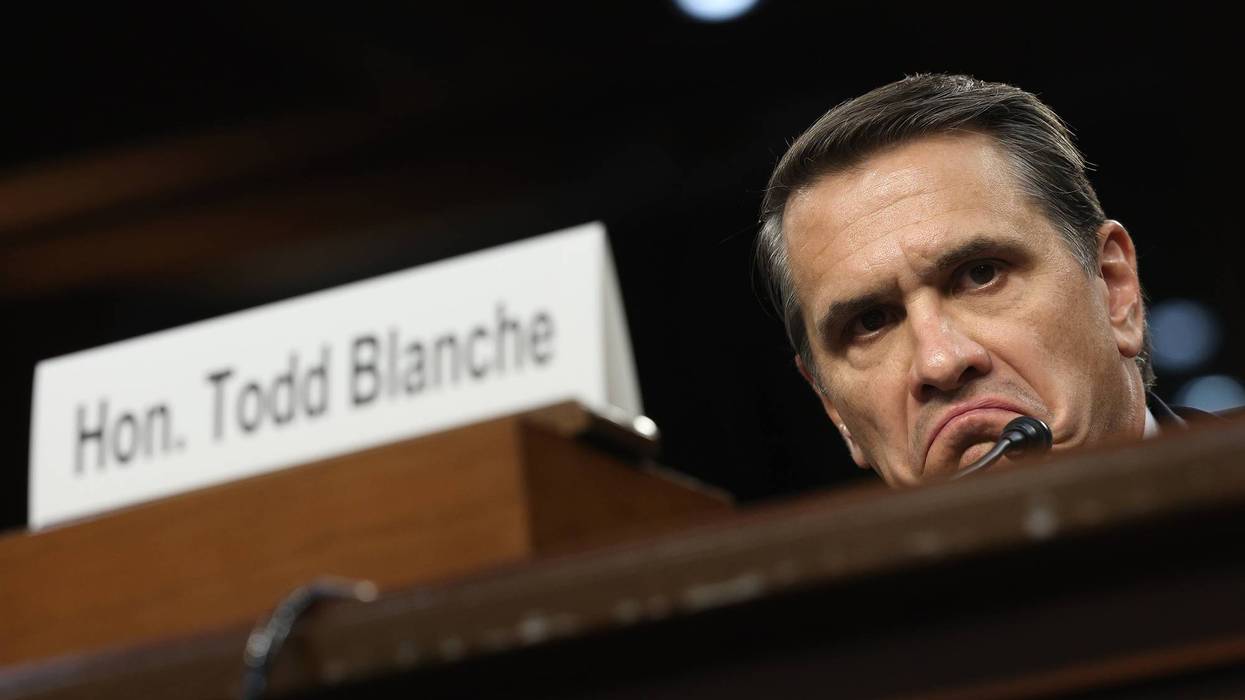
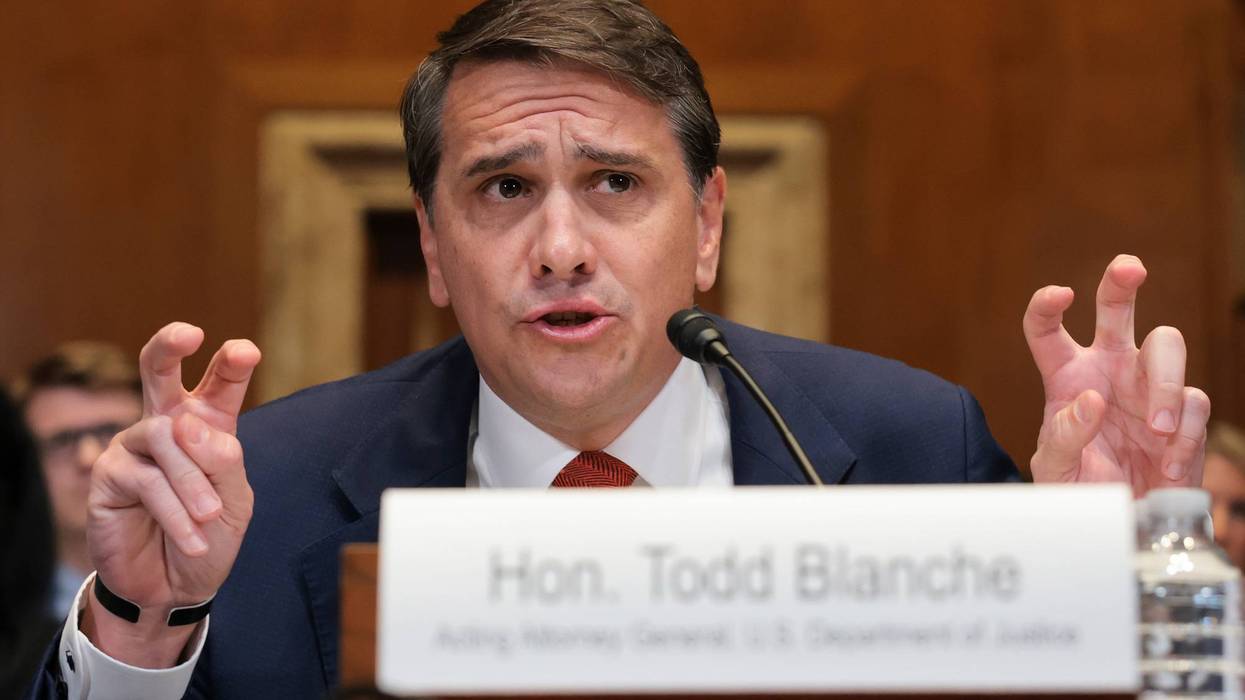
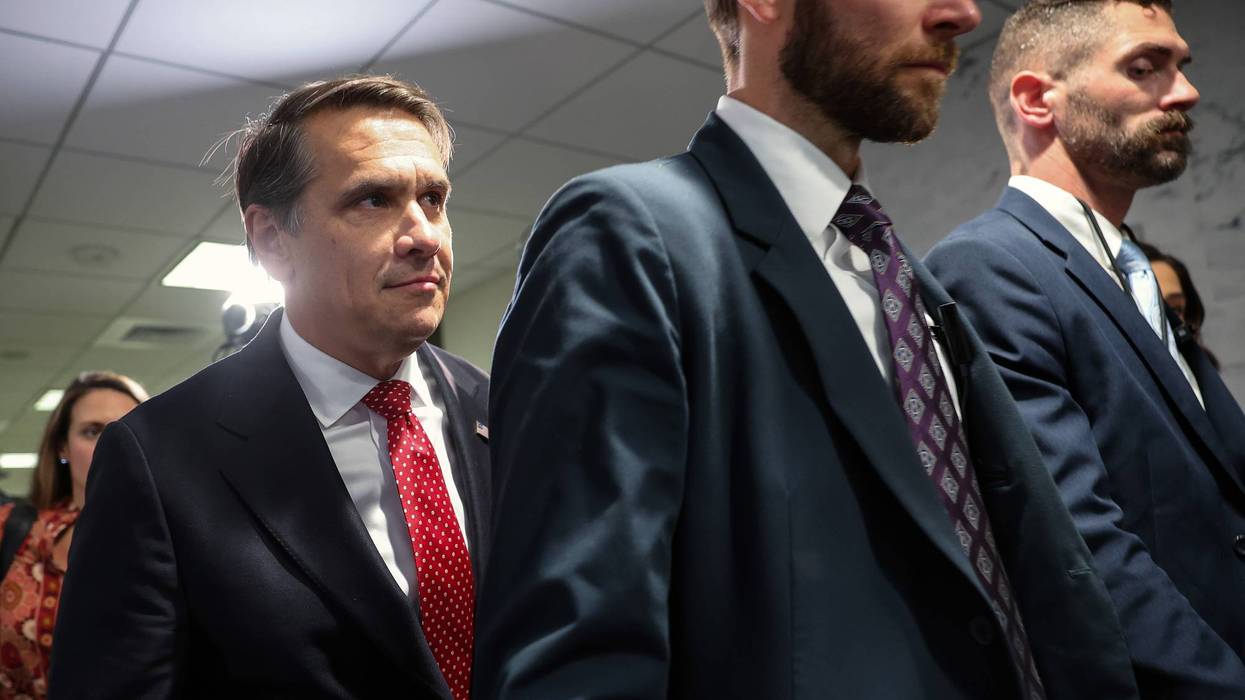
As two Republican senators continue to stand with Democrats against the nomination of Todd Blanche as US attorney general over the so-called "Anti-Weaponization Fund," President Donald Trump made clear on Saturday that he's willing to keep his former personal lawyer in the post in an acting capacity while pushing for legislation to allow the widely condemned payout scheme.
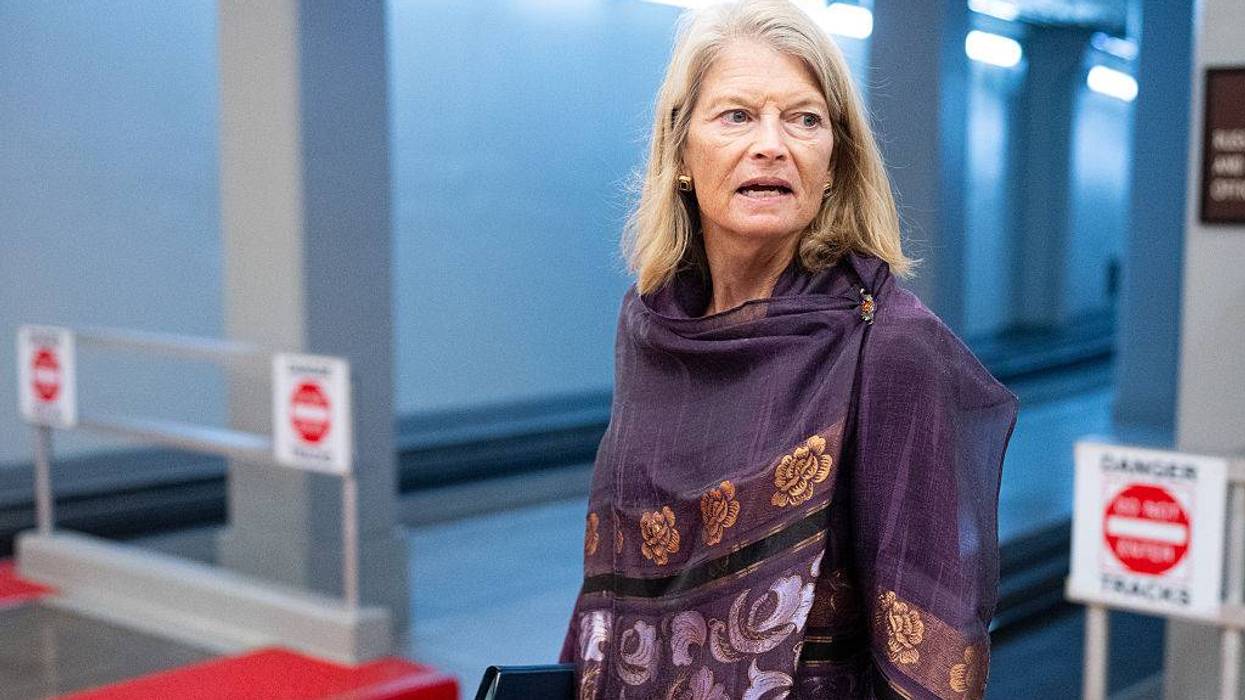
Due to the unexpected death of Sen. Lindsey Graham (R-SC), Republicans need full support on the Senate Judiciary Committee to advance Blanche, but GOP Sens. Thom Tillis (NC) and John Cornyn (Texas) have been blocking him over the $1.776 billion fund—which, in addition to an immunity deal, was part of the settlement for the Trump family's lawsuit against the Internal Revenue Service. A panel vote is rescheduled for Tuesday, but so far there's no deal.
Since US District Judge Kathleen Williams—appointed in the Southern District of Florida by former President Barack Obama—ruled against the fund last month, Blanche has indicated the US Department of Justice (DOJ) will no longer pursue the creation of the slush fund, and Trump even referred to it as "dead" on Friday. However, the Trump family also appealed to the 11th Circuit on Friday.
Responding to the appeal on Friday, Sen. Chris Van Hollen (D-Md.) said that "when I offered my amendment to kill this slush fund, Republicans said we should accept Trump's word that it was dead. We knew they were wrong. This is why. Even in the middle of an illegal war, with prices rising, Trump wants to send your tax dollars to criminals and save his sweetheart tax deal."
The president on Friday also ranted about Cornyn—who lost a May primary to a Trump-backed opponent—on his Truth Social platform, writing that "John Cornyn never had a problem with the so called 'Fund,' which will not benefit me, but rather the great American Patriots who were hunted down like dogs and whose lives were unfairly and illegally destroyed by the Crooked Joe Biden Administration, until after I decided to Endorse and Support his Republican Primary opponent in Texas, who easily won the Nomination for the United States Senate."
Trump did not mention the timeline: The DOJ announced the settlement, including the slush fund, on May 18, and the president endorsed Cornyn's scandal-plagued primary challenger, Texas Attorney General Ken Paxton, on May 19.
Instead, the president focused on the potential recipients of payouts—including January 6, 2021 insurrectionists previously pardoned by him—claiming that "perhaps there has never been a group of people treated so badly in our Nation’s history. They are suffering still, many ruined, and I felt that they should be given compensation for what has been done to them. I gave up any payments for myself, which would have been substantial, including for the illegal and unprecedented raid on Mar-a-Lago, my home in Florida, even though many legal experts, and others, including John Cornyn, said it was a shocking and disgusting display of 'weaponization' against me."
"Such an event has never happened before, and hopefully will never happen again!" Trump continued. "I will always feel that these victims of government abuse should be paid back for what they were forced to endure, their lives have been ruined! Millions of people agree with me, as was proven in my landslide Presidential win, where this was a major subject of debate, and so did John Cornyn, until he lost his Election to an opponent that I Endorsed. Todd Blanche, a good man, should be immediately approved as US Attorney General."
Tillis responded on the platform X, writing Friday that "the president made it clear today that the so-called Anti Weaponization Fund is still alive, which is exactly why we are attempting to formally end it. While I never disagreed that the Biden administration pursued a number of vindictive prosecutions related to January 6, the criminals who assaulted police officers and defiled our nation's Capitol are not 'great American patriots' who are 'victims of government abuse.' Anyone who attacked law enforcement should still be in prison, not getting a check from the federal government."
"Sen. Cornyn and I have been working with acting AG Todd Blanche to end the Anti-Weaponization Fund, and he has been forthright, thoughtful, and patient," added Tillis, who is retiring after this term. "It's a shame his confirmation has hit a snag only because an incompetent personal adviser to the president refuses to amend the bogus settlement. I will continue working in good faith to put an end [to] this legal and political albatross and prevent any potential misallocation of taxpayer dollars."
Trump then took aim at both of them on Saturday, saying that "if Senators Cornyn and Tillis, both upset because I wouldn’t Endorse them (they lost, and quit, respectively!), aren't going to approve Todd Blanche, one of the most respected professionals, according to everybody, in the Country, to be the United States Attorney General, then I will keep Todd as Acting AG, and push hard to get the Anti-Weaponization Bill, which takes care of those who have been so badly treated by the Crooked Joe Biden (and Obuma!) Administration (I get nothing, although I was treated horribly!), PASSED. Todd Blanche was a voice of reason! It will immediately be back on the table, and I will get it done."
Tillis again replied on X: "Despite comments as late as yesterday that the fund is dead, President Trump clearly intends to resurrect the payout pot for punks either by inappropriately establishing another bogus fund or pushing Congress to vote for a bill that the majority of Republicans in the Senate would be against. It's unfortunate that Todd Blanche, who I consider qualified for the job, will not be confirmed because of this reversal. Hopefully, we can resolve this by Tuesday."
Meanwhile, many elected Democrats and other critics, from advocacy group leaders to survivors of Jeffrey Epstein, don't agree Blanche is qualified, and want his nomination withdrawn. For example, after the committee vote was postponed, MoveOn Political Action chief communications officer Joel Payne said Thursday that "Todd Blanche's nomination is stalled because his record is corrupt and indefensible."
"He has spent his career proving that there is no legal principle he will not bend and no institution he will not compromise in service of Donald Trump," Payne continued. "His blind loyalty, willingness to use the justice system to protect the president, and role in a sweetheart settlement benefiting Trump make him completely unfit to serve as attorney general."
"Senate Republicans may be trying to put some distance between themselves and this toxic nomination, but moving the vote does not change the facts," he added. "Blanche is still Trump's fixer, still disqualified, and still a threat to the rule of law. The Senate should stop dragging this out and kill the nomination."
"He has spent his career proving that there is no legal principle he will not bend and no institution he will not compromise in service of Donald Trump."
President Donald Trump on Thursday said he would consider withdrawing his nomination of Todd Blanche to be US attorney general if two Republican senators refused to vote for his confirmation.
However, Trump indicated in a social media post that this would only be a temporary retreat, as he vowed to renominate Blanch, who had previously served as the president's personal attorney, after Sens. Thom Tillis (R-NC) and John Cornyn (R-Texas) are out of office when their terms at the start of next year.
Cornyn and Tillis said they would not vote to support Blanche unless he assured them that the DOJ under his leadership would not reconstitute the widely criticized $1.8 billion slush fund created for allies of the president who were supposedly hurt by the "weaponization" of the department under former President Joe Biden.
The Republican senators also want limits on Internal Revenue Service audit protections for Trump and his family, which were proposed as part of a deal to settle the president’s $10 billion lawsuit against the IRS.
In a Thursday interview with NOTUS reporter Igor Bobic, Tillis expressed bewilderment at Trump's refusal to rule out restarting the slush fund, which he said was damaging the Republican Party's chances of holding onto Congress in the 2026 midterms.
"It makes no sense to me," Tillis said. "This is not popular. The president's not winning on this issue. It is killing some of our candidates because they can't explain it. And now it looks like they weren't being honest when they said it was inoperative."
Trump critics urged the Senate to permanently bury Blanche's aspirations of becoming attorney general. (Blanche currently serves as acting head of the Justice Department.)
The social media account for Democrats on the House Judiciary Committee called on the US Senate to "reject this dangerous nomination for good and demand an attorney general who serves the Constitution and the American people, not Donald Trump and the Epstein class."
"Todd Blanche sealed his fate by refusing to disavow Trump’s $1.8 billion slush fund for cop-beating MAGA foot soldiers," the House Judiciary Democrats noted, "or retract his family-sized super pardon for the Trumps and all their businesses."
Joel Payne, chief communications officer for MoveOn Political Action, said that Blanche's nomination deserved to be killed "because his record is corrupt and indefensible."
"He has spent his career proving that there is no legal principle he will not bend and no institution he will not compromise in service of Donald Trump," Payne said. "His blind loyalty, willingness to use the justice system to protect the president, and role in a sweetheart settlement benefiting Trump make him completely unfit to serve as attorney general."
Lisa Gilbert, co-president of Public Citizen, labeled Blanche "unequivocally unfit to serve" as attorney general, as he "has enabled corruption at the highest level of government by not only permitting, but actively encouraging lawlessness, conflicts of interest, and the prioritization of the interests of the president over the interests of the American people."
"In postponing the vote, it is clear that Blanche’s nomination is hanging by a thread," Gilbert added. "Trump should concede defeat and revoke Blanche’s nomination immediately. His personal fixer must not helm the DOJ."
According to conservative legal analyst Ed Whelan, it's likely that Trump could allow Blanche to continue running the DOJ indefinitely in an acting capacity given that the US Senate already confirmed him to be deputy AG.
"It's not at all clear that the time limit under the Federal Vacancies Reform Act applies to a Deputy AG who is serving as Acting AG," Whelan wrote in a social media post. "And in any event, Blanche in his capacity as Deputy AG has virtually all of the powers of the AG. So the reality is that whether or not Blanche is confirmed as AG, he can continue to run DOJ indefinitely."
"Blanche had months to deliver on the demands both senators and the people have had of him, and he has failed, proving he only serves President Trump," said one advocacy group.
The Senate Judiciary Committee on Wednesday delayed its planned vote to advance Todd Blanche's nomination as US attorney general as the Justice Department—which he currently leads in an acting capacity—refused to commit to kill elements of a legal deal that he reached to settle President Donald Trump's $10 billion lawsuit against the Internal Revenue Service.
Sen. Chuck Grassley (R-Iowa), chair of the judiciary panel, announced that the scheduled Thursday vote on Blanche's nomination was "postponed as work continues to secure sufficient support in committee." Two key Republicans, John Cornyn of Texas and Thom Tillis of North Carolina, are demanding written commitments from Blanche that the Justice Department will not move forward with a $1.8 billion "slush fund" for Trump's political allies and will limit the reach of IRS audit protections for the Trump family—central elements of the IRS settlement.
Cornyn and Tillis appeared convinced that the so-called "anti-weaponization fund" was dead and would not be revived, but the senators expressed concern that Blanche is committed to upholding provisions of the IRS settlement that would permanently insulate Trump and his family members from tax audits. The New York Times reported that Cornyn, who lost reelection in May to corrupt Trump-backed challenger Ken Paxton, "had received no written assurances from Mr. Blanche that the audit shield would not apply to future tax liabilities or be extended to a wider circle of people."
"Maybe they think they can roll me," Cornyn told CNN, expressing astonishment at the Justice Department's foot-dragging. "We actually sent them a red line strikeout of what we need, and they just need to make a decision, and if they do, then we’ll proceed with the markup."
"We’re trying to make it easy for them," the senator added. "They won’t take the help."
Blanche's nomination has faced widespread opposition—including from the New York City Bar Association—over his handling of the Epstein files, treatment of the late sex offender's victims, and willingness to target the president's political opponents and carry out his assault on voting rights. (Blanche previously worked as Trump's personal attorney and said, "I'm his lawyer," during a confirmation hearing earlier this month.)
Omar Noureldin, senior vice president of policy and litigation at Common Cause, said in a statement late Wednesday that "Blanche had months to deliver on the demands both senators and the people have had of him, and he has failed, proving he only serves President Trump."
"Blanche should show humility and withdraw immediately," said Noureldin.
"If the Federal Reserve loses its independence, the stability of our markets and the broader economy will suffer."
The US Department of Justice's decision to open a criminal investigation into Federal Reserve Chairman Jerome Powell has ignited a major backlash that even has some Republican senators drawing a line in the sand.
Shortly after Powell released a video on Sunday accusing the Department of Justice (DOJ) of waging an "intimidation" campaign against him on behalf of President Donald Trump, Sen. Thom Tillis (R-NC) blasted the administration, accusing them of trying to compromise the independence of America's central bank.
“If there were any remaining doubt whether advisers within the Trump administration are actively pushing to end the independence of the Federal Reserve, there should now be none,” said Tillis, who further vowed to "oppose the confirmation of any nominee for the Fed—including the upcoming Fed chair vacancy—until this legal matter is fully resolved."
On Monday, Sen. Lisa Murkowski (R-Alaska) backed up Tillis' pledge to oppose any nominees for the Federal Reserve until the criminal probe of Powell, whose term as Fed chair is due to end in May, has been resolved.
Murkowski also revealed that she spoke with Powell and determined that "it’s clear the administration’s investigation is nothing more than an attempt at coercion" aimed at affecting his decisions on US monetary policy.
"The stakes are too high to look the other way," Murkowski emphasized. "If the Federal Reserve loses its independence, the stability of our markets and the broader economy will suffer."
Trump can only afford to lose the support of four Republican senators in a vote for a new Fed chair, which means Tillis and Murkowski's vows not to support any nominee until the case against Powell is resolved carry significant weight.
A bipartisan group of economists who have served under US presidents dating back to Ronald Reagan—including former Federal Reserve Chairs Alan Greenspan, Ben Bernanke, and Janet Yellin—released a joint statement on Monday denouncing what they described as an effort to strong-arm the Federal Reserve into doing the president's bidding.
"The reported criminal inquiry into Federal Reserve Chair Jay Powell is an unprecedented attempt to use prosecutorial attacks to undermine... independence," they wrote. "This is how monetary policy is made in emerging markets with weak institutions, with highly negative consequences for inflation and the functioning of their economies more broadly. It has no place in the United States, whose greatest strength is the rule of law, which is at the foundation of our economic success."
Trump, who nominated Powell to be Federal Reserve chairman in 2017, has been openly pressuring Powell for months to more aggressively cut interest rates in the face of a faltering jobs market.
Powell, however, has continued to take a more cautious approach, and has cited the price instability caused by Trump's tariffs as a reason to hold off on more aggressive rate cuts.
"They know they can't win fair and square, so they rig the maps," said the North Carolina Democratic Party. "This fight isn’t over."
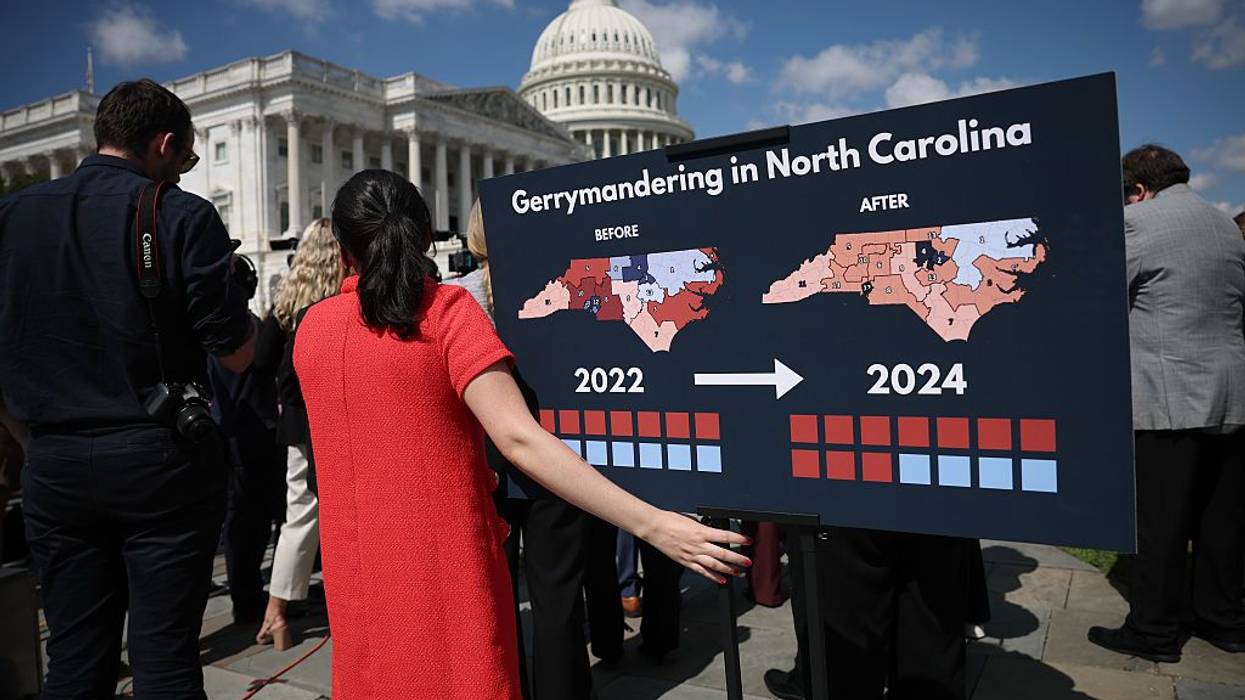
Republicans in North Carolina have passed a new congressional map that eliminates the one genuinely competitive district in the state and makes it likely the GOP will gain an extra seat in next year's midterm elections.
As reported by local news station WRAL, the new map passed on a party-line vote in the North Carolina House of Representatives on Wednesday, and will now become law, as Democratic North Carolina Gov. Josh Stein is not allowed under state law to veto redistricting legislation.
The law's passage came even as protesters flooded the House gallery ahead of the vote and chanted, "Don’t rig the maps!" and "We need healthcare, not racist maps!"
📍Raleigh, NC
Protesters escorted out of the N.C. State House gallery chanting “we need healthcare, not racist maps”
The State House is slated for to pass a new gerrymandered congressional map as soon as this afternoon. pic.twitter.com/gx8AM5KAzi
— Alex Tabet (@AlexanderTabet) October 22, 2025
The North Carolina Democratic Party lashed out at state Republicans for ramming through the new map ahead of the 2026 midterm elections.
"RIP to free and fair elections in North Carolina," the party said in a social media post. "Republicans just passed rigged maps to keep power—turning our 50/50 state into an 11-3 Republican advantage at [President Donald] Trump's request. They know they can't win fair and square, so they rig the maps. This fight isn’t over. We’ll organize, we’ll mobilize, and we’ll take it back at the ballot box."
US Rep. Don Davis (D-NC), whose seat is being targeted by the GOP redistricting plan, noted in a statement that voters in his district last year voted for both him and Trump, and he argued that "not a single" one of them had ever demanded "a new congressional map redrawing eastern North Carolina."
Republicans in the Tar Heel State redrew their congressional map as part of an unprecedented mid-decade redistricting campaign being pushed by Trump to help Republicans maintain their razor-thin majority in the US House of Representatives next year. In addition to North Carolina, both Texas and Missouri have also heeded Trump's call to redraw their maps to boost their party's chances.
However, not every North Carolina Republican is on board with the scheme, as US Sen. Thom Tillis (R-NC) on Wednesday told Spectrum News' Reuben Jones that he supported having independent redistricting panels, and warned his party that their scheme could have unintended consequences.
"You need to be careful," said Tillis, who is not seeking reelection. "North Carolina is a purple state... if you go a little bit further, you could get surprised in an election cycle, and [it will] not go your way. So just be careful what you wish for!"
As things stand now, Republicans currently have 10 of North Carolina's 14 congressional seats, and under the new map, that is projected to increase to 11 seats.
Tillis squandered a unique opportunity to protect the nation from Pete Hegseth. The country is now paying the price for his cowardice.
The incompetence of U.S. President Donald Trump’s Secretary of Defense is painfully obvious. Former Fox & Friends weekend host Pete Hegseth was never qualified for the job.
Belatedly, Sen. Thom Tillis (R-N.C.)—who became the key vote to confirm the nominee—now admits it.
Tillis squandered a unique opportunity to protect the nation from Hegseth. The country is now paying the price for his cowardice.
In a phone call with Trump just before Christmas, Tillis promised to support all of Trump’s cabinet picks. But he developed strong reservations about Pete Hegseth—strong enough to participate in a secret effort to kill the nomination. Serious issues about character, statements about barring women in combat, and allegations of sexual misconduct dogged Hegseth. He had none of the qualifications necessary to run the defense department of more than 2 million military and civilian personnel.
Other Republicans—including Sens. Joni Ernst (R-Iowa), Lisa Murkowski (R-Alaska), Susan Collins (R-Maine), and Mitch McConnell (R-Ky.)—had similar concerns. And to confirm Hegseth, Trump could afford to lose only three Republican senators. Ernst, a former combat veteran who had survived a sexual assault, capitulated to pressure from Trump’s supporters who threatened a primary challenge in her upcoming reelection. The other three—Murkowski, Collins, and McConnell—held firm.
That left Tillis. After weeks of coordinating with fellow senators to oppose the nomination, he caved. As with Ernst, the threat of a Trump-endorsed primary challenger lurked. But Tillis attributed his earlier resistance to “vetting” and said that he decided to support Hegseth after conducting “due diligence.”
Even so, his abrupt, 11th-hour reversal from “no” to “yes” surprised Murkowski and Collins. And it positioned Vice President JD Vance to cast a tie-breaking vote that put Hegseth in charge at the Pentagon by one of the narrowest margins of any defense secretary in modern history: 51 to 50.
Before long, Hegseth’s incompetence revealed itself.
In his first major overseas appearance on February 12, he “made a rookie mistake,” according to Sen. Roger Wicker (R-Miss.), chairman of the Armed Services Committee. Hegseth told NATO and Ukrainian ministers that a return to Ukraine’s pre-2014 borders was “an unrealistic objective” and ruled out NATO membership for Kyiv. Hegseth’s comments gave away Ukraine’s negotiating leverage before cease-fire negotiations with Russia had even begun.
“I don’t know who wrote the speech,” Wicker continued. “[I]t is the kind of thing Tucker Carlson could have written, and Carlson is a fool.”
Then came the “Signalgate” scandal. Hegseth was on a group chat from March 13-15 that inadvertently included the editor-in-chief of The Atlantic. The chat detailed sensitive information describing the United States’ imminent attack on Houthi rebels in Yemen.
Shortly after that scandal became public came Signalgate II. The New York Times reported that Hegseth himself had shared detailed information about the forthcoming strikes in Yemen on March 15 in a private Signal group chat that included his wife, brother, and personal lawyer.
According to the Times, “Mr. Hegseth’s wife, Jennifer, a former Fox News producer, is not a Defense Department employee, but she has traveled with him overseas and drawn criticism for accompanying her husband to sensitive meetings with foreign leaders.”
“Mr. Hegseth’s brother Phil and Tim Parlatore, who continues to serve as his personal lawyer, both have jobs in the Pentagon, but it is not clear why either would need to know about upcoming military strikes aimed at the Houthis in Yemen.”
There’s more. Recently, the public learned that Hegseth paused U.S. weapons shipments to Ukraine without informing Trump. A week later, Trump resumed the shipments.
At long last, Tillis finally found his spine—but only after announcing that he would not seek reelection in 2026. In a July 9 interview on CNN, he admitted the truth about Hegseth: “With the passing of time, I think it’s clear he’s out of his depth as a manager of a large, complex organization.”
As for Hegseth’s unilateral pause on weapons to Ukraine without informing Trump, Tillis said, “That’s just amateurish. That’s from somebody who doesn’t understand large organization dynamics.”
Would Tillis vote to confirm Hegseth today? “Now, I have the information of him being a manager, and I don’t think his probationary period has been very positive.”
In the same interview, Tillis also commented on his affirmative vote for another Trump cabinet member whose incompetence is likewise becoming clear and deadly: Health and Human Services Secretary Robert F. Kennedy Jr.
“Quite honestly, the main reason I supported Kennedy was because [Sen.] Bill Cassidy [R-La.] thought that we should see how it plays out,” Tillis said.
That cabinet pick is not playing out very well either. Just ask Sen. Cassidy.
"We have been debating amendments for 21 hours and we are still going because through 12 hours of debate and 21 hours of amendment votes, Republicans still don't have 50 votes for their bill," said Sen. Chris Murphy.
Even after an all-night session of amendment votes and wrangling behind closed doors, Senate Republicans still did not have enough support to pass their reconciliation package as of Tuesday morning, leaving party leaders scrambling to placate GOP holdovers who are purportedly nervous about the legislation's unprecedented cuts to Medicaid and federal nutrition assistance.
Sen. Chris Murphy (D-Conn.) argued in a social media post that the reason for the GOP's inability to quickly rally its own members around the legislation is straightforward: "Because it's a moral monstrosity."
"We have been debating amendments for 21 hours and we are still going because through 12 hours of debate and 21 hours of amendment votes, Republicans still don't have 50 votes for their bill," Murphy wrote at roughly 5:30 am ET, as the marathon "vote-a-rama" continued with no end in sight.
With Democrats unanimously opposed to the bill, Senate Republicans can only afford to lose three GOP votes if they are to send the measure back to the House for final approval. Sens. Rand Paul (R-Ky.) and Thom Tillis (R-N.C.) have said they will vote against the bill in its current form, and Sens. Lisa Murkowski (R-Alaska) and Susan Collins (R-Maine) are undecided. Sen. Ron Johnson (R-Wis.) also suggested he's on the fence.
Republican leaders have been working to bring Murkowski into the yes column with a proposal that would temporarily exempt Alaska and other states from the bill's massive cuts to the Supplemental Nutrition Assistance Program (SNAP). Sen. Amy Klobuchar (D-Minn.), the top Democrat on the Senate Agriculture Committee, ripped the proposal as "absurd" and said it would reward the states with the highest SNAP error rates.
"Insanity reigns," Klobuchar wrote on social media.
Senate Republicans' margins became more difficult after Sen. Thom Tillis (R-N.C.) announced his opposition to the legislation over the weekend, pointing to the Senate version's devastating cuts to Medicaid.
"What do I tell 663,000 people in two years or three years, when President Trump breaks his promise by pushing them off of Medicaid because the funding's not there anymore?" Tillis asked in a floor speech on Sunday, citing an estimate of the number of people in North Carolina who could lose health insurance under the Republican bill.
Throughout the country, nearly 12 million people would lose coverage under the Senate reconciliation bill, according to the nonpartisan Congressional Budget Office.
"Kicking millions off healthcare, blowing up the national debt by trillions, and devastating generational economic harms—all being written into law on the fly," Sen. Patty Murray (D-Wash.) said early Tuesday morning after hours of debate and amendment votes.
Sen. Thom Tillis' bill also states that the Supreme Court "shall have sole jurisdiction to decide" cases involving the Constitution's insurrection clause.
Republican U.S. Sen. Thom Tillis announced late Tuesday that he plans to introduce legislation to slash federal funding for states whose lawmakers or judges disqualify presidential candidates from the ballot, as Colorado's Supreme Court did with former President Donald Trump in a landmark ruling.
Tillis (N.C.) said in a statement following the decision that "regardless of whether you support or oppose former President Donald Trump, it is outrageous to see left-wing activists make a mockery of our political system by scheming with partisan state officials and pressuring judges to remove him from the ballot."
"American voters, not partisan activists, should decide who we elect as our president," he added.
Tillis' legislation, titled the Constitutional Election Integrity Act, would prevent federal funds from being used to "administer any election for federal office in a state that has in effect a law or policy to prohibit a candidate for the office of president who is otherwise eligible from appearing on the ballot for such office using Section 3 of the 14th Amendment to the Constitution."
The bill also states that the U.S. Supreme Court—which is likely to hear the Trump campaign's appeal of the Colorado ruling in the coming weeks—"shall have sole jurisdiction to decide" matters related to Section 3, which is known as the insurrection clause. The clause bars those who have "engaged in insurrection" from holding office.
Aaron Fritschner, deputy chief of staff for Rep. Don Beyer (D-Va.), called Tillis' bill "an idiotic response" to the Colorado Supreme Court's decision.
"If the Supreme Court overturns CO this will be unnecessary, if they uphold it will be unconstitutional," Fritschner wrote on social media.
Following Tuesday's ruling, Trump's presidential campaign expressed "full confidence" that the U.S. Supreme Court—which consists of three Trump-appointed justices—will "quickly rule in our favor and finally put an end to these un-American lawsuits."
Legal efforts to bar Trump from the 2024 ballot under the insurrection clause are currently underway in more than a dozen states across the U.S.
In recent weeks, judges in Michigan, Minnesota, and New Hampshire have ruled that Trump—who is currently facing more than 90 criminal charges, including several stemming from his incitement of the January 6, 2021 attack—can stay on the states' presidential primary ballots despite what even some conservative scholars say is a clear legal case for disqualification under the 14th Amendment.
A majority of Colorado's high court agreed with that position, ruling Tuesday that Trump's actions in the lead-up to the January 6 assault on the U.S. Capitol constituted engagement in insurrection and were therefore disqualifying under the 14th Amendment.
"We do not reach these conclusions lightly," the decision reads. "We are mindful of the magnitude and weight of the questions now before us. We are likewise mindful of our solemn duty to apply the law, without fear or favor, and without being swayed by public reaction to the decisions that the law mandates we reach."
The ruling is stayed until January 4, 2024, the day before the deadline to certify Colorado's presidential primary ballot.
"These lawmakers," said one advocate, "should answer to their constituents why they'd rather represent their industry donors at the expense of everyday families."
Residents of U.S. Rep. Patrick McHenry's home state of North Carolina won back more than $24 million from the Consumer Financial Protection Bureau's Civil Penalty Fund between 2012 and 2022—but that hasn't stopped the Republican lawmaker from spearheading an effort to significantly weaken the agency.
Government watchdog Accountable.US on Wednesday released a report detailing the money that the CFPB's Civil Penalty Fund, which compensates victims of misconduct by financial companies, has returned to the constituents of Republican lawmakers who are intent on attacking the agency—as well as the donations those same politicians have taken from the industry the CFPB regulates.
" Republicans in Congress should be celebrating the fact the Consumer Financial Protection Bureau has recouped billions of dollars for families who've been ripped off by bad actors in the financial industry," said Liz Zelnick, director of Accountable.US' Economic Security & Corporate Power program. "Instead, many Republicans are rooting for efforts to defund and defang the nation's top consumer advocate."
The group's report shows that in 10 states including North Carolina, Arizona, South Carolina, and Michigan, constituents have been awarded compensation totaling more than $240 million from the CFPB's fund.
In North Carolina, Republican Sen. Thom Tillis has joined McHenry in attacking the CFPB, accusing the bureau of "undertaking a name-and-shame campaign to coerce banks who were following the established prudential standards for the crime of listening to their previous federal regulators."
Judging from his attacks on the CFPB, said Accountable.US, Tillis "would prefer if tens of thousands of North Carolinians were vulnerable to scams from the likes of predatory lenders and greedy big banks."
Both lawmakers were among those who signed an amicus brief in support of a federal lawsuit brought by the Community Financial Services Association of America (CFSA), a group that represents the predatory payday lending industry, which aims to strike down the bureau's funding structure through the Federal Reserve. The group and a number of Republicans have claimed the CFPB should be funded through appropriations passed by Congress.
The U.S. Supreme Court is scheduled to hear arguments in the case when it reconvenes in October.
Accountable.US found that in the 10 states in its report, the Republicans who signed the amicus brief have received more than $51 million from people and political action committees affiliated with financial companies regulated by the CFPB.
McHenry has taken more than $5.4 million from the industry, while Sen. Tim Scott (R-S.C.) has received more than $4.8 million. Scott has denounced the bureau as "an agency that lacks transparency and seeks to operate beyond its jurisdiction."
Other lawmakers featured in the group's report include Rep. Ralph Norman (R-S.C.), who has taken more than $315,000 from the industry and has called the CFPB a "rogue organization" that "ought to be zeroed out"; Rep. Andy Barr (R-Ky.), who has repeatedly proposed legislation to gut the agency and has taken $3.9 million from the industry; and Senate Minority Leader Mitch McConnell (R-Ky.), who told a group of lobbyists in 2017 that he would overturn a CFPB rule preventing bans on class-action lawsuits against Wall Street companies. McConnell has taken more than $9.2 million from the industry during his career.
"The CFPB helped put money back into the pockets of over 27,000 Kentuckians," said Accountable.US, "but McConnell would rather represent his industry donors in Senate at their expense."
The agency has returned nearly $20 million to Michigan residents, $45.7 million to New Yorkers, and $28.2 million to Pennsylvanians—but Republican lawmakers who represent those states have also signed the amicus brief in the CFSA case and have collectively taken millions of dollars from the industry the CFPB is tasked with regulating.
"The industry's goal," said Accountable.US, is to "leave everyday families vulnerable to tricks, debt traps, discrimination, and outright scams from the likes of predatory lenders and greedy big banks."
The group's report suggested that goal is shared by many GOP lawmakers.
"These lawmakers," said Zelnick, "should answer to their constituents why they'd rather represent their industry donors at the expense of everyday families."
A new analysis shows Republicans on the Senate Judiciary Committee have received more than $450,000 from the same GOP megadonor who has lavished Justice Clarence Thomas with undisclosed gifts.
The Senate Judiciary Committee on Monday sent a letter asking Harlan Crow—the billionaire GOP megadonor who has secretly showered U.S. Supreme Court Justice Clarence Thomas with hundreds of thousands of dollars in gifts since the mid-1990s—to provide a full accounting of his financial ties to Thomas and any other judges on the high court.
It comes as "no surprise" that none of the panel's nine Republicans signed the letter, Accountable.US declared Tuesday, because they have collectively accepted nearly half a million dollars in campaign cash from Crow since the turn of the century, as a new analysis from the watchdog group shows.
Last month, one day after ProPublica published its bombshell report on Crow's under-the-table funding of near-annual luxury vacations for Thomas—the first of what would become many revelations about the two men's financial relationship—Accountable.US calculated that the current Republican members of the Senate Judiciary Committee received $453,300 from Crow between 2001 and 2022. The group revised that figure up to $457,000 on Tuesday in light of a $3,700 donation Crow made to Sen. John Cornyn (R-Texas) earlier this year.
The following is a list of Crow's total contributions to the nine GOP lawmakers on the panel as well as their affiliated PACs and joint fundraising committees, in descending order:
"There should be bipartisan outrage about the undisclosed gifts and travel billionaire megadonor Harlan Crow has given Justice Thomas," Accountable.US president Kyle Herrig said last month. "Senate Judiciary Republicans should join their Democratic colleagues to act. However, their silence so far may be because they have received hundreds of thousands of dollars from Crow as well."
"The highest court in the land should have the highest ethical standards," he added. "When it doesn't, Congress should exert its oversight authority."
Not only have Republicans on the Senate Judiciary Committee with apparent conflicts of interest refused to join their Democratic colleagues in trying to establish enforceable ethics rules for the Supreme Court, but they have attempted to downplay the seriousness of the court's growing crisis of legitimacy.
Several of the panel's GOP members used last week's hearing on proposed Supreme Court ethics reforms—a hearing Chief Justice John Roberts refused to testify at despite mounting evidence of possible corruption involving Thomas and others, including Roberts himself as well as Justice Neil Gorsuch—as "an opportunity for political grandstanding and performative outrage," Accountable.US noted Tuesday.
"Cornyn claimed Congress did not have the authority to regulate the courts due to separation of powers—a claim that was disproven by an expert witness that testified at the hearing," Accountable.US pointed out. "Cruz claimed the hearing was not about judicial ethics, but instead, was an attempt to attack Justice Thomas for having rich friends."
Lee went so far as to say that "when this chapter of American history is written, those who attack Justice Thomas today will be justly dismissed as intolerant bigots."
Meanwhile, Graham, the ranking member, accused the left of trying to "delegitimize the court and cherry-pick examples to make a point." Echoing his right-wing ally, Grassley argued that recent revelations are part of a long-term effort to "cast doubt on certain judges and justices, all because the left is opposed to recent court rulings."
Kennedy, for his part, denounced "attacks on conservative justices" as "targeted" and "exaggerated" and dismissed proposed Supreme Court ethics rules as "unnecessary."
Two days after right-wing senators accused reform advocates of launching what Cruz called a "smear campaign" against Thomas, ProPublica revealed that Crow also paid tens of thousands of dollars for the jurist's grandnephew to attend a pair of elite private schools. This came after earlier exposés about Crow footing the bill for yacht trips, buying and remodeling Thomas' mother's home, and more.
Given the mounting evidence of potential connections between Crow's gifts, which Thomas sought to keep hidden, and Thomas' inclination to rule in ways favorable to his superrich benefactor, calls for the judge to resign or face impeachment are growing.
Not only does Crow have links to numerous right-wing groups involved in Supreme Court cases since Thomas was first confirmed to the bench in 1991, but his own real estate company, Crow Holdings, was directly implicated in a 2021 case before the court.
As The Lever reported last month, Thomas voted to end the Covid-era federal eviction moratorium after Crow Holdings called the lifesaving policy a threat to its "profit margins." Now, as a group of New York City landlords prepares to ask the high court to overturn local rent control laws condemned by Crow Holdings—a move that would endanger rent stabilization efforts nationwide—"there is no indication" Thomas would recuse himself, the outlet noted.
Moreover, as Common Dreams reported last week, an Americans for Tax Fairness analysis of campaign finance data shows that after Thomas provided a deciding vote in the Citizens United v. Federal Election Commission case, the Crow family's average annual campaign contributions soared by 862%, from $163,241 before 2010 to $1.57 million since.
This massive increase, which is partly reflected in Crow's donations to Republicans on the Senate Judiciary Committee, underscores how the 5-4 ruling that effectively legalized unlimited political spending has strengthened the wealthy's ability to shape electoral outcomes, further undermining U.S. democracy.
On Tuesday, The Lever argued that the main goal of Crow and other billionaires who provide gifts and outside money to members of the Supreme Court is not to obtain certain decisions in specific cases, given that the court's right-wing ideologues would likely rule conservatively anyway, but to prevent GOP appointees from becoming more liberal over time—a phenomenon that has occurred in the past.
Alluding to Monday's letter from Senate Judiciary Committee Chair Dick Durbin (D-Ill.), The Washington Post reported that "if Crow ignores the request for information by the committee's May 22 deadline, it's unclear what Durbin's next move would be."
The San Francisco Chronicle reported Tuesday that Sen. Dianne Feinstein (D-Calif.) is returning to Capitol Hill after an illness kept her away from the Senate since February. Feinstein's absence has left Durbin without a majority on the panel, enabling the GOP minority to impede action, but her return would open up options.
In an interview with CNN on Sunday, Durbin did not rule out the possibility of a subpoena, saying that "everything is on the table."
In addition to the implementation of robust ethics rules, progressives have called for other far-reaching changes to disempower the country's "rogue" Supreme Court justices, including expanding the court. Seats have been added seven times throughout U.S. history.
Polling data shows that public approval of the nation's chief judicial body has decreased sharply in the months since its reactionary supermajority eliminated the constitutional right to abortion care, among other harmful and unpopular decisions. According to a survey conducted last month, nearly two-thirds of U.S. adults no longer have confidence in the high court.