

SUBSCRIBE TO OUR FREE NEWSLETTER
Daily news & progressive opinion—funded by the people, not the corporations—delivered straight to your inbox.
5
#000000
#FFFFFF
To donate by check, phone, or other method, see our More Ways to Give page.
Daily news & progressive opinion—funded by the people, not the corporations—delivered straight to your inbox.
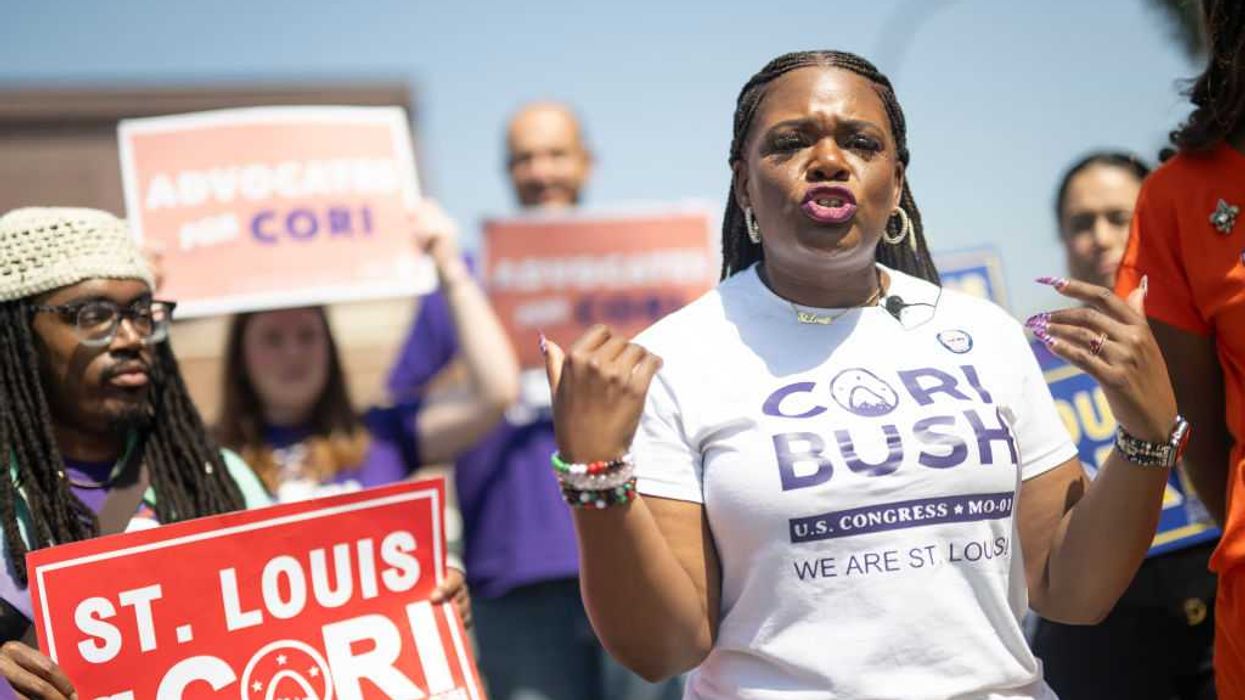
"I’m running again because St. Louis deserves leadership that doesn’t wait for permission, doesn’t answer to wealthy donors, and doesn’t hide when things get tough."
Former Democratic Congresswoman Cori Bush is running again in Missouri to reclaim the US House seat from which she was ousted last year amid a tsunami of campaign spending against her and other progressives by the Israel lobby.
"St. Louis deserves a leader who is built different. That’s why I’m running to represent Missouri’s 1st District in Congress," Bush announced Friday on social media. "We need a fighter who will lower costs, protect our communities, and make life fairer. I’ll be that fighter."
“I ran for Congress to change things for regular people,” Bush says in her first 2026 campaign ad. “I’m running again because St. Louis deserves leadership that doesn’t wait for permission, doesn’t answer to wealthy donors, and doesn’t hide when things get tough.”
Bush—a two-term member of the so-called "Squad" of progressive House lawmakers—was defeated in her district's August 2024 Democratic primary by current Rep. Wesley Bell (D-Mo.), a former county prosecutor.
Nearly two-thirds of Bell's campaign funding came from one source: The American Israel Public Affairs Committee's independent expenditures arm and conduit for dark money, the United Democracy Project, which allocated more than $100 million toward defeating candidates AIPAC deemed insufficiently supportive of Israel.
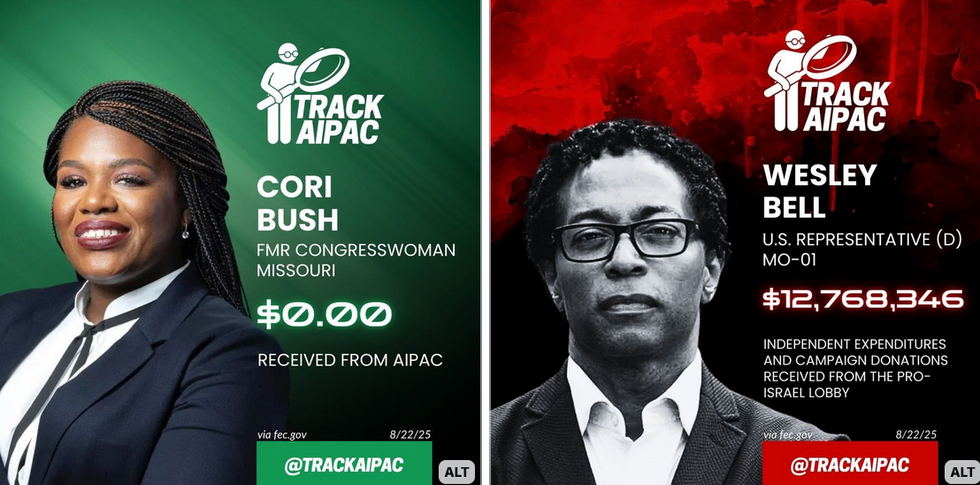 (Image by @TrackAIPAC/X)
UDP also spent heavily last year to defeat then-Congressman Jamaal Bowman (D-NY) and to help thwart the Democratic congressional candidacy of Susheela Jayapal in Oregon and former Republican Congressman John Hostettler's comeback bid in Indiana.
AIPAC's largesse was stoked by Bush's steadfast advocacy for Palestine and staunch opposition to Israel's genocidal war on Gaza. It was Bush who, just over a week into Israel's genocidal retaliation for the Hamas-led October 7 attack, introduced the first House ceasefire resolution.
Bush was also one of the first lawmakers to call Israel's annihilation and starvation of Gaza a genocide—as countless observers have since done, including numerous members of Congress, national governments and leaders, jurists, Holocaust scholars, and United Nations experts.
However, it was championing the needs and values of her overwhelmingly working-class community that propelled Bush—who rose to prominence during the Ferguson, Missouri protests against the police killing of unarmed Black man Michael Brown—to her 2020 Democratic primary victory over an opponent whose family had held the 1st Congressional District seat for half a century.
For example, during the Covid-19 pandemic, Bush led a five-day sit-in outside Congress, where she slept rough with other Squad members and persuaded the Biden administration to extend a temporary eviction moratorium. She also secured hundreds of millions of dollars in economic recovery funds via the American Rescue Plan signed by former President Joe Biden in 2021.
While Bell dismissed Bush's comeback bid by contending that "the headlines and controversies of the past aren’t what we need," progressives cheered her reentry into the political arena.
The political action group Our Revolution quickly endorsed Bush, as it had previously done.
BIG NEWS: Cori Bush could officially announced her run for Congress 👀🔥The nurse. The activist. The Congresswoman who camped on the Capitol steps to stop evictions. The one who never backed down. 👇 🧵
[image or embed]
— Our Revolution (@our-revolution.bsky.social) October 3, 2025 at 7:51 AM
"Cori Bush embodies the values of our movement—she is a nurse, a pastor, and an activist who rose up from Ferguson to fight for working families in Congress,” Our Revolution executive director Joseph Geevarghese said in a statement. “She has been a fearless advocate for Medicare for All, student debt cancellation, housing rights, climate justice, and an end to US military support of Israel."
"That’s why oligarchs and dark money super PACs spent millions to buy this seat and silence her voice," he added. "But they cannot silence the people she represents, and Our Revolution is proud to stand with her as she takes back the people’s seat in Missouri’s 1st.”
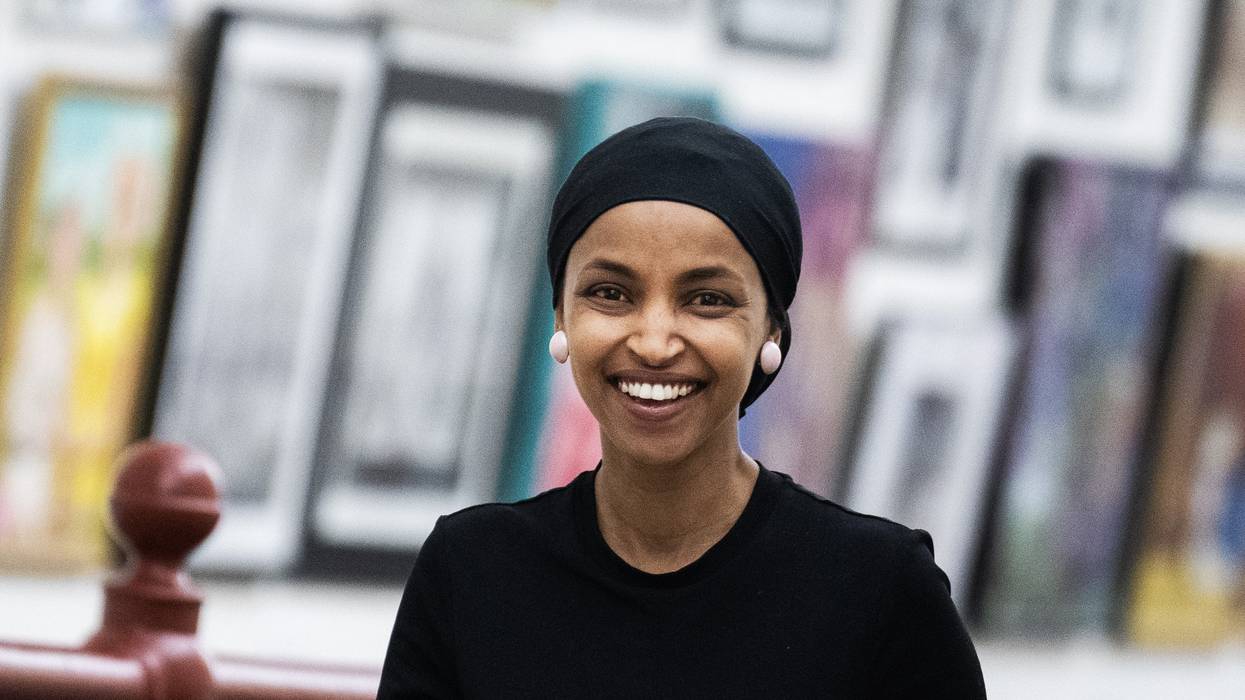
"Whether it's universal school meals, student debt cancellation, climate action, or a just foreign policy that reflects our values—the 5th District showed tonight that we want to drive the nation toward a better future."
U.S. Rep. Ilhan Omar handily won her primary race in Minnesota's 5th District on Tuesday, effectively securing her reelection to Congress in the face of an onslaught of pro-Israel cash aimed at unseating progressive supporters of a Gaza cease-fire and other popular policy positions.
Omar defeated her main challenger, former Minneapolis city councilmember Don Samuels, by more than 16,000 votes after narrowly fending him off in 2022. The American Israel Public Affairs Committee (AIPAC), which has spent aggressively to defeat other members of the progressive "Squad," did not get heavily involved in the Minnesota race after its attempt to recruit a different challenger failed.
Samuels' campaign did receive a late boost from pro-Israel donors—including a flurry of contributions following Rep. Cori Bush's (D-Mo.) primary loss to an AIPAC-backed Democrat last week—but Omar enjoyed a significant fundraising and spending advantage.
"I am honored that my community voted to send me back to Congress," Omar, the deputy chair of the Congressional Progressive Caucus, said after The Associated Press called the race in her favor. "Tonight's victory shows that the 5th District believes in the collective values we are fighting for in Washington."
"Whether it's universal school meals, student debt cancellation, climate action, or a just foreign policy that reflects our values—the 5th District showed tonight that we want to drive the nation toward a better future," she continued. "And our work is far from over. From protecting reproductive healthcare to reforming the Supreme Court to ending the genocide in Gaza to combatting the climate crisis—we will continue to fight for a more just world."
Tonight, special interests lost and our movement won. Thank you to everyone who was a part of it. Every single person who contributed made this moment possible.
— Ilhan Omar (@IlhanMN) August 14, 2024
Omar's decisive victory in a primary that was open to voters of all party affiliations came after candidates bankrolled by AIPAC's super PAC succeeded in defeating Bush and Rep. Jamaal Bowman (D-N.Y.) in two of the most expensive congressional primaries in U.S. history. Along with Omar, Bush and Bowman are among Congress' most vocal supporters of a Gaza cease-fire.
A Politico analysis found that AIPAC has been "the biggest source of Republican money flowing into competitive Democratic primaries this year." The lobbying organization has spent nearly $25 million on elections in 2024.
Justice Democrats, a progressive advocacy group that has been working to counter AIPAC's influence in Democratic primaries, acknowledged in the wake of Omar's win Tuesday that "our movement has suffered immeasurable losses this cycle."
"But the backlash from monied corporate and right-wing interests proves not only are we succeeding, but our mandate to elect more Justice Democrats and take big money out of politics is abundantly clear," the group added. "The greatest obstacle to Democrats delivering the agenda they have promised the American people is the influence of corporate super PACs and lobbies buying our party's inaction. We must show our voters that a brighter future is possible, if we fight for it."
Joseph Geevarghese, executive director of Our Revolution—a group that backed Omar's campaign—said Tuesday that the Minnesota progressive's victory was "a powerful rebuke to the influence of corporate money in our democracy."
"Her commitment to bold, progressive policies—whether it's climate action, Medicare for All, or standing up for a permanent cease-fire and end to unconditional aid to Israel—resonates deeply with her constituents," said Geevarghese. "The Democratic Party must take note: To secure victories in 2024 and beyond, they must embrace the policies that truly address the struggles of working families, and reject the influence of dark money that seeks to undermine our democracy."
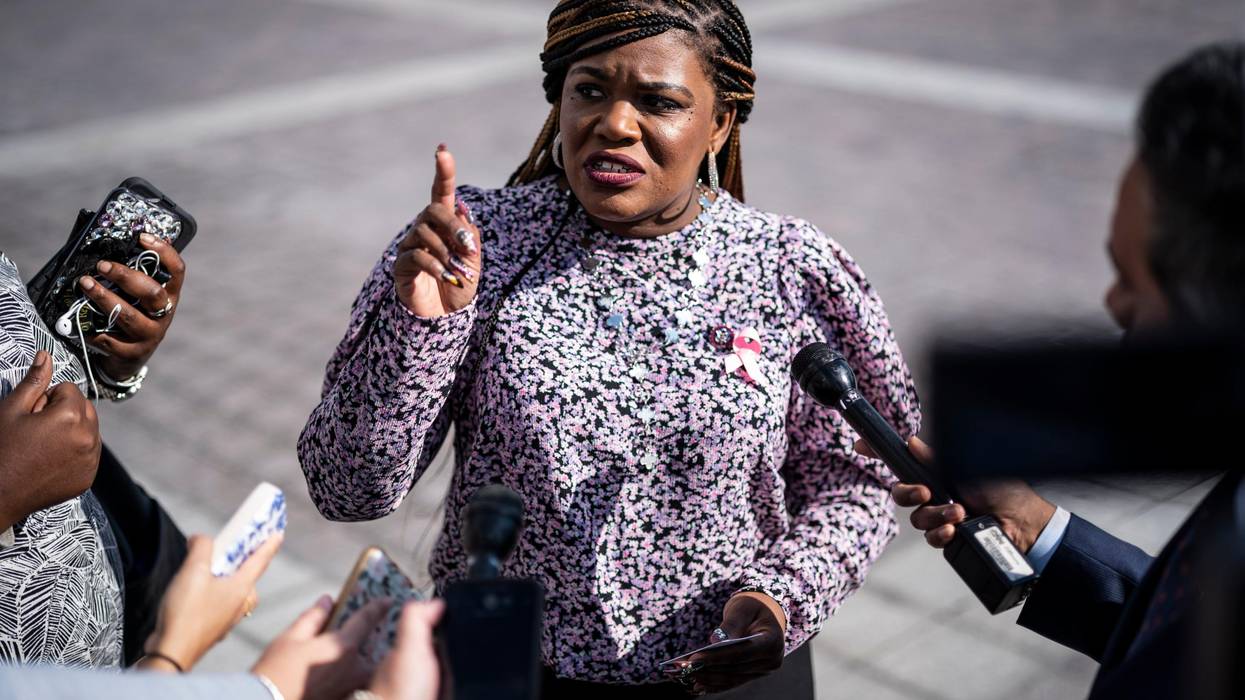
The progressive lawmaker's defeat in her Democratic primary is a tremendous blow to progressives and to the U.S. electoral process itself.
Representative Cori Bush, a progressive black woman from St. Louis, Missouri who is a member of “the Squad” in the U.S. House and has been a powerful voice in Congress for poor people, women’s rights, healthcare, housing–and Palestine—just lost her primary because pro-Israel lobby groups flooded the race with outside funding. Her loss is a tremendous blow to progressives and to the U.S. electoral process itself.
This is the pro-Israel lobby’s second “win” of the season. The first was the June defeat of progressive, black congressman from Westchester County, N.Y., Jamaal Bowman, who was a forceful critic of Israel’s attacks on Gaza. AIPAC and its mis-named super PAC, the United Democracy Project, barged into Westchester County to anoint an opponent—white, pro-Israel Westchester County Executive George Latimer—and then shower him with cash.
The ads against Bowman were not about Israel. Instead, AIPAC smeared the congressman’s character and criticized him as a “hot head” who was not a reliable member of the Democratic team. In the words of President of the Arab American Institute Jim Zogby, the race became “the angry, frightening young black man versus the calm, thoughtful older white guy.”
By throwing $17 million into the race, pro-Israel groups turned Bowman’s primary into the most expensive one in U.S. history. When Bowman was defeated, AIPAC declared the outcome showed that the pro-Israel position is “both good policy and good politics.” On the contrary, what it really showed was that pro-Israel groups can buy elections and send a frightening message to all elected officials that if they criticize Israel, even during a genocide, they may well pay with their careers.
AIPAC hides the Israel issue and then claims the “win” is a victory for Israel.
Buoyed by its success, AIPAC then took on Cori Bush, marching into her district determined to defeat a black woman who was one of the most unique voices in all of congress. Once a unhoused single mother of two, and a survivor of gun violence, domestic violence and sexual assault, Bush became a nurse and a pastor, and in the wake of the killing of the unarmed black man Michael Brown in Ferguson in 2014, she became an activist on the frontlines of the movement to save black lives. After protesting in the streets for 400 days, she jumped into the political arena. In 2020 made a successful run for Congress, becoming the first black representative from Missouri.
In Bush’s two terms in Congress, she demonstrated leadership on many fronts, including reproductive justice and abortion rights. At a House of Representatives committee hearing in 2021, Bush was one of three congresswomen to share her abortion story publicly. And after the Dobbs decision that overturned Roe v. Wade, she introduced a host of bills, including the Reproductive Health Care Accessibility Act, the Protecting Access to Medication Abortion Act, the Reproductive Health Travel Fund Act, and the Protect Sexual and Reproductive Health Act.
She also championed housing rights. When the Covid-19 moratorium on evictions was about to expire, she grabbed her sleeping bag and lawn chair, and organized a “sleep in” on the steps of the U.S. Capitol that resulted in an extension of the moratorium on evictions.
Foreign policy was not her focus, but in the wake of the Hamas attack on October 9, 2023 and Israel’s subsequent bombing of civilians in Gaza, Bush felt compelled to speak out. Just nine days after the October 7 Hamas attack, she had the courage to introduce a ceasefire resolution in the House. She was one of only nine House members who opposed a resolution supporting Israel. She boycotted Israeli Prime Minister Benjamin Netanyahu’s speech before Congress, calling him a “war criminal.”
As a result of defending Palestinians, she found herself in AIPAC’s crosshairs. “Cori Bush has been one of the most hostile critics of Israel since she came to Congress in 2021 and has actively worked to undermine mainstream Democratic support for the U.S.-Israel relationship, “ AIPAC claimed.
AIPAC’s super PAC spent nearly $9 million, much of it coming from Republican mega-donors, to buy ads smearing Bush and shoring up contender Wesley Bell, a St. Louis County Prosecutor. The attacks were vicious, including ads that darkened Bush’s skin and manipulated her racial features. They also distorted her domestic voting record, condemning her for not supporting Biden’s Infrastructure Bill instead of explaining that her vote was part of a strategy to gain leverage for key social programs in the Build Back Better Act.
Curiously, in the cases of both Bowman and Bush, the attack ads did not even mention Israel. But if Israel is AIPAC’s singular focus, why did the ads avoid the issue? That’s because most Americans, especially in those liberal Democrat districts, agree with their positions. Most Americans want a ceasefire and disapprove of Israel’s military actions in Gaza. As Jewish Voice for Peace executive director Stephanie Fox said during a call to rally support for the Congresswoman Bush, “She has been a life raft for our values and principles in Congress and she has been under attack because far right extremist groups like AIPAC are scared.”
Jim Zogby of the Arab American Institute agrees. “Pro-Israel groups are running scared,” he said. “They are losing the public debate over policy—especially among Democrats. Most Democrats are deeply opposed to Israeli policies in Gaza and the Occupied Palestinian lands. Majorities want a ceasefire and an end to settlements. And they want to stop further arms shipments to Israel.” So AIPAC hides the Israel issue and then claims the “win” is a victory for Israel.
If we are going to stop U.S. support for Israel’s genocide, prevent the Middle East from erupting in flames and reclaim our elections here at home, we have to stop AIPAC.
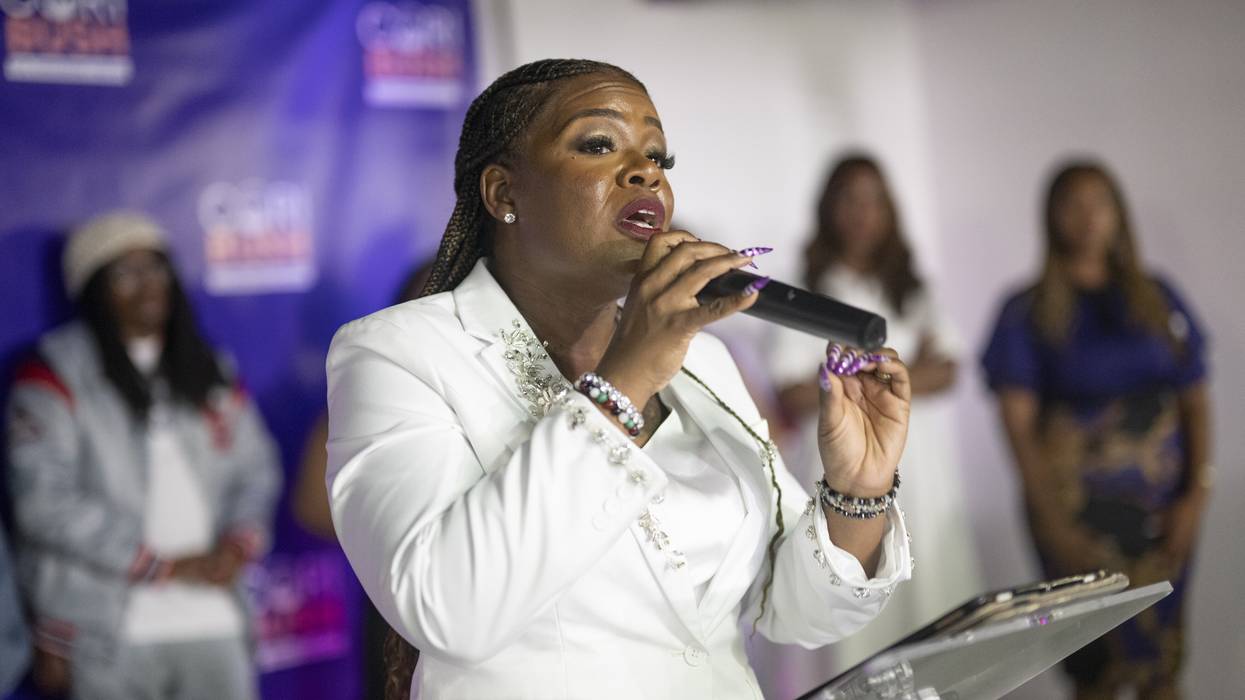
"Tonight's results should be a warning sign to anyone who cares about our democracy," said one advocacy group.
Rep. Cori Bush lost her reelection bid in Missouri's 1st Congressional District on Tuesday to a Democratic primary candidate backed by a massive influx of spending from AIPAC, which targeted the progressive incumbent over her early calls for a cease-fire in the Gaza Strip.
Wesley Bell, the prosecuting attorney for St. Louis County, enjoyed a huge cash advantage over Bush, with nearly two-thirds of his campaign money coming from fundraising efforts by AIPAC's super PAC, the United Democracy Project (UDP).
UDP, which has been bankrolled by ultra-wealthy Republicans, spent around $8.5 million to oust Bush, the second Squad member to lose to an AIPAC-backed primary opponent this election cycle. AIPAC pledged earlier this year to spend $100 million attacking progressive candidates, and the organization has thus far been the largest source of Republican money flowing into competitive Democratic primaries this year.
The Intercept's Akela Lacy reported that in Tuesday's race, AIPAC's money was spent "on voter engagement efforts and phone banking in addition to digital and mail ads."
"One of the mailers, first reported by The Intercept, included images that distorted Bush's features," Lacy added.
Bell, who also raised money directly from Republican billionaires and previously served as campaign manager for a GOP candidate, narrowly defeated Bush, winning 51.2% of the vote compared to the incumbent's 45.6%—a margin of fewer than 7,000 votes.
In a fiery speech to supporters following her defeat, Bush said that by "pulling me away from my position as congresswoman, all you did was take some of the strings off."
Bush, who was elected to the House in 2020, went on to directly address AIPAC's role in what became one of the most expensive congressional primaries in U.S. history.
"AIPAC, I'm coming to tear your kingdom down," said Bush. "And let me put all of these corporations on notice: I'm coming after you too. But I'm not coming by myself. I'm coming with all the people that's in here, that's doing the work."
Cori Bush defiant in defeat: "All they did was radicalize me, so now they need to be afraid."
"They about to see this other Cori, this other side," she said. "AIPAC, I'm coming to tear your kingdom down." pic.twitter.com/690T0aEhmZ
— Mark Maxwell (@MarkMaxwellTV) August 7, 2024
Justice Democrats, a progressive organization that helped propel Bush to victory in 2020 and backed her reelection bid, said following Tuesday's contest that "no matter what a singular super PAC can spend to try and buy an election, nothing can take away from the transformational effect Cori Bush has directly had on the people of St. Louis."
"That power—of everyday people to transform what we can expect from our political system—is such a threat to right-wing power, corporate interests, and AIPAC's influence, that a coalition of GOP-funded Super PACs had to spend over $12 million to even have a chance at defeating it," the group said in a statement posted to social media. "As AIPAC's influence in Congress wanes and the right-wing network propping it up is exposed, AIPAC has to spend historic amounts to continue advancing their interests at the expense of the Democratic mainstream that overwhelmingly supports a ceasefire and an end to genocide in Gaza."
Bush was one of the original sponsors of a congressional resolution calling for an end to Israel's assault on the Gaza Strip, which has dragged on for 10 months and left nearly 40,000 Palestinians dead, according to official tallies that are likely a vast undercount given the number of people missing under ruins and in mass graves.
"We can't bomb our way to peace, equality, and freedom," Bush said as she introduced the resolution alongside her progressive House colleagues on October 16. "With thousands of lives lost and millions more at stake, we need a cease-fire now."
"Cori Bush had the moral courage to speak out against her constituents' taxpayer dollars funding war crimes in Gaza."
Aru Shiney-Ajay, executive director of the Sunrise Movement, said Tuesday that "without the deluge of misleading advertisements" attacking Bush, she "would be headed to Congress for another term next year."
"Tonight's results should be a warning sign to anyone who cares about our democracy," said Shiney-Ajay. "If Democratic Party leaders don't stand against AIPAC and right-wing billionaires, they undermine our democracy and risk disillusioning the young voters and voters of color we need to defeat the far-right."
Our Revolution executive director Joseph Geevarghese echoed that message, saying in a statement that "tonight's outcome puts the blatantly undemocratic nature of Democratic Party primaries on full display."
"Cori Bush had the moral courage to speak out against her constituents' taxpayer dollars funding war crimes in Gaza. As a result, AIPAC and its MAGA Republican-funded super PAC spent more than $8.4 million to buy her congressional seat," said Geevarghese.
"Democratic Party elites have spent years decrying Trump as an existential threat to democracy," he added, "yet they are resoundingly silent when wealthy conservative donors unseat a true working-class champion who was among the first federal lawmakers to endorse Kamala Harris in her historic candidacy for president."
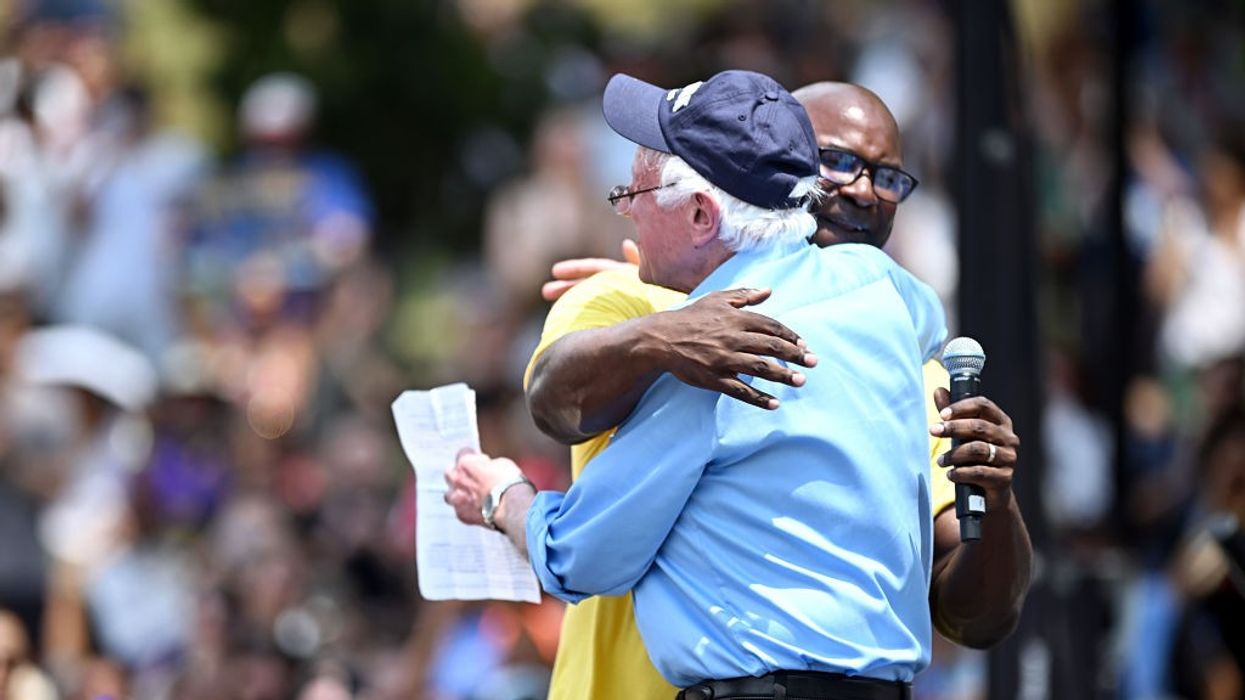
"Campaigns should be about a clash of ideas, not which candidate can raise more money from the oligarchs," Sanders said after the defeat of Bowman, a progressive who was the target of huge dark-money spending.
U.S. Sen. Bernie Sanders on Wednesday responded to the defeat of Rep. Jamaal Bowman, whom outside groups spent record-breaking sums to oust in a Democratic primary in New York this week, by condemning Citizens United v. Federal Election Commission and calling for a public campaign finance system.
Outside groups, mainly super political action committees (PACs), poured in more than $17.7 million to oust Bowman (D-N.Y.) and less than $3 million to help him. The beneficiary of the lopsided spending was challenger George Latimer, a Westchester County official, who won the primary with about 58% of the vote to Bowman's 42%.
Progressives have decried the role of the American Israel Public Affairs Committee (AIPAC), which, through its super PAC, paid more than $14 million for ads that either supported Latimer, who is pro-Israel, or attacked Bowman, who is pro-Palestine—the most ever spent on a U.S. House of Representatives race by a non-party-affiliated group.
Sanders (I-Vt.), in a statement, drew a wider target: the campaign finance system that AIPAC was able to exploit.
He called for a reversal of the "disastrous" Citizens United decision—a 2010 Supreme Court ruling that allowed unlimited outside spending on elections, on the basis of freedom of speech, increasing the power of rich donors and corporations.
"Buying elections is not 'freedom of speech'," Sanders, who campaigned for Bowman, said.
"It is an outrage and an insult to democracy that we maintain a corrupt campaign finance system which allows billionaire-funded super PACs to buy elections," he added.
The pundits will draw their conclusions about the NY-16 race. Here’s mine:
$23m was spent to defeat @JamaalBowmanNY.
It is an outrage and an insult to democracy that we maintain a corrupt campaign finance system which allows billionaire-funded super PACs to buy elections. pic.twitter.com/x3W8JlLwK3
— Bernie Sanders (@BernieSanders) June 26, 2024
Sanders' statement comes amid a flurry of analyses of the race from legacy media outlets, many of which frame the result as a blow to the left wing of the Democratic Party.
"Bowman's win in 2020 seemed to herald an ascendant progressive movement," according to The New York Times. "In 2024, the center is regaining power."
As The Atlantic reported, "The New York progressive veered too far left of his constituents."
Neither article mentions Citizens United or campaign finance reform, or the fact that redistricting in 2022 left far more of Bowman's seat in the suburbs than had been the case in 2020, with just a small slice in the Bronx that remained in the 16th district.
Bowman won 84% of the vote in the northern slice of the Bronx that remained in his district, but was beaten soundly in Westchester County, which is wealthy and has a sizable Jewish population that mobilized for Latimer.
Bowman had weaknesses as a candidate that may also make his race of limited use as a bellwether in other centrist v. progressive primary battles, the most notable of which features Rep. Cori Bush (D-Mo.) against an AIPAC-backed challenger, Wesley Bell. Polling shows a very tight race.
Bowman received some criticism after pleading guilty to a misdemeanor for pulling a fire alarm at the Capitol last year, in what he said was an accident. He has also been accused of "subpar constituent work," according to The New Republic.
Most notably, Bowman was caught on video saying that claims of Hamas sexual violence on October 7 were unsubstantiated "propaganda," though he later reversed his position and condemned the sexual violence.
If the political establishment has drawn significance from the Bowman defeat, it's a significance that progressives to some degree invited, albeit in a different framing.
During the campaign, Sanders had called the Bowman-Latimer race "one of the most important in the modern history of America" because it was about whether the "billionaire class" could control Congress.
For Sanders, the lesson of the race should be the need for fundamental reforms, including the abolishment of Citizens United and the institution of public campaign finance mechanisms.
"We must also move to the public funding of elections," Sanders said. "Campaigns should be about a clash of ideas, not which candidate can raise more money from the oligarchs."
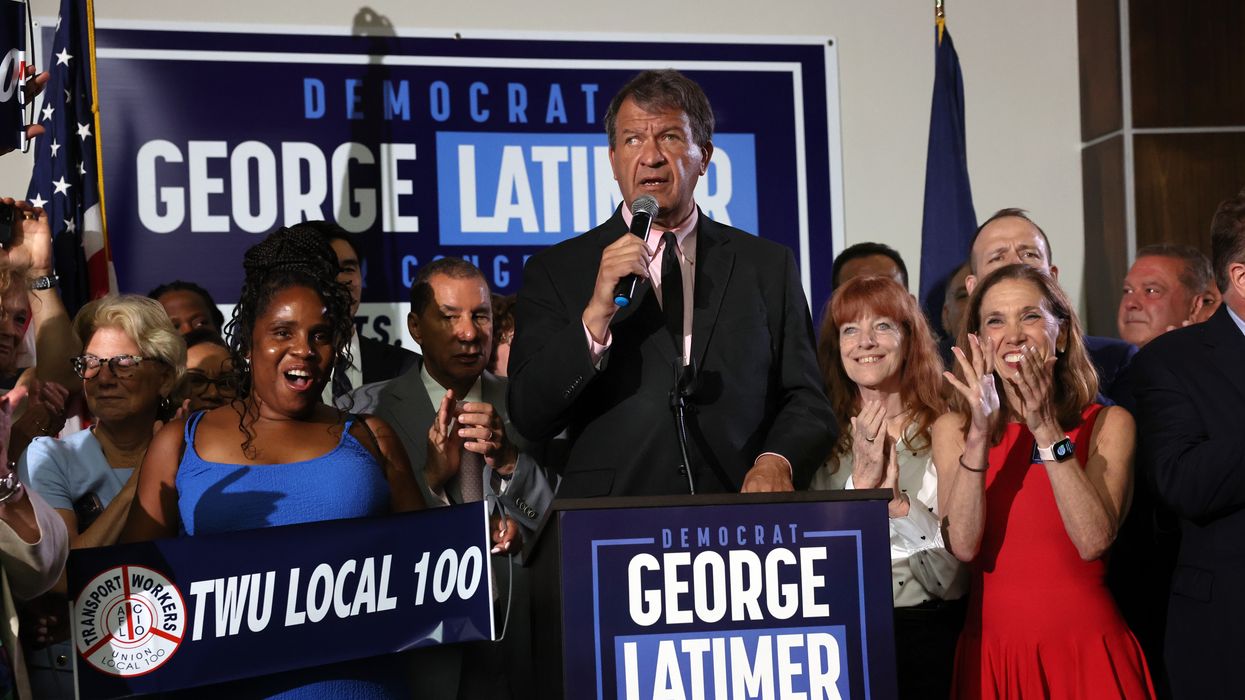
"Jamaal and our movement were such a threat to right-wing power, to GOP megadonors, and to AIPAC's influence in Congress that they had to spend $15 million to defeat us," said one progressive organizer.
Progressive Rep. Jamaal Bowman lost his reelection bid in New York's 16th Congressional District on Tuesday to an establishment-backed county official whose campaign was propelled by nearly $15 million in spending by AIPAC's Republican-funded super PAC.
The United Democracy Project's (UDP) spending made the Democratic primary contest the most expensive House race in U.S. history. According to a Sludge analysis of independent election expenditures dating back to 2001, UDP's $14.5 million onslaught to oust Bowman was "more than any other group besides those affiliated with a political party has ever spent on a House election."
The investment paid off, with Westchester County Executive George Latimer leading Bowman by a margin of 58% to 42% with close to 90% of the vote counted in the 16th District, which was redrawn ahead of the 2022 midterms to include more of suburban Westchester County and less of the Bronx.
Bowman, a former Bronx middle school principal who won his House seat in 2020 by defeating AIPAC favorite Eliot Engel, said in his concession speech late Tuesday that "we should be outraged when a super PAC of dark money can spend $20 million to brainwash people into believing something that isn't true."
"When we say 'Free Palestine,' it is not antisemitic," said Bowman, one of the House's most vocal critics of Israel's assault on Gaza. A majority of Democratic voters in the U.S. believe Israel is committing genocide in the Palestinian enclave, according to a recent survey.
"I would like to make a public apology for sometimes using foul language," he added, referring to remarks he made during a rally over the weekend. "But we should not be well-adjusted to a sick society."
"If you stand by while far-right groups try to buy elections, you further alienate and disillusion the young voters and voters of color you need to reelect Joe Biden this November."
Alexandra Rojas of Justice Democrats, the progressive group that recruited Bowman for the 2020 contest against Engel, said late Tuesday that "Jamaal and our movement were such a threat to right-wing power, to GOP megadonors, and to AIPAC's influence in Congress that they had to spend $15 million to defeat us."
"This demonstrates the power of our people-funded movement, the strength that any single progressive with the moral clarity to stand up to far-right interests has, and just how on defense AIPAC really is," said Rojas. "AIPAC knows the future is not on their side, so they have no choice but to overwhelm, confuse, and depress voters with a flood of dark money to generate support for their candidates. That's exactly why they pledged to spend an unprecedented $100 million to unseat the Squad this year."
Rojas said her organization is now turning its attention to Rep. Cori Bush's (D-Mo.) August 6 primary against St. Louis County Prosecuting Attorney Wesley Bell, whose campaign is backed by AIPAC and Republican donors—including a billionaire CEO from St. Louis.
"We cannot give in to hopelessness or cynicism—we must fight back, NOW," said Rojas. "Let's come together in this difficult moment and do what it takes to stop AIPAC from unseating another one of our progressive champions this summer."
While Bowman fell to Latimer, another Squad member—Rep. Alexandria Ocasio-Cortez (D-N.Y.)—cruised to victory in her primary, winning more than 80% of the vote against investment banker Marty Dolan. AIPAC's super PAC did not spend in the race, according to available disclosures.
" Wall Street came for us again, and the people prevailed," Ocasio-Cortez wrote on Twitter following her victory. "Thank you to the Bronx and Queens for choosing me to be your congresswoman."
Rep. Summer Lee (D-Pa.), another Squad member, also fended off a primary challenge earlier this year, overcoming a torrent of right-wing dark money. AIPAC sat out this year's race after failing to defeat Lee in 2022.
But Emgage, a PAC that works to turn out Muslim American voters, said Tuesday that Bowman's defeat at the hands of a candidate loaded with UDP cash "sets a dangerous precedent for groups like AIPAC to influence local elections and crush people-led politics."
"It should sound the alarm for Democrats and Americans across the country who believe in collective organizing to advance positive change for communities that are often sidelined in American politics," the group said. Axios reported Wednesday that some House Democrats are quietly "grumbling" about AIPAC's massive spending to defeat Bowman.
"The number is gross... I don't like it," one unnamed Democratic lawmaker told the outlet.
Aru Shiney-Ajay, executive director of the youth-led Sunrise Movement, echoed Emgage's message, saying in a statement that "Democrats should see this race as a massive warning for November."
"If you stand by while far-right groups try to buy elections, you further alienate and disillusion the young voters and voters of color you need to reelect Joe Biden this November," said Shiney-Ajay. "Here's my warning to Democratic leadership: reject AIPAC, or risk losing your own base."
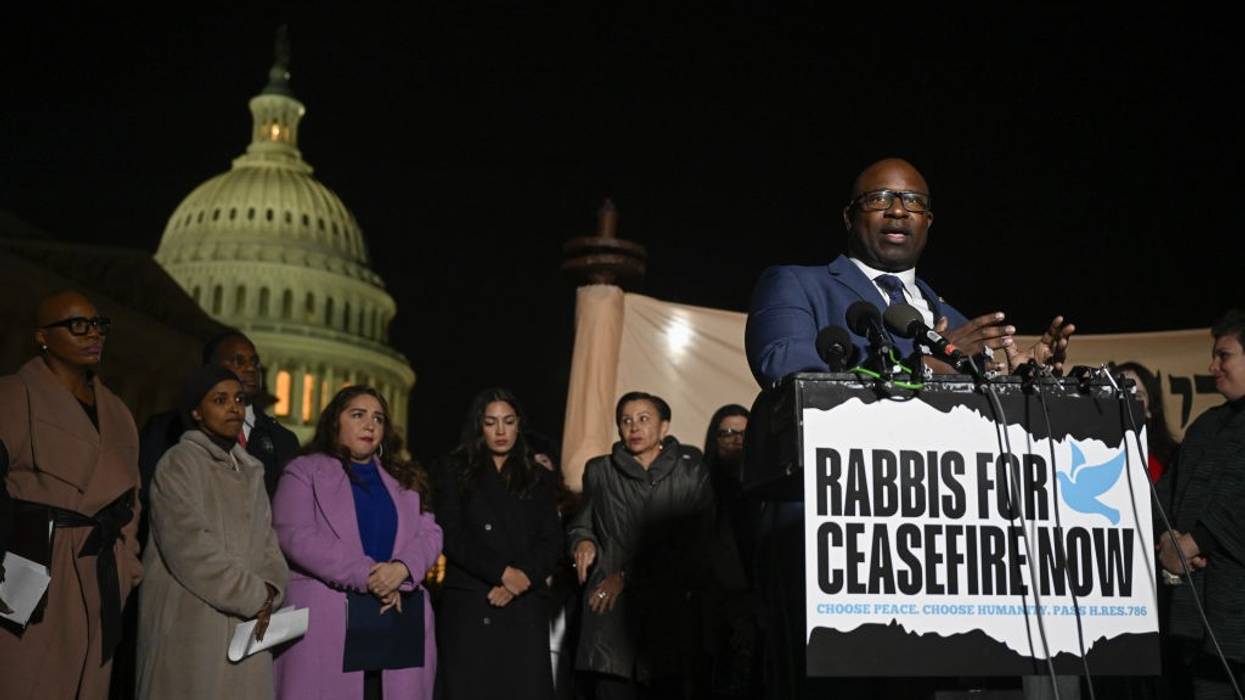
"It's our duty to fight back," said Rep. Summer Lee, arguing that no super PAC "should be able to drop millions to usurp the conversation for their agenda."
As the leading U.S. pro-Israel lobby's political action committee unleashes a nearly $2 million ad blitz targeting Congressman Jamaal Bowman, Jewish allies of the New York Democrat—who is an outspoken critic of what he and many experts call Israel's genocide in Gaza—on Thursday joined progressive lawmakers in condemning right-wing efforts to defeat pro-Palestine incumbents.
United Democracy Project (UDP), the American Israel Public Affairs Committee's (AIPAC) super PAC, has booked $1.9 million in television ads to influence the outcome of the Democratic primary in New York's 16th Congressional District, according to Wednesday reporting by Sludge's David Moore.
"This new ad spending in New York shows once and for all that my opponent, George Latimer, is bankrolled by a right-wing super PAC that has received over $40 million from Republican megadonors who want to defend Republican insurrectionists, overturn voting rights, and ban abortion nationwide," Bowman said in a statement.
"Democrats across New York deserve better, and will reject these attempts to buy our elections and undermine our democracy," he added.
Jews for Jamaal, a pro-Bowman coalition spearheaded by the group Jews for Racial & Economic Justice Action, said in a statement that "we recognize this media blitz for what it is: a desperate move by powerful interests to silence the district's first Black representative in history."
"UDP is overwhelmingly spending its millions in Democratic primaries, mostly against Black and brown Democratic incumbents who speak out against war and for the human rights of Palestinians," the coalition continued. "This massive amount of spending distorts the political landscape, drowning out the needs and voices of everyday constituents with the interests of a few wealthy donors."
"It undermines the very foundation of our democracy, which must be built on the principles of transparency, accountability, and genuine representation," Jews for Jamaal added.
As more and more Democrats speak out against Israel's assault on Gaza—which according to Palestinian health officials has killed, maimed, or left missing more than 125,000 people—and violent repression by Israeli soldiers and settlers in the occupied West Bank and East Jerusalem, AIPAC has lashed out at even the mildest criticism of Israeli government policies and practices, which many experts around the world call genocidal.
Last November, Slate's Alex Sammon reported that UDP was set to spend approximately $100 million in a bid to unseat both pro-Palestine congressional progressives and more moderate Democratic candidates who the powerful lobby group believes don't sufficiently support Israel. Sammon said that Bowman, along with fellow "Squad" members Reps. Alexandria Ocasio-Cortez (D-N.Y.), Ilhan Omar (D-Minn.), Rashida Tlaib (D-Mich.), Ayanna Pressley (D-Mass.), Cori Bush (D-Mo.), and Summer Lee (D-Pa.) are among UDP's top targets.
Some of those lawmakers also rallied to Bowman's defense on Thursday.
"It's our duty to fight back," Lee said on social media. "As somebody who knows these folks intimately, I can speak to the damage UDP causes not just to the candidates they target and smear, but to the communities attached to us and democracy itself."
The congresswoman—who won her primary last month—continued:
Their campaign against me in 2022 was steeped in dog whistles and disinformation. Their most shameful million-dollar attack against me was just unsubtly implying I was a [former U.S. President Donald] Trump supporter... in mailers where my skin was oddly shadowed or darker. For three weeks, they plastered the airwaves and mailboxes in wall-to-wall attacks that overwhelmed our midsized media market. Cable and broadcast, digital and streaming... even children's programming on YouTube was targeted.
Omar asserted on social media that "a people-powered movement will always be stronger than special interest groups."
"We got your back, Jamaal Bowman," she added.
Bush said that Latimer "is being used as a Trojan Horse for far-right billionaires and anti-abortion extremists."
"But from the Bronx to St. Louis, we won't let them win," she vowed.
Bowman, in turn, posted in support of Bush, whom he pledged to defend against "Republican billionaires... coming for her."
Last month, another coalition—the youth-led Protect Our Power campaign—was launched in support of progressive congressional incumbents under attack by AIPAC and other pro-Israel groups.
"The only thing that beats organized money is organized people," the young organizers said at the time. "Fortunately, that's what we know how to do best."
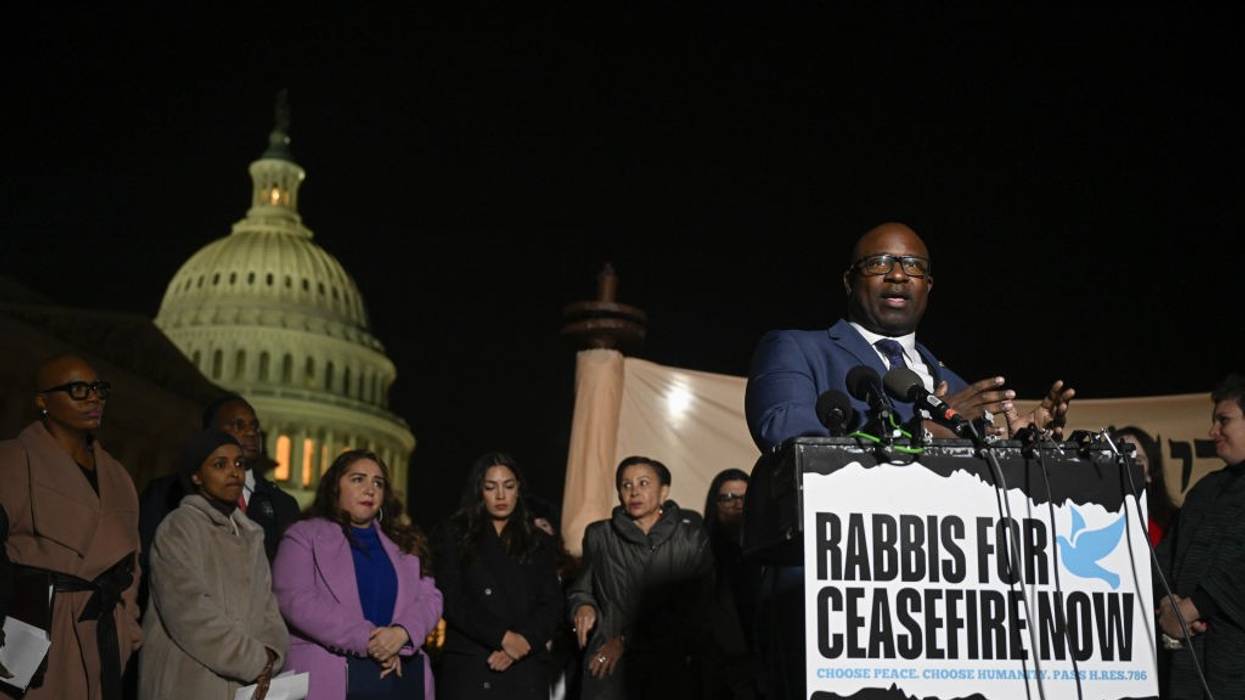
House progressives "have shifted the political narrative to center young people's leadership on the most pressing issues of our generation—from climate justice, labor rights, and abortion access, to anti-war foreign policy."
A coalition of youth organizers this week launched the "Protect Our Power" campaign to help reelect progressives in Congress who are under attack from pro-Israel lobbyists for their criticism of the U.S.-backed Israeli assault of the Gaza Strip.
"We are among the leaders of the most diverse and progressive generation in U.S. history," says a fact sheet from organizers. "We've met each other on Zoom calls, college campuses, campaigns, rallies, and parties. Spanning across a range of organizations and movements, we're united by our generation's common fight for peace, justice, a livable world, and a multiracial democracy."
"Over the past few years, we've experimented with a diverse set of tactics to grow our power—our involvement in elections being one of them," the organizers noted. "Today, we not only occupy the streets but Congress itself. With just a handful of insurgent electeds known as 'The Squad,' we have forced our generation's priorities to the forefront of American politics and reinspired young people to be involved in the political process."
"We're united by our generation's common fight for peace, justice, a livable world, and a multiracial democracy."
The Squad began with Reps. Alexandria Ocasio-Cortez (D-N.Y.), Ilhan Omar (D-Minn.), Ayanna Pressley (D-Mass.), and Rashida Tlaib (D-Mich.)—younger progressive women of color all elected in 2018. The informal group has since expanded to include Reps. Jamaal Bowman (D-N.Y.), Cori Bush (D-Mo.), and Summer Lee (D-Pa.).
Young progressives in the U.S. House of Representatives recently dubbed "Squad-adjacent" by Slate's Alexander Sammon include Reps. Greg Casar (D-Texas), Delia Ramirez (D-Ill.), and Maxwell Frost (D-Fla.).
Tlaib—the only Palestinian American in Congress—and Bush led the first Gaza cease-fire resolution effort in Congress, just days after the October 7 Hamas-led attack on Israel, which has retaliated over the past six months by killing more than 33,000 Palestinians, injuring another 75,000, displacing most people in Gaza, and devastating civilian infrastructure.
While global condemnation of Israel grows—a genocide case against the country at the International Court of Justice continues to garner support—the dark money affiliate of the American Israel Public Affairs Committee (AIPAC) plans to spend $100 million trying to unseat congressional critics of the Israeli government this election cycle.
Reporting on those plans led to the recent creation of Reject AIPAC, a coalition of progressive organizations working to take on the group and its affiliated super political action committees (PACs). Members include Justice Democrats, Jewish Voice for Peace Action, IfNotNow, Working Families Party, Sunrise Movement, Democratic Socialists of America, and Gen-Z for Change.
Youth organizers from some of those same organizations are involved with the new Protect Our Power effort.
"The only thing that beats organized money is organized people," the young organizers argued. "Fortunately, that's what we know how to do best. Over the next few months, we'll build out a cohort of committed young leaders across the country and equip them with the training and tools to bring their own networks into this work."
"We'll work with these leaders to mobilize their networks to engage in a variety of tactics to defend the Squad," the organizers said. "For some groups, that might mean making texts, calls, and knocking on doors. For others, that could mean birddogging, targeted and disruptive demonstrations, oppo research, and much more. Then, once we win, we'll frame our victories as a governing mandate to shape the Democratic platform and agenda in the 2024 general election."
Before November, progressives targeted by pro-Israel groups are working to win their primaries. In Pennsylvania, voters are set to head to the polls on April 23. Lee's primary challenger is Bhavini Patel, who is taking money from rich right-wingers; a previous challenger, Laurie MacDonald, is now running a write-in campaign as a Republican.
The New York primary elections are on June 25. Bowman faces an AIPAC-backed Westchester County Executive George Latimer—who last week was accused of "straight-up genocide denial" for his comments on the mass slaughter in Gaza.
Bush and Omar are both set to face locally prominent primary challengers in August.
Those four incumbents "and the rest of the Squad have shifted the political narrative to center young people's leadership on the most pressing issues of our generation—from climate justice, labor rights, and abortion access, to anti-war foreign policy," the Protect Our Power coalition said on social media Thursday.
"Help us reelect the Squad and guarantee that our allies in Congress can continue to represent young people across this country," the group added. "Join us this Sunday for our
kickoff."
The coalition is made up of "over 100 youth organizers across issues, including students from 30+ universities," according to spokesperson John Paul Mejia. "We're defending the Squad and our generation's political power from right-wing, billionaire-funded organizations that want to silence us."
Among the campaign's supporters is climate activist Magnolia Mead, who
warned this week that "our movements can't afford to lose their critical voices in Congress. Now and in the coming months we have a chance to throw down and protect them."
Kavi Shrestha, an Oregon-based leader with College Democrats of America, similarly
stressed that "our generation cannot stand by as right-wing billionaires and PACs attack the representatives who stand up for our interests—Medicare for All, a habitable planet, and an immediate cease-fire."
"While they have money," said Shrestha, "we have numbers."
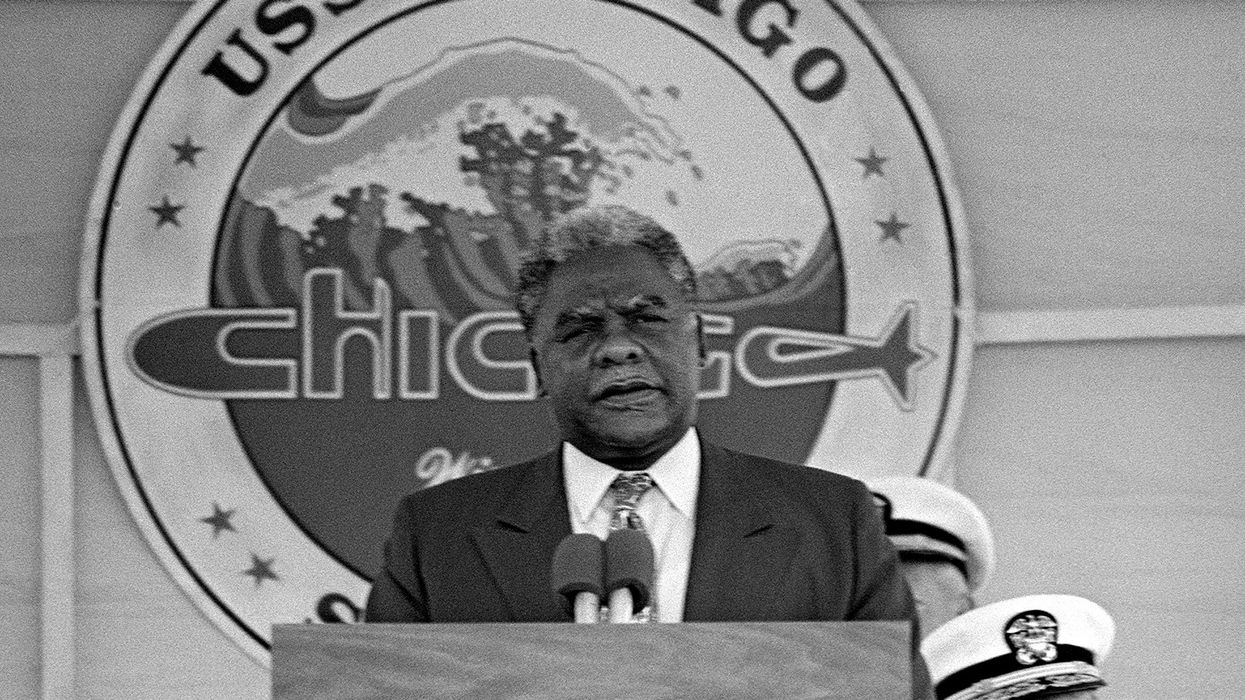
Filmmaker Joe Winston discusses his new documentary about Chicago’s first Black mayor and insights that Washington’ story can provide for social movements looking to bring new voices into electoral politics today.
Four decades ago, at the start of 1984, Harold Washington was finishing his historic opening year in office as Chicago’s first Black mayor. An outsider candidate who had been persuaded to run by the city’s social movements, Washington represented a major break from the past, and his 1983 victory served as an important milestone in the efforts of civil rights activists to gain footholds in electoral politics.
Today, as social movements increasingly take interest in running insurgent candidates for office, Washington provides a vital model for how grassroots forces can bring new constituencies into the electoral realm and upend the established practices of insider politics.
Once in office, the mayor—widely known in the city simply as “Harold”—faced entrenched opposition. And yet he was able to take significant strides in dismantling the city machine. Run for decades by Richard J. Daley, this machine long maintained a racist and inequitable system of distributing municipal resources.
Tragically, Washington died of a heart attack just months into his second term, in 1987. His sudden passing created a lasting trauma for progressive forces in the city and raised questions about what more he might have been able to accomplish had he lived.
The turbulent times of his election, governance, and untimely death are something that no one who lived through it can ever forget.
More recently, the 2023 election of a new progressive mayor in Chicago, Brandon Johnson, has both generated fresh hope and created revived interest in the lessons that might be drawn from Washington’s example in taking on Chicago’s old guard some 40 years ago.
As a filmmaker, Joe Winston has tackled topics ranging from conservative organizing in America’s heartland (as director of 2009’s What’s the Matter with Kansas) to the influence of the ultra-rich on our political system (as producer of 2013’s Citizen Koch). His latest film, Punch 9 For Harold Washington, is showing in coming months in cities including Denver, Atlanta, Nashville, and Chicago, and it has just been made available for both educational use and community screenings.
Recently, we spoke to Winston to discuss insights that Washington’ story can provide for social movements looking to bring new voices into electoral politics today. Our conversation has been edited for length and clarity.
Tell us about your background and how you got involved in this story.
My film, Punch 9 for Harold Washington, is about Chicago’s first African American mayor. When he was elected in 1983, I was a junior in a high school that was located just three or four blocks from Harold’s apartment. He was a huge figure in Chicago, and the turbulent times of his election, governance, and untimely death are something that no one who lived through it can ever forget.
As a documentary filmmaker, I realized years later that the story of Harold Washington has universal significance. As a trailblazing Black mayor in a city which was undergoing rapid demographic change, the kinds of coalitions that Harold had to build in order to win an election—and then subsequently to govern—had tremendous resonance. That was particularly true in the Obama era. Barack Obama came to Chicago as a community organizer partly because Harold Washington had taken office. And, subsequently, the white backlash to Obama’s presidency mirrored almost exactly what Harold Washington had to navigate as mayor of Chicago.
Before he decided to run for mayor in 1983, Harold almost had to be drafted by social movements. He made a number of demands that local organizers had to meet in order for him to run, including the demand that they register 50,000 new voters—which seemed like an impossibly huge number.
Right. Washington is a fascinating and complex figure. He was 61 years old when he first became mayor in 1983, and he had actually run for mayor before—in 1977, during a special election that was called shortly after the death of the legendary political boss Richard J. Daley. That election attracted a lot of candidates, and Washington only placed third. His experience of an underfunded, hastily put together campaign taught him that in order to beat an entrenched political organization like the Cook County Democratic Party machine, he needed more than a great campaign. He needed to be assured that there was a true groundswell and a broad coalition willing to support him.
Harold’s vision for Chicago was very detailed. He made it very clear that he was taking on an entrenched system of corruption that was harming the entire city.
By the time 1982 came around, Harold was serving in the U.S. Congress and he was reluctant to run for mayor again, unless he saw that there was a lot of infrastructure in place. And this time there was. There were a lot of people working in the neighborhoods who had opposed Mayor Daley on Vietnam, racism, development, and countless other issues. They knew what they wanted, and they mobilized the community. Depending on which figure you cite, they registered as many as 200,000 new voters for the 1983 mayor’s race—far more than he had demanded. And that convinced Harold Washington that it was his time to run again.
In your film, a Chicago politician named David Orr, who had served in the City Council when Washington was in office, says that was “the first time this coalition had come together.” What were the distinctive elements of the coalition that Washington created?
The famous Harold Washington Coalition was made necessary by the ethnic makeup of Chicago at the time. The city was about 40% African American, 40% white, and 20% other ethnic groups, primarily Puerto Rican and Mexican. So no single ethnic group in Chicago could win a majority on its own. Washington and his allies understood this. They formed an alliance that joined African American with white liberals—and they also brought in the Hispanic community, which previously had not been very politically active. That gave them just the numbers they needed to overcome the entrenched machine and white resistance.
One of the exciting things about the Washington campaign of 1983, that would be echoed in the Obama campaign of 2008, is that both brought in people who were new to electoral politics, people in groups who were energized by a sense of new possibilities. Washington not only formed an electoral coalition of these different groups, but he translated it into a governing coalition.
One thing that seems to make Harold Washington different from other politicians is that he seemed to reject polite politics and to embrace polarizing subjects. When he talked about the legacy of Richard J. Daley, whom many people in Chicago still loved, Harold didn’t pull any punches. Instead, he denounced Daley as a flat-out racist. It seems he had a strategy of energizing his base, while also somehow reaching out to the middle over time. That’s different from how most politicians think about messaging. What do you think?
A lot of the messaging that Harold Washington used was being carried out over Black radio and newspapers—publications like the legendary Chicago Defender—that most white Chicagoans didn’t pay any attention to. So when Washington defeated two white Democrats in the Democratic primary, the major news media was shocked. They didn’t think this guy had a chance, because they hadn’t been paying attention to what was being discussed in the media consumed in Black neighborhoods.
These days, media targeting looks different, but certainly Washington was a great political communicator. He could be very blunt and populist in his appeal to voters. But he was smart enough and understood policy well enough to really engage them. He didn’t have to waffle on the issues, although he certainly had to try to be polite. There would have been plenty of opportunities for a Black politician to be much more negative about the power structure that existed in the city at the time. To this day, Black politicians always have this onus on them: They are always expected to reach out, and Washington was certainly subject to those burdens.
It seems like Washington did things to intentionally agitate and engage his base, which did push away some people. But he wasn’t concerned about that, because he had a strategy to build a majority. Do you think that’s correct?
Well, I would take issue with that a little bit. The truth is that when we’re telling his story, we are focused on the political combat that he engaged in. By the time he ran, he already had opponents who were saying the worst possible things about him. When he was running in the general election against a Republican opponent, his opponent’s slogan was “Before it’s too late.” Everybody in Chicago knew what that meant: It was a blunt, racial appeal. So in some cases, I think Harold Washington was really just fighting back. I don’t think he intended to push away a single voter. In fact, winning over white voters was the thing he worked the hardest at.
Harold was very determined not just to put a new face on the old system, but to overthrow the system completely.
Harold’s vision for Chicago was very detailed. He made it very clear that he was taking on an entrenched system of corruption that was harming the entire city. He put through programs that not only helped African Americans, but actually benefited a lot of white neighborhoods, which themselves had been neglected.
One of the ways that he ended up beating the deadlock in City Council was by putting forward a bond issue on infrastructure and then going directly to the public to say, “Your City Council members are blocking this.” He appealed to the common interest of people throughout the city of having their roads repaired.
Yes, that was one of his great victories.
In the film you show how, once Harold came into office, he made an attack on the patronage system in Chicago politics his central fight. But because this system was so deep-seated in city politics, his attack created massive resistance from the City Council. It probably made it more difficult for him to accomplish things in the short run than if he tried to make peace and cut deals. Why do you think he took on this strategy?
The battle that you’re describing is the crux of the Washington story. Harold was very determined not just to put a new face on the old system, but to overthrow the system completely. It was an enormous challenge, and it led to a stalemate known as the “Council Wars,” which stymied much of his governance for his first three years.
The saddest part of the Harold Washington story is that he simply did not live long enough to consolidate his coalition into something that could outlast him.
Many of his allies did not want him to do this, because it was incredibly difficult. But Washington knew exactly what he was doing. He himself had come up through this very same system, having served as a precinct captain as a young man. His father had tried to work his way up from the bottom ranks of the Democratic Party, too, and was rebuffed by the Daley machine. So, for Harold, this was the fight of his life. He felt the system was wrong, and that it needed to be changed.
It’s interesting that, before running for mayor in the 1983 election, Harold was serving as Congressperson in Washington, D.C. Prior to that, he had been in the state government. So he had figured out how to operate inside of the machine system, even if he eventually came to hate the machine. How do you look at Harold’s political evolution?
Washington came up through the machine in a ward organization during the Daley years. Then he found his place in the state legislature, where you’re kind of at arm’s length from the Cook County machine. Those legislators had a little bit more latitude. For a couple of decades, Washington managed to stay within his lane, deciding which votes he could take and which ones he needed to skip in order to get good work done. In the state legislature, Harold passed the first holiday in the country commemorating Dr. Martin Luther King, for example. But he broke with the machine in the late ‘70s. At that point, his opponents tried to run somebody against him, but Harold beat them. So by 1980 or so, Harold was completely independent; he had his own power base, and he was able to become a U.S. congressman. The machine itself was weakened after the death of Richard J. Daley in 1976, and that set the stage for Harold to later become mayor.
There was a history of reform candidates in Chicago who couldn’t get much done. Because they were always on the outside, they didn’t know the machine’s internal workings. You could say that one part of Harold’s genius was that he really knew the system, and this is what allowed him to take it apart.
I think that’s absolutely correct. It’s quite remarkable that he was so schooled in this system of politics and power, but then he chose to take it on. It’s rare, but that is part of what made him the right person to do the job.
In your documentary, there’s a scene where they talk about disrupting the patronage system, and Harold decides to fire everyone who doesn’t show up for work and isn’t in the office. Would you say that he had a vision of using the power of the institutional bureaucracy in a way that might be different from other politicians?
At the time that Washington was elected mayor of Chicago, the city employed something close to 40,000 people, with various positions directly appointed. When Washington took office, most of these people had been employed by his opponents. So the machinery of bureaucracy was working against him. This was kind of the mirror image of what former President Donald Trump would talk about as the “deep state.” There really was a deep state in Chicago of bureaucrats who had been appointed to patronage jobs. The reason that they were in the Department of Housing was not because they knew anything about housing, but because they had turned out 1,200 votes in their precinct in the last election. Harold and his allies realized this was a system that could not continue.
A variety of people, including Barack Obama in Dreams from My Father, have made the point that the coalition that put Harold in office ended up being overly dependent on the charisma and the personality of one individual. So when Harold died suddenly, the machine was able to come back and co-opt parts of his coalition.
The saddest part of the Harold Washington story is that he simply did not live long enough to consolidate his coalition into something that could outlast him. Harold died of a sudden heart attack in 1987. He collapsed at his desk, having won re-election just a few months prior. This was an enormous trauma for the Black community in Chicago, as well as for all progressives, inside and outside of Chicago.
Politically, it set off complete chaos. The fracturing of the Washington coalition was an immense tragedy. And it did unfold with horrifying speed—basically in one week’s time. Part of the problem was that a lot of City Council members, and even a number who were in the Washington coalition, had come up through the old system of patronage and corruption. They were really much more comfortable with that. It was only Harold Washington’s immense popularity and force of personality that kept them in line. So it became pretty easy for the operators of the Chicago machine to bring around just enough Black members to form a new majority and take power again.
“You know, I need people to be on the outside pushing this. Change is hard. And I want to see protests out there.”
There’s that old line from Will Rogers: “I’m not a member of any organized party. I’m a Democrat.” Progressive coalitions are always tricky to hold together. And the Washington coalition had not been together very long. Daley’s son came in as mayor soon after, and the son ended up ruling longer than his father had.
In terms of their reliance on a single leader, do you think there were alternatives that movements could have pursued?
It’s clearly a tremendous weakness for a movement to be dependent on any one person. Black Lives Matter groups and younger activist groups have taken this to heart. But at the same time, the forceful leadership and the cohesiveness that Washington applied was crucial to getting so much to change so fast. Harold destroyed a decades-old system of patronage and corruption very quickly, and change like that is hard to make happen. Having your leader die on you, four years after getting elected, is a crippling wound. There is no simple answer. There’s just a continuing need to nurture new political talent. And we must have an understanding that these movements take time.
Harold was not the first Black mayor of a major U.S. city after the civil rights movement of the 1960s. Before 1983, you had Black mayors in places like Cleveland, Washington D.C., Detroit, Atlanta, and Los Angeles. And yet many people talk about Harold Washington as a model in a different way. Why do you think that is?
I think what was really special about Harold was that as a trailblazing Black mayor of a major U.S. city, he neither presided over a city which whites had abandoned, like Cleveland, Detroit, or St. Louis, nor was he looking to just put a new face on the old system. Harold was someone who came into office promising revolutionary change, as a Black mayor in a city where Black people were a substantial ethnic group and not the majority. So I think that makes him tremendously important. What he was able to accomplish was a real civil rights movement candidacy and governance, but one in which he did have to reach out beyond African Americans to form coalitions to make it happen.
We are in a moment where there has again been a lot of interest in social movement circles in running insurgent electoral campaigns—something that’s been on the rise at least since Bernie Sanders’ presidential run in 2016. We’ve seen things such as the rise of The Squad in Congress coming out of that. What do you think are the lessons that Harold Washington offers for activists who are looking to bring social movement energy and issues into electoral politics today?
The fact that Washington had to build a coalition beyond his base is really crucial. The fact that he couldn’t just depend on his ethnic group identification to carry him to victory. And the fact that he did it through bread and butter issues. He understood infrastructure and development and redistribution—and how all these things would actually get done in ways that could broaden his appeal. He had programs for the whole city, and I think he provides a really valuable example of how politicians can broaden their coalitions.
It’s also crucial that Harold Washington’s candidacy came from a movement. Although voters later might remember his qualities as a politician—his charisma and his political skills—he wasn’t out there by himself. There was an entire movement behind him that had goals and also had the ability to mobilize people.
I wanted to present a documentary of a unique person and place that could inspire people to want to do governance better—and maybe give some tips on how to do that.
Washington is somebody who was not only brought up in bare-knuckle, Democratic Party politics, but also in the social movements. In the 1940s he went to Roosevelt College, which was a rare integrated institution of its day that admitted Blacks, Jews, and women. He was surrounded by really smart people who were doing things like lunch counter protests very early, 25 years before you were seeing the events that we celebrate from the 1960s.
In terms of bringing social movements into governance, what are the mechanisms of accountability or inclusion that make grassroots groups part of a governing project?
David Orr, who was a close ally of Washington’s, told us an interesting story we didn’t end up having room for in the film. He said that Harold had a meeting with him shortly before his death, where he was talking about his reelection, having secured his position and working majority on the council. He finally had the ability to enact the programs that the two of them and many others have been fighting for. And then Harold turned to Orr, who was much younger than him, and said, “You know, I need people to be on the outside pushing this. Change is hard. And I want to see protests out there.”
This meeting was never documented. But certainly Washington was somebody who was aware of the tension between grassroots advocacy and insider governance. There were staff people who were brought into his administration that came from activism, instead of conventional politics. And there were lots of others who stayed on the outside and kept pushing. Had Harold been around longer, that tension would have always been there. But he embraced it. He understood the usefulness of having both of those forces pushing for change.
Harold Washington’s story is pretty well known. In making your film, did you feel like there was an aspect that hadn’t been told already?
There have been a lot of films about political campaigns. They make for good stories because there’s a natural beginning, middle, and an end. There’s a winner and a loser. But we had always wanted to dig deeper into governance, which is less sexy and much harder to project. To me, a lot of the stories about inspirational candidates fall short, especially for the left. Really, the election is only the beginning. There’s so much that has to happen after that. I wanted to present a documentary of a unique person and place that could inspire people to want to do governance better—and maybe give some tips on how to do that.
Because he died unexpectedly, and relatively young, there’s a huge sense of lost potential that surrounds Harold Washington. And there is the idea that by the start of his second term he had finally subdued his opposition and got the position where he could start really accomplishing things. Of course, all of that was cut short.
There’s a tendency to say that Harold’s accomplishments were completely vaporized when Daley took over. But when you look more closely at it, I think that’s not true. When Washington disassembled the political patronage machine, no one was able to put it back together in quite the same way. People had to govern differently. They were forced to be more inclusive and to distribute services equally to all areas of the city. I don’t think that would have happened without Harold.

The Missouri Democrat said she is "fully cooperating" with the investigation and she has "not used any federal tax dollars for personal security services."
Progressive Congresswoman Cori Bush confirmed Tuesday that the U.S. Department of Justice is conducting a criminal investigation into her spending on private security while also denying any wrongdoing.
Punchbowl News and other outlets had reported that as part of the probe into the Missouri Democrat, the DOJ sent a subpoena for documents to the House of Representatives Office of the Sergeant at Arms.
"I asked Cori Bush about the investigation directly last night," Punchbowl's Max Cohen said on social media early Tuesday. "She repeatedly declined to comment and reprimanded me for approaching her as she had a toothache."
The "Squad" member later addressed the reporting in a lengthy statement, saying that she is "fully cooperating" with the DOJ investigation, as well as probes by the Federal Election Commission (FEC) and House Committee on Ethics.
"Since before I was sworn into office, I have endured relentless threats to my physical safety and life," noted Bush, who was elected in 2020. "As a rank-and-file member of Congress, I am not entitled to personal protection by the House, and instead have used campaign funds as permissible to retain security services. I have not used any federal tax dollars for personal security services. Any reporting that I have used federal funds for personal security is simply false."
As Bush acknowledged, she has repeatedly faced scrutiny—particularly from right-wing media and groups—for her security spending, including for her campaign paying her husband, Cortney Merritts.
The Foundation for Accountability and Civic Trust last March filed a complaint with the FEC after records showed that Bush's campaign paid $571,856 for security services in 2022, including $62,359 to Merritts. Campaign funds may only be used to pay family members if they are "providing a bona fide service" and "payments reflect the fair market value."
After investigating the campaign's payments to Merritts in response to another complaint last year, the Office of Congressional Ethics last fall cleared Bush of any wrongdoing.
"I have complied with all applicable laws and House rules—and will continue to prioritize the rules that govern us as federal elected officials," Bush said Tuesday. "In accordance with all applicable rules, I retained my husband as part of my security team to provide security services because he has had extensive experience in this area, and is able to provide the necessary services at or below a fair market rate."
Amid reporting on a private ceremony last February, Bush's chief of staff, Abbas Alawieh, confirmed her marriage, noting in a statement that "Mr. Merritts, a veteran of the U.S. Army and a security professional, has been Congresswoman Bush's partner since before her congressional tenure and is not employed by her congressional office."
"Those who know the congresswoman personally and have followed her inspiring story know that she is a survivor of multiple forms of violence, including intimate partner violence," Alawieh added. "That she has married someone who supports her in all that she does, including as representative of the incredible people of St. Louis, is cause for great celebration."
This post has been updated with comment from Rep. Cori Bush.