SUBSCRIBE TO OUR FREE NEWSLETTER
Daily news & progressive opinion—funded by the people, not the corporations—delivered straight to your inbox.
5
#000000
#FFFFFF
To donate by check, phone, or other method, see our More Ways to Give page.
Daily news & progressive opinion—funded by the people, not the corporations—delivered straight to your inbox.
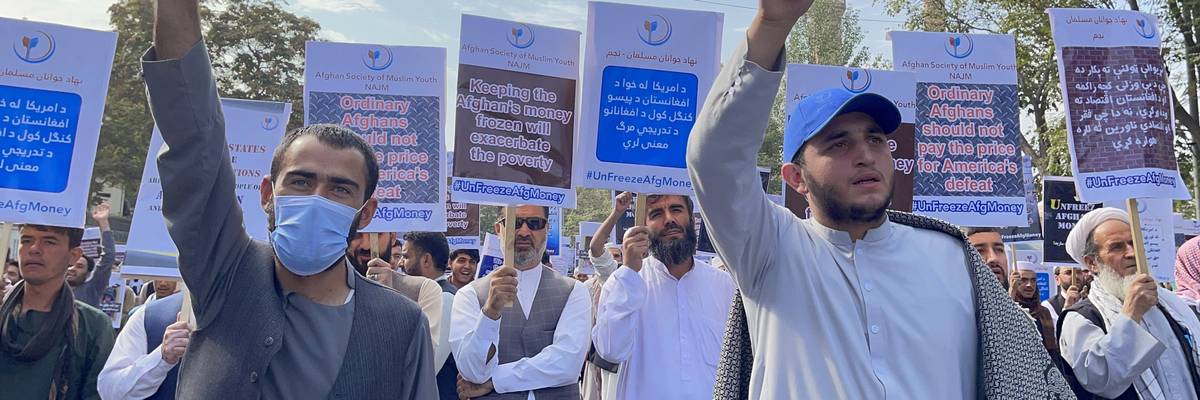
Demonstrators take part in a September 24, 2021 protest in Kabul, Afghanistan demanding the release of billions of dollars in frozen funds from the country's central bank by the United States.
"This money belongs to the Afghan people, and no one else," said Afghans for a Better Tomorrow, a coalition of Afghan-American community groups.
A coalition of Afghan-American community organizations on Wednesday welcomed a U.S. federal judge's ruling rejecting a bid by relatives of 9/11 victims to seize billions of dollars in assets belonging to the people of Afghanistan.
In a 30-page opinion issued Tuesday, Judge George B. Daniels of the Southern District of New York denied an effort by family members of people killed during the September 11, 2001 attacks on the United States to gain access to $3.5 billion in frozen funds from Da Afghanistan Bank (DAB), the country's central bank.
"The judgment creditors are entitled to collect on their default judgments and be made whole for the worst terrorist attack in our nation's history, but they cannot do so with the funds of the central bank of Afghanistan," Daniels wrote. "The Taliban—not the former Islamic Republic of Afghanistan or the Afghan people—must pay for the Taliban's liability in the 9/11 attacks."
"We support the 9/11 families' quest for just compensation, but believe justice will not be achieved by 'raiding the coffers'... of a people already suffering."
The frozen assets are currently being held by the Federal Reserve Bank of New York in the wake of the Taliban's reconquest of the nation that, under the militant group's previous rule, hosted al-Qaeda leader Osama bin Laden and other figures involved in planning and executing the terrorist attacks that killed nearly 3,000 people. The 9/11 attacks resulted in a U.S.-led invasion and occupation of Afghanistan that lasted nearly two decades, the longest war in American history.
"We are pleased to see that Judge Daniels shares the same assessment we laid out in our amicus brief to the court: That this money belongs to the Afghan people, and no one else," the coalition—Afghans for a Better Tomorrow (AFBT)—said in a statement.
In February 2022, the Biden administration said it would split $7 billion in frozen DAB funds between the people of Afghanistan and victims of the 9/11 attacks who sued the Taliban—a move that one critic warned would amount to a "death sentence for untold numbers of civilians" in a war-ravaged country reeling from multiple humanitarian crises including widespread starvation.
Last August, U.S. Magistrate Judge Sarah Netburn said that 9/11 families should not be allowed to use billions of frozen DAB funds to pay off legal judgments against the Taliban.
"Just like the families of the September 11th attack victims, the Afghan people are no stranger to the Taliban's brutality and rule," AFBT co-director Arash Azizzada said. "We support the 9/11 families' quest for just compensation, but believe justice will not be achieved by 'raiding the coffers,' as Judge Daniels put [it], of a people already suffering."
Homaira Hosseini, a board member of coalition member Afghan-American Community Organization (AACO), asserted that "an appeal of this decision, which the 9/11 families have stated they will pursue, will only cause further harm to both Afghans and the families involved."
"We continue to encourage these families to seek legal retribution elsewhere," Hosseini added, "and to not further harm Afghans in the process."
Dear Common Dreams reader, It’s been nearly 30 years since I co-founded Common Dreams with my late wife, Lina Newhouser. We had the radical notion that journalism should serve the public good, not corporate profits. It was clear to us from the outset what it would take to build such a project. No paid advertisements. No corporate sponsors. No millionaire publisher telling us what to think or do. Many people said we wouldn't last a year, but we proved those doubters wrong. Together with a tremendous team of journalists and dedicated staff, we built an independent media outlet free from the constraints of profits and corporate control. Our mission has always been simple: To inform. To inspire. To ignite change for the common good. Building Common Dreams was not easy. Our survival was never guaranteed. When you take on the most powerful forces—Wall Street greed, fossil fuel industry destruction, Big Tech lobbyists, and uber-rich oligarchs who have spent billions upon billions rigging the economy and democracy in their favor—the only bulwark you have is supporters who believe in your work. But here’s the urgent message from me today. It's never been this bad out there. And it's never been this hard to keep us going. At the very moment Common Dreams is most needed, the threats we face are intensifying. We need your support now more than ever. We don't accept corporate advertising and never will. We don't have a paywall because we don't think people should be blocked from critical news based on their ability to pay. Everything we do is funded by the donations of readers like you. When everyone does the little they can afford, we are strong. But if that support retreats or dries up, so do we. Will you donate now to make sure Common Dreams not only survives but thrives? —Craig Brown, Co-founder |
A coalition of Afghan-American community organizations on Wednesday welcomed a U.S. federal judge's ruling rejecting a bid by relatives of 9/11 victims to seize billions of dollars in assets belonging to the people of Afghanistan.
In a 30-page opinion issued Tuesday, Judge George B. Daniels of the Southern District of New York denied an effort by family members of people killed during the September 11, 2001 attacks on the United States to gain access to $3.5 billion in frozen funds from Da Afghanistan Bank (DAB), the country's central bank.
"The judgment creditors are entitled to collect on their default judgments and be made whole for the worst terrorist attack in our nation's history, but they cannot do so with the funds of the central bank of Afghanistan," Daniels wrote. "The Taliban—not the former Islamic Republic of Afghanistan or the Afghan people—must pay for the Taliban's liability in the 9/11 attacks."
"We support the 9/11 families' quest for just compensation, but believe justice will not be achieved by 'raiding the coffers'... of a people already suffering."
The frozen assets are currently being held by the Federal Reserve Bank of New York in the wake of the Taliban's reconquest of the nation that, under the militant group's previous rule, hosted al-Qaeda leader Osama bin Laden and other figures involved in planning and executing the terrorist attacks that killed nearly 3,000 people. The 9/11 attacks resulted in a U.S.-led invasion and occupation of Afghanistan that lasted nearly two decades, the longest war in American history.
"We are pleased to see that Judge Daniels shares the same assessment we laid out in our amicus brief to the court: That this money belongs to the Afghan people, and no one else," the coalition—Afghans for a Better Tomorrow (AFBT)—said in a statement.
In February 2022, the Biden administration said it would split $7 billion in frozen DAB funds between the people of Afghanistan and victims of the 9/11 attacks who sued the Taliban—a move that one critic warned would amount to a "death sentence for untold numbers of civilians" in a war-ravaged country reeling from multiple humanitarian crises including widespread starvation.
Last August, U.S. Magistrate Judge Sarah Netburn said that 9/11 families should not be allowed to use billions of frozen DAB funds to pay off legal judgments against the Taliban.
"Just like the families of the September 11th attack victims, the Afghan people are no stranger to the Taliban's brutality and rule," AFBT co-director Arash Azizzada said. "We support the 9/11 families' quest for just compensation, but believe justice will not be achieved by 'raiding the coffers,' as Judge Daniels put [it], of a people already suffering."
Homaira Hosseini, a board member of coalition member Afghan-American Community Organization (AACO), asserted that "an appeal of this decision, which the 9/11 families have stated they will pursue, will only cause further harm to both Afghans and the families involved."
"We continue to encourage these families to seek legal retribution elsewhere," Hosseini added, "and to not further harm Afghans in the process."
A coalition of Afghan-American community organizations on Wednesday welcomed a U.S. federal judge's ruling rejecting a bid by relatives of 9/11 victims to seize billions of dollars in assets belonging to the people of Afghanistan.
In a 30-page opinion issued Tuesday, Judge George B. Daniels of the Southern District of New York denied an effort by family members of people killed during the September 11, 2001 attacks on the United States to gain access to $3.5 billion in frozen funds from Da Afghanistan Bank (DAB), the country's central bank.
"The judgment creditors are entitled to collect on their default judgments and be made whole for the worst terrorist attack in our nation's history, but they cannot do so with the funds of the central bank of Afghanistan," Daniels wrote. "The Taliban—not the former Islamic Republic of Afghanistan or the Afghan people—must pay for the Taliban's liability in the 9/11 attacks."
"We support the 9/11 families' quest for just compensation, but believe justice will not be achieved by 'raiding the coffers'... of a people already suffering."
The frozen assets are currently being held by the Federal Reserve Bank of New York in the wake of the Taliban's reconquest of the nation that, under the militant group's previous rule, hosted al-Qaeda leader Osama bin Laden and other figures involved in planning and executing the terrorist attacks that killed nearly 3,000 people. The 9/11 attacks resulted in a U.S.-led invasion and occupation of Afghanistan that lasted nearly two decades, the longest war in American history.
"We are pleased to see that Judge Daniels shares the same assessment we laid out in our amicus brief to the court: That this money belongs to the Afghan people, and no one else," the coalition—Afghans for a Better Tomorrow (AFBT)—said in a statement.
In February 2022, the Biden administration said it would split $7 billion in frozen DAB funds between the people of Afghanistan and victims of the 9/11 attacks who sued the Taliban—a move that one critic warned would amount to a "death sentence for untold numbers of civilians" in a war-ravaged country reeling from multiple humanitarian crises including widespread starvation.
Last August, U.S. Magistrate Judge Sarah Netburn said that 9/11 families should not be allowed to use billions of frozen DAB funds to pay off legal judgments against the Taliban.
"Just like the families of the September 11th attack victims, the Afghan people are no stranger to the Taliban's brutality and rule," AFBT co-director Arash Azizzada said. "We support the 9/11 families' quest for just compensation, but believe justice will not be achieved by 'raiding the coffers,' as Judge Daniels put [it], of a people already suffering."
Homaira Hosseini, a board member of coalition member Afghan-American Community Organization (AACO), asserted that "an appeal of this decision, which the 9/11 families have stated they will pursue, will only cause further harm to both Afghans and the families involved."
"We continue to encourage these families to seek legal retribution elsewhere," Hosseini added, "and to not further harm Afghans in the process."