

SUBSCRIBE TO OUR FREE NEWSLETTER
Daily news & progressive opinion—funded by the people, not the corporations—delivered straight to your inbox.
5
#000000
#FFFFFF
To donate by check, phone, or other method, see our More Ways to Give page.
Daily news & progressive opinion—funded by the people, not the corporations—delivered straight to your inbox.
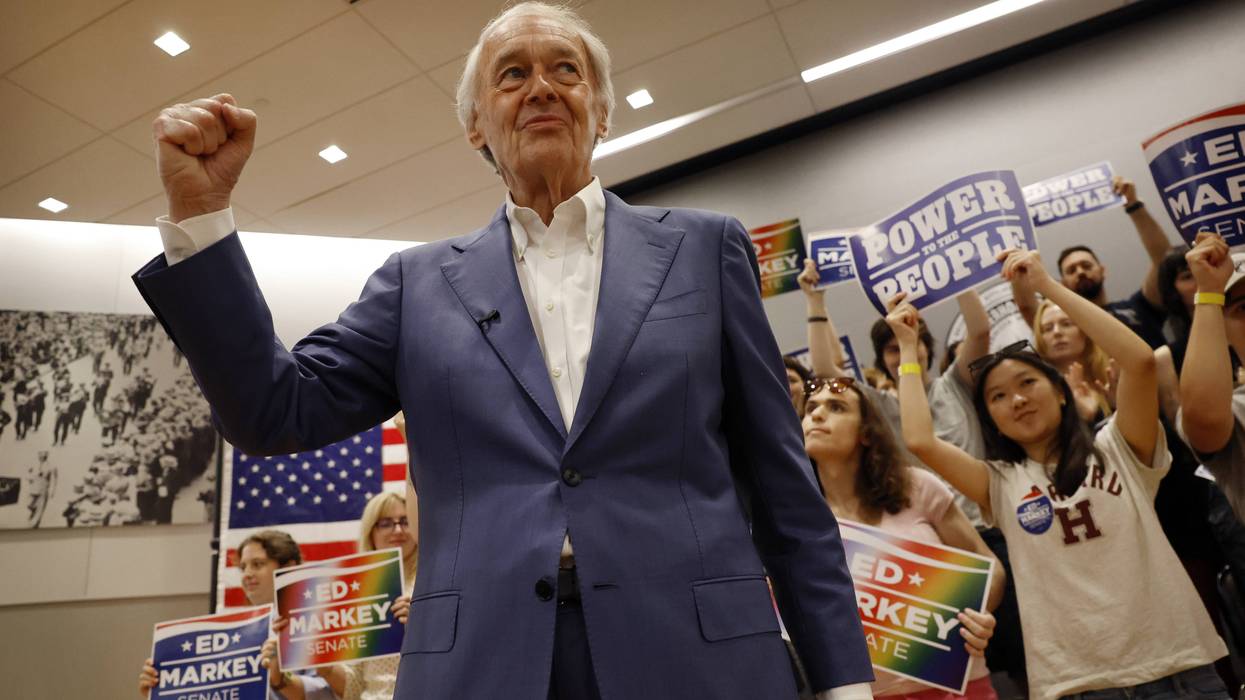
One Markey supporter called his victory "a rejection of the idea that generational change has to come at the expense of bold, progressive leadership."
Progressive US Sen. Ed Markey, a champion of Medicare for All and the Green New Deal, decisively fended off a Democratic primary challenge from his right on Tuesday, defeating Rep. Seth Moulton by nearly 30 percentage points in a contest that focused heavily on the incumbent senator's age.
Markey, 80, and his supporters—including prominent young Democrats such as Rep. Alexandria Ocasio-Cortez (D-NY)—rejected the notion that "generational change" necessarily means electing the youngest candidate in the race. Markey said in his victory speech Tuesday night that "generational change isn’t about compromising to do the small things better—it’s about fighting to do the big things best."
“Tonight is a testament to the power of the progressive movement,” Markey added. “It is a progressive movement fueled by young people, demanding more from their leaders, and it’s your voices that are the ones we need to hear right now.”
Moulton, a 47-year-old member of the conservative New Democrat Coalition, attempted to capture momentum that has propelled other younger candidates to victory over entrenched incumbents by making Markey's age and lengthy tenure in Congress—rather than his policy agenda—a central focus of Tuesday's contest. In a recent interview with MS NOW, Moulton removed ideology and policy from the equation completely, lumping Markey in with Sen. Mitch McConnell (R-Ky.) and late Sen. Lindsey Graham (R-SC) as well as elderly Democrats such as former President Joe Biden.
The Democratic representative, who opposes Medicare for All and attacked Sens. Bernie Sanders (I-Vt.) and Elizabeth Warren (D-Mass.) from the right during his ill-fated 2020 presidential bid, also falsely claimed in a campaign ad that he and Markey "want the same things."
Moulton's age-centric message failed, according to Markey's backers, because voters in Massachusetts and elsewhere are hungry for progressive politics, not just younger politicians.
"We don’t want younger politicians with older politics,” Tyler Hack, the 21-year-old executive director of the Christopher Street Project, a trans rights group, said at a rally for Markey over the weekend.
Joseph Geevarghese, executive director of Our Revolution, said in a statement that "tonight's victory isn't just a win for Ed Markey or for our progressive movement. It's a rejection of the idea that generational change has to come at the expense of bold, progressive leadership."
"Massachusetts voters understood the difference between changing the age of our leaders and changing the politics of our country," said Geevarghese. "Ed Markey has never settled for the moderate Democratic establishment or accepted the status quo simply because Washington said change was impossible. From staking his political capital on the Green New Deal, to fighting for Medicare for All, abolishing ICE, and taking on corporations and billionaires rigging our economy, Ed has consistently been willing to go where the Democratic Party needs to go—often before the rest of Washington gets there."
"That's the lesson from Massachusetts tonight," he added. "The future doesn't belong to the youngest politician in the room. It belongs to the people with the courage to fight for it."
Markey, who is heavily favored to win the general election in November, has said a new six-year Senate term would be his last.
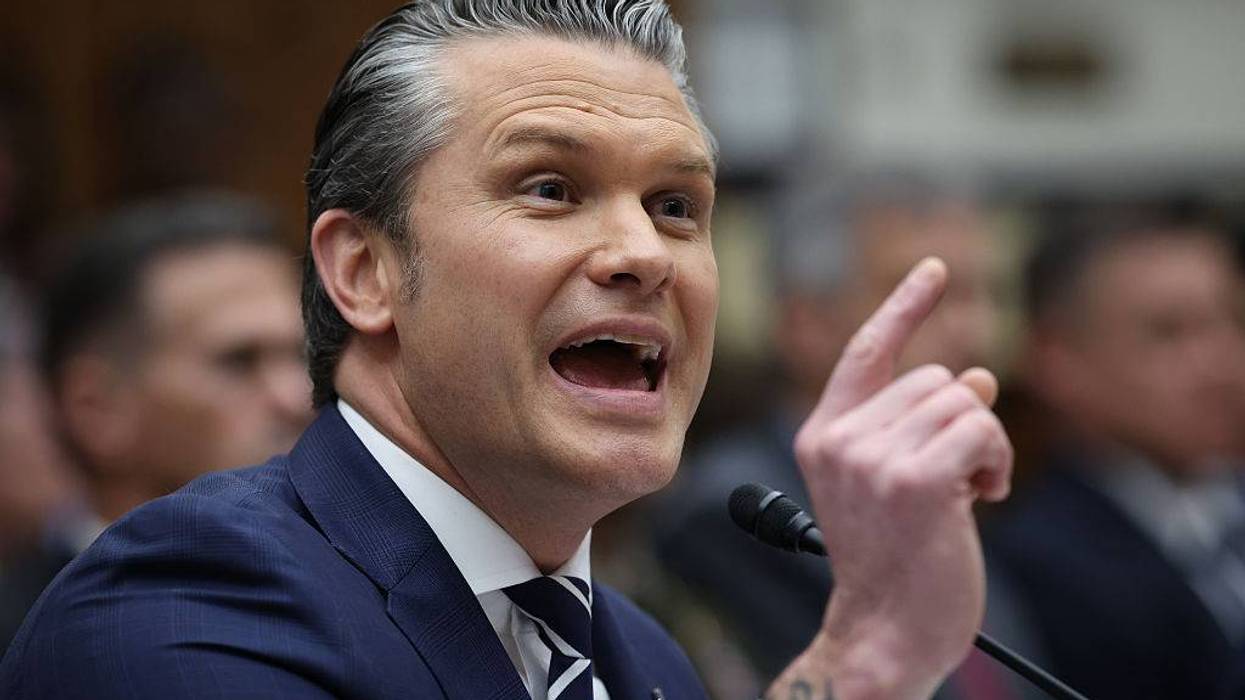
Rep. John Garamendi on Tuesday described Trump's war as "nothing short of a self-inflicted national security and economic disaster."
US Defense Secretary Pete Hegseth on Wednesday lashed out at a Democratic lawmaker over his criticism of President Donald Trump's illegal war with Iran.
During testimony before the House Armed Services Committee, Hegseth attacked Rep. John Garamendi (D-Calif.) for describing the Iran War, which Trump launched in late February without any authorization from Congress, as a "quagmire."
"You stain the troops when you tell them, two months in, two months in, congressman, shame on you, calling this a quagmire," Hegseth said. "The effort, what they've undertaken, what they've succeeded, the success on the battlefield to create strategic opportunities, the courage of a president to confront a nuclear Iran, and you call it a quagmire, handing propaganda to our enemies!"
Hegseth attacks Garamendi: "You stain the troops when you call this a quagmire two months in, handing propaganda to our enemies. Shame on you. Don't say I support the troops on one hand, and then a two-month mission is a quagmire. That's a false equivalation [sic]. Who are you… pic.twitter.com/WhsjEE3nbH
— Aaron Rupar (@atrupar) April 29, 2026
Hegseth continued by saying that calling the war a quagmire was "reckless to our troops," and then asked the congressman, "Who are you cheering for here?"
After questioning Garamendi's patriotism, Hegseth told the California Democrat that "your hatred for President Trump blinds you to the truth of the success of this mission, and the historic stakes that the president is addressing."
Hegseth's tirade against Garamendi came after the congressman on Tuesday introduced a new war powers resolution aimed at ending the Iran war.
"Trump’s war is nothing short of a self-inflicted national security and economic disaster," Garamendi said in explaining his support for the resolution. "Thirteen American servicemembers and thousands of Iranian civilians have been killed. Americans, who are already plagued by one of the worst affordability crises in years, are now paying unconscionable amounts for a tank of gas and are struggling to keep food on the table."
Later in the hearing, Hegseth was confronted by Rep. Seth Moulton (D-Mass.) about the strategic failures of the war, particularly the continued closure of the Strait of Hormuz, which has resulted in global oil and gas prices spiking upward.
Hegseth dismisses concerns over the Strait of Hormuz being closed because the US blockaded Iran’s blockade
Moulton: So they blockaded us, and then we blockaded their blockade—that's like if President Madison had said, well, the British just burned down Washington, but don't… pic.twitter.com/PuK4A3gtHS
— Acyn (@Acyn) April 29, 2026
"Would you call Iran closing the Strait of Hormuz winning?" Moulton asked.
"Well, I would say the blockade that we hold that doesn't allow anything to come in or out of the Iranian port..." Hegseth responded, before being interrupted by Moulton.
"OK, we we blockaded their blockade," Moulton said. "They blockaded us, and then we blockaded their blockade—that's like saying, 'Tag, you're it,' or like if President Madison had said, well, the British just burned down Washington, but don't worry, we're going to burn it down as well."
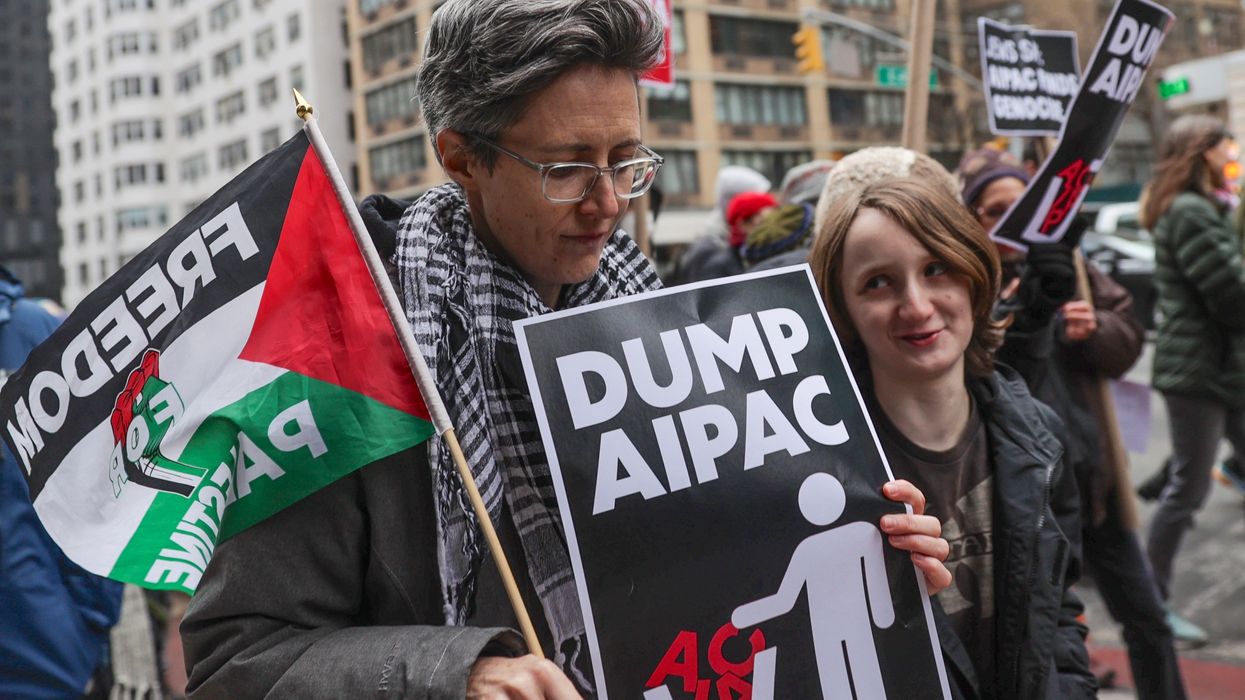
"AIPAC's brand is increasingly, perhaps irredeemably toxic," wrote one observer.
A centrist Democratic lawmaker on Thursday surprised many political observers when he announced he would be returning donations he'd received from the American Israel Public Affairs Committee.
Rep. Seth Moulton (D-Mass.), who is running a primary challenge against Sen. Ed Markey (D-Mass.), said that he was rejecting donations from AIPAC because it had aligned itself too closely with the government of Israeli Prime Minister Benjamin Netanyahu, who last year was accused of committing crimes against humanity by the International Criminal Court.
"I'm a friend of Israel, but not of its current government, and AIPAC's mission is to back that government," Moulton said in a social media post. "I don't support that direction."
As flagged by New York Times reporter Annie Karni, Moulton is now the fourth Democratic lawmaker who once received heavy support from AIPAC to reject their donations, following Reps. Morgan McGarvey (D-Ky.), Deborah Ross (D-NC), and Valerie Foushee (D-NC).
Hamid Bendaas, communications director for the Institute for Middle East Understanding Policy Project, observed in a post on X that Moulton appeared to be ignoring advice given by a prominent Democratic consultant over the summer to not focus on the Israel-Palestine conflict because polls showed it wasn't important to voters.
Dylan Williams, the vice president for government affairs at the Center for International Policy, argued that Moulton's rejection of AIPAC cash showed how far the organization's reputation with the electorate has fallen over the past several years.
"AIPAC is now so toxic to Democratic voters that support from it is widely seen as a political liability," he wrote. "The NRA-ization of AIPAC is nearly complete."
Ishaan Tharoor, a Washington Post global affairs columnist, also reflected on how much AIPAC's brand has been damaged over the last two years of war in Gaza, which has resulted in the deaths of at least 68,000 Palestinians.
"There was a time when people would refer to AIPAC as the gold standard in lobbying," he wrote. "So many in India and the Indian diaspora have talked about a future 'Indian AIPAC' one day influencing US politics in similar fashion. But AIPAC's brand is increasingly, perhaps irredeemably toxic."
Journalist Ryan Grim had a one-word reaction to Moulton's rejection of AIPAC cash: "Wow."
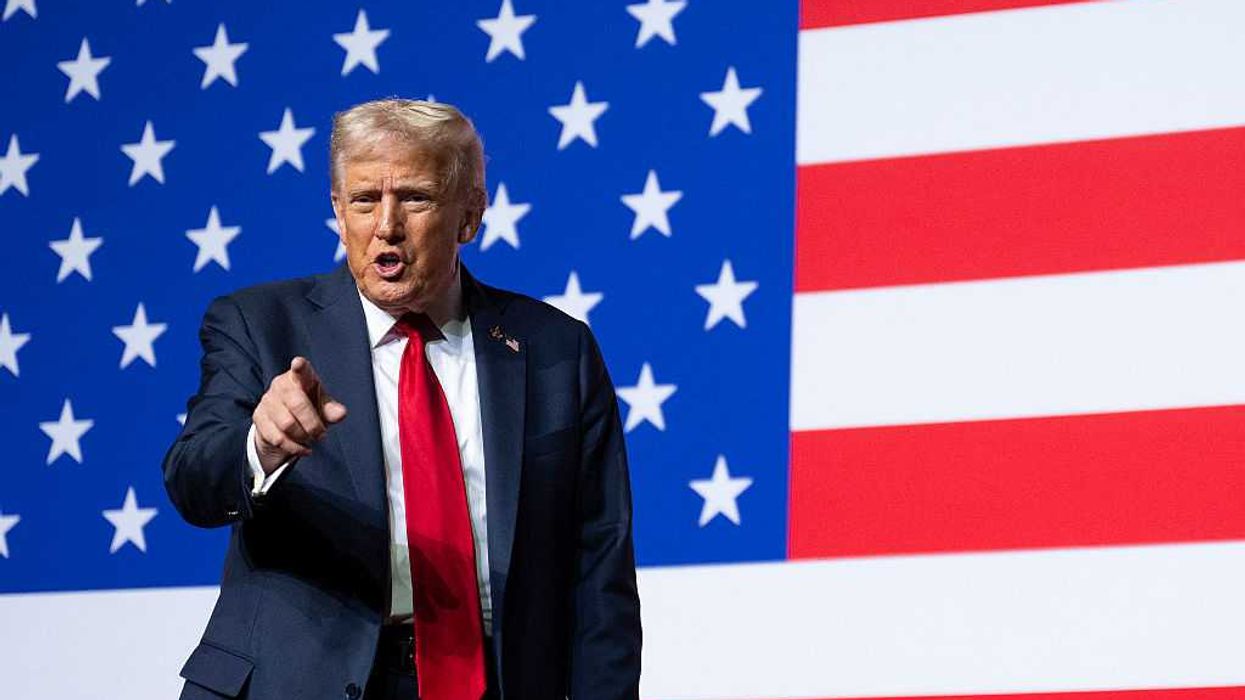
"Wake up, people, the US is fast approaching a point of no return," warned one critic, who said the president's alarming rhetoric "comes right out of the fascism playbook."
President Donald Trump told hundreds of senior military commanders Tuesday that the country is "under invasion from within" and that they should use American cities as "training grounds" to target domestic "enemies"—remarks that drew warnings of encroaching fascism as the president expands his invasion and occupation of US communities.
Speaking to nearly 800 US generals and admirals stationed around the world who were summoned to Quantico, Virginia by Defense Secretary Pete Hegseth for a highly unusual assembly, Trump told military leaders they would be used against the American people.
"They're vicious people that we have to fight," the president said, referring in this case to critical journalists, whom he called "sleazebags."
(Trump begins speaking at the 1:09:45 mark in the following video)
"Just like you have to fight vicious people, mine are a different kind of vicious," he added.
Trump then said that cities "run by the radical left Democrats... San Francisco, Chicago, New York, Los Angeles" are "very unsafe places, and we're gonna straighten them out one by one."
"And this is gonna be a major part for some of the people in this room," he continued. "This is a war too. It's a war from within."
Referring to Hegseth, Trump said, "and I told Pete, "we should use some of these dangerous cities as training grounds for our military."
Responding to this, Naureen Shah, director of government affairs at the ACLU's Equality Division, told Common Dreams that when Trump said "the enemy within," he meant "those who disagree with him."
"We don't need to spell out how dangerous the president’s message is, but here goes: Military troops must not police us, let alone be used as a tool to suppress the president’s critics," Shah said. "In cities across the country, the president’s federal deployments are already creating conflict where there is none and instilling profound fear in people who are simply trying to live their lives and exercise their constitutional rights. Our country and democracy deserve far better than this."
Trump also said during his Tuesday speech that "only in recent decades did politicians somehow come to believe that our job is to police the far reaches of Kenya and Somalia while America is under invasion from within," a false assertion given centuries of US imperialism and colonization, first in the Americas and then around the globe.
"We’re under invasion from within, no different than a foreign enemy, but more difficult in many ways, because they don’t wear uniforms—at least when they're wearing a uniform you can take them out; these people don't have uniforms," Trump said. "But we are under invasion from within; we're stopping it very quickly."
He then turned his attention to "radical left lunatics, that are brilliant people but dumb as hell when it comes to common sense," falsely accusing the previous administration of opening US borders to Venezuelans after that country's government "emptied its prison population into our country."
In another lie, Trump said that "Washington, DC was the most unsafe, the most dangerous city in the United States of America, and to a large extent, beyond."
The president claimed that "we took out 1,700 career criminals" during his recently launched takeover of DC—almost certainly another false statement given that more than 80% of arrests made in the capital were for misdemeanor offenses, many of them immigration-related.
Trump said US troops are "following in a great and storied military tradition" of presidents who have deployed military forces against "domestic" enemies.
"Today, I want to thank every service member from general to private who's helped secure the nation's capital and make America safe for the American people," he said, adding in another blatant lie that "we haven't had a crime in Washington in so long."
"We're going into Chicago very soon," he said, although Operation Midway Blitz is already underway in the city.
"How about Portland?" he asked, adding in a comment utterly divorced from reality that the laconic Oregon city "looks like a war zone."
Trump ordered troops to invade Portland despite the city ranking 72nd in violent crime in the US, according to FBI data.
In an apparent moment of doubt, Trump asked during a Sunday NBC News interview, "Well wait a minute, am I watching things on television that are different from what’s happening?"
Recounting how Democratic Oregon Gov. Tina Kotek asked Trump to not deploy federal forces to Portland, Trump said during Tuesday's speech that "unless they're playing false tapes, this looked like World War II. Your place is burning down."
Amid small-scale protests in Portland over Trump's authoritarian Immigration and Customs Enforcement (ICE) crackdown, Fox News aired a report conflating video footage from 2020 protests against the police murder of George Floyd with the recent images. Anti-ICE protesters have burned an American flag and set small street fires in Portland, but no structures have been burned down.
Trump also said that any anti-ICE protesters who throw objects at federal vehicles or agents can be met with unlimited force.
"You get out of that car, and you can do whatever the hell you want to do," the president said.
Critics swiftly pushed back on Trump's suggestion of using American cities as military "training grounds."
Congressman Seth Moulton (D-Mass.), a former Marine Corps combat veteran who served multiple tours during the US invasion and occupation of Iraq, said on the social media site X that "today’s speeches by Trump and Hegseth were weak portrayals of 'leadership' by two small, insecure men."
"US cities should never be 'training grounds' for the military," Moulton added. "There is no 'enemy from within.' The reputational and operational damage being done to our military will take years to undo."
The Democratic Association of Secretaries of State said on social media, "This is authoritarian, unconstitutional, and a direct threat to our democracy."
"Today’s speeches by Trump and Hegseth were weak portrayals of 'leadership' by two small, insecure men."
Chris Rilling, a former senior official at the National Oceanic and Atmospheric Administration (NOAA), said on X: "Trump should be impeached for this statement alone. Period."
Some legal experts noted that the Posse Comitatus Act of 1878 prohibits use of the military for domestic law enforcement.
Leaders of the Not Above the Law Coalition—which includes progressive groups such as Public Citizen, MoveOn, and Stand Up America—called Trump's remarks "deeply un-American."
“This dangerous rhetoric delivered during an unprecedented gathering reveals a fundamental misunderstanding of our military's purpose and the people it serves," the coalition co-chairs said. "Make no mistake: This isn't about public safety—it's about turning our own military into a force to be used against Trump’s perceived political opponents or anyone who questions his administration."
“Americans cannot stay silent when our leaders express plans to use our military against us," they added. "We must reject any attempt to normalize this outrageous and unlawful directive.”
Observers abroad also expressed shock at Trump's remarks.
"In Trump’s speech today, Trump mentioned something very dangerous: using US cities (Democrat-run, I bet) as US troops training ground," said José Antonio Salcedo, a professor at University of Porto in Portugal. "This is definitely contrary to the US Constitution."
"It comes right out of the fascism playbook that Project 2025 and its fringe lunatic authors have been advocating and planning," he added. "Wake up, people, the US is fast approaching a point of no return."

"Removing Cuba from this list is one thing that the U.S. can do immediately to ease the daily hardships facing so many Cuban families," wrote seven lawmakers.
Following a private briefing on Capitol Hill in which a U.S. State Department official angered Democratic lawmakers by revealing that the Biden administration has not yet begun a lengthy review process to remove Cuba from the government's list of "State Sponsors of Terror," Reps. Ayanna Pressley and Jim McGovern led other Massachusetts Democrats in demanding that the White House expedite the process.
The letter sent to President Joe Biden was written in mid-December, a week after the closed-door meeting took place, but was not released on until Tuesday.
Pressley and McGovern were joined by Reps. Lori Trahan, Stephen Lynch, and Seth Moulton, as well as Sens. Elizabeth Warren and Ed Markey in calling on Biden to reverse the "vindictive action" taken by former Republican President Donald Trump just before he left office in January 2021, when he added Cuba to the SSOT list.
The Democrats noted that while there are numerous reasons for Cuba's economic crisis, "without a doubt a significant contributing factor is the restrictions and penalties facing international financial institutions and other entities because Cuba is on the SSOT list."
"From the poorest and most vulnerable to the struggling private sector to religious, humanitarian, and cultural actors, the Cuban people are enduring the most dire deprivations in recent memory—everyone is suffering," the letter reads. "Removing Cuba from this list is one thing that the U.S. can do immediately to ease the daily hardships facing so many Cuban families, including its struggling private sector."
Inclusion on the SSOT list limits Cuba's participation in international financial markets, as other countries are forced to choose between doing business with the wealthiest country in the world and the small island nation that it claims supports terrorism.
Trump claimed the designation was necessary because Cuba was aiding terrorists in Colombia—reasoning that the lawmakers called "specious."
"During his most recent visit to the United States, Colombian President Gustavo Petro appealed personally to you for Cuba to be removed from the list to facilitate peace negotiations between the Colombian government and the National Liberation Army (ELN) guerrillas," wrote the lawmakers.
The December meeting on Capitol Hill left several Democrats "furious," a lawmaker who was granted anonymity told The Intercept last month, particularly because McGovern had reportedly been told that the review process, which takes about six months, was ongoing.
In the letter the lawmakers pointed out that on the campaign trail, Biden pledged to "address re-engagement with Cuba" and lift Trump's punishing economic sanctions, returning to the normalized relations introduced by the Obama-Biden administration.
As William Leogrande wrote at the The Nation on Monday, Cuba's foreign exchange earnings have been "drastically reduced" by the sanctions.
"The impact of the economic crisis is visible everywhere," wrote Leogrande. "There are fewer cars on the streets and long lines at gas stations because of the fuel shortage. Tourist hotels stand half-empty and the once bustling streets of Old Havana are quiet. The shelves in state stores are mostly bare, often lacking even the limited basket of goods that Cubans receive at subsidized prices on their ration book. Garbage is accumulating on street corners. Street crime is rising."
Alleviating some of the suffering by removing Cuba from the SSOT list, said the Democratic lawmakers in their letter to Biden, "is the only option worthy of the United States."

Clean transportation supporters in Congress joined with environmental and labor advocates for a Wednesday rally to demand funding for high-speed rail, a call that was echoed in a new letter from five Democratic lawmakers amid ongoing infrastructure talks.
"High-speed rail connects communities. It brings people together. It's the way of the future."
--Rep. Seth Moulton
The letter is spearheaded by Reps. Seth Moulton (D-Mass.), Jim Costa (D-Calif.), and Alexandria Ocasio-Cortez (D-N.Y.) as well as Sens. Kirsten Gillibrand (D-N.Y.) and Ed Markey (D-Mass)--some of whom spoke at the morning rally.
"For too long," Moulton said at the podium, "our highways have divided our cities. They have gone directly through neighborhoods--usually neighborhoods of color. High-speed rail connects communities. It brings people together. It's the way of the future."
As Ocasio-Cortez put it: "This is part of our overall goal to create millions of union jobs in the United States of America building climate infrastructure to bring down our carbon emissions, save our future, and improve our quality of life."
The Democrats behind the letter are also among those who have expressed frustration with GOP attempts to water down President Joe Biden's two-part infrastructure proposal--the American Jobs Plan and American Families Plan--that some progressive critics argue is already inadequate.
The letter, addressed to the party leaders in each chamber as well as key committee chairs and ranking members, says that "with the new administration, we have a generational opportunity to invest in our nation's infrastructure, and we are grateful for your leadership in ensuring we invest in next generation infrastructure, not just the infrastructure of the past."
"As negotiations continue to develop around a comprehensive infrastructure package, we write to express our support for the inclusion of dedicated funding to develop international-standard high-speed rail with high-performance connections that feed into a larger network," it adds. "A federal commitment to these modern and proven transportation systems will dramatically improve our environment, reduce inequity, and help grow cities and sustain vibrant downtowns across the nation."
"Reducing emissions from the transportation sector is critical to meeting our nation's climate goals and cutting our carbon footprint," notes the letter, echoing scientific findings. "A robust network of high-speed rail corridors with high-performance connections is the best option to dramatically reduce carbon emissions while improving intercity travel."
"As we rebuild coming out of the pandemic," it continues, "investing in a high-speed rail network with high-performance rail connections will create direct, good-paying, and secure jobs immediately, while enabling long-term economic growth across whole megaregions and providing vital access to opportunity for smaller communities."
The letter's authors are also leaders of major climate proposals recently put forth in Congress: Ocasio-Cortez and Markey reintroduced the Green New Deal Resolution in April; Markey and Rep. Debbie Dingell (D-Mich.) unveiled the $10 trillion THRIVE Act that same month; and Moulton proposed a national high-speed rail plan in May.
Moutlon's "ambitious--and expensive--plan," detailed in a WIRED report and a white paper (pdf) on his website, calls for investing $205 billion over five years into building a national high-speed rail network.
According to WIRED:
That money could, in turn, encourage another $243 billion in matching state, local, and private investments, Moulton says. The bill would create a unified, national vision of a rail network that could guide future investments and would iron out regulations to speed construction. It would encourage private companies to operate the new rail networks, instead of, say, Amtrak, which is projecting a $700 million loss this year. It cites firms like Virgin Trains USA, which runs and hopes to extend a rail line in Florida, and Texas Central Railway, Moulton's former employer, which is working to build one in the Lone Star State, as models.
The rally and letter initiative followed a Tuesday announcement that the developers behind the proposed high-speed rail project between Dallas and Houston signed a $16 billion contract with a construction and engineering company to build the 200-miles-per-hour train system.
Wednesday's developments also came a day after Markey joined with Sen. Jeff Merkley (D-Ore.) for an event under the "no climate, no deal" catchphrase that progressive lawmakers and advocacy groups are using in public discussions and demands about the developing infrastructure deal.
Kate Aronoff reported Tuesday for The New Republic that "progressive offices and nonprofits are now in the process of trying to align their priorities, which may include $1 trillion of funding for public renewables and $500 billion for clean transportation."
Sunrise Movement legislative director Lauren Maunus told Aronoff that "we understand the political constraints and reality in this moment, and we need to work within them while continuing to shift the conditions for more ambitious climate action in years to come."
"We need to make sure that Biden does not walk back his campaign commitments and the American Jobs Plan," said Maunus, whose youth-led group has endorsed bold climate proposals like the Green New Deal and THRIVE Act. "That's already a compromise, and we can't afford anything less than that."

When Donald Trump entered the Oval Office in January 2017, Americans took to the streets all across the country to protest their instantly endangered rights. Conspicuously absent from the newfound civic engagement, despite more than a decade and a half of this country's fruitless, destructive wars across the Greater Middle East and northern Africa, was antiwar sentiment, much less an actual movement.
Those like me working against America's seemingly endless wars wondered why the subject merited so little discussion, attention, or protest. Was it because the still-spreading war on terror remained shrouded in government secrecy? Was the lack of media coverage about what America was doing overseas to blame? Or was it simply that most Americans didn't care about what was happening past the water's edge? If you had asked me two years ago, I would have chosen "all of the above." Now, I'm not so sure.
After the enormous demonstrations against the invasion of Iraq in 2003, the antiwar movement disappeared almost as suddenly as it began, with some even openly declaring it dead.
After the enormous demonstrations against the invasion of Iraq in 2003, the antiwar movement disappeared almost as suddenly as it began, with some even openly declaring it dead. Critics noted the long-term absence of significant protests against those wars, a lack of political will in Congress to deal with them, and ultimately, apathy on matters of war and peace when compared to issues like health care, gun control, or recently even climate change.
The pessimists have been right to point out that none of the plethora of marches on Washington since Donald Trump was elected have had even a secondary focus on America's fruitless wars. They're certainly right to question why Congress, with the constitutional duty to declare war, has until recently allowed both presidents Barack Obama and Donald Trump to wage war as they wished without even consulting them. They're right to feel nervous when a national poll shows that more Americans think we're fighting a war in Iran (we're not) than a war in Somalia (we are).
But here's what I've been wondering recently: What if there's an antiwar movement growing right under our noses and we just haven't noticed? What if we don't see it, in part, because it doesn't look like any antiwar movement we've even imagined?
If a movement is only a movement when people fill the streets, then maybe the critics are right. It might also be fair to say, however, that protest marches do not always a movement make. Movements are defined by their ability to challenge the status quo and, right now, that's what might be beginning to happen when it comes to America's wars.
What if it's Parkland students condemning American imperialism or groups fighting the Muslim Ban that are also fighting the war on terror? It's veterans not only trying to take on the wars they fought in, but putting themselves on the front lines of the gun control, climate change, and police brutality debates. It's Congress passing the first War Powers Resolution in almost 50 years. It's Democratic presidential candidates signing a pledge to end America's endless wars.
For the last decade and a half, Americans--and their elected representatives--looked at our endless wars and essentially shrugged. In 2019, however, an antiwar movement seems to be brewing. It just doesn't look like the ones that some remember from the Vietnam era and others from the pre-invasion-of-Iraq moment. Instead, it's a movement that's being woven into just about every other issue that Americans are fighting for right now--which is exactly why it might actually work.
A Veteran's Antiwar Movement in the Making?
During the Vietnam War of the 1960s and early 1970s, protests began with religious groups and peace organizations morally opposed to war. As that conflict intensified, however, students began to join the movement, then civil rights leaders like Martin Luther King, Jr. got involved, then war veterans who had witnessed the horror firsthand stepped in--until, with a seemingly constant storm of protest in the streets, Washington eventually withdrew from Indochina.
You might look at the lack of public outrage now, or perhaps the exhaustion of having been outraged and nothing changing, and think an antiwar movement doesn't exist. Certainly, there's nothing like the active one that fought against America's involvement in Vietnam for so long and so persistently. Yet it's important to notice that, among some of the very same groups (like veterans, students, and even politicians) that fought against that war, a healthy skepticism about America's twenty-first-century wars, the Pentagon, the military industrial complex, and even the very idea of American exceptionalism is finally on the rise--or so the polls tell us.
Right after the midterms last year, an organization named Foundation for Liberty and American Greatness reported mournfully that younger Americans were "turning on the country and forgetting its ideals," with nearly half believing that this country isn't "great" and many eyeing the U.S. flag as "a sign of intolerance and hatred." With millennials and Generation Z rapidly becoming the largest voting bloc in America for the next 20 years, their priorities are taking center stage. When it comes to foreign policy and war, as it happens, they're quite different from the generations that preceded them. According to the Chicago Council of Global Affairs,
"Each successor generation is less likely than the previous to prioritize maintaining superior military power worldwide as a goal of U.S. foreign policy, to see U.S. military superiority as a very effective way of achieving U.S. foreign policy goals, and to support expanding defense spending. At the same time, support for international cooperation and free trade remains high across the generations. In fact, younger Americans are more inclined to support cooperative approaches to U.S. foreign policy and more likely to feel favorably towards trade and globalization."
Although marches are the most public way to protest, another striking but understated way is simply not to engage with the systems one doesn't agree with. For instance, the vast majority of today's teenagers aren't at all interested in joining the all-volunteer military. Last year, for the first time since the height of the Iraq war 13 years ago, the Army fell thousands of troops short of its recruiting goals. That trend was emphasized in a 2017 Department of Defense poll that found only 14% of respondents ages 16 to 24 said it was likely they'd serve in the military in the coming years. This has the Army so worried that it has been refocusing its recruitment efforts on creating an entirely new strategy aimed specifically at Generation Z.
In addition, we're finally seeing what happens when soldiers from America's post-9/11 wars come home infused with a sense of hopelessness in relation to those conflicts. These days, significant numbers of young veterans have been returning disillusioned and ready to lobby Congress against wars they once, however unknowingly, bought into. Look no farther than a new left-right alliance between two influential veterans groups, VoteVets and Concerned Veterans for America, to stop those forever wars. Their campaign, aimed specifically at getting Congress to weigh in on issues of war and peace, is emblematic of what may be a diverse potential movement coming together to oppose America's conflicts. Another veterans group, Common Defense, is similarly asking politicians to sign a pledge to end those wars. In just a couple of months, they've gotten on board 10 congressional sponsors, including freshmen heavyweights in the House of Representatives Alexandria Ocasio-Cortez and Ilhan Omar.
Sooner or later fighting climate change will mean taking on the Pentagon's global footprint, too.
And this may just be the tip of a growing antiwar iceberg. A misconception about movement-building is that everyone is there for the same reason, however broadly defined. That's often not the case and sometimes it's possible that you're in a movement and don't even know it. If, for instance, I asked a room full of climate-change activists whether they also considered themselves part of an antiwar movement, I can imagine the denials I'd get. And yet, whether they know it or not, sooner or later fighting climate change will mean taking on the Pentagon's global footprint, too.
Think about it: not only is the U.S. military the world's largest institutional consumer of fossil fuels but, according to a new report from Brown University's Costs of War Project, between 2001 and 2017, it released more than 1.2 billion metric tons of greenhouse gases into the atmosphere (400 million of which were related to the waron terror). That's equivalent to the emissions of 257 million passenger cars, more than double the number currently on the road in the U.S.
A Growing Antiwar Movement in Congress
One way to sense the growth of antiwar sentiment in this country is to look not at the empty streets or even at veterans organizations or recruitment polls, but at Congress. After all, one indicator of a successful movement, however incipient, is its power to influence and change those making the decisions in Washington. Since Donald Trump was elected, the most visible evidence of growing antiwar sentiment is the way America's congressional policymakers have increasingly become engaged with issues of war and peace. Politicians, after all, tend to follow the voters and, right now, growing numbers of them seem to be following rising antiwar sentiment back home into an expanding set of debates about war and peace in the age of Trump.
In campaign season 2016, in an op-ed in the Washington Post, political scientist Elizabeth Saunders wondered whether foreign policy would play a significant role in the presidential election. "Not likely," she concluded. "Voters do not pay much attention to foreign policy." And at the time, she was on to something. For instance, Senator Bernie Sanders, then competing for the Democratic presidential nomination against Hillary Clinton, didn't even prepare stock answers to basic national security questions, choosing instead, if asked at all, to quickly pivot back to more familiar topics. In a debate with Clinton, for instance, he was asked whether he would keep troops in Afghanistan to deal with the growing success of the Taliban. In his answer, he skipped Afghanistan entirely, while warning only vaguely against a "quagmire" in Iraq and Syria.
Heading for 2020, Sanders is once again competing for the nomination, but instead of shying away from foreign policy, starting in 2017, he became the face of what could be a new American way of thinking when it comes to how we see our role in the world.
In February 2018, Sanders also became the first senator to risk introducing a war powers resolution to end American support for the brutal Saudi-led war in Yemen. In April 2019, with the sponsorship of other senators added to his, the bill ultimately passed the House and the Senate in an extremely rare showing of bipartisanship, only to be vetoed by President Trump. That such a bill might pass the House, no less a still-Republican Senate, even if not by a veto-proof majority, would have been unthinkable in 2016. So much has changed since the last election that support for the Yemen resolution has now become what Tara Golshan at Vox termed "a litmus test of the Democratic Party's progressive shift on foreign policy."
Nor, strikingly enough, is Sanders the only Democratic presidential candidate now running on what is essentially an antiwar platform. One of the main aspects of Elizabeth Warren's foreign policy plan, for instance, is to "seriously review the country's military commitments overseas, and that includes bringing U.S. troops home from Afghanistan and Iraq." Entrepreneur Andrew Yang and former Alaska Senator Mike Gravel have joined Sanders and Warren in signing a pledge to end America's forever wars if elected. Beto O'Rourke has called for the repeal of Congress's 2001 Authorization to Use Military Force that presidents have cited ever since whenever they've sent American forces into battle. Marianne Williamson, one of the many (unlikely) Democratic candidates seeking the nomination, has even proposed a plan to transform America's "wartime economy into a peace-time economy, repurposing the tremendous talents and infrastructure of [America's] military industrial complex... to the work of promoting life instead of death."
And for the first time ever, three veterans of America's post-9/11 wars--Seth Moulton and Tulsi Gabbard of the House of Representatives, and South Bend Mayor Pete Buttigieg--are running for president, bringing their skepticism about American interventionism with them. The very inclusion of such viewpoints in the presidential race is bound to change the conversation, putting a spotlight on America's wars in the months to come.
Get on Board or Get Out of the Way
When trying to create a movement, there are three likely outcomes: you will be accepted by the establishment, or rejected for your efforts, or the establishment will be replaced, in part or in whole, by those who agree with you. That last point is exactly what we've been seeing, at least among Democrats, in the Trump years. While 2020 Democratic candidates for president, some of whom have been in the political arena for decades, are gradually hopping on the end-the-endless-wars bandwagon, the real antiwar momentum in Washington has begun to come from new members of Congress like Alexandria Ocasio-Cortez (AOC) and Ilhan Omar who are unwilling to accept business as usual when it comes to either the Pentagon or the country's forever wars. In doing so, moreover, they are responding to what their constituents actually want.
Somewhere just under the surface of American life lurks a genuine, diverse antiwar movement that appears to be coalescing around a common goal: getting Washington politicians to believe that antiwar policies are supportable, even potentially popular.
As far back as 2014, when a University of Texas-Austin Energy Poll asked people where the U.S. government should spend their tax dollars, only 7% of respondents under 35 said it should go toward military and defense spending. Instead, in a "pretty significant political shift" at the time, they overwhelmingly opted for their tax dollars to go toward job creation and education. Such a trend has only become more apparent as those calling for free public college, Medicare-for-all, or a Green New Deal have come to realize that they could pay for such ideas if America would stop pouring trillions of dollars into wars that never should have been launched.
The new members of the House of Representatives, in particular, part of the youngest, most diverse crew to date, have begun to replace the old guard and are increasingly signalling their readiness to throw out policies that don't work for the American people, especially those reinforcing the American war machine. They understand that by ending the wars and beginning to scale back the military-industrial complex, this country could once again have the resources it needs to fix so many other problems.
In May, for instance, Omar tweeted, "We have to recognize that foreign policy IS domestic policy. We can't invest in health care, climate resilience, or education if we continue to spend more than half of discretionary spending on endless wars and Pentagon contracts. When I say we need something equivalent to the Green New Deal for foreign policy, it's this."
A few days before that, at a House Committee on Oversight and Reform hearing, Ocasio-Cortez confronted executives from military contractor TransDigm about the way they were price-gouging the American taxpayer by selling a $32 "non-vehicular clutch disc" to the Department of Defense for $1,443 per disc. "A pair of jeans can cost $32; imagine paying over $1,000 for that," she said. "Are you aware of how many doses of insulin we could get for that margin? I could've gotten over 1,500 people insulin for the cost of the margin of your price gouging for these vehicular discs alone."
And while such ridiculous waste isn't news to those of us who follow Pentagon spending closely, this was undoubtedly something many of her millions of supporters hadn't thought about before. After the hearing, Teen Vogue created a list of the "5 most ridiculous things the United States military has spent money on," comedian Sarah Silverman tweeted out the AOC hearing clip to her 12.6 million followers, Will and Grace actress Debra Messing publicly expressed her gratitude to AOC, and according to Crowdtangle, a social media analytics tool, the NowThis clip of her in that congressional hearing garnered more than 20 million impressions.
Not only are members of Congress beginning to call attention to such undercovered issues, but perhaps they're even starting to accomplish something. Just two weeks after that contentious hearing, TransDigm agreed to return $16.1 million in excess profits to the Department of Defense. "We saved more money today for the American people than our committee's entire budget for the year," said House Oversight Committee Chair Elijah Cummings.
Of course, antiwar demonstrators have yet to pour into the streets, even though the wars we're already involved in continue to drag on and a possible new one with Iran looms on the horizon. Still, there seems to be a notable trend in antiwar opinion and activism. Somewhere just under the surface of American life lurks a genuine, diverse antiwar movement that appears to be coalescing around a common goal: getting Washington politicians to believe that antiwar policies are supportable, even potentially popular. Call me an eternal optimist, but someday I can imagine such a movement helping end those disastrous wars.

The attitudes of Democratic voters toward the Israeli-Palestinian conflict have become decidedly more balanced in the past two decades. Favorable attitudes toward Palestinians are up while attitudes toward Israel appear to be in decline. While, overall views of Israel remain positive, substantial numbers of Democrats are opposed to Israeli policies - namely settlement construction and violations of Palestinian rights. Israel's leader, Benjamin Netanyahu, is also viewed negatively by most Democrats.
These shifts in opinion have placed many Democratic presidential candidates in a bind - especially those who have served in Congress or as Governors. As conscious as they may be of their base's changing mood, they have also been schooled not to alienate pro-Israel donors or cross Israel's lobbyists, who can, if aroused, distract their campaigns with a barrage of protests.
It was against this backdrop that I watched the results of a months-long New York Times' project in which they interviewed 21 of the Democrats running for president on a range of foreign and domestic policy issues that will confront the next president. There were questions on Afghanistan, handguns, health care, immigration, and the death penalty.
Most intriguing to me was question #4: "Do you think that Israel meets international standards of human rights?" because it was deeply revealing about each of candidates' principles, their understanding of, and readiness to deal with the Israeli-Palestinian conflict.
It was disturbing how few of the candidates appear to have given the matter any serious thought. With the notable exceptions of Senator Bernie Sanders, Mayor Pete Buttigieg, and Congressmen Eric Swalwell and Seth Moulton, most of the elected officials stumbled about like frightened high schoolers being asked a test question for which they hadn't prepared.
Only a handful found the inner strength to suggest that Israel, in fact, was violating human rights.
Only a handful found the inner strength to suggest that Israel, in fact, was violating human rights. Most respondents hedged their replies noting the challenges Israel faces or "Israel attempts meet human rights standards...but could do a better job. A few, Senators Kamala Harris and Michael Bennet, Mayor Bill de Blasio, and Congressman John Delaney, actually indicated that they believed that Israel was upholding human rights. Some, instead of addressing the question, shifted to a more comfortable critique of the failings of President Trump or Prime Minister Netanyahu - as if to suggest that problems began with these two leaders.
Additionally, those who hedged their answers implying that Israel's record was less than perfect offered, as their way out of appearing to be critical of Israel, something like - "Israel's trying to do the right thing, but sometimes they fail and need our help." Finally, other than the few that mentioned settlement expansion, most failed to consider other human rights violations that occur in the Occupied Territories. The only Democrat who did was Seth Moulton, who cited his earlier support for legislation calling for "not supplying Israel with weapons and goods if they do not uphold standards for the treatment of Palestinian kids in prison."
As they awkwardly struggled to get out of the challenge foisted upon them, you could almost see the wheels spinning inside their heads weighing their need to assert their pro-Israel bona fides with the newly felt need to be relevant to the changing mood of the Democratic electorate. It was for many "a damned if they do, damned if they don't" situation.
What became painfully clear was the extent to which most of the candidates, either because they were loath to offer any criticism of Israel or because they simply had no idea how to answer this question, found themselves forced to recall comfortable, though irrelevant, talking points.
The top of mind reply of a majority of the respondents was a variation of "Israel is our most important ally" or "Israel is a liberal democracy" - completely dodging the question asked. Equally off-topic was the support a majority of the candidates expressed for a "two state solution."
You can read the transcripts of their comments, but far more interesting was watching their faces as they struggled to answer this simple question. First, there was the obvious discomfort at being called upon to talk about a topic they would rather avoid. Then, you could see them fumbling about trying to remember talking points and looking for a safety net. At one point, you can see the lights go on when they recalled the magical "two state solution" formula. It was as if at the end of a long and grueling half-baked answer to an unwanted question, they remembered "Ah ha! Two states - that's the way out of this mess." then without any connection to the question or anything they had said up until that point, they would shift into their comfort zone and say "we should be doing more to press the parties to negotiate a two-state solution" - end of answer and smile - as if they were saying "Phew! Did I get out of that one?"
What's especially troubling about this "fall back" two-state solution answer, in addition to the fact that it had nothing to do with the question that was asked, is that most seemed to act as if just saying they supported two states absolved them of needing to say or do more - for this reason, I've come to refer to it as "the two state absolution." The notable exception here was Congressman Julian Castro who acknowledged that settlement expansion made the goal of two states "harder."
Most disappointing was the non-response of the usually thoughtful Senator Elizabeth Warren, who said that she would urge the Israelis and Palestinians to "come to the table and negotiate" and then "stay out of the way to let them negotiate," as if that had never been tried before and as if the ascendancy of far-right in Israel isn't hell-bent on doing everything they can to avoid an independent Palestinian state.
The bottom line is that most of the Democrats running for president have a long way to go to in dealing with Israel/Palestine. The reason is simple. Because of the pervasive presence and power of pro-Israel forces, elected officials have long taken a "hands off" approach to dealing with this issue. Many have learned that stepping "out of line" brings painful results - calls that tie up their office phones and angry emails that fill up their inboxes, leading them to avoid this issue like a disease. The result is what I called "willed ignorance." They focus on "their issues" - the ones that got them elected and ignore those that can only bring trouble. Therefore, they don't receive or even request briefings on this critical question.
But the situation is changing. The evolving attitudes of the electorate - especially key blocs of Democratic voters and the disgust of many Democrats with Netanyahu's policies and the Trump/Netanyahu "love-fest" - all point to the fact that this will not be the last time uncomfortable questions about Israel-Palestine will be asked. It's time for those who hope to lead us to take the time to learn about this issue that has vexed every American president for 70 years.

After 2020 presidential candidate Joe Biden bowed to pressure and announced he no longer supports the anti-choice Hyde Amendment, Rep. Seth Moulton on Friday applauded Biden for reversing his position and said he should do the same for the Iraq invasion he voted for as a senator in 2002.
"Bravo to Joe Biden for doing the right thing and reversing his longstanding support for the Hyde Amendment," tweeted Moulton, who is also a 2020 Democratic presidential candidate. "It takes courage to admit when you're wrong, especially when those decisions affect millions of people."
"Now do the Iraq War," added Moulton, an Iraq War veteran.
Moulton's tweet on Friday was not the first time he has criticized Biden for supporting the invasion of Iraq.
"It was a mistake," Moulton said of Biden's vote in an interview on CNN earlier this month. "Because we should've been a lot more careful about going into Iraq. We should have questioned the intelligence. We should have made sure that we exhausted every opportunity before we put young American lives in danger."
Biden's vote in favor of the invasion of Iraq is one of his many past positions that, according to critics, show he is out of touch with the current direction of the Democratic Party.
"Joe Biden stands in near complete opposition to where the center of energy is in the Democratic Party today," progressive advocacy group Justice Democrats said after Biden announced his candidacy in April. "We don't need someone who voted for the Iraq War, for mass incarceration, and for the Bankruptcy Reform Act while voting against gay marriage, reproductive rights, and school desegregation."
Biden is the only 2020 Democratic presidential candidate who voted for the Iraq invasion. Sen. Bernie Sanders (I-Vt.)--the only other presidential contender who was in Congress during the build-up to the invasion--voted no as a member of the House.
"Joe voted for the war in Iraq," Sanders told ABC last month, highlighting the contrasts between himself and the former vice president. "I led the effort against it."
As Norman Solomon wrote for Common Dreams in March, the problem "wasn't just that Biden voted for the Iraq war on the Senate floor five months before it began."
"During the lead-up to that vote, in August 2002, as chairman of the Foreign Relations Committee," Solomon wrote, "he presided over sham hearings--refusing to allow experts who opposed an invasion to get any words in edgewise--while a cavalcade of war hawks testified in the national spotlight."

In a signal that Democratic voters aren't satisfied with timid steps to address the human-made global climate crisis, new polling from Data for Progress--initially reported by HuffPost on Thursday--shows that incumbent congressional candidates in 2020 could be ousted by progressive primary challengers if they fail to back a Green New Deal.
Championed by Rep. Alexandria Ocasio-Cortez (D-N.Y.) and a growing collective of Democratic lawmakers and climate campaigners, a Green New Deal would combine efforts to curb global warming and create a more just economy through generating clean energy jobs and other initiatives. Such a deal, however, has been met with opposition from more conservative Democrats.
The youth-led Sunrise Movement, which has organized protests at congressional offices in recent weeks to encourage House Speaker Nancy Pelosi (D-Calif.) and other Democrats to support a Green New Deal, celebrated the new polling results in a tweet:
The movement has called on Pelosi to pursue bold climate action that aligns with the latest science, or to step aside so more ambitious lawmakers can take the lead. Pelosi, for her part, has pushed for a pay-go rule for the House that opponents say will hinder Medicare for All and a Green New Deal as well as a Select Committee on the Climate Crisis that critics denounce as a "toothless" stand-in for a committee dedicated to crafting such a deal.
Democratic Rep. Kathleen Rice (N.Y.), meanwhile, has unsuccessfully fought to replace Pelosi with someone more conservative and has not publicly backed mounting calls for the Democratically-controlled House to work on a Green New Deal. The new polling, conducted Dec. 17 to Dec. 27, suggests such positions could have major consequences come 2020.
In Rice's Long Island district, 300 likely Democratic primary voters were told that Rice "does not currently support a Green New Deal," and asked about how a candidate's position on a plan "to invest trillions of dollars into the development and distribution of green energy, creating millions of new high-wage jobs while preventing catastrophic climate change" would impact their decisions in the ballot box during the next primary.
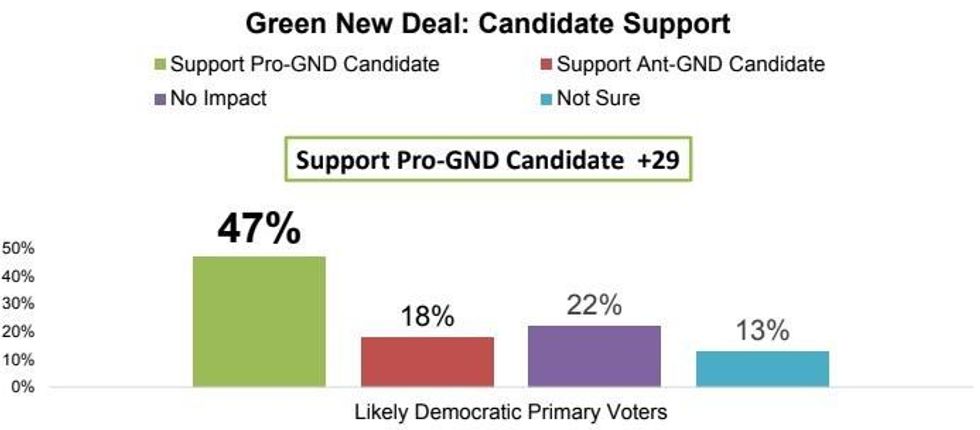
Although Rice has a high approval rating in New York's 4th District and she told HuffPost that she supports "robust federal investment in energy-efficient infrastructure projects and training for green energy jobs," a plurality of respondents, 47 percent, indicated that they would back a candidate who supports a Green New Deal.
"The strongest margin of support are older suburban women," noted Evan Roth Smith of Slingshot Strategies, which conducted the survey for Data for Progress. "That is the constituency for a Green New Deal in her district."
However, polling from Massachusetts' 6th District, currently represented by Rep. Seth Moulton (D-Mass.), shows that Democrats who have backed the Green New Deal but are more centrist and opposed Pelosi's bid for speaker--even if they ultimately voted for her--could also face progressive challengers in 2020. Moulton had a 61 percent favorable rating among 300 likely Democratic primary voters, according to The Daily Beast. "But when pitted against other prospective Democratic challengers, only 49 percent said that they would back him. Of those surveyed, 29 percent said they were not sure."
As Smith put it: "Seth Moulton is in real political trouble over his hesitancy to vote for Pelosi... Moulton will be forced to defend his political decision making, and is clearly vulnerable to potential primary challengers who are already registering double-digit support."
Though he has endorsed a Green New Deal, "Moulton faces a real risk from his opposition to Medicare for All," Data for Progress co-founder Sean McElwee told The Daily Beast. "The base is ready. When a primary challenger emerges, I'd bet on them."
Meanwhile, on Long Island, a potential challenger to Rice--who took tens of thousands of campaign dollars from Donald Trump before he was elected president--already has emerged. Nassau County activist Siela Bynoe reportedly is considering a bid to challenge the incumbent in the 2020 primary.
Perhaps the most well known recent instance of a progressive beating out a more conservative Democrat is Ocasio-Cortez's stunning primary upset against longtime Democratic Rep. Joe Crowley last June. Looking forward, McElwee told HuffPost, "People like Ocasio-Cortez are more than willing to primary a Democrat for not supporting a Green New Deal."
This post has been amended to reflect the fact that Rep. Seth Moulton (D-Mass.) has endorsed a Green New Deal.