SUBSCRIBE TO OUR FREE NEWSLETTER
Daily news & progressive opinion—funded by the people, not the corporations—delivered straight to your inbox.
5
#000000
#FFFFFF
To donate by check, phone, or other method, see our More Ways to Give page.

Daily news & progressive opinion—funded by the people, not the corporations—delivered straight to your inbox.
Ideas are not tied to specific individuals, and resilience and resistance are a culture, not a job title.
The killing of seven Palestinian journalists and media workers in Gaza on August 10 has prompted verbal condemnations, yet has inspired little to no substantive action. This has become the predictable and horrifying trajectory of the international community's response to the ongoing Israeli genocide.
By eliminating Palestinian journalists like Anas al-Sharif and Mohammed Qraiqeh, Israel has made a sinister statement that the genocide will spare no one. According to the monitoring website Shireen.ps, Israel has killed nearly 270 journalists since October 2023.
More journalists are likely to die covering the genocide of their own people in Gaza, especially since Israel has manufactured a convenient and easily deployed narrative that every Gazan journalist is simply a "terrorist." This is the same cruel logic offered by numerous Israeli officials in the past, including Israeli President Isaac Herzog, who declared that "an entire nation" in Gaza "is responsible" for not having rebelled against Hamas, effectively stating that there are no innocent people in Gaza.
This Israeli discourse, which dehumanizes entire populations based on a vicious logic, is frequently repeated by officials who fear no accountability. Even Israeli diplomats, whose job in theory is to improve their country's image internationally, frequently engage in this brutal ritual. In comments made in January 2024, Israeli ambassador to the United Kingdom, Tzipi Hotovely, callously argued that "every school, every mosque, every second house has access to tunnels," implying that all of Gaza is a valid military target.
With foreign media forbidden from operating in the strip per Israeli orders, the Gazan intellectual rose to the occasion and, in the course of two years, managed to reverse most of Zionism's gains over the past century.
This cruelty of language would be easily dismissed as mere rhetoric, except that Israel has, in fact, according to Euro-Med Human Rights Monitor reports, destroyed over 70% of Gaza's infrastructure.
While extremist language is often used by politicians around the world, it is rare for the extremism of the language to so precisely mirror the extremism of the action itself. This makes Israeli political discourse a uniquely dangerous phenomenon.
There can be no military justification for the wholesale annihilation of an entire region. Yet again, the Israelis are not shying away from providing the political discourse that explains this unprecedented destruction. Former Knesset member Moshe Feiglin chillingly said, last May, that "every child, every baby in Gaza is an enemy… not a single Gazan child will be left there."
But for the systematic destruction of a whole nation to succeed, it must include the deliberate targeting of its scientists, doctors, intellectuals, journalists, artists, and poets. While children and women remain the largest categories of victims, many of those killed in deliberate assassinations appear to be targeted specifically to disorient Palestinian society, deprive it of societal leadership, and render the process of rebuilding Gaza impossible.
These figures powerfully illustrate this point: According to a report released by the United Nations Office for the Coordination of Humanitarian Affairs, based on the latest satellite damage assessment conducted in July, 97% of Gaza's educational facilities have been affected, with 91% in need of major repairs or full reconstruction. Additionally, hundreds of teachers and thousands of students have been killed.
But why is Israel so intent on killing those responsible for intellectual production? The answer is twofold: one unique to Gaza, and the other unique to the nature of Israel's founding ideology, Zionism.
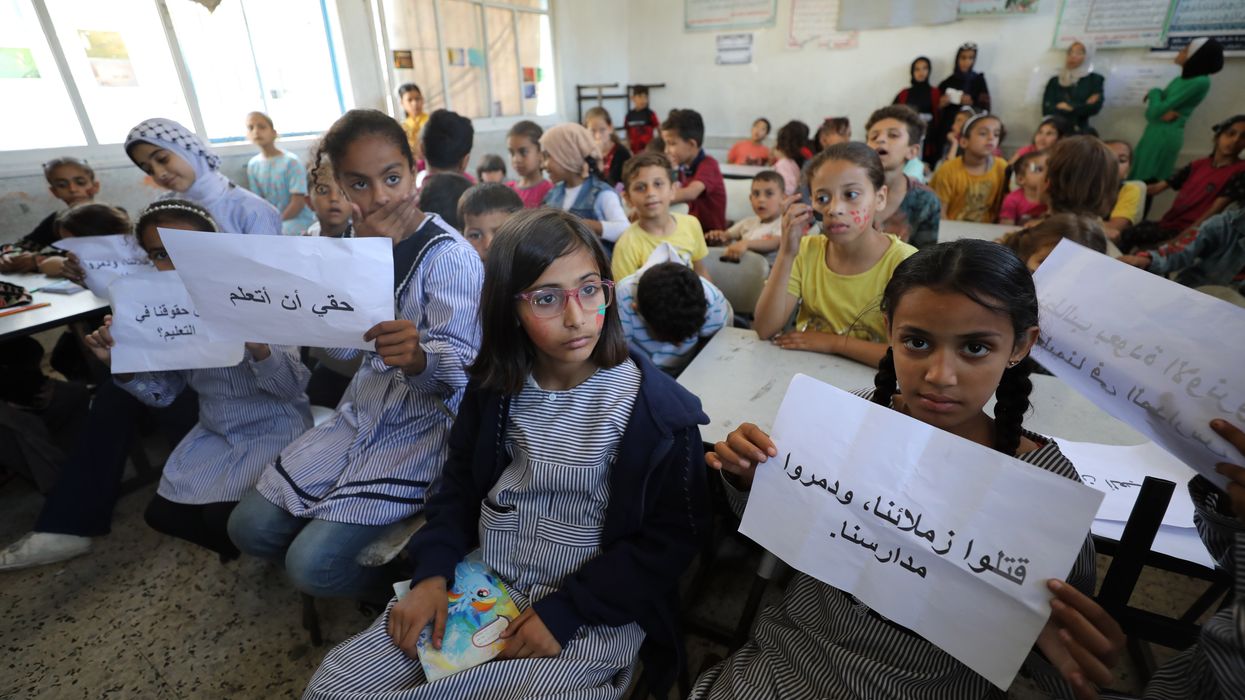
First, regarding Gaza: Since the Nakba in 1948, Palestinian society in Gaza has invested heavily in education, seeing it as a crucial tool for liberation and self-determination. Early footage shows classrooms being held in tents and open spaces, a testament to this community's tenacious pursuit of knowledge. This focus on education transformed the strip into a regional hub for intellectual and cultural production, despite poorly funded UN Relief and Works Agency for Palestinian Refugees in the Near East schools. Israel's campaign of destruction is a deliberate attempt to erase this generational achievement, a practice known as scholasticide, and Gaza is the most deliberate example of this horrific act.
Second, regarding Zionism: For many years, we were led to believe that Zionism was winning the intellectual war due to the cleverness and refinement of Israeli propaganda, or hasbara. The prevailing narrative, particularly in the Arab world, was that Palestinians and Arabs were simply no match for the savvy Israeli and pro-Israeli public relations machine in Western media. This created a sense of intellectual inferiority, masking the true reason for the imbalance.
Israel was able to "win" in mainstream media discourse due to the intentional marginalization and demonization of Palestinian and pro-Palestinian voices. The latter had no chance of fighting back simply because they were not allowed to, and were instead labeled as "terrorist sympathizers" and the like. Even the late, world-renowned Palestinian scholar Edward Said was called a "Nazi" by the extremist, now-banned Jewish Defense League, who went so far as to set the beloved professor's university office on fire.
Gaza, however, represented a major problem. With foreign media forbidden from operating in the strip per Israeli orders, the Gazan intellectual rose to the occasion and, in the course of two years, managed to reverse most of Zionism's gains over the past century. This forced Israel into a desperate race against time to remove as many Palestinian journalists, intellectuals, academics, and even social media influencers from the scene as quickly as possible—thus, the war on the Palestinian thinker.
The Israeli logic, however, is destined to fail, as ideas are not tied to specific individuals, and resilience and resistance are a culture, not a job title. Gaza shall once more emerge, not only as the culturally thriving place it has always been, but as the cornerstone of a new liberation discourse that is set to inspire the globe regarding the power of intellect to stand firm, to fight for what is right, and to live with purpose for a higher cause.
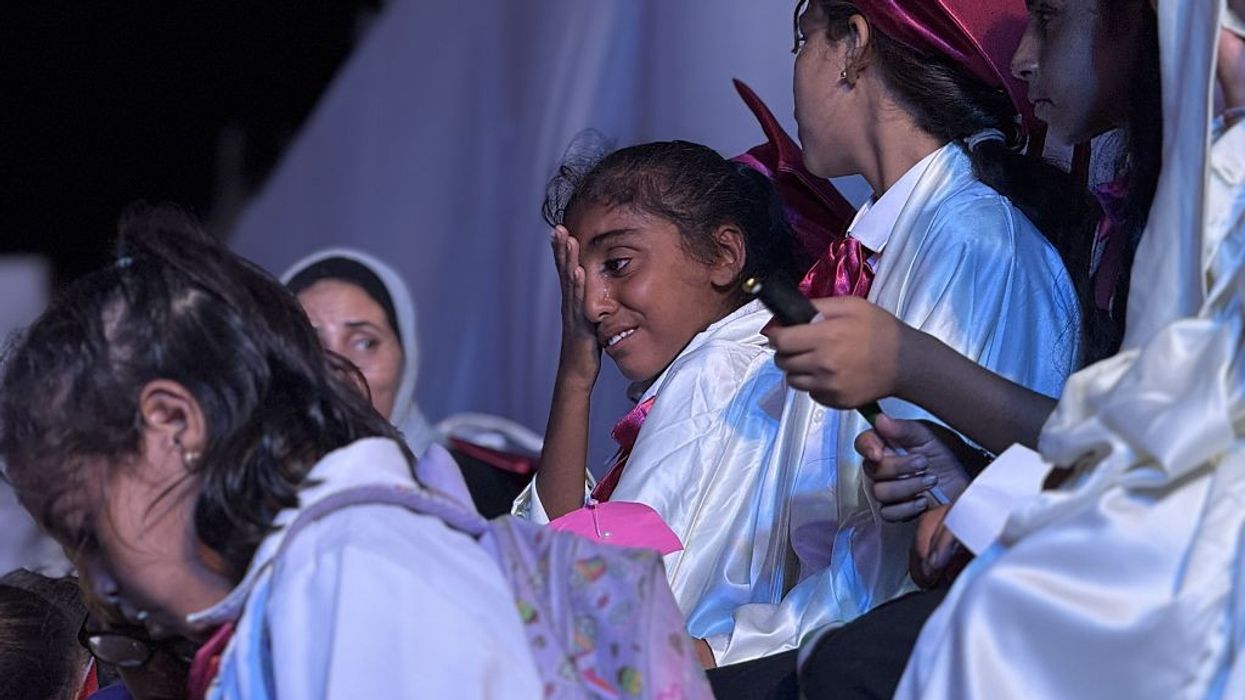
"The children wept, as no parents were there to share the moment—their parents had been killed by the Israeli army," said one observer.
More than 1,000 Palestinian children orphaned by Israel's genocidal assault on Gaza took part in a bittersweet graduation ceremony Monday at a special school in the south of the embattled enclave as Israeli forces continued their US-backed campaign of annihilation and ethnic cleansing nearby.
Dressed in caps and gowns and waving Palestinian flags, graduates of the school at al-Wafa Orphan Village in Khan Younis—opened earlier this year by speech pathologist Wafaa Abu Jalala—received diplomas as students and staff proudly looked on. It was a remarkable event given the tremendous suffering of Palestinians in Gaza, especially the children, and Israel's obliteration of the strip's educational infrastructure, often referred to as scholasticide.
Organizers said the event was the largest of its kind since Israel began leveling Gaza after the Hamas-led attack of October 7, 2023. Israel's assault and siege, which are the subject of an International Court of Justice genocide case, have left more than 62,000 Palestinians dead, including over 18,500 children—official death tolls that are likely to be a severe undercount.
The Palestinian Central Bureau of Statistics reported in April that nearly 40,000 children in Gaza have lost one or both of their parents to Israeli bombs and bullets in what the agency called the world's "largest orphan crisis" in modern history. Other independent groups say the number of orphans is even higher during a war in which medical professionals have coined a grim new acronym: WCNSF—wounded child, no surviving family.
Hundreds of thousands of other Palestinians are starving in what Amnesty International on Monday called a "deliberate campaign." Thousands of Gazan children are treated for malnutrition each month, and at least 122 have starved to death, according to local officials.
Early in the war, the United Nations Children's Fund (UNICEF) called Gaza "the world's most dangerous place to be a child." Last year, United Nations Secretary-General António Guterres for the first time added Israel to his so-called "List of Shame" of countries that kill and injure children during wars and other armed conflicts. Doctors and others including volunteers from the United States have documented many cases in which they've concluded Israeli snipers and other troops have deliberately shot children in the head and chest.

There are also more child amputees in Gaza than anywhere else in the world, with UN agencies estimating earlier this year that 3,000-4,000 Palestinian children have had one or more limbs removed, sometimes without anesthesia. The administration of US President Donald Trump—which provides Israel with many of the weapons used to kill and maim Palestinian children—recently stopped issuing visas to amputees and other victims seeking medical treatment in the United States.
All of the above have wrought what one Gaza mother called the "complete psychological destruction" of children in the embattled enclave.
Indeed, a 2024 survey of more than 500 Palestinian children in Gaza revealed that 96% of them fear imminent death, 92% are not accepting of reality, 79% suffer from nightmares, 77% avoid discussing traumatic events, 73% display signs of aggression, 49% wish to die because of the war, and many more "show signs of withdrawal and severe anxiety, alongside a pervasive sense of hopelessness."
Iain Overton, executive director of the UK-based group Action on Armed Violence, said at the time of the survey's publication that "the world's failure to protect Gaza's children is a moral failing on a monumental scale."
"We must not allow Trump to destroy the First Amendment," Sanders said as the Ivy League school expelled or suspended scores of students in what critics called a bid to win back blocked federal funding.
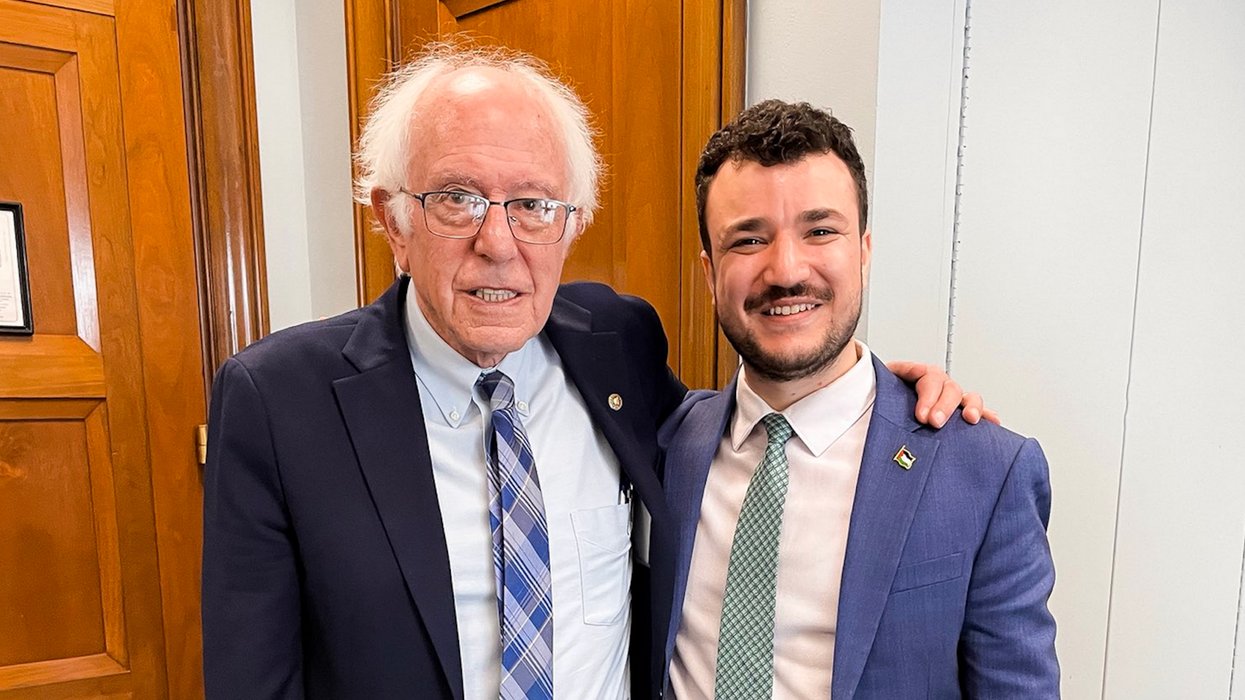
U.S. Sen. Bernie Sanders on Tuesday met with Mahmoud Khalil—the former Columbia University Palestine defender recently imprisoned by the Trump administration—on the same day that the school expelled or suspended more than 70 students who protested Israel's genocidal obliteration of Gaza.
Sanders (I-Vt.) posted a photo of himself with his arm around a beaming Khalil, with the caption: "I met with Mahmoud Khalil, a Palestinian student at Columbia University, who was imprisoned for 104 days by the Trump administration for opposing [Israeli Prime Minister Benjamin] Netanyahu's illegal and horrific war in Gaza. Outrageous. We must not allow [U.S. President Donald] Trump to destroy the First Amendment and freedom to dissent."
Khalil, an Algerian citizen of Palestinian descent married to a U.S. citizen, last year finished his graduate studies at Columbia. He was arrested at his New York home by plainclothes Department of Homeland Security officers on March 8 before being transferred to New Jersey and then Louisiana, where he missed the birth of his first child.
Accused of no criminal offense and widely considered a political prisoner, Khalil was arrested following Trump's issuance of an executive order authorizing the deportation of noncitizen students and others who take part in pro-Palestine demonstrations. U.S. Secretary of State Marco Rubio has also invoked the Immigration and Nationality Act of 1952—which allows for the deportation of noncitizens whose presence in the United States is deemed detrimental to foreign policy interests—to target peaceful Palestine protesters who have committed no crimes.
Khalil was released last month upon a federal judge's order. He is far from the only student jailed for opposing the Gaza genocide; others include Mohsen Mahdawi and Yunseo Chung—both permanent U.S. residents—as well as Rümeysa Öztürk, Badar Khan Suri, and others.
On Tuesday, Columbia announced disciplinary action against more than 70 students who took part in last year's protests for Gaza at the New York City school's Butler Library. Around 80 Columbia students were arrested amid the violent police crackdown on campus encampments and occupations.
"While the university does not release individual disciplinary results of any student, the sanctions from Butler Library include probation, suspensions (ranging from one year to three years), degree revocations, and expulsions," Columbia's Office of Public Affairs said in a statement.
The school's announcement came days after Columbia and Trump administration officials met in Washington, D.C. to negotiate an agreement to restore most of the nearly $400 million in federal contracts for the university that were canceled in March over an alleged failure to tackle antisemitism.
As part of the deal, Columbia agreed to adopt the dubious International Holocaust Remembrance Alliance Working Definition of Antisemitism, which critics say conflates legitimate criticism and condemnation of Israeli policies and practices with anti-Jewish bigotry, and forces people to accept the legitimacy of a settler-colonial apartheid state engaged in illegal occupation and a war that experts increasingly agree is genocidal.
The school also said it would partner with the Anti-Defamation League on antisemitism training. Last year, the Council on American-Islamic Relations condemned the ADL for what it called a "pattern of enabling anti-Palestinian hate."
Columbia University interim president Claire Shipman has already been working with white nationalist Stephen Miller—Trump's White House deputy chief of staff and a primary architect of the president's first-term migrant family separation and Muslim travel ban policies—to restore lost contracts.
Columbia's acquiescence to the Trump administration comes as Israeli forces have killed or maimed more than 215,000 Palestinians in Gaza, according to the Gaza Health Ministry, including at least 14,000 people who are missing and presumed dead and buried beneath rubble. Most of Gaza's more than 2 million people have been forcibly displaced, often multiple times, and hundreds of thousands of Gazans are starving amid an increasingly fatal famine fueled by Israel's siege of the enclave, which is partly the subject of an International Court of Justice genocide case.
Israel has also been accused of committing scholasticide in Gaza, where every university has been destroyed or damaged.
"Hundreds of academics have been killed. Books and archives have been incinerated. Entire families have been erased from the civil registry," said one student quoted in a recent Columbia University Apartheid Divest blog post. "This is not a war. It is a campaign of erasure."
"As Israeli aggression obliterates Palestinian homes and guns down children in Jenin, as unspeakable suffering continues in Gaza, and as America descends further into fascism, we ask—what type of institution does Bowdoin want to be?"
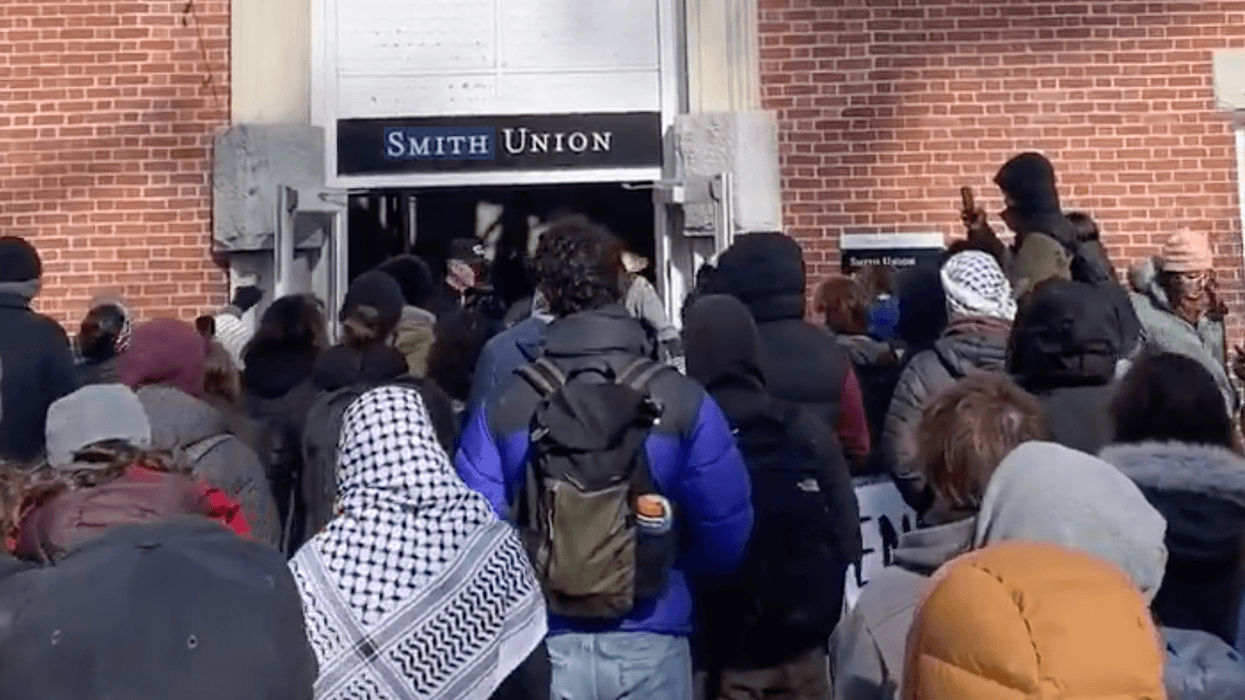
Activists at Bowdoin College in Brunswick, Maine have launched what is believed to be the first Palestine solidarity encampment since President Donald Trump took office, occupying the first floor of the liberal arts school's student union to protest the U.S. leader's proposal to take over the Gaza Strip and expel its native Palestinian population.
Bowdoin Students for Justice in Palestine (SJP) occupied the first floor of Smith Union on Thursday night and erected tents there, The Bowdoin Orient reported. They named the encampment after Sha'ban al-Dalou, a 19-year-old computer engineering student at al-Azhar University in Gaza who burned alive in a refugee tent encampment bombed by Israel last October.
The protesters—who reportedly number around 50—acted in response to Trump's Tuesday press conference with fugitive Israeli Prime Minister Benjamin Netanyahu, during which the president floated U.S. ownership of Gaza, the ethnic cleansing of its Palestinian population, and the construction of the "Riviera of the Middle East" there following 15 months of Israel's genocidal war on the coastal enclave.
Demonstrators also condemned Israel's ongoing assault on the illegally occupied West Bank, where the killing and injury of thousands of Palestinians since October 2023 has been overshadowed by the annihilation of Gaza.
"As Israeli aggression obliterates Palestinian homes and guns down children in Jenin, as unspeakable suffering continues in Gaza, and as America descends further into fascism, we ask—what type of institution does Bowdoin want to be?" Bowdoin SJP said in a statement Thursday. "One that cowers to authoritarianism, that chooses cowardice in the face of injustice? The choice is Bowdoin's."
The Orient reported that a Bowdoin College security official began asking student protesters to identify themselves around 1:00 am on Friday morning while Dean of Students Michael Pulju informed students about the disciplinary repercussions of their action, including the possibility of expulsion.
On Friday morning, more Bowdoin students showed up outside the student union to protest and try to enter the building, chanting, "Open Smith!"
According to the Orient:
The encampment... comes nearly a year after Bowdoin students voted in favor of the SJP-organized Bowdoin Solidarity Referendum, a resolution demanding that the college take an institutional stand against the scholasticide and stop future investments in defense-focused funds. At the beginning of the fall semester, the college established its Ad Hoc Committee on Investments and Responsibility in response to the referendum but has yet to alter its investment practices or offer an institutional statement.
Lead SJP organizer Olivia Kenney told the Orient that the protesters plan to occupy Smith Union "until the demands of the Bowdoin Solidarity Referendum are met" by the school's Board of Trustees.
Staff and students at Birzeit University in the occupied West Bank recorded a message of solidarity with the "beautiful and wonderful" Bowdoin encampment.
"We woke up this morning to... the news of your encampment, and we've been following the news of the solidarity encampment at Bowdoin and Students for Justice in Palestine," they said in the message, which was posted on Instagram. "We see you, we love you."
"Thank you, from occupied Palestine in the West Bank, where students and faculty and employees alike can barely if at all get to campus because of the checkpoints and roadblocks," the message continued. "From all of Palestine, from the river to the sea, all of the universities that were actively destroyed in 471 days of genocide. Universities throughout the occupied West Bank, which are being surrounded and isolated."
"We are in this together," the message added. "We see you and thank you for raising your voices and screaming loudly that the space of a university is our space. It is a space where knowledge is exchanged. It is the space where we imagine and work to achieve the world that we want to live in, not the world that has been thrust upon us."
"Academics will make careers out of writing about past atrocities while ignoring the ones happening in real time," said one critic.
In what one observer decried as an "absolutely shameful" rebuff of American Historical Association members' overwhelming approval of a resolution condemning Israel's annihilation of education infrastructure in Gaza, the elected council of the nation's oldest learned society on Thursday vetoed the measure over a claimed technicality.
AHA members voted 428-88 earlier this month in favor of a resolution opposing Israeli scholasticide—defined by United Nations experts as the "systemic obliteration of education through the arrest, detention, or killing of teachers, students, and staff, and the destruction of educational infrastructure"—during the 15-month assault on the Gaza Strip.
However, the AHA's 16-member elected council voted 11-4 with one abstention to reject the measure, according to Inside Higher Ed, which noted that the panel "could have accepted the resolution or sent it to the organization's roughly 10,450 members for a vote."
While the council said in a statement that it "deplores any intentional destruction of Palestinian educational institutions, libraries, universities, and archives in Gaza," it determined that the resolution does not comply with the AHA's constitution and bylaws "because it lies outside the scope of the association's mission and purpose."
Council member and University of Oklahoma history professor Anne Hyde told Inside Higher Ed that she voted to veto the resolution "to protect the AHA's reputation as an unbiased historical actor," adding that the Gaza war "is not settled history, so we're not clear what happened or who to blame or when it began even, so it isn't something that a professional organization should be commenting on yet."
However, Van Gosse, a co-chair and founder of Historians for Peace and Democracy—the resolution's author—told the outlet that "we are extremely shocked by this decision," which "overturns the democratic decision" of members' "landslide vote."
Lake Forest College history professor Rudi Batzell said on social media: "Shame on the AHA leadership for vetoing the scholasticide in Gaza resolution. Members voted overwhelmingly to support, and the resolution was written so narrowly and so carefully to meet exactly this kind of procedural objection. Craven."
The AHA council's veto follows last week's move by the Modern Language Association executive council, as Common Dreams reported, to block members of the preeminent U.S. professional group for scholars of language and literature from voting on a resolution supporting the boycott, divestment, and sanctions movement for Palestinian rights.
"We feel that it is our responsibility as the largest North American organization of scholars of literature and language to protest and stand with our colleagues who are being murdered for their existence," said one organizer.
"The more they try to silence us, the louder we will be!"
That was the message that protesters at the Modern Language Association Delegate Assembly in New Orleans wanted to send Saturday after the executive council of the MLA—the preeminent U.S. professional group for scholars of language and literature—blocked them from holding a member vote on a resolution endorsing the international Boycott, Divestment, and Sanctions (BDS) movement for Palestinian rights.
Like the resolution recently passed by the American Historical Association, the declaration issued by MLA Members for Justice in Palestine accuses Israel of committing scholasticide in Gaza, where—in addition to killing over 46,000 Palestinians, wounding nearly 110,000 others, and displacing around 2 million more—15 months of relentless Israeli onslaught has obliterated the embattled enclave's education infrastructure.
The MLA resolution—which supports the initial 2005 BDS call issued by Palestinian civil society groups—also acknowledges that international law experts accuse Israel of genocide and that the International Court of Justice, which is weighing a genocide case against Israel, has "determined that Israel is maintaining a system of apartheid."
"The MLA's commitment to 'justice throughout the humanities ecosystem' requires ending institutional complicity with genocide and supporting Palestinian colleagues," the statement asserts. "Therefore, be it resolved that we, the members of the MLA, endorse the 2005 BDS call."
Karim Mattar, an associate professor of English at the University of Colorado, Boulder, took part in Saturday's demonstration, during which supporters of the resolution staged a die-in and walkout, chanted slogans, and held a banner that read, "MLA Is Complicit in Genocide."
"I consider the executive council's decision to be a cowardly one," Mattar told Common Dreams. "The MLA is a humanities advocacy organization, and by repressing a membership vote, a democratic process to deliberate on the necessity of institutional divestment with companies that profit from genocide, it's actively contributing to the problem."
"I think it's a fundamental contradiction in the MLA's values between these stated values and principles of advocacy for the humanities and the blocking of a mechanism by which such advocacy might be facilitated," he added.
Mattar—who is Palestinian American and whose relatives were among the more than 750,000 Arabs who fled or were ethnically cleansed from Palestine during the Nakba, or "catastrophe" during the establishment of the modern state of Israel—said Saturday's protest brought tears to his eyes.
"To see this protest, this movement emerging at the MLA, to see this national and international movement of solidarity with Palestine to emerge in the last year, has been incredibly moving for me," he said.
Protest co-organizer Neelofer Qadir, an assistant professor of English at Georgia State University, told Common Dreams that protesters "really wanted to draw attention to how institutions are being destroyed, like universities, like libraries, like archives, which makes certain that there is a deep commitment to genocide and why scholasticide is part of genocide because the Israeli government intends to destroy all possible evidence of Palestinian life, past, present, and therefore no longer in the future."
"And we feel that it is our responsibility as the largest North American organization of scholars of literature and language to protest and stand with our colleagues who are being murdered for their existence," she added.
Last month, the MLA executive council
explained that while it is "appalled by the continued attack on Gaza," it believed that "supporting a BDS resolution was not a possible way forward for the association to address the crisis" due to "legal and fiduciary reasons."
Qadir dismissed the council's excuse, saying she believes the MLA is "engaged in a formal program of organized abandonment that is part and parcel of fascist and neoliberal governance that's happening in the U.S., Canada, and across the world."
St. John's University associate English professor Raj Chetty, who also organized Saturday's action, told Common Dreams that "whatever the MLA has said about the 'fiduciary concerns' about this, we're like, you're going to find out some other fiduciary concerns as you notice that both intellectual work and membership dues are going to start evaporating."
As part of their effort, MLA Members for Justice in Palestine are urging supporters to not renew their MLA membership "until there's a meaningful substantial change in position," as Chetty put it.
"This [protest] is a real call to humanity, a real call to justice, a real call against complicity, and a real call to support Palestinian life and rail against Israeli actions that are ending Palestinian life in all the ways that Neelofer talked about," he said.
Disclosure note: Olivia Rosane reported from the MLA conference, which she attended as a member, and has signed the pledge not to renew membership.
Before the current war, Shahd’s favorite thing to draw was eyes. Now she draws powerful images showing the brutality of the Israeli occupation.
Shahd Rajab, a Palestinian artist from Gaza, is like any 21-year-old university student. She enjoys lattes, reads in the library, and loves to draw in her free time. Unlike students in the United States, however, Shahd has lived under the Israeli occupation of Gaza.
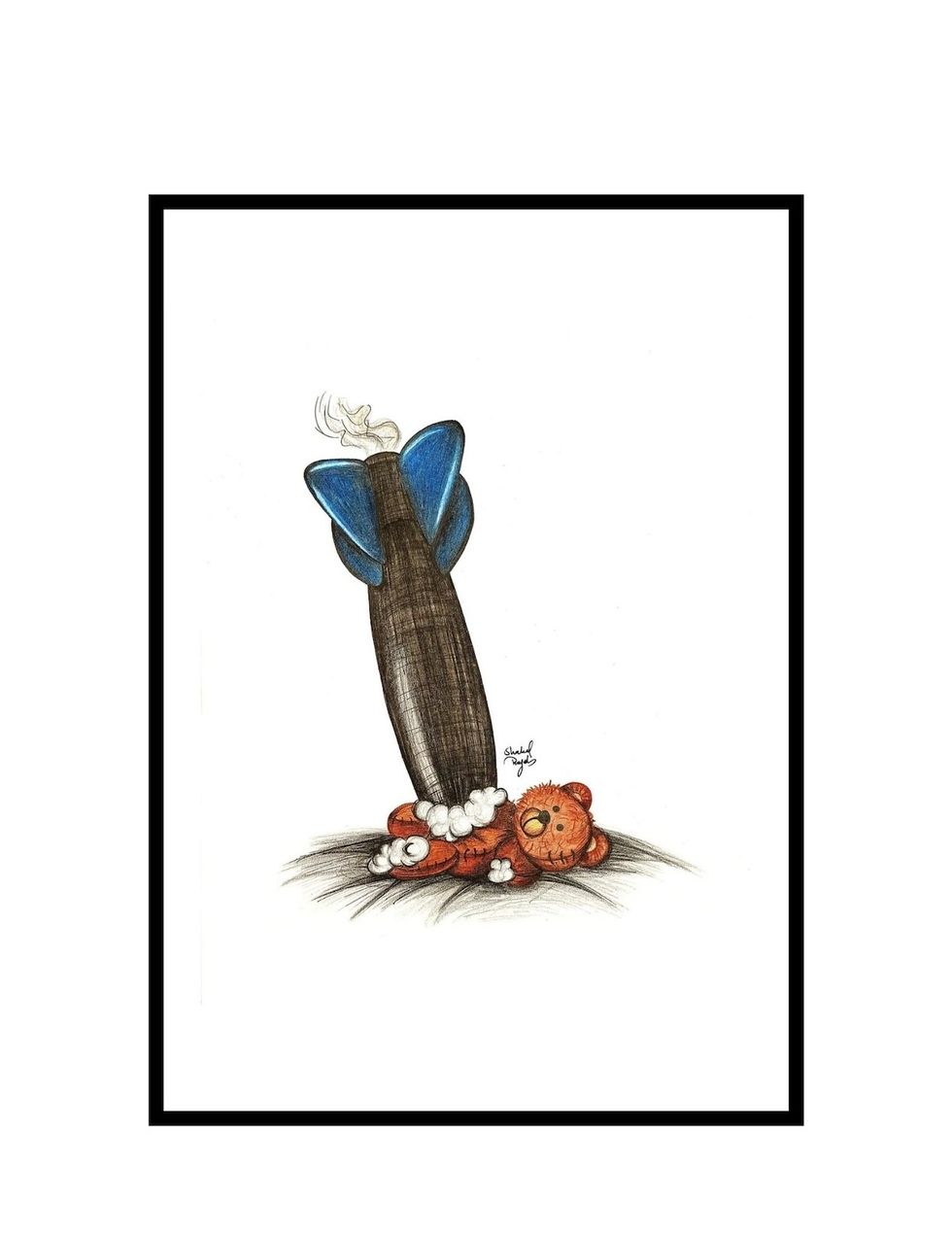
Now during Israel’s most brutal war against Gaza, Shahd has produced more than 80 drawings, using her art as a means of expression and resistance as she and her family endure Israel’s impacts, not only a long war but also a genocidal war.
For Shahd, war, injustice, and loss are things the young Palestinian has experienced all her life before Israel’s war on Gaza began in October of 2023.
I met Shahd through a mutual friend, Albert Campos, a Cuban-American local artist who also finds the means of resistance through art. Albert was looking for art of a young Palestinian in Gaza, then found Shahid’s work in early June of this year and began messaging Shahd on Instagram in hopes of collaborating with the artist. Dr. Manal Hamzeh, a professor at the Borderlands and Ethnic Studies Department at New Mexico State University (NMSU), encouraged Albert to collaborate with Shahd. Later she acted as a translator and facilitator to Albert’s conversation with Shahd over WhatsApp and Zoom. We began looking at Shahd’s social media to get to know the artist before communicating directly with her over WhatsApp text. The outcome of this first round of communication resulted in the selection of one of Shahd’s drawings, “Our Right to Education was Stolen, Destroyed Too (Scholasticide),” to be the cover of the December 28, 2024 issue of the Journal of Ethnic Studies Pedagogies.
On the International Day of Solidarity to Palestinians, gathered at the table of NMSU Students for Justice for Palestine in Corbett, the three of us—Dr. Hamzeh, Albert, and I—expanded the collaboration with Shahd and decided to tell her story in a feature article.
Though Shahd is learning English, we decided to present a set of questions translated into Arabic. We also preferred to have Shahd fully and freely respond to the questions in her mother language, Arabic. Dr. Hamzeh was the conduit to this process. The following are pieces of her engagement with our questions that introduce who she is, what her art is about, and what she has been experiencing the past year, since the start of Israel’s genocidal war on Gaza, its 458 days and still counting.
When asked what she wanted Americans to know about the Palestinian people and their struggle, Shahd emphasized the importance of speaking out against the Israeli occupation and the U.S. funding of this genocidal war against Palestinians, even if you are not Palestinian.
“I was five years old in the 2008 war, nine years old in the 2012 war, and 11 in the 2014 war. I remember the first time my family ran from death, and in the 2014 war when we were temporarily displaced from our home. At times when the bombardment was bad, realizing the gravity of the situation and the risk of getting killed, my family would sleep in one room, so we would die together.”
These harsh conditions Palestinians in Gaza have endured have not deterred young people like Shahd, who was in her second year of college when the most recent war began in 2023, hoping to earn a bachelor's degree by the end of her studies. When this current war started, Shahd was studying at the University College for Applied Sciences in Gaza, specializing in IT. The last time a war affected her studies she was a senior in high school.
“The last and most important year of my studies, I was studying for my high school metrication exam while hearing Israeli fighter planes flying overhead and missiles exploding nearby. Despite the war, I ended the year with a 3.9 GPA,” said Shahd about her senior year of high school.
Shahd had the typical routine of a university student: She would wake up early, get coffee with her friends before morning classes, and spend her free time in the library drawing in her sketchbook. She was active on campus, attending conferences, seminars, student group meetings, and socializing with her friends. When the university student was not busy with the hustle of her college routine, she would find time to go to a cafe to have a drink and draw, or she would find time at home to work on her art. Before the current war on Gaza, Shahd drew on paper and learned digital art on her laptop or tablet.
That changed on October 9, 2023, when Shahd and her family were displaced again, this time permanently from their home in Shuja’iyya, Gaza City, under threat of death due to Israeli bombardment of residential areas. This war was not just different because of the unbridled brutality from Israeli forces. This time Shahd was separated from her father.
“As a child, I remember moments of hiding behind my father when I heard the bombs and the missiles,” said Shahd.
Shahd’s father traveled to the occupied West Bank for medical treatment three days before the war. According to the article “Cruelty against Gaza Patients Enabled by U.S. and E.U.” published by Electronic Intifada in 2022 by Maureen Clare Murphy, Palestinians have struggled to receive adequate treatment in Gaza with a total land, air, and sea blockade that has been implemented since 2007. The healthcare system in Gaza is deprived of proper advancements to deal with certain procedures. Israel has typically denied Palestinians medical transfers into advanced hospitals in Israel or nearby countries, like Jordan or Egypt. Instead, and if they get permits from Israel, most Palestinians in need of specialized medical care may be allowed to travel to the West Bank for treatment. Shahd and the rest of her family had to evacuate Gaza City, where their house is, in the center of the strip, where they were under direct risk of bombing and ethnic cleansing, at the beginning of the current war, to an area in the southern part of the strip. The Israeli military did not allow them to return to their home in Gaza City, like all displaced Palestinians from the North of Gaza, or leave Gaza to join her father in the West Bank.
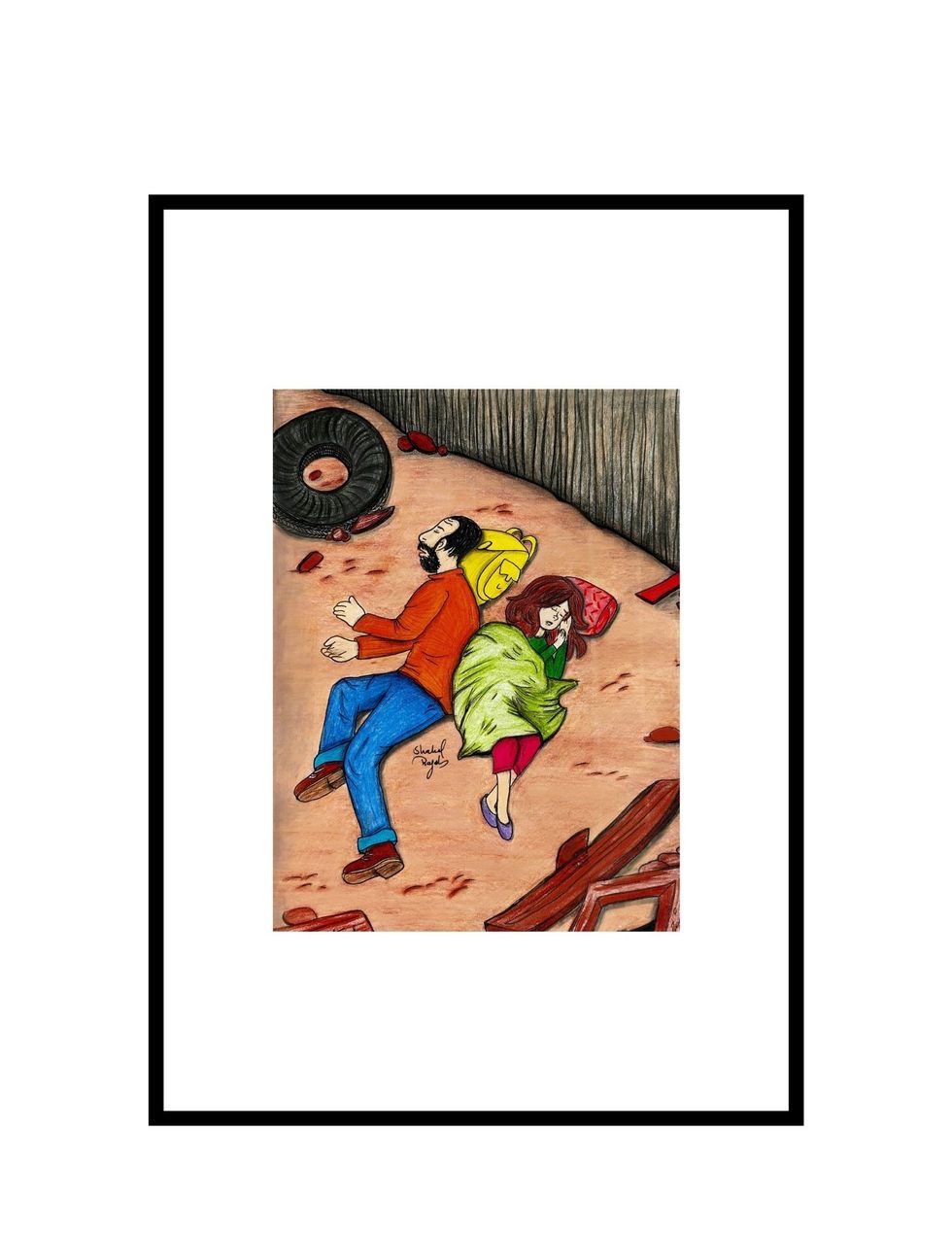
“This war has displaced us over 20 times; we have ended up living in a small tent; we have run from one place to another, escaping death. I only carry on me important items such as my ID card, my phone, and a single pair of pajamas. We are enduring a difficult life.”
Amid the current Israeli genocidal war on Gaza, Shahd finds strength in her art, using it not just as a form of self-expression but as a form of resistance for herself and her people.
“Art allows me to express myself and assert our just cause as Palestinians; art allows me to expose the violence of the Israeli occupation and the killing that I witness every day. I do not write my feelings, but I can draw them. When I complete a drawing, I sleep better. Through my art, I feel some joy amid the atrocities, loss, and the killing we live with.”
“Israel is actively erasing our existence as people, our memories, our schools, universities, our knowledge of the land, and our art.”
Shahd began drawing when she was seven years old. She remembers drawing cartoon characters she liked to watch as a child and how creative her father was when she was younger. Sitting together, Shahd would watch her father draw different animals with only a pen.
“I used to take my drawings to school to show my friends and teachers. The principal of the school used to love to see my drawings. Everyone, including my family, encouraged me to draw.”
Before the current war, Shahd’s favorite thing to draw was eyes. Now she draws powerful images showing the brutality of the Israeli occupation. The Israeli war on Gaza and blockade have driven up prices and dwindled supplies. After heavy bombardment, Shahd has been left with nothing but colored pencils to capture the injustice she has endured not just in the past year, but throughout her entire life. It took her months to find those colored pencils, which were very expensive. Shahd also creates images that make political commentary and reflect Palestinians’ many ways of resistance.
Despite more than 400 days of the current genocidal war on Gaza, Shahd and her people, the Palestinians, endure as they have since 1948, and insist on their right to return to their homes and land. Shahd now lives in a tent on the beach during the winter season in Gaza. She hopes, after the war, to return to her home, though she knows it is not intact, and find the drawings her mother has kept over the years still in the box among the rubble. When asked what she wanted Americans to know about the Palestinian people and their struggle, Shahd emphasized the importance of speaking out against the Israeli occupation and the U.S. funding of this genocidal war against Palestinians, even if you are not Palestinian.

“Israel is actively erasing our existence as people, our memories, our schools, universities, our knowledge of the land, and our art. They try to steal our Palestinian heritage, they appropriated it and claim it is theirs. There will be a day when Palestine is liberated, and when we achieve our liberation, I will draw myself in the courtyard of the holy site, Al Aqsa Mosque, in Jerusalem.”
Shahd has a GoFundMe. Readers can donate to help Shahd and her family preserve the harsh life until the war is over and reunite with her father. Readers can also donate to the Palestine Red Crescent Society and UNRWA.
Acknowledgment: Dr. Manal Hamzeh translated all of Shahd’s responses to our questions, facilitated communication with her, and guided us throughout.
The nation's oldest learned society noted Israel's 15-month onslaught has "effectively obliterated" Gaza's education infrastructure and called for its rebuilding and a permanent cease-fire.
Members of the American Historical Association, the nation's oldest learned society, voted 428-88 Sunday for a resolution condemning scholasticide in Gaza, where Israel's 15-month U.S.-backed onslaught has killed or wounded tens of thousands of Palestinian students and academics and destroyed the embattled enclave's educational infrastructure.
The resolution—which must be approved by the AHA's elected council—states that "beyond causing massive death and injury to Palestinian civilians and the collapse of basic life structures," the Israel Defense Forces' (IDF) assault—which is enabled by tens of billions of dollars in U.S. military aid—"has effectively obliterated Gaza's education system."
"We just won a very basic resolution to oppose scholasticide and 15 months of genocide at the American Historical Association," University of California, Santa Barbara professor and Journal of Palestine Studies editor Sherene Seikaly said following the vote in New York City.
"We won it in a landslide," Seikaly added. "And this moment makes me feel like, despite the fact that every single day for the last 15 months I have watched the obliteration of my people, the future is still ours."
Today, a resolution passed at the American Historical Association, by a margin of 428 to 88, condemning the Israeli scholasticide in Gaza. Here are my remarks for “The Palestine Exception: War, Protest, and Free Speech panel.” open.substack.com/pub/jehadabu...
[image or embed]
— Jehad Abusalim (@jehadabusalim.bsky.social) January 5, 2025 at 8:16 PM
The measure notes that United Nations experts last April expressed their "grave concern over the pattern of attacks on schools, universities, teachers, and students in the Gaza Strip," and their "serious alarm over the systemic destruction of the Palestinian education system."
"With more than 80% of schools in Gaza damaged or destroyed, it may be reasonable to ask if there is an intentional effort to comprehensively destroy the Palestinian education system, an action known as 'scholasticide,'" the U.N. experts said at the time, defining the term as the "systemic obliteration of education through the arrest, detention, or killing of teachers, students, and staff, and the destruction of educational infrastructure."
The resolution notes:
"Therefore, be it resolved that the AHA, which supports the right of all peoples to freely teach and learn about their past, condemns the Israeli violence in Gaza that undermines that right," the measure states. "Be it further resolved that the AHA calls for a permanent cease-fire to halt the scholasticide documented above. Finally, be it resolved that the AHA form a committee to assist in rebuilding Gaza's educational infrastructure."
As Inside Higher Ed reported Sunday:
The resolution passed after a boisterous, hourlong, standing-room-only meeting in a hotel ballroom that was so full some attendees couldn't fit inside. Before members voted, they heard a structured debate on the resolution that included five people speaking for the resolution and five people against it. Throughout, there was raucous applause, cheers, and standing ovations for the speakers who advocated for the resolution and more muted claps for opponents.
According to data released by the Gaza Ministry of Education on December 31, at least 12,943 Palestinian students have been killed and 21,681 others wounded by Israeli forces since they launched their response to the devastating Hamas-led attack on Israel. The ministry also said that 630 educators and administrative staff have been killed and 3,865 others injured during that same period.
Overall, the Gaza Health Ministry says Israel's 458-day war on Gaza—which is the subject of an International Court of Justicegenocide case—has left at least 165,000 Palestinians dead, maimed, or missing in the coastal enclave and millions more forcibly displaced, starved, or sickened.
In an interview with Democracy Now!, Seikaly said: "I really have to give credit where it's due, which is to the Historians for Peace and Democracy, which is a group that actually began in 2003 under the name of Historians Against the War... They were really the spearheads and leaders of this resolution."
The American Historical Association overwhelmingly approved a resolution at its annual meeting on Sunday to oppose "scholasticide" in Gaza, condemning Israel's systematic targeting and destruction of the Palestinian education system and Palestinian educators. pic.twitter.com/4uEb7RbwKD
— Democracy Now! (@democracynow) January 6, 2025
"This genocide is really attempting to destroy our capacity to narrate our past and to imagine our future," Seikaly added. "And to be able to articulate a principled but really not that radical of a resolution opposing this, with such a landslide of support, was a turning point for the American Historical Association and, I believe, for the field in this country."
Addressing opposition to the resolution by New School professor Natalia Petrzela—who objected to the lack of mention of the October 7 attack or the hundreds of Israelis and others taken hostage by Hamas and other Palestinian militants—Seikaly told Democracy Now! host Amy Goodman that Petrzela was engaging in "bothsidesism."
"We got this from more than one of the opposing figures, attempting to equate the last 15 months with the incidents of October 7," she said. "And to me, that is really a very clear position of valuing certain lives over others. And this is the kind of hiding of the truth that we have seen."
"We know that today in the Gaza Strip, when there are rumors of humanitarian convoys coming, Israeli soldiers bulldoze corpses to hide the evidence of decomposing bodies," Seikaly added. "And it isn't just these soldiers who are trying to hide the truth. This is also happening in mainstream media, in the courts, as well as in our universities. And I think this equating is really trying to mask that truth that can no longer hide under the rubble."
Parents, community members, social justice organizations, and solidarity activists must demand a school curriculum that looks forthrightly at the history of Zionism and Palestinian struggles for justice.
Scholasticide.
It’s a term coined in 2009, but has taken on new power as the devastation of Gazan schools, universities, and libraries becomes almost total. As Rice University Professor Abdel Razzaq Takriti of Scholars Against the War on Palestine said about the Israeli assault: “They’re demolishing universities and schools intentionally. They bombarded and destroyed every single university. They’re using schools as barracks and military stations.”
But another facet of scholasticide can be found in our own schools in the United States—erasing Palestinian lives and hiding the history of Palestine-Israel from young people.
Attempts to silence critical teaching around Palestine-Israel have at times been ferocious. And it requires courage for teachers to confront this repression.
In the forthcoming book from Rethinking Schools, Teaching Palestine: Lessons, Stories, Voices, Palestinian American educator Nina Shoman-Dajani writes: “Of the hundreds of assignments my children have brought home from school over the years, not one of them has referred to Palestine.”
In a review of children’s literature on Palestine, in the book, Nadine Foty, Palestinian-Egyptian-American early childhood educator, writes: “As a child, I remember feeling like I didn’t belong because I could never walk over to a map in my classrooms and see my father’s home, Palestine. When I asked, I was met by responses that Palestine didn’t exist.”
The curricular silence that turns Palestinians invisible impoverishes all young people. Instead of the knowledge they need to make sense of how Palestine became Israel and how Israel continues to wage war on Palestinians, they get nothing. Or worse.
Widely adopted corporate textbooks feed students pernicious myth after myth. Glencoe’s World History, for example, begins its section “The Question of Palestine” not with Palestinians, but with Jewish immigrants: “In the years between the two world wars, many Jews had immigrated to Palestine, believing this area to be their promised land.” The entire section simply tells Israel’s origin story as Israeli propagandists would tell it.
About Israel’s founding, Holt McDougal’s Modern World History lectures young people: “The new nation of Israel got a hostile greeting from its neighbors.” The first “Critical Thinking” question in the teacher’s edition asks: “What prevented the establishment of the Arab state in 1948?”
The sole possible answer the book offers: “Palestinian Arabs rejected the partition plan.” (That partition plan was seen by many as a temporary inconvenience, including Israel’s first Prime Minister, David Ben-Gurion, who wrote partition was “not the end but the beginning.”)
The good news is that more and more teachers around the country are breaking through the mainstream curriculum’s silences and lies.
Pro-Israel efforts to repress critical teaching about the history of Zionism and Palestine echo the country’s ferocious right-wing attacks on anti-racist, social justice curricula.
Teaching Palestine collects stories of imaginative teaching from across the country: a simulation that introduces students to Israel’s apartheid system of fragmentation and domination; a critical thinking activity with students evaluating Palestinian narratives on the 1948 Nakba (the Catastrophe), alongside Zionist narratives that fill our textbooks; an historical dive into U.S. policy choices toward Israel from the 1956 Suez Canal Crisis through Hamas’ rise to elected power in Gaza in 2006; a role play activity on the ”seeds of violence” in Palestine-Israel that transports students to Palestine in the Ottoman era and the early years of Zionist immigration and ethnic nation-building alongside Palestinian dispossession; an elementary lesson that uses Malak Matar’s poignant children’s book Sitti’s Bird: A Gaza Story.
But attempts to silence critical teaching around Palestine-Israel have at times been ferocious. And it requires courage for teachers to confront this repression.
Some instances feel absurd. In Portland, Oregon, in response to student work on Palestine posted on the walls of a public school last spring, the school district recently instituted a new administrative directive. Now, teachers may display art or posters that might “stimulate and illustrate” an area of study, but if these are visible from a “common area” like the hallway, they must have prior approval from the building administrator. This fall, school officials tore down—literally—a teacher’s “Stop the Genocide” posters. In a meeting, administrators said that “Stop Genocide” would be permissible, but inserting “the” rendered this unacceptably partisan.
In an article included in Teaching Palestine, the young adult novelist Nora Lester Murad describes how the Anti-Defamation League (ADL) bullies teachers and students by pushing—and weaponizing—the International Holocaust Remembrance Alliance’s (IHRA) working definition of antisemitism, which conflates Palestinian perspectives with antisemitism.
In Philadelphia, students of the award-winning high school teacher Keziah Ridgeway made a podcast comparing the art of Palestinians with the art of enslaved people. In response, groups there including the School District of Philadelphia Jewish Family Association labeled Ridgeway’s work with students “antisemitic and dangerous.”
Amplifying the Jewish Family Association’s complaints against Ridgeway and other teachers, ADL later submitted a Title VI complaint against the school district. As Murad notes, in the complaint, “the ADL advocates for the ‘suspension and expulsion’ of students and the ‘suspension and termination’ of teachers, who under the IHRA definition… have engaged in ‘discriminatory conduct’ for being publicly critical of Zionism.”
As we reported in the spring 2024 Rethinking Schools magazine, four teachers in Montgomery County, Maryland were placed on administrative leave for public expressions of support for Palestinians. A charter school in Los Angeles fired two first-grade teachers and placed their principal on leave after one teacher posted on Instagram that they had taught a “lesson on the genocide in Palestine.” The Decatur, Georgia school district disciplined their equity coordinator for sharing “Resources for Learning & Actions to Support Gaza.”
A recent Jewish Federation of Greater Portland parent advocacy training I attended, told parents, “You are our eyes and ears”—“Record everything. Every single word.” One presenter told the story of a group of parents confronting a principal about a teacher who showed “one-sided” CNN videos. “We demanded that some action be taken. And this teacher—I can tell you, this year, that teacher does not teach at that school.”
Pro-Israel efforts to repress critical teaching about the history of Zionism and Palestine echo the country’s ferocious right-wing attacks on anti-racist, social justice curricula. As Jesse Hagopian points out in his forthcoming book Teach Truth: The Struggle for Antiracist Education, almost half of public school children in the United States live in states that restrict teaching about race and racism.
Educators of conscience need allies who can support their efforts to build a curriculum that centers Palestinian perspectives. This is not the work of educators alone. They need parents, community members, social justice organizations, and solidarity activists to demand a school curriculum of fearless curiosity—one that looks forthrightly at the history of Zionism and Palestinian struggles for justice.
Palestine has been the site of invasion, colonialism, ethnic cleansing, and war. But also of resilience, of hope. Let’s help teachers introduce young people to the critical stories they need to make sense of the world—and to change it.
"Another day, another bombing of kids at a U.N. refugee school, another set of children mangled beyond recognition, livestreamed for all the world to see."
Israeli forces on Saturday killed more than a dozen displaced Palestinians in a targeted attack on a United Nations-run school in central Gaza, the latest bombing of an education facility as Israel's assault on the besieged enclave entered its 10th month.
Video footage from the scene of the attack on the al-Jaouni school in central Gaza's al-Nuseirat refugee camp shows puddles of blood on the ground amid the ruins of a building destroyed in the bombing, which reportedly killed at least 16 people and injured over 75 more, children among them.
The Israeli military confirmed it carried out the attack, claiming without evidence that the school was used by Hamas operatives.
"Another day, another bombing of kids at a U.N. refugee school, another set of children mangled beyond recognition, livestreamed for all the world to see," said Vincent Wong, an assistant professor at the University of Windsor.
Trita Parsi, executive vice president of the Quincy Institute for Responsible Statecraft, asked, "Why have we allowed this to become normal?"
Saturday's bombing of al-Jaouni was one of many attacks Israel's military has carried out against U.N.-run schools since its latest assault on Gaza began in October following a deadly Hamas-led attack. Last month, Israel used U.S.-made small-diameter bombs in an attack on a U.N. school that killed 14 children.
Israeli forces have damaged or destroyed 80% of Gaza's schools, including all of its universities—harm that will reverberate for generations. U.N. experts have said it is "reasonable to ask" if Israel is guilty of "scholasticide," defined as "the systemic obliteration of education through the arrest, detention, or killing of teachers, students, and staff, and the destruction of educational infrastructure."
Chandni Desai, an assistant professor at the University of Toronto, noted in a Guardian op-ed last month that Israeli soldiers recently "set ablaze the remaining parts of the al-Aqsa University's library in Gaza City and photographed themselves sitting in front of the burning books."
"Similarly, an Israeli soldier recently filmed himself walking through the ruins of al-Azhar University, mocking scholasticide and rejoicing in the occupation's destruction of the university," Desai wrote. "'We're starting a new semester,' he said, adding: 'It'll start never.'"
Now in month 10, Israel's war on Gaza has killed more than 38,000 people and wounded nearly 90,000, with tens of thousands more believed to be trapped under the ruins of bombed-out buildings.
Citing unnamed medical sources, Al Jazeera reported Sunday that at least "15 Palestinians had been killed in Israeli bombing across the Gaza Strip since dawn."
The wave of Israeli attacks came amid reports of progress toward a possible cease-fire and hostage-release agreement. The U.S., which has supported Israel's assault with weaponry and diplomatic cover, described Hamas' latest cease-fire proposal as a "breakthrough," but it's far from clear Israel will accept the terms even in the face of massive domestic protests demanding a deal.
According to The New York Times, Hamas is pushing for "international assurances that, once an initial truce kicks in, both sides will keep negotiating until they reach a final deal to end the war and free all of the hostages remaining in Gaza."
"In effect, Hamas wants to ensure that it does not turn over many of the hostages only for Israel to restart the war," the Times reported, citing unnamed officials. "Israeli negotiators immediately rejected that demand... Israel wants the option to resume fighting if it deems it necessary."
Egypt is expected to host U.S. and Israeli delegations for a fresh round of cease-fire talks, which could drag on for weeks as Israel's military continues to bomb Gaza and starve its population.