SUBSCRIBE TO OUR FREE NEWSLETTER
Daily news & progressive opinion—funded by the people, not the corporations—delivered straight to your inbox.
5
#000000
#FFFFFF
To donate by check, phone, or other method, see our More Ways to Give page.
Daily news & progressive opinion—funded by the people, not the corporations—delivered straight to your inbox.
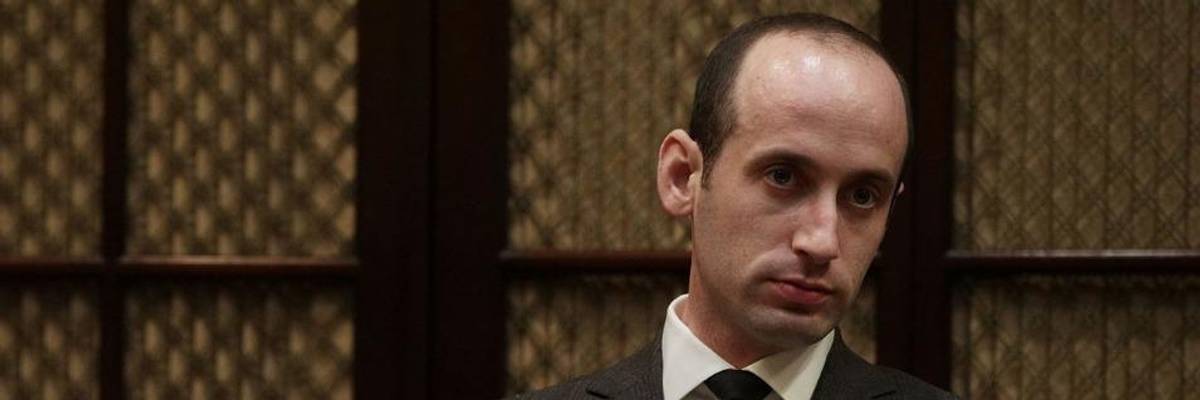
Stephen Miller, a senior policy adviser to President Donald Trump, has seen his extreme right-wing views on immigration translated into U.S. policy in recent weeks. (Photo: @TheOnion/Twitter)
"Translation: We at 'the paper of record' decided to put our thirst for continued access to the architect of a barbaric program separating children from their parents ahead of the public's right to have the fullest possible picture of that program and the twisted mind behind it." --Naomi Klein
Although far-right activist-turned-White House policy adviser Stephen Miller has been a chief architect of the Trump administration's "zero tolerance" immigration policy and its forcible separation of families, he has remained largely behind the scenes as outrage has grown over the practice--and on Tuesday, with help from the New York Times, the White House kept it that way.
After conducting an on-the-record interview with Miller for an article that appeared in the New York Times last week about the family separation policy, the Times submitted to a White House request to not include audio from the interview in its popular news podcast "The Daily."
Reporter Julie Hirschfeld Davis, who had interviewed Miller for the article, explained before describing some of Miller's comments to "Daily" host Michael Barano:
When I went into the West Wing to interview Stephen Miller with Michael Shear, my colleague here at the Times, the purpose was we were doing a big deep dive story on this family separation practice that's broken out all over the country. And we didn't talk about any sort of alternative uses for the interview. And when they found out that his voice was actually going to be on a podcast discussing it, they were not happy about this. So, they asked us not to use it.
Many journalists and media critics viewed the newspaper's cooperation with the White House as a violation of political outlets' supposed purpose--to give the public a full understanding of the government and its policies.
Others argued that while Davis relayed Miller's comments on the podcast, Barbano's interview with her was no substitute for hearing Miller describe, in his own words, why he feels it's acceptable for the Homeland Security Department to separate families--in some cases, reportedly deceiving parents and then informing them that their children have been taken away.
Since Davis and Shear's interview with Miller was on the record, the reporters technically had permission to use the content of their discussion with the senior policy adviser in the Times' reporting--not necessarily just in the article they were writing. The Associated Press defines the phrase "on the record" as denoting that "the information can be used with no caveats, quoting the source by name."
In a statement, the Times said the reporters had not made clear to the White House that Miller's audio could be used in "The Daily."
"While Miller's comments were on the record, we realized that the ground rules for the original interview were not clear, and so we made a decision not to run the audio," read the statement from the paper's communications department.
Critics including author Naomi Klein refused to accept the newspaper's excuse--accusing the Times of being more concerned with its access to the White House than giving a full accounting of what it learns from its interactions with Trump administration sources.
Translation: We at "the paper of record" decided to put our thirst for continued access to the architect of a barbaric program separating children from their parents ahead of the public's right to have the fullest possible picture of that program and the twisted mind behind it. https://t.co/Mxk8mVCiIu
-- Naomi Klein (@NaomiAKlein) June 19, 2018
Dear Common Dreams reader, It’s been nearly 30 years since I co-founded Common Dreams with my late wife, Lina Newhouser. We had the radical notion that journalism should serve the public good, not corporate profits. It was clear to us from the outset what it would take to build such a project. No paid advertisements. No corporate sponsors. No millionaire publisher telling us what to think or do. Many people said we wouldn't last a year, but we proved those doubters wrong. Together with a tremendous team of journalists and dedicated staff, we built an independent media outlet free from the constraints of profits and corporate control. Our mission has always been simple: To inform. To inspire. To ignite change for the common good. Building Common Dreams was not easy. Our survival was never guaranteed. When you take on the most powerful forces—Wall Street greed, fossil fuel industry destruction, Big Tech lobbyists, and uber-rich oligarchs who have spent billions upon billions rigging the economy and democracy in their favor—the only bulwark you have is supporters who believe in your work. But here’s the urgent message from me today. It's never been this bad out there. And it's never been this hard to keep us going. At the very moment Common Dreams is most needed, the threats we face are intensifying. We need your support now more than ever. We don't accept corporate advertising and never will. We don't have a paywall because we don't think people should be blocked from critical news based on their ability to pay. Everything we do is funded by the donations of readers like you. When everyone does the little they can afford, we are strong. But if that support retreats or dries up, so do we. Will you donate now to make sure Common Dreams not only survives but thrives? —Craig Brown, Co-founder |
"Translation: We at 'the paper of record' decided to put our thirst for continued access to the architect of a barbaric program separating children from their parents ahead of the public's right to have the fullest possible picture of that program and the twisted mind behind it." --Naomi Klein
Although far-right activist-turned-White House policy adviser Stephen Miller has been a chief architect of the Trump administration's "zero tolerance" immigration policy and its forcible separation of families, he has remained largely behind the scenes as outrage has grown over the practice--and on Tuesday, with help from the New York Times, the White House kept it that way.
After conducting an on-the-record interview with Miller for an article that appeared in the New York Times last week about the family separation policy, the Times submitted to a White House request to not include audio from the interview in its popular news podcast "The Daily."
Reporter Julie Hirschfeld Davis, who had interviewed Miller for the article, explained before describing some of Miller's comments to "Daily" host Michael Barano:
When I went into the West Wing to interview Stephen Miller with Michael Shear, my colleague here at the Times, the purpose was we were doing a big deep dive story on this family separation practice that's broken out all over the country. And we didn't talk about any sort of alternative uses for the interview. And when they found out that his voice was actually going to be on a podcast discussing it, they were not happy about this. So, they asked us not to use it.
Many journalists and media critics viewed the newspaper's cooperation with the White House as a violation of political outlets' supposed purpose--to give the public a full understanding of the government and its policies.
Others argued that while Davis relayed Miller's comments on the podcast, Barbano's interview with her was no substitute for hearing Miller describe, in his own words, why he feels it's acceptable for the Homeland Security Department to separate families--in some cases, reportedly deceiving parents and then informing them that their children have been taken away.
Since Davis and Shear's interview with Miller was on the record, the reporters technically had permission to use the content of their discussion with the senior policy adviser in the Times' reporting--not necessarily just in the article they were writing. The Associated Press defines the phrase "on the record" as denoting that "the information can be used with no caveats, quoting the source by name."
In a statement, the Times said the reporters had not made clear to the White House that Miller's audio could be used in "The Daily."
"While Miller's comments were on the record, we realized that the ground rules for the original interview were not clear, and so we made a decision not to run the audio," read the statement from the paper's communications department.
Critics including author Naomi Klein refused to accept the newspaper's excuse--accusing the Times of being more concerned with its access to the White House than giving a full accounting of what it learns from its interactions with Trump administration sources.
Translation: We at "the paper of record" decided to put our thirst for continued access to the architect of a barbaric program separating children from their parents ahead of the public's right to have the fullest possible picture of that program and the twisted mind behind it. https://t.co/Mxk8mVCiIu
-- Naomi Klein (@NaomiAKlein) June 19, 2018
"Translation: We at 'the paper of record' decided to put our thirst for continued access to the architect of a barbaric program separating children from their parents ahead of the public's right to have the fullest possible picture of that program and the twisted mind behind it." --Naomi Klein
Although far-right activist-turned-White House policy adviser Stephen Miller has been a chief architect of the Trump administration's "zero tolerance" immigration policy and its forcible separation of families, he has remained largely behind the scenes as outrage has grown over the practice--and on Tuesday, with help from the New York Times, the White House kept it that way.
After conducting an on-the-record interview with Miller for an article that appeared in the New York Times last week about the family separation policy, the Times submitted to a White House request to not include audio from the interview in its popular news podcast "The Daily."
Reporter Julie Hirschfeld Davis, who had interviewed Miller for the article, explained before describing some of Miller's comments to "Daily" host Michael Barano:
When I went into the West Wing to interview Stephen Miller with Michael Shear, my colleague here at the Times, the purpose was we were doing a big deep dive story on this family separation practice that's broken out all over the country. And we didn't talk about any sort of alternative uses for the interview. And when they found out that his voice was actually going to be on a podcast discussing it, they were not happy about this. So, they asked us not to use it.
Many journalists and media critics viewed the newspaper's cooperation with the White House as a violation of political outlets' supposed purpose--to give the public a full understanding of the government and its policies.
Others argued that while Davis relayed Miller's comments on the podcast, Barbano's interview with her was no substitute for hearing Miller describe, in his own words, why he feels it's acceptable for the Homeland Security Department to separate families--in some cases, reportedly deceiving parents and then informing them that their children have been taken away.
Since Davis and Shear's interview with Miller was on the record, the reporters technically had permission to use the content of their discussion with the senior policy adviser in the Times' reporting--not necessarily just in the article they were writing. The Associated Press defines the phrase "on the record" as denoting that "the information can be used with no caveats, quoting the source by name."
In a statement, the Times said the reporters had not made clear to the White House that Miller's audio could be used in "The Daily."
"While Miller's comments were on the record, we realized that the ground rules for the original interview were not clear, and so we made a decision not to run the audio," read the statement from the paper's communications department.
Critics including author Naomi Klein refused to accept the newspaper's excuse--accusing the Times of being more concerned with its access to the White House than giving a full accounting of what it learns from its interactions with Trump administration sources.
Translation: We at "the paper of record" decided to put our thirst for continued access to the architect of a barbaric program separating children from their parents ahead of the public's right to have the fullest possible picture of that program and the twisted mind behind it. https://t.co/Mxk8mVCiIu
-- Naomi Klein (@NaomiAKlein) June 19, 2018