
SUBSCRIBE TO OUR FREE NEWSLETTER
Daily news & progressive opinion—funded by the people, not the corporations—delivered straight to your inbox.
5
#000000
#FFFFFF
To donate by check, phone, or other method, see our More Ways to Give page.


Daily news & progressive opinion—funded by the people, not the corporations—delivered straight to your inbox.
The US military has publicly confirmed using "a variety of advanced AI tools" in the Iran assault to "help us sift through vast amounts of data in seconds."
A group of more than 120 Democrats in the US House on Thursday pressed Pentagon Secretary Pete Hegseth on whether American forces used artificial intelligence in the deadly bombing of an elementary school in southern Iran.
"What is the role of artificial intelligence, if any, in selecting targets, assessing intelligence, and making legal determinations during Operation Epic Fury?" the Democratic lawmakers, led by Rep. Sara Jacobs (D-Calif.), asked in a letter to Hegseth. "If AI is used, is it subject to human review and at what point? Was artificial intelligence, including the use of the Maven Smart System, used to identify the Shajareh Tayyebeh school as a target? If so, did a human verify the accuracy of this target?"
The letter to Hegseth was sent a day after The New York Times reported that Pentagon investigators preliminarily concluded that US forces were responsible for the bombing of the girls' school in Minab, Iran—a strike that killed at least 175 people, mostly children.
The Democratic lawmakers cited the Times' reporting in their letter, writing that they "are particularly disturbed" by the school bombing, which President Donald Trump initially—and without a shred of evidence—tried to pin on Iran before later saying he didn't "know enough about it" to assign blame.
According to the Times, the school strike "was the result of a targeting mistake by the US military, which was conducting strikes on an adjacent Iranian base of which the school building was formerly a part."
The US military has confirmed using AI tools in its illegal war on Iran, which is being carried out in partnership with Israeli forces that have used artificial intelligence extensively in their genocidal assault on the Gaza Strip.
“Our war fighters are leveraging a variety of advanced AI tools," Brad Cooper, the head of the US Central Command, said in a video message released Wednesday. "These systems help us sift through vast amounts of data in seconds so our leaders can cut through the noise and make smarter decisions faster than the enemy can react."
NBC News reported earlier this week that the US military is "using AI systems from data analytics company Palantir to identify potential targets in the ongoing attacks."
"The use of Palantir’s software, which relies in part on Anthropic’s Claude AI systems, comes as Defense Secretary Pete Hegseth aims to put artificial intelligence at the heart of America’s combat operations," the outlet noted.
During his tenure as head of the Pentagon, Hegseth has worked to dismantle initiatives aimed at reducing civilian killings, scoffed at "stupid rules of engagement," and touted "maximum lethality" as a top priority for the US military.
In their letter on Thursday, the House Democrats wrote that mass civilian deaths in the US-Israeli war on Iran are "alarming yet unsurprising" given Hegseth and Trump's open contempt for legal constraints on American forces.
"The US and Israel have reportedly struck or impacted numerous civilian sites—including schools, hospitals, gymnasiums, public gathering spaces, and a UNESCO heritage site," the lawmakers wrote. "Civilians and civilian infrastructure may under no circumstances be the object of attack and must at all times be respected and protected by all parties."

At least 76 people have been killed in 19 US attacks on alleged drug smugglers in the Caribbean Sea and Pacific Ocean since early September.
Six people were killed Sunday in US military strikes on what Defense Secretary Pete Hegseth claimed were boats smuggling drugs in the eastern Pacific Ocean, bringing the total death toll from all such reported attacks to at least 76 since early September.
"Yesterday, at the direction of President [Donald] Trump, two lethal kinetic strikes were conducted on two vessels operated by designated terrorist organizations. These vessels were known by our intelligence to be associated with illicit narcotics smuggling, were carrying narcotics, and were transiting along a known narco-trafficking transit route in the eastern Pacific," Hegseth said Monday on social media without providing evidence to support his claim.
"Both strikes were conducted in international waters and three male narco-terrorists were aboard each vessel. All six were killed," he added. "No US forces were harmed. Under President Trump, we are protecting the homeland and killing these cartel terrorists who wish to harm our country and its people."
Sunday's attacks raised the death toll in the Trump administration's nine-week campaign to at least 76 people in 19 attacks in the Pacific Ocean and Caribbean Sea. The US strikes have come amid Trump's deployment of warships and thousands of troops off the coast of Venezuela and follow the president's approval of covert CIA action and threats to attack inside the oil-rich country.
Last week, Republicans in the US Senate rejected a bipartisan war powers resolution aimed at stopping the Trump administration from continuing its bombing of alleged drug boats or attacking Venezuela without lawmakers’ assent, as required by law.
Trump administration officials have admitted that they aren't attempting to identify people aboard boats before or after bombing them. Congresswoman Sara Jacobs (D-Calif.) recently told CNN that Pentagon officials briefed her “that they do not need to positively identify individuals on the vessel to do the strikes."
Jacobs also said that the administration is not making any effort to imprison survivors of the strikes or prosecute them, “because they could not satisfy the evidentiary burden.”
In the past, drug trafficking in the Caribbean and Pacific has been treated by the US government as a law enforcement issue, with the Coast Guard and other agencies sometimes intercepting boats and arresting those on board if evidence was found, granting them a day in court.
Leaders in Venezuela, Colombia, and other nations; United Nations officials; human rights groups; and Democratic US lawmakers are among those who have condemned the boat bombings as extrajudicial assassination, murder, and war crimes.
While some residents of the Venezuelan villages from which the targeted boats departed have said that many of the men killed in the strikes were running drugs, regional officials and relatives of victims have asserted that numerous men slain in the attacks were not narco-traffickers.
According to an MSNBC investigation published last week, the identities of up to 50 strike victims remain publicly unknown. In a rare display of congressional bipartisanship, Reps. Don Bacon (R-Neb.), Mike Turner (R-Ohio), Seth Moulton (D-Mass.), and Jason Crow (D-Col.) last week sent a letter to Trump seeking clarification on the administration's legal reasoning for the strikes and asking, "What evidence confirms that those killed were cartel operatives, rather than coerced, deceived, or trafficked civilians?"
"We strongly support the effort to reduce the flow of narcotics into this country," the lawmakers wrote. "This effort, like every action the United States military takes, must be done within the legal, moral, and ethical framework that sets us apart from our adversaries."
"There is no legal justification for this military strike," said one Amnesty International campaigner. "The US must be held accountable."
President Donald Trump said Monday that the US carried out a fresh strike on what he said was a boat used by Venezuelan drug gangs, killing three people in what one human rights campaigner called another "extrajudicial execution."
"This morning, on my Orders, US Military Forces conducted a SECOND Kinetic Strike against positively identified, extraordinarily violent drug trafficking cartels and narcoterrorists in the [US Southern Command] area of responsibility," Trump said on his Truth Social network. "The Strike occurred while these confirmed narcoterrorists from Venezuela were in International Waters transporting illegal narcotics (A DEADLY WEAPON POISONING AMERICANS!) headed to the US."
"These extremely violent drug trafficking cartels POSE A THREAT to US National Security, Foreign Policy, and vital US Interests," the Republican president continued. "The Strike resulted in three male terrorists killed in action. No US Forces were harmed in this Strike."
"BE WARNED—IF YOU ARE TRANSPORTING DRUGS THAT CAN KILL AMERICANS, WE ARE HUNTING YOU!" Trump added. "The illicit activities by these cartels have wrought DEVASTATING CONSEQUENCES ON AMERICAN COMMUNITIES FOR DECADES, killing millions of American Citizens. NO LONGER. Thank you for your attention to this matter!!!"
US President Trump just announced that a second drug smuggling boat from Venezuela was hit by a US airstrike in the Caribbean, killing 3 people on board the boat.#Venezuela pic.twitter.com/dO34gYr9GZ
— CNW (@ConflictsW) September 15, 2025
Responding to arguments by legal experts and Venezuelan officials that the September 2 strike was illegal, Trump said Sunday that "what's illegal are the drugs that were on the boat... and the fact that 300 million people died last year from drugs."
Only 62 million people died in the entire world of all causes last year, making Trump's claim impossibly false.
Monday's attack followed the September 2 bombing of a vessel allegedly transporting cocaine off the Venezuelan coast, a strike that killed 11 people. Venezuelan officials say none of the 11 men were members of the Tren de Aragua gang, as claimed by Trump.
On his first day back in the White House, Trump signed an executive order designating drug cartels as foreign terrorist organizations. Last month, the president reportedly signed a secret order directing the Pentagon to use military force to combat drug cartels abroad, sparking fears of renewed US aggression in a region that has endured well over 100 US attacks, invasions, occupations, and other interventions since the issuance of the dubious Monroe Doctrine in 1823.
The Intercept's Nick Turse reported Monday that the Trump administration's recently rebranded Department of War "is thwarting congressional oversight" of the September 2 attack.
“I’m incredibly disturbed by this new reporting that the Trump administration launched multiple strikes on the boat off Venezuela,” Congresswoman Sara Jacobs (D-Calif.) said in response to Turse's reporting. “They didn’t even bother to seek congressional authorization, bragged about these killings—and teased more to come.”
Common Dreams reported last week that Congresswoman Ilhan Omar (D-Minn.) introduced a war powers resolution seeking to restrain Trump from conducting attacks in the Caribbean.
Also last week, Sen. Tim Kaine (D-Va.) led a letter signed by two dozen Democratic colleagues and Sen. Bernie Sanders (I-Vt.) asserting that the Trump administration offered "no legitimate justification" for the first boat strike.
It's not just congressional Democrats who have decried Trump's September 2 attack. Last week, Sen. Rand Paul (R-Ky.) said that "the recent drone attack on a small speedboat over 2,000 miles from our shore without identification of the occupants or the content of the boat is in no way part of a declared war, and defies our longstanding Coast Guard rules of engagement."
“What a despicable and thoughtless sentiment it is to glorify killing someone without a trial," Paul later added.
Paul also mirrored Democratic lawmakers' questioning of Trump's narrative that the boat bombed on September 2 was heading to the United States.
Echoing congressional critics, Daphne Eviatar, director of Amnesty International's Security With Human Rights program, said of Monday's attack, "Today, President Trump claimed his administration carried out another lethal strike against a boat in the Caribbean."
"This is an extrajudicial execution, which is murder," Eviatar added. "There is no legal justification for this military strike. The US must be held accountable."
Conflating free speech and hate crimes will not make Jewish students any safer on campus. This bill would stifle First Amendment rights to free speech and distract from the need to confront real antisemitism that exists.
Editor's Note: The following is a statement by the Congresswoman following her vote, alongside nearly 70 Democratic colleagues, against the Antisemitism Awareness Act on Wednesday, May 1, 2024.
As a Jewish woman, I’ve experienced antisemitism all my life. I’ve been called a kike while I was waiting for a drink at a bar when I was at college. I’ve heard too many ‘jokes’ to count about my frizzy hair and my big nose. I remember my classmates who thought it was funny to say people were ‘being Jewed’ when someone was being frugal.
Conflating free speech and hate crimes will not make Jewish students any safer.
I know the hatred and ignorance that lie behind all these comments, and how they can quickly escalate into violence—and I’m deeply concerned about the rise of antisemitism in San Diego and across the country.
But I do not believe that anti-Zionism is inherently antisemitism. I support Israel’s right to exist, but I also know many people who question whether Israel should exist as a Jewish state who are deeply connected to their Judaism.
Today, I voted against H.R. 6090, because it fails to effectively address the very real rise of antisemitism, all while defunding colleges and universities across the country and punishing many, if not all, of the non-violent protestors speaking out against the Israeli military’s conduct. Conflating free speech and hate crimes will not make Jewish students any safer. This bill would stifle First Amendment rights to free speech and free assembly. And it would distract from real antisemitism and our efforts to address it.
"The legacy of cluster bombs is misery, death, and expensive cleanup after generations of use," said Rep. Betty McCollum. "These weapons should be eliminated from our stockpiles."
The U.S. House of Representatives on Wednesday rejected a bipartisan amendment to the 2024 military spending bill that would have prohibited the transfer of cluster munitions—which are banned under a treaty ratified by more than 100 nations but not the United States—to any country.
The House voted 160-269 on the amendment to next year's National Defense Authorization Act co-sponsored by Reps. Sarah Jacobs (D-Calif.), Matt Gaetz (R-Fl.), Ilhan Omar (D-Minn.), Pramila Jayapal (D-Wash.), and Jim McGovern (D-Mass.). Seventy-five Democrats voted for the measure, while 137 voted "no"; 85 GOP lawmakers approved the amendment while 132 opposed it.
The vote took place less than a week after U.S. President Joe Biden said the United States would send more cluster munitions to Ukraine.
"Many of us have this idea of American exceptionalism, that America is set apart from the rest of the world. Well, that's certainly true when it comes to cluster munitions and not in the way that we want," Jacobs said on the House floor before Wednesday's vote.
"America is an outlier. We are one of the few countries that hasn't become party to the Convention on Cluster Munitions, and that is a grave mistake," she asserted, referring to a landmark 2008 treaty, to which 112 nations are parties.
Jacobs continued:
These weapons maim and kill indiscriminately. In 2021, the Landmine and Cluster Munition Monitor found that over 97% of casualties from cluster bomb remnants were civilians, and two-thirds of those were children. That's because these bomblets are small, colorful, and interesting shapes, so to children they look like toys. So when kids find these unexploded bomblets stuck in trees, or in the water, or simply on the ground and try to pick them up and play with them, they could lose a limb or their life in the blink of an eye.... These weapons are unpredictable, and the human cost is far too high to justify.
Since the end of the Vietnam War half a century ago, unexploded cluster munitions have killed approximately 20,000 civilians in Laos, where the U.S. dropped more bombs than all sides in World War II combined. The U.S. rained as many as 270 million cluster bombs on Laos, and less than 1% of the unexploded bomblets have been cleared since. They are still killing civilians today.
"These cluster bombs are indiscriminate," Gaetz said on the House floor Wednesday. "They've killed tens of thousands of people... and when this is all done, we'll be right back here on the floor appropriating money to de-mine the cluster bombs that we're now sending, which seems ludicrous to me."
"These cluster bombs are indiscriminate. They've killed tens of thousands of people."
Since Vietnam, the U.S. has used cluster bombs in wars including the 1999 NATO air campaign against Yugoslavia; the 1991 Desert Storm war in Iraq and Kuwait; and in Afghanistan, Iraq, and Yemen during the so-called War on Terror. U.S. cluster munitions have been linked to birth defects, miscarriages, cancers, and other ailments.
Earlier this year, the U.S. began sending artillery-fired cluster munitions to Ukraine. Russian invaders and Ukrainian homeland defenders have both killed and wounded soldiers and civilians with cluster bombs during the war.
"The decision by the Biden administration to transfer cluster munitions to Ukraine in my opinion was unnecessary and a sad mistake," McCollum told her House colleagues Wednesday. "The legacy of U.S. cluster munitions... undermines our moral authority and places the U.S. in a position that directly contradicts 23 of our NATO allies who have joined the Convention on Cluster Munitions."
"The legacy of cluster bombs is misery, death, and expensive cleanup after generations of use," McCollum added. "These weapons should be eliminated from our stockpiles."
"Sending these weapons anywhere makes us complicit in unavoidable civilian harm and creates blowback that undermines our national security."
Last week, Biden informed Ukrainian President Volodymyr Zelenskyy that the United States will provide Kyiv with long-range missiles with cluster munition warheads.
"Let's be clear," Jacobs added. "This isn't about one country, this is not about Ukraine. This is about protecting civilian lives and ensuring our national security all over the world. Because sending these weapons anywhere makes us complicit in unavoidable civilian harm and creates blowback that undermines our national security."
Multiple efforts by lawmakers to ban the export of U.S. cluster munitions have failed to advance. Earlier this year, the GOP-controlled House Rules Committee voted down a resolution proposed by Omar and Jacobs (D-Calif.), while backing another led by Rep. Marjorie Taylor Greene (R-Ga.)—whose controversial sponsorship doomed the proposal.
Nobel laureate Mary Wareham admonished nonsignatories to the Convention on Cluster Munitions to join "without delay" as Bulgaria, Slovakia, and South Africa said they have dismantled their arsenals.
As the U.S. gives cluster bombs to Ukraine—and as the Biden administration reportedly moves to send longer-range missiles armed with them to Kyiv—three nations this week said they've finished destroying their stockpiles of the internationally banned weapons amid renewed calls for more countries to join the Convention on Cluster Munitions.
The 11th meeting of parties to the 2008 Convention on Cluster Munitions (CCM), to which 112 nations are party, wrapped up Thursday in Geneva on a high note as Bulgaria, Slovakia, and South Africa announced that they have completed the destruction of a combined 9,582 bombs and 585,422 bomblets. South Africa is the only country that once possessed but gave up both nuclear weapons and cluster bombs.
"Countries that have joined the Convention on Cluster Munitions have repeatedly demonstrated their commitment to destroy their stockpiles, clear remnants, and oppose the weapon's use," said Human Rights Watch acting arms director Mary Wareham, who played a key role in the CCM's success.
"The main concern remains with countries unwilling to ban the weapon that may continue to use them now or start using them in the future," added Wareham, who was also jointly awarded the 1997 Nobel Peace Prize for her work with the International Campaign to Ban Landmines.
As Common Dreams reported earlier this month, the refusal of countries including Russia, Ukraine, and the United States to end the use and transfer of cluster munitions caused nearly 1,000 civilian casualties last year.
"Countries that have not banned cluster munitions should heed the call of the United Nations secretary-general and join the convention without delay," Wareham asserted.
A youth contingent of the advocacy group Mine Action Fellows, members of which attended the Geneva meeting, said in a statement that "while we have much to celebrate, we cannot ignore the harm done by states not party and the escalation in deaths from cluster munitions."
"Producing, using, and transferring cluster munitions by any actor, under any circumstance is unacceptable," the group added. "We call for an immediate stop to the transfer and use of this indiscriminate weapon."
The remarks from Wareham and Mine Action Fellows came as the Biden administration is reportedly close to approving the shipment of longer-range ballistic missiles armed with cluster munitions to Ukrainian forces defending their country from a 19-month Russian invasion. This, after the U.S. began sending 155mm artillery shells to Kyiv earlier this summer. Russian and Ukrainian forces have both killed and wounded soldiers and civilians with cluster bombs during the war.
Earlier this month, the U.S. also started sending Ukraine depleted uranium munitions, which have been linked to birth defects, miscarriages, and cancers after their use by U.S. forces in Iraq and Yugoslavia.
Multiple congressional efforts to prohibit the export of U.S. cluster munitions to any country have failed to advance. Earlier this summer, the Republican-controlled House Rules Committee voted down a resolution proposed by Reps. Ilhan Omar (D-Minn.) and Sara Jacobs (D-Calif.), while backing a new one led by Rep. Marjorie Taylor Greene (R-Ga.)—whose controversial sponsorship doomed the measure.
The latest effort to thwart the transfer of cluster bombs is an amendment spearheaded by Jacobs and Rep. Matt Gaetz (R-Fla.), with Reps. Jesús "Chuy" García (D-Ill.), Barbara Lee (D-Calif.), Thomas Massie (R-Ky.), Jim McGovern (D-Mass.), Andrea Salinas (D-Ore.), Rashida Tlaib (D-Mich.), and Jill Tokuda (D-Hawaii) as co-sponsors.
"Sending cluster munitions anywhere in the world makes the United States complicit in the unavoidable and inevitable civilian harm that follows," Jacobs told The Intercept on Thursday. "No amount of guardrails or promised precautions are enough because these weapons are unpredictable and maim and kill indiscriminately—potentially years after their intended use."
Claiming that the U.S. "has a strong reputation for upholding human rights around the world," Jacobs added that "that message is muddied when we're willing to send these weapons that are infamous for the carnage they cause."
Since the end of the Vietnam War, unexploded cluster munitions—which can look like inviting toys to children who find them—have killed approximately 20,000 civilians in Laos, where the U.S. dropped more bombs than all sides in World War II combined. The U.S. dropped as many as 270 million cluster bombs on Laos, and less than 1% of the unexploded bomblets have been cleared since. They are still killing civilians to this day.
"If the U.S. is going to be a leader on international human rights, we must not participate in human rights abuses," said Rep. Ilhan Omar.
Democratic Reps. Ilhan Omar and Sara Jacobs on Thursday introduced an amendment to prohibit the transfer or sale of U.S. cluster munitions as President Joe Biden granted final approval to deliver the widely banned weapons to Ukraine, drawing outrage from human rights organizations and anti-war groups.
Omar (D-Minn.) and Jacobs' (D-Calif.) amendment to the 2024 National Defense Authorization Act, which passed out of the House Armed Services Committee last month, states that "no military assistance shall be furnished for cluster munitions, no defense export license for cluster munitions may be issued, and no cluster munitions or cluster munitions technology shall be sold or transferred."
In a statement Thursday, Jacobs said she opposes and is "alarmed by" the Biden administration's decision to send U.S. cluster bombs to Ukraine, which has been using the cluster munitions already in its arsenal to fight off Russia's invasion.
"Cluster munitions keep killing long after their initial use with the potential to injure and kill civilians, especially young children, for generations," Jacobs said, referring to the fact that cluster bombs often fail to explode on impact, leaving behind what are effectively landmines.
"We've already seen these weapons hurt civilians in other post-war contexts like Cambodia and Vietnam," Jacobs added, "and we should do everything in our power to prevent that suffering, dismemberment, and death."
Omar echoed that sentiment in comments to Politico, saying that "if the U.S. is going to be a leader on international human rights, we must not participate in human rights abuses."
"We can support the people of Ukraine in their freedom struggle, while also opposing violations of international law," said Omar, deputy chair of the Congressional Progressive Caucus.
Both Russian and Ukrainian forces have used cluster munitions in the ongoing war. According to Human Rights Watch, Ukraine "inherited a large stockpile of cluster munitions after the breakup of the Soviet Union" and "reported in 2011 that cluster munitions constituted 35% of its stocks of conventional weapons."
The Washington Post reported Friday that the main weapon the Biden administration is set to send Ukraine is "an M864 artillery shell first produced in 1987" that "is fired from the 155mm howitzers the United States and other Western countries have provided Ukraine."
"In its last publicly available estimate, more than 20 years ago, the Pentagon assessed that artillery shell to have a 'dud' rate of 6%, meaning that at least four of each of the 72 submunitions each shell carries would remain unexploded across an area of approximately 22,500 square meters—roughly the size of 4½ football fields," the Post noted.
U.S. law prohibits the transfer of cluster munitions with a dud rate higher than 1%. A Pentagon spokesperson claimed Thursday that the Defense Department "would be carefully selecting rounds with lower dud rates."
"If we are now OK with sending banned munitions into an active warzone, is anything off the table?"
Late last year, nearly a dozen House Democrats including Jacobs and Rep. Barbara Lee (D-Calif.) wrote in a letter to Biden that the U.S. "should be leading the global effort to rid the world of these weapons, not continuing to stockpile them."
Urging the White House to join NATO allies in backing the United Nations Convention on Cluster Munitions, the lawmakers noted that the U.S. last used cluster munitions in Iraq in 2003 and has not exported any of the weapons since 2015.
But the Biden administration appears committed to changing that, a decision that will have the backing of top congressional Republicans who decried Biden's "reluctance" to send Ukraine cluster munitions earlier this year.
Human rights groups, meanwhile, expressed dismay over the administration's move, which the Pentagon is expected to formally announce on Friday.
"Today's decision is beyond disappointing and heartbreaking," said Bridget Moix, general secretary of the Friends Committee on National Legislation. "If we are now OK with sending banned munitions into an active warzone, is anything off the table? Can we at some point stop the killing and start talking? That is the only way this war will end."
"We urge President Joe Biden to reconsider today's decision," Moix added.
"If House Republicans can't even get it together to choose their leader, they can't be trusted with the debt ceiling, fighting inflation, or helping families make ends meet," said Democratic Rep. Sara Jacobs.
The refusal by U.S. House Republicans to collectively get behind a speaker candidate in six rounds of voting so far this week has renewed concerns about the coming fight over raising the debt ceiling to prevent an unprecedented government default.
After the GOP won a narrow House majority in the November midterm elections, economists and progressives in Congress called for raising the federal borrowing limit during the lame-duck session. However, Democrats failed to pass standalone legislation or include a provision in the omnibus package President Joe Biden signed last week, setting up the battle for this year.
The arbitrary cap was last increased by $2.5 trillion to $31.381 trillion in December 2021 and is expected to be reached no sooner than the summer. Although that means lawmakers likely have months to act, some Republicans have signaled that they intend to use the threat of a potential default—which could cause a global economic crisis—to force concessions.
Specifically, GOP lawmakers have set their sights on cuts to Medicare and Social Security. While Biden vowed in November that "under no circumstances" would he go along with GOP attacks on such programs, the political theater in the House on Tuesday and Wednesday has fueled fears that some Republicans would be willing to force the first-ever default.
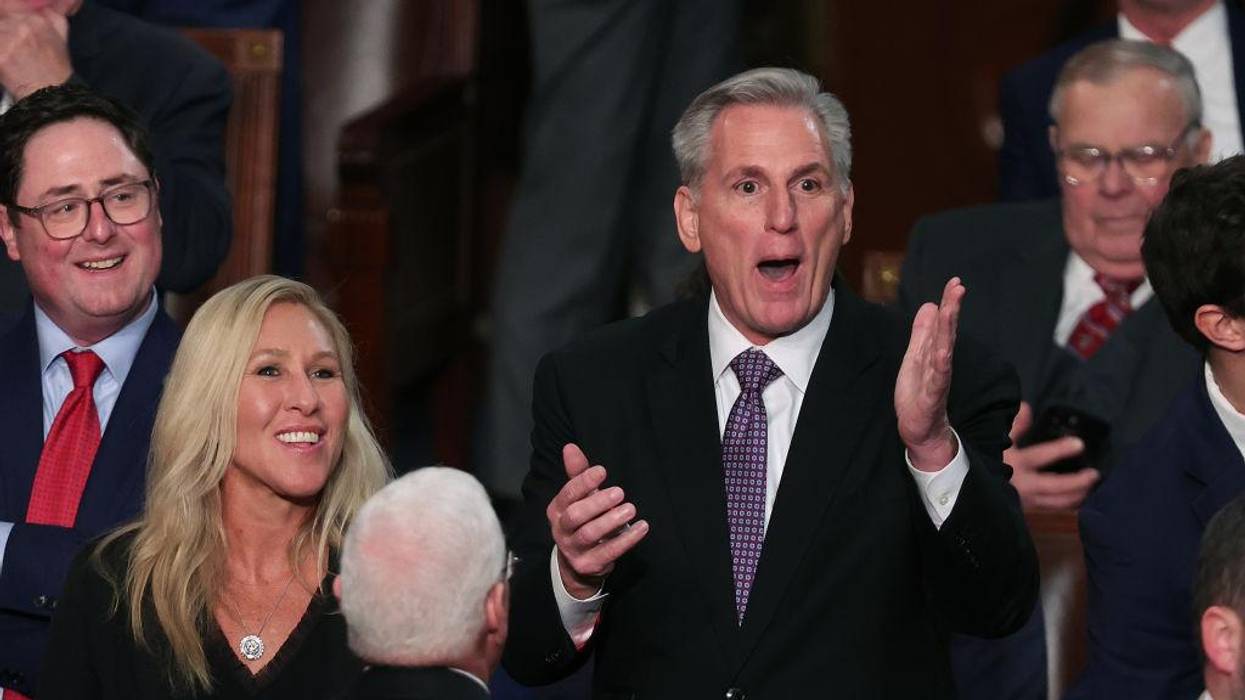
The House adjourned Wednesday afternoon until 8:00 pm ET, after a trio of votes in which far-right House Republicans repeatedly denied Congressman Kevin McCarthy (R-Calif.) the speakership—events that followed three similar voting rounds on Tuesday. Members briefly returned to the chamber as planned Wednesday night and narrowly voted to adjourn until noon on Thursday. The chamber can't move forward with any legislative business until the leadership position is filled.
"The 20 opposed to McCarthy want all-out war against Democrats and Biden," Institute for Policy Studies fellow Sanho Tree said of the Republicans blocking his path to speaker. "They think that by taking the debt ceiling hostage this year, the House can force the Senate and [White House] to agree to slashing spending, a border wall, and cuts to Medicare and Social Security."
Rep. Andy Barr (R-Ky.) suggested to Punchbowl News' Brendan Pedersen that the speaker fight doesn't "necessarily portend a problem with the debt limit," adding that "I think there will be a way forward," but some Democrats aren't convinced.
"If House Republicans can't even get it together to choose their leader, they can't be trusted with the debt ceiling, fighting inflation, or helping families make ends meet," Rep. Sara Jacobs (D-Calif.) tweeted Wednesday evening. "They've proven they can't lead."
One of the House Freedom Caucus members who has repeatedly voted against McCarthy for speaker, Rep. Ralph Norman (R-S.C.), discussed the debt limit with journalists on Wednesday, reportedly saying: "Is he willing to shut the government down rather than raise the debt ceiling? That's a non-negotiable item."
According to The Intercept's Ryan Grim:
A reporter asked Norman if he meant default on the debt, as the debt ceiling and a government shutdown are not directly linked. "That's why you need to be planning now what agencies—what path you're gonna take now to trim government. Tell the programs you're going to get to this number. And you do that before chairs are picked," he said, referring to the process of choosing and installing House committee chairs.
A quirk of parliamentary procedure requires Congress to authorize spending, then appropriate money for those authorized expenditures, and then to authorize the Treasury Department to issue debt in order to pay for that appropriated money. Some constitutional scholars argue that the debt ceiling is unconstitutional, but currently both parties recognize it as a legal and valid restriction on the government's ability to issue debt.
Appearing on a Bloomberg Radio program Wednesday, Rep. Brad Sherman (D-Calif.) floated the possibility of trading Democratic voters in favor of McCarthy for a debt limit deal.
"Eventually, he's going to have to cut a deal with Democrats, because it's going to be easier to get a deal with us than with his 20-headed monster he has over there," Sherman said. "He's going to have to agree with Democrats to not hold hostage the full faith and credit of the United States, to not put us in a position where we're going to shut down the government. And eventually, I think Americans will benefit from this ugly picture of chaos."
The New York Daily News reported Wednesday that though Rep. Alexandria Ocasio-Cortez (D-N.Y.) "emphatically ruled out supporting embattled" McCarthy, the progressive congresswoman suggested to journalists that there was potential for a compromise speaker who agreed to raise the debt ceiling along with "a combination of" other concessions.
Meanwhile, some critics of the Republican Party used the ongoing speakership drama to remind Americans that no matter who ultimately ends up at the helm, "they all want to cut your Social Security" and protect wealthy tax dodgers.