

SUBSCRIBE TO OUR FREE NEWSLETTER
Daily news & progressive opinion—funded by the people, not the corporations—delivered straight to your inbox.
5
#000000
#FFFFFF
To donate by check, phone, or other method, see our More Ways to Give page.
Daily news & progressive opinion—funded by the people, not the corporations—delivered straight to your inbox.
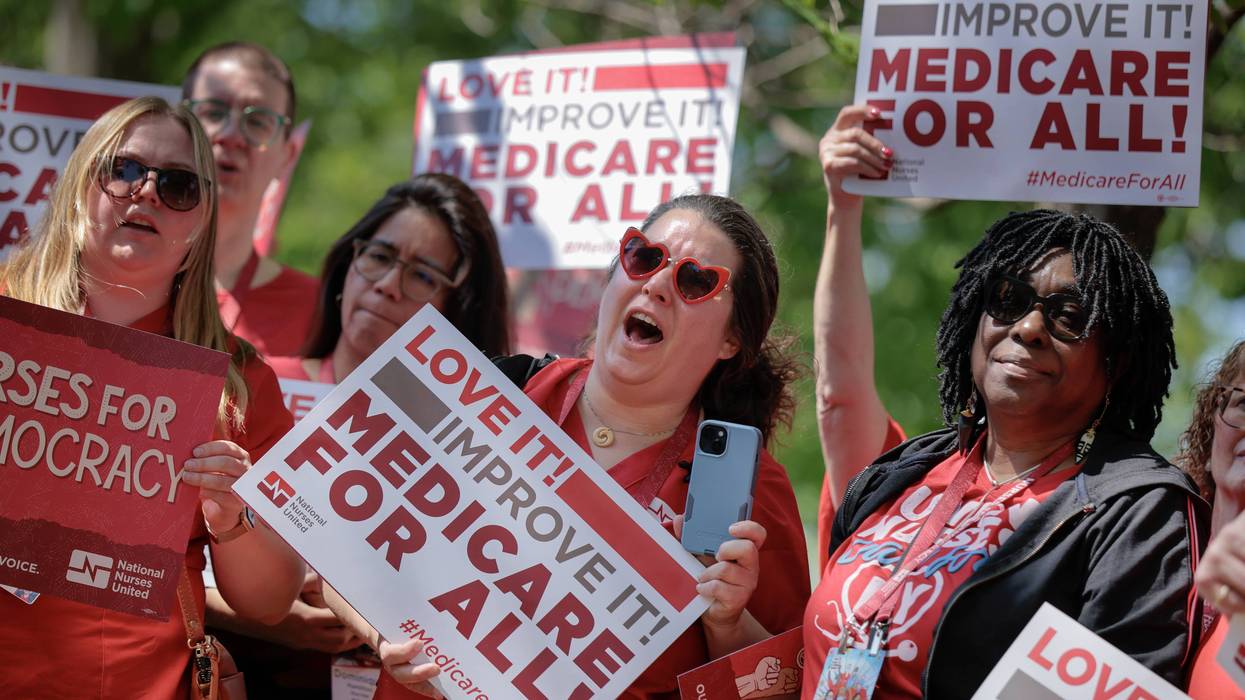
"Americans are done with a healthcare system that puts profits before people," said Congresswoman Ilhan Omar.
Two-thirds of Americans now support a national health insurance program commonly known as Medicare for All, according to a new poll released Tuesday by KFF, marking the highest level of support recorded since the public health policy group began tracking the proposal a decade ago.
The latest KFF Health Tracking Poll, conducted between September 16-21, found that 66% of US adults favor Medicare for All, up substantially from the 53% who supported the idea when KFF last asked the question in October 2020. Just 34% now oppose it.
KFF's findings come as healthcare affordability has emerged as a major concern heading into November's midterm elections. Health costs and gasoline prices are tied as Americans' top economic worries, while voters now trust Democrats over Republicans by a 20-point margin to handle healthcare costs, according to the poll.
Two-thirds of the public favor Medicare-for-All — the highest share since KFF began polling on the topic in 2016 — but public opinion is highly malleable and support shifts when competing claims from critics and proponents are heard: https://on.kff.org/4zgJv6z
[image or embed]
— KFF (@kff.org) October 6, 2026 at 11:04 AM
The poll results also underscore growing public frustration with the nation's costly and fragmented healthcare system, with progressives increasingly arguing that voters want more than incremental reforms.
"People are sick of a broken healthcare system driven by the greed of the insurance industry and Big Pharma," Sen. Bernie Sanders (I-Vt.)—who twice ran for president as a Democrat on a Medicare for All platform—said Tuesday on social media. "The time to pass Medicare for All is NOW."
Congresswoman Ilhan Omar (D-Minn.) said: "Two-thirds of Americans support Medicare for All. Americans are done with a healthcare system that puts profits before people."
"Medicare for All can save 114,000 lives and $1 trillion a year," Omar noted, referring to a recently published study out of Yale University and adding, "Turns out, progressive policies can be good politics AND good policy."
Audrey Kearney, a senior survey analyst at KFF, told Reuters that “all year, KFF polls have shown that the public is frustrated with the high cost of healthcare, and that may be leading to a desire for change."
As The Guardian reported Sunday, 1,500 unionized nurses gathered in San Francisco last week to rally for Medicare for All, a policy their unions have championed for many years.
Michigan Democratic Senate nominee Abdul El-Sayed, one of the proposal's most prominent 2026 advocates, asked the nurses: “Medicare for who?”
"All!” they shouted back.
El-Sayed then described Medicare for All as addressing “the very simple idea that in the richest, most powerful country in the world you should not have to suffer for your healthcare.”
I believe in Medicare for All like I believe in public schools. There for you no matter what.
[image or embed]
— Abdul El-Sayed (@abdulelsayed.bsky.social) October 4, 2026 at 6:16 AM
The California Nurses Association's Michelle Gutierrez Vo, meanwhile, pointed to the costs and failures of the existing system.
“There’s too many unnecessary illnesses and unnecessary costs,” she said. “What are we doing?”
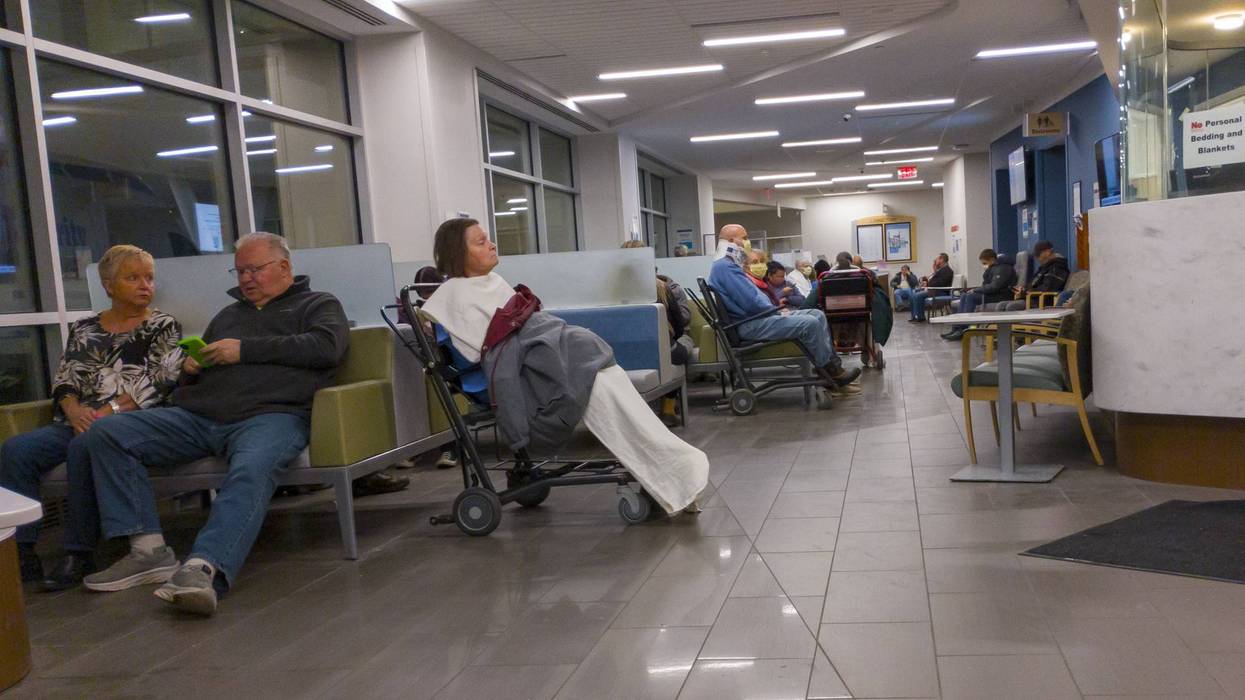
"We’re really crushing people who are desperately trying to pay their bills," said a chief executive at a nonprofit hospital group.
Months after congressional Republicans refused to extend enhanced subsidies for Americans who receive their health insurance through the Affordable Care Act, hospitals across the US are seeing a surge in uninsured patients seeking emergency medical care.
According to a Thursday report in The New York Times, executives at large hospital systems have been raising alarms over "the unexpectedly sharp rise in uninsured patients and the costs associated with treating them."
With many uninsured patients unable to pay their hospital bills, the Times noted, hospitals are seeing "lost revenues amounting to hundreds of millions of dollars across the country's vast health systems."
The Times linked this surge in uninsured patients directly to the Republican-controlled Congress allowing more generous subsidies for plans purchased through the ACA to lapse at the end of 2025. Enrollment in the program has fallen by about 3 million people since last year.
"What that tells me is that there are patients who are completely unable to pay," Laura Kaiser, chief executive of Catholic nonprofit hospital group SSM Health, told the Times. "We’re really crushing people who are desperately trying to pay their bills."
Executives at Universal Health Services (UHS), a for-profit hospital operator, said during an earnings call on Tuesday that the losses they expect to incur from treating uninsured patients have been significantly higher than their initial projects.
As reported by Healthcare Dive on Wednesday, UHS had initially projected that some patients who dropped their coverage provided by the ACA would find another way to get health insurance.
However, UHS CFO Steve Filton told investors that "it felt like virtually everyone who lost their exchange coverage became an uninsured patient."
UHS is hardly alone in suffering losses due to lapsed ACA subsidies, as Axios reported on Tuesday that HCA Healthcare, the largest for-profit hospital chain in the US, is projecting a $400 million hit to revenue that is tied partially to "an influx of uninsured patients."
HCA CEO Sam Hazen said the increase in uninsured patients was a direct consequence of the GOP's refusal to extend the ACA subsidies.
"The effects, as expected, were that many people became uninsured and still needed emergency care from hospitals," Hazen said. "As we look at the first half of the year, our expectations proved accurate, although the impact was greater than our estimates."
An increase in uninsured patients is bad both for hospitals' finances and patients themselves.
As KFF explained in a June report, people without insurance are more likely to avoid seeking medical treatment until their situation becomes too dire to ignore.
"People without health coverage are more likely to be hospitalized for avoidable health problems," KFF wrote, "and to experience declines in their overall health as a consequence of having undiagnosed conditions and a lower likelihood of receiving preventive and chronic disease management care. When they are hospitalized, uninsured people receive fewer diagnostic and therapeutic services and also have higher mortality rates than those with insurance."