

SUBSCRIBE TO OUR FREE NEWSLETTER
Daily news & progressive opinion—funded by the people, not the corporations—delivered straight to your inbox.
5
#000000
#FFFFFF
To donate by check, phone, or other method, see our More Ways to Give page.
Daily news & progressive opinion—funded by the people, not the corporations—delivered straight to your inbox.
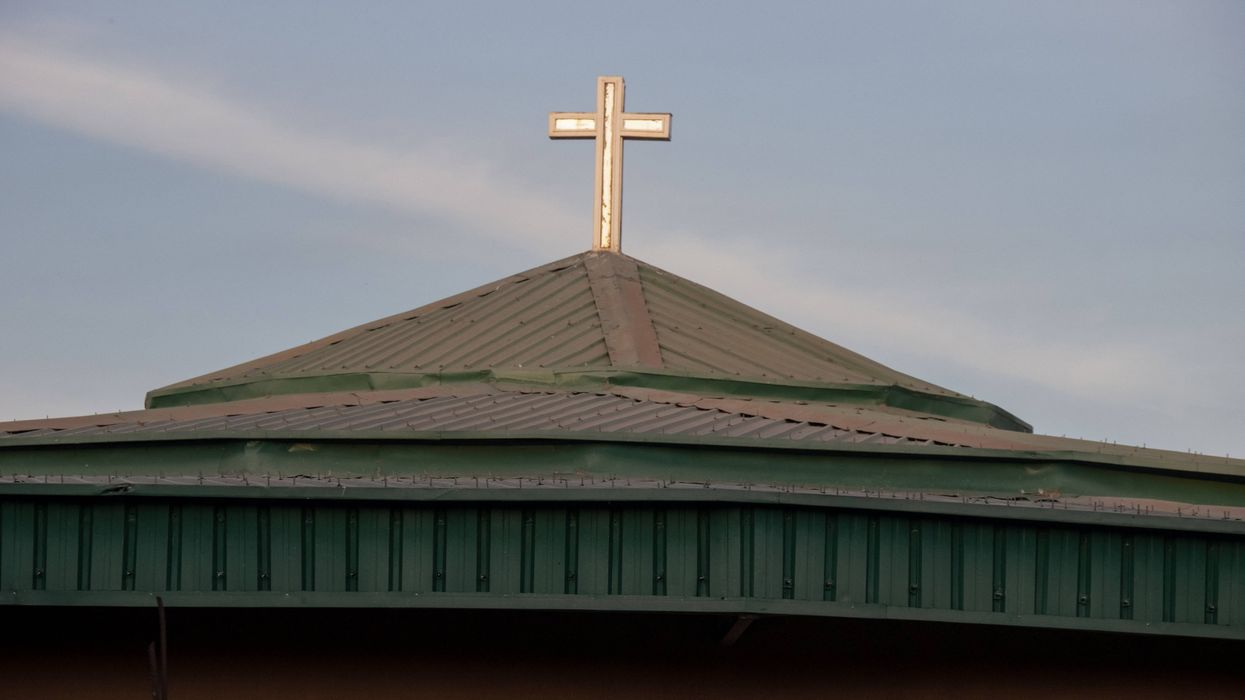
“Portraying Nigeria’s security challenges as a targeted campaign against a single religious group is a gross misrepresentation of reality,” said Nigeria's information minister.
When President Donald Trump launched a series of airstrikes in Nigeria on Christmas, he described it as an attack against "ISIS Terrorist Scum in Northwest Nigeria who have been targeting and viciously killing, primarily, innocent Christians."
But locals in a town that was hit during the strike say terrorism has never been a problem for them. On Friday, CNN published a report based on interviews with several residents of Jabo, which was hit by a US missile during Thursday's attack, which landed just feet away from the town's only hospital.
The rural town of Jabo is part of the Sokoto state in northwestern Nigeria, which the Trump administration and the Nigerian government said was hit during the strike.
Both sides have said militants were killed during the attack, but have not specified their identities or the number of casualties.
Kabir Adamu, a security analyst from Beacon Security and Intelligence in Abuja, told Al Jazeera that the likely targets are members of “Lakurawa,” a recently formed offshoot of ISIS.
But the Trump administration's explanation that their home is at the center of a "Christian genocide" left many residents of Jabo confused. As CNN reported:
While parts of Sokoto face challenges with banditry, kidnappings and attacks by armed groups including Lakurawa–which Nigeria classifies as a terrorist organization due to suspected affiliations with [the] Islamic State–villagers say Jabo is not known for terrorist activity and that local Christians coexist peacefully with the Muslim majority.
Bashar Isah Jabo, a lawmaker who represents the town and surrounding areas in Nigeria's parliament, described the village to CNN as “a peaceful community” that has “no known history of ISIS, Lakurawa, or any other terrorist groups operating in the area.”
While the town is predominantly Muslim, resident Suleiman Kagara, told reporters: "We see Christians as our brothers. We don’t have religious conflicts, so we weren’t expecting this."
Nigeria, Africa's most populous nation with more than 237 million people, has a long history of violence between Christians and Muslims, with each making up about half the population.
However, Nigerian officials have disputed claims by Republican leaders—including US Sen. Ted Cruz (Texas)—who have claimed that the government is “ignoring and even facilitating the mass murder of Christians.”
The senator recently claimed, without citing a source for the figures, that "since 2009, over 50,000 Christians in Nigeria have been massacred, and over 18,000 churches and 2,000 Christian schools have been destroyed" by the Islamist group Boko Haram.
Cruz is correct that many Christians have been killed by Boko Haram. But according to reports by the US-based Armed Conflict Location and Event Data Project and the Council on Foreign Relations, the majority of the approximately 53,000 civilians killed by the group since 2009 have been Muslim.
Moreover, the areas where Boko Haram is most active are in northeastern Nigeria, far away from where Trump's strikes were conducted. Attacks on Christians cited in October by Cruz, meanwhile, have been in Nigeria's Middle Belt region, which is separate from violence in the north.
The Nigerian government has pushed back on what they have called an "oversimplified" narrative coming out of the White House and from figures in US media, like HBO host Bill Maher, who has echoed Cruz's overwrought claims of "Christian genocide."
“Portraying Nigeria’s security challenges as a targeted campaign against a single religious group is a gross misrepresentation of reality,” said Nigerian information minister Mohammed Idris Malagi. “While Nigeria, like many countries, has faced security challenges, including acts of terrorism perpetrated by criminals, couching the situation as a deliberate, systematic attack on Christians is inaccurate and harmful. It oversimplifies a complex, multifaceted security environment and plays into the hands of terrorists and criminals who seek to divide Nigerians along religious or ethnic lines."
Anthea Butler, a religious scholar at the University of Pennsylvania, has criticized the Trump administration's attempts to turn the complex situation in Nigeria into a "holy war."
"This theme of persecution of Christians is a very politically charged, and actually religiously charged, theme for evangelicals across the world. And when you say that Christians are being persecuted, that’s a thing," she told Democracy Now! in November. "It fits this sort of savior narrative of this American sort of ethos right now that is seeing itself going into countries for a moral war, a moral suasion, as it were, to do something to help other people."
Nigeria also notably produces more crude oil than any other country in Africa. Trump has explicitly argued that the US should carry out regime change in Venezuela for the purposes of "taking back" that nation's oil.
Butler has doubted the sincerity of Trump's concern for the nation's Christians due to his administration's denial of entry for Nigerian refugees, as well as virtually every other refugee group, with the exception of white South Africans.
She said: "I think this is sort of disingenuous to say you’re going to go in and save Christianity in Nigeria, when you have, you know, banned Nigerians from coming to this country."
I wrote about the Alt-right for Salon today. It's not the same as European ethno-nationalism. It's scarier:
After months of squabbling about whether it's acceptable to use the "F" word (fascism), it seems at long last that we have come to some consensus about what to call Donald Trump's "philosophy": Alt-Right, also known as white nationalism. With the hiring of the former chief of Breitbart Media, ground zero for the Alt-right movement, as Trump's campaign chairman, the interest in it has now gone mainstream. Hillary Clinton made a speech about it later today.
Alt-right white nationalism is an apt term for a campaign that has electrified white supremacists so it makes sense that most people would focus on the racial angle. According to this analysis in the Guardian, the rising right-wing ethno-nationalist movement in Europe is the progenitor of this American version, which adheres to its basic premise but brings its own special brand of deep-fried racism. Both share a belief that the white race is under siege and that "demands for diversity in the workplace, which means fewer white males in particular, forms the foundation for the movement." So it stands to reason that Trump's border wall, Muslim ban, and bellicose appeals for "law and order" (along with his overt misogyny) is a clarion call to this faction.
But while it's obvious that the subtle and not-so-subtle racial messaging are among the primary attractions for Trump voters, they are also responding to an economic appeal, much of which stems from the misconception that because Trump himself is a successful businessman he must know what he's doing. But as Dave Johnson of Campaign for America's Future pointed out, many of the white working-class folk who believe Trump's promises to "bring back jobs" would be surprised to know what he actually means by that:
Trump says the U.S. is not "competitive" with other countries. He has said repeatedly we need to lower American wages, taxes and regulations to the point where we can be "competitive" with Mexico and China. In other words, he is saying that business won't send jobs out of the country if we can make wages low enough here.
His "plan" is to compete by pitting states against each other to lower wages, particularly by encouraging businesses to move to low-wage, anti-union states. Once the layoffs start, workers will be willing to take big pay cuts to keep their jobs. Johnson shows how Trump believes "companies should continue this in a 'rotation' of wage cuts, state to state, until you go 'full-circle,' getting wages low enough across the entire country. Then, the U.S. will be 'competitive' with China and Mexico.
So this white nationalist "populist" economic appeal is less than meets the eye. In that regard Trump is just another "cuck-servative" (you can look it up) who thinks he can fool the rubes into making people like him even richer than they already are. But all that is subsumed in Trump's message of white grievance and American decline.
One of the most important characteristics of this faction is a strong attraction to authoritarianism. This fascinating report at Vox by Amanda Taub tracked studies which show that "more than 65 percent of people who scored highest on the authoritarianism questions were GOP voters and more than 55 percent of surveyed Republicans scored as "high" or "very high" authoritarians."
Authoritarians, we found in our survey, tend to most fear threats that come from abroad, such as ISIS or Russia or Iran. These are threats, the researchers point out, to which people can put a face; a scary terrorist or an Iranian ayatollah
That fear is also something the American alt-right has in common with their European cousins, but I see it having a different effect here. In Europe, the desire truly is for a withdrawal from external obligations and the dismantling of institutions that have blurred national identity and political independence. They are afraid of mass immigration from the Middle East in the age of terrorism and the economic crisis emboldened the usual European suspects. So some observers are tempted to believe that Trump's invocation of the old isolationist slogan "America First" will likewise result in a pull-back of the American global empire. But a closer look at Trump's rhetoric shows that he and his followers have a different worldview.
Look at his slogan: "Make America Great Again." Those four words imply the idea of America dominating the planet as it did after World War II. Of course, it still does, but in Trump's mind, America has become a weak and struggling nation hardly able to keep up with countries like Mexico. He believes other countries are laughing at us and treating us disrespectfully, which has had him seething for over 30 years. Back then it was Japan "cuckolding" America. Today it's China and Mexico, both of which he promises to sanction for failing to properly "respect" America -- with a thinly veiled violent threat backing it up. After all, trade wars have often led to shooting wars.
American nationalism cannot be separated from its status as the world's only superpower. Trump promises to build up the American military to the most massive force in history (of course, it already is) so that "nobody will mess with us ever again." He doesn't say that America should pull back from its security guarantees, merely that it should require other nations to pay more for the protection. He doesn't take nuclear war off the table, one can assume for the reason that it's a cheaper, quicker way to "take care of" problems than these relatively smaller wars we've waged since the world burned in the two epic conflagrations of the 20th century. His nationalism is all about domination not withdrawal.
And that view is shared by the American alt-right. Here's one Breitbart writer making the case:
I'd like an America that makes 7 "Fast & Furious" movies without making concessions to Ayatollah Khamenei. I'd like an America that humiliates the likes of Vladimir Putin, not vice-versa. An America that punches back eight times as hard over a tiny offense. An America that everyone might laugh at but ultimately stop attacking because it can only end poorly for them.
Trump's nationalism is absolutely about ethno-purity, and there's an element of populism as well, although it's clearly a misdirection. But it's largely about wounded national pride,e which has been a potent motivating force on the American right for a long time. There's a reason Trump is now playing the conservative anthem "Proud To Be An American" at his rallies. Good old-fashioned jingoism is the one thing that brings the old right, the new right, and the alt-right together.
As the United States this week expands its bombing campaign against the Islamic State (ISIS) to Libya, Khizr Khan, the Gold Star father who gave a powerful anti-Donald Trump speech at the Democratic National Convention (DNC), has criticized U.S. wars in Muslim nations as leaving us in a "quagmire," "more vulnerable," and creating "chaos for ourselves." But Khan's take on the war on terror is unlikely to be amplified by corporate media, as one political writer points out.
Khan, a Muslim, Pakistani-American, and father of a U.S. Army captain who was killed in Iraq in 2004, made waves last week for his speech at the DNC. Standing beside his wife, Ghazala, he directed his criticism at the Republican presidential nominee, and said, "You have sacrificed nothing and no one," and asked, "Have you even read the United States Constitution?"
As the New Yorker's Amy Davidson wrote, "Khan, though his speech centered on the loss of his son, had made the case against Trump more powerfully than almost any other speaker."
Since the convention, Khan "has become something of a media celebrity," writes Ben Norton, politics staff writer at Salon. The portrayal often used in these accounts, Norton continues, focuses on patriotism. One such example can be seen here, as posted on CNN Money on Tuesday:
Here was an in-the-flesh example of Muslim assimilation--a man who had lost his son, yet who espoused patriotism to the point of literally brandishing a pocket-sized copy of the Constitution. Not only was the couple's grief universal and relatable, but the Khans put a face on Muslims who are pursuing the American Dream just as countless other ethnicities have done.
On Monday, the same day the U.S. started its new campaign in Libya--a move one antiwar group said will only further "entrench divisions and intensify violence" in the region--the Khans gave an interview on MSNBC's "Hardball."
Asked by host Chris Matthews, "What do you think when you, or feel, when you see us attack Iraq or go into Afghanistan after Osama bin Laden, or we go attack with bombs Libya? We're bombing Syria now--all Islamic countries. What do you feel as an Islamic man?"
Khizr Khan replied, "As a Muslim-American, not just as Islamic man--as a Muslim American, I feel that these policies are not in the interest of United States of America, and we see the result of it. We are more vulnerable now. We have created a chaos and--for ourselves."
"Well, you know you're speaking to the choir," Matthews responded. (In fact, "Matthews' record isn't entirely consistent" on being against either the war in Iraq or on avoiding a military approach to confronting ISIS, Norton notes.)
"I wish this country would have listened to Chris Matthews when he was talking, when he was preaching," Khan said, "we could have saved ourselves from this quagmire."
This section of the interview, Norton points out, "is not included in the isolated clips for the episode on MSNBC's website. One has to watch the full episode to see it."
The situation may remind some of how the corporate media chose to portray Malala Yousafzai, the Nobel laureate and children's education advocate who was attacked by the Taliban. She met with President Barack Obama at the White House and told him that "drone attacks are fueling terrorism." Yet, as Peter Hart wrote at FAIR in 2013, that "didn't register in a corporate media that followed Malala's visit, and her story, very closely." Hart continued:
This is in keeping with other media patterns we've seen. Earlier this year, Farea al-Muslimi, a Yemeni writer and activist, came to Washington to deliver moving testimony to the Senate Judiciary Committee about the effect of drone strikes on his country: "What the violent militants had previously failed to achieve, one drone strike accomplished in an instant. There is now an intense anger against America." His words received scant coverage in the US media (FAIR Blog, 4/24/13).
If Americans wish to understand how US wars are experienced by those on the other side of the military attacks, it is important to hear these voices. But will US media allow these voices to be heard?
Meanwhile, the U.S.-led coalition's strikes on ISIS continue with deadly consequences. According to the transparency group Airwars, July 2016 had the highest number of reported civilian deaths in Syria from coalition strikes since the bombing campaign began nearly two years ago.
Also this week, the U.S. has said it will begin, based on credible evidence, a second probe into whether its strikes near Manjib, Syria killed civilians.
The second formal investigation centers around a July 28 strike, which, according to the U.K.-based Syrian Observatory for Human Rights, left at least 28 civilians dead.
The first formal investigation, which the Pentagon announced last week, will look into a July 20 strike which, according to the monitoring group, may have killed scores.
In Brussels this week, two former U.S. drone technicians are speaking out against the aerial bombing program as the European Parliament gears up for a hearing on unmanned warfare and the U.S. prepares to confront its own legacy on drone strikes.
At an event with campaigners on Thursday, Cian Westmoreland and Lisa Ling, who worked on the military's drone technology systems, criticized the bombing program for what they say was a lack of recognition for human life.
Westmoreland first spoke out against the program in 2015 along with three other Air Force pilots, who published a letter accusing the Obama administration of "lying publicly" about the program and warning that "the innocent civilians we were killing only fueled the feelings of hatred that ignited terrorism and groups like ISIS."
On Thursday, he said he was compelled to come forward after being given an award for helping build a station in Kandahar, Afghanistan, that contributed to 2,400 missions and 2,000 "enemy kills."
That made him feel "horrible," he told the Guardian.
"The connection needs to be made that if strategic and military goals are to be fulfilled, civilian lives must be respected," he said.
The Guardian notes that Britain is currently the only European country to use drones but that the European Parliament believes that may change as more nations come under increasing pressure to support U.S. warfare.
The two whistleblowers also attended a parliamentary hearing on Thursday to discuss the impacts of drone warfare on civilian communities. Westmoreland said he noticed a "total disconnect" among many of the Members of European Parliament (MEPs) during the hearing, including during videotaped testimony from the brother of a cleric killed during a strike who talked about the impact it had on his family. "One of them was playing on their cellphone while this was going on," Westmoreland said.
Thursday's hearing also took place just a day before President Barack Obama is expected to announce the number of civilian casualties caused by U.S. drone strikes in nontraditional battlegrounds like Pakistan, Yemen, Somalia, and Libya since 2009, leaving out figures for active war zones like Iraq and Afghanistan.
A report released Thursday by the international human rights group Reprieve exposes the administration's misleading--and rare--public statements on civilian casualties from drone strikes.
Ling said the hearing felt like a first step toward "exploring issues of what does participation in the drone war or extrajudicial killing actually look like."
She added that she had been shocked by "how little the public knew" about the program. "As citizens, we need to talk about the things that are in the dark.... The people who are out of the picture are the people who are on the ground within the drone program, and the victims," she said.
"Humanity has been taken out of the decision: there has been a lot of talk about the plane itself and how cool the technology is," she added, "but not a lot of conversation about the people who are affected."
Donald Trump has reaffirmed his backing of torture.
Speaking at a campaign rally Tuesday in St. Clairsville, Ohio, he said of the terrorist group ISIS, "We have to fight so viciously and violently because we're dealing with violent people."
"What do you think about waterboarding?" he asked the crowd. "I like it a lot," he said to cheers. "I don't think it's tough enough."
The comments, which came in the wake of the bomb and gun attack on Istanbul's Ataturk airport that killed scores, were "about as Trumpian as you could get," according to one commentator.
Democratic presidential rival Hillary Clinton, for her part, responded to the Turkish attack by calling for the U.S. to "deepen our cooperation with our allies and partners in the Middle East" to confront terrorism. "Such cooperation is essential to protecting the homeland and keeping our country safe," she said.
The presumptive Republican nominee has previously embraced the torture technique, saying in the last Republican presidential debate before the New Hampshire primary, "I would bring back waterboarding, and I'd bring back a hell of a lot worse than waterboarding."
He also said following the deadly Brussels terror attacks in March that if he were commander-in-chief, "waterboarding would be fine," adding, "If they could expand the laws, I would do a lot more than waterboarding."
During the Ohio speech Tuesday, Trump also denounced the Trans-Pacific Partnership and compared it to rape.
The trade deal was "done and pushed by special interests who want to rape our country, just a continuing rape of our country. That's what it is, too," he said.
Jezebel writer Joanna Rothkopf called it "an obviously despicable turn of phrase for anyone who has been the victim of sexual assault, faces the constant threat of assault, or has any sympathy for people who do."
As the sun set over New York on June 12, hundreds of Muslims gathered together in Hudson River Park to break their Ramadan fast.
Iftar, the evening Ramadan meal, is often a joyous celebration of faith and family. But the mood that Sunday was solemn: That morning, news had broken of the ghastly massacre of LGBTQ revelers at Pulse nightclub in Orlando.
A lone Muslim had allegedly perpetrated the attack. Here by the Hudson, over 200 knelt in prayer.
"We're praying for those who were lost," one woman explained in a video circulated by the Huffington Post, her voice breaking. "As Muslims, we're united in our outrage over this senseless act of violence."
Meanwhile, an Orlando imam condemned terrorism as un-Islamic and affirmed his belief that "Islam teaches peace." The Florida chapter of a national Muslim group called on members to donate blood for the victims. And statements of sympathy tumbled forth from American Muslims in what CBS News called "an avalanche."
"Today, we stand in solidarity with the LGBTQ community," said the group Muslim Advocates. "Your grief is our grief. Your outrage is our outrage."
Unfortunately, none of those touching gestures deterred Donald Trump from warning darkly that "radical Islam is coming to our shores."
In a falsehood-riddled speech following the Orlando massacre, the presumptive GOP nominee blamed the shooting on immigration and "political correctness."
As Muslims all over America sent their sympathies to Orlando, Trump mocked his Democratic rival's insistence that "Muslims are peaceful and tolerant people." He accused Muslims of causing "death and destruction" by covering up terrorism in their midst (though it was later revealed that a Muslim member of Mateen's community had reported him as suspicious).
Then, in perhaps the most ominous part of the address, Trump claimed that Democrats will "take away Americans' guns and then admit the very people who want to slaughter us."
Muslim immigrants are the problem, he seems to be saying. And guns are the solution.
If you ask me, I'd feel much safer with the crowd at Hudson River Park than anywhere near a rally of armed Trump supporters. But here's the creepier part: For all his blathering that "we have to get smart" about "radical Islam," Trump is stupidly playing right into ISIS's hands.
Like Trump himself, the group benefits immensely from anything that drives a wedge between Muslims and the societies they live in.
ISIS said as much itself -- in plain English -- in a publication detailing its plan to "destroy the gray zone" between infidels and believers. Since most Muslims seem to like living in the liberal societies of Europe and North America, ISIS propagandists have written that the only way to drive up recruitment is to make Muslims feel unwelcome there.
No wonder ISIS recruiters are now featuring Donald Trump in advertisements.
It's not because they're afraid of him -- it's because few people are working harder to make Muslims feel unwelcome than he is. Civil rights groups report that Trump's rise has paralleled a shocking increase in hate crimes against Muslims in this country.
That's an outrage. And it's thoroughly self-defeating.
In fact, the United States has arguably the most prosperous, well-integrated Muslim population in the Western world. Even as ISIS has scored a few recruiting successes among the much more marginalized Muslim communities of Europe -- though even there, the group falls way outside the mainstream -- it's flat-lined here.
Scenes like the iftar gathering in New York, in other words, are the rule, not the exception. They're a touching rejoinder to the toxic politics of division and a far more accurate reflection of our Muslim neighbors than anything peddled by Trump.
And, not least, they're a much better asset in the fight against terrorism than any bullet or bomb -- or any demagogue who urges his followers to reach for their guns at the first sign of trouble.
After President Obama announced on Monday that he would deploy 250 additional special operations troops to Syria, State Department spokesperson John Kirby tried to deny that Obama had ever promised not to send "boots on the ground" there.
"There was never this 'no boots on the ground,'" said Kirby. "I don't know where this keeps coming from."
After President Obama announced on Monday that he would deploy 250 additional special operations troops to Syria, State Department spokesperson John Kirby tried to deny that Obama had ever promised not to send "boots on the ground" there.
"There was never this 'no boots on the ground,'" said Kirby. "I don't know where this keeps coming from."
The problem for Kirby was that Obama had repeated the promise at least 16 times since 2013:
For instance, on August 30, 2013, Obama said: "We're not considering any boots-on-the-ground approach."
On September 10, 2013, he said: "Many of you have asked, won't this put us on a slippery slope to another war? One man wrote to me that we are 'still recovering from our involvement in Iraq.' A veteran put it more bluntly: 'This nation is sick and tired of war.' My answer is simple: I will not put American boots on the ground in Syria."
On September 7, 2014, he said: "In Syria, the boots on the ground have to be Syrian."
After reporters pointed out the mistake, Kirby tried to walk back his claim by defining the phrase "boots on the ground" to exclude special forces.
"When we talk about boots on the ground, in the context that you have heard people in the administration speak to, we are talking about conventional, large-scale ground troops," said Kirby. "I'm not disputing the fact that we have troops on the ground, and they're wearing boots."
The new deployment will result in a six-fold increase to the 50 U.S. special forces troops already in Syria. There are also 4,000 U.S. troops in Iraq. The White House has insisted that its forces "do not have a combat mission" and are deployed in an "advise and assist" capacity only, helping to train local militias that engage ISIS directly.
There is, as Kirby indicated, a distinction between a large-scale ground invasion and, say, a small group of advisers hanging back from the front. But the line between "combat" and "assist" missions is not always so clear.
Read the full article at The Intercept
An Israeli tactic deemed "ineffective" at preventing civilian causalities by a United Nations commission has now been adopted by the United States in its fight against ISIS, according to a U.S. military official.
Air Force Maj. Peter Gersten, the deputy commander for operations and intelligence for the U.S.-led coalition, explained at a press briefing Tuesday that the tactic dubbed "knocking on the roof" was, in fact, used during a strike in Mosul, Iraq against a "major distributor of funds to Daesh fighters." A woman the military had seen come and go with her children from the building died in the strike--"an unfortunality," as Gersten called it.
"We went as far as actually to put a Hellfire on top of the building and air-burst it so it wouldn't destroy the building, simply knock on the roof to ensure that she and the children were out of the building. And then we proceeded with our operations," Gersten said. He went on to say that ISIS fighters are "using the civilian force as human shields." He said that the military saw the woman and children leave the building. They then "began to process the strike," but the woman ran back into the building and was killed.
As CNN reported in 2014, "The Israeli Air Force developed the technique in 2009 as a way to warn civilians in Gaza to leave buildings it has identified as locations where Hamas keeps ammunition, a rocket stash or command post. But it is a controversial policy that human rights groups have criticized."
The reporting also notes that the tactic was used "extensively" during Israel's 2014 bombing campaign on Gaza dubbed "Operation Protective Edge."
The UN estimated that Israeli strikes during the operation killed over 1,400 civilians--69 percent of Gaza's causalities. Those casualties included nearly 500 children and over 250 women. Just months after the campaign ended, as the Jerusalem Post reported at the time, Chairman of the Joint Chiefs of Staff Martin Dempsey sent a team of officers to learn tactics from the Israel Defense Forces during the operation. Dempsey made note of "roof knocking" and praised Israel for taking "extraordinary lengths to limit collateral damage and civilian casualties."
A UN commission report looking into that conflict criticized the tactic.
"Based on its findings, the commission concludes that the 'roof-knocking' technique is not effective, in particular if not combined with other specific warnings," it stated.
"In some cases, it appears that concerned persons did not understand that their house had been the subject of a 'roof-knock,'" the inquiry added. It also criticized the short time between the roof knock and the attack, writing, "If the 'roof-knock' is the first warning, a few minutes are clearly not sufficient to allow a multi-story building inhabited by families with children and elderly and sometimes disabled persons to be evacuated, taking into account the time required to realize that the strike was meant as a warning."
Human rights attorney and writer Noura Erakat argued in 2015 of Operation Protective Edge, "The use of force against Gaza in 2014 reflects a new norm that Israel, together with the United States, aims to establish in the context of counter-terrorism operations."
Erakat charged that
Israel considered those who did not flee following a warning as involuntary human shields, whom they consider Hamas's victims of "terrorism." Israel has not been clear, however, whether these involuntary human shields constitute civilian harm to be considered in its proportionality assessment. Its military decisions reflect that they did not count: at least 142 families lost three or more members in attacks on residential buildings resulting in at least 742 casualties. Based on their investigation, the FIDH concluded that "rather than minimizing loss of civilian life, Israel's warning policy fomented massive forced displacement and spread confusion and fear among the population."
The U.S. said last month that civilian casualties in Iraq and Syria as a result its war against Isis in Iraq and Syria totaled to 41. Independent watchdog project Airwars, however, found that over 1,000 civilian casualties "appear likely" from coalition strikes.
They have done it again. The US, Britain and regional allies led by Saudi Arabia have come together to intervene in another country with calamitous results. Instead of achieving their aims, they have produced chaos, ruining the lives of millions of people and creating ideal conditions for salafi-jihadi movements like al-Qaeda and Islamic State.
The latest self-inflicted failure in the "war on terror" is in Yemen, where Saudi Arabia and a coalition of Sunni states intervened on one side in a civil war in March 2015. Their aim was to defeat the Houthis - labelled somewhat inaccurately as Shia and pro-Iranian - who had seized most of the country in alliance with the former President Ali Abdullah Saleh, who retained the loyalty of much of the Yemeni army. Yemeni politics is exceptionally complicated and often violent, but violence has traditionally been followed by compromise between warring parties.
The Saudi intervention, supported in practice by the US and Britain, has made a bad situation far worse. A year-long campaign of air strikes was supposed to re-impose the rule of former president Abd Rabbo Mansour Hadi, whose dysfunctional and unelected government had fled to Saudi Arabia. Relentless bombing had some success and the forces fighting in President Hadi's name advanced north, but were unable to retake the capital Sanaa. Over the last week there has been a shaky truce.
The real winners in this war are al-Qaeda in the Arabian Peninsula (AQAP) which has taken advantage of the collapse of central government to create its own mini-state. This now stretches for 340 miles - longer than the distance from London to Edinburgh - along the south coast of Yemen. AQAP, which the CIA once described as the most dangerous protagonist of "global jihad" in the world, today has an organized administration with its own tax revenues.
Unnoticed by the outside world, AQAP has been swiftly expanding its own statelet in Yemen in 2015/16, just as Isis did in western Iraq and eastern in Syria in 2013/14. Early last year, President Obama contemptuously described Isis as being like a junior basketball team that would never play in the big leagues. Likewise in Yemen, the American and British governments misjudged the degree to which AQAP would benefit from Operation Decisive Storm, the ill-chosen Saudi name for its military intervention that has proved predictably indecisive.
The Saudi intervention turned a crisis into a catastrophe. Some 6,427 people are known to have been killed in the fighting, but these are only the figures for casualties known to the health authorities. Since the UN says that 14.1 million Yemenis, 54 percent of the population, have no access to health care, this is likely to be an underestimate. Even before the war, Yemen was the poorest Arab nation and its people are now starving or malnourished. OXFAM estimates that 82 percent of Yemen's 21 million population are in need of humanitarian assistance.
The disaster is not only humanitarian, but political, and does not only affect Yemen. As in Iraq, Libya, Syria, and Afghanistan, foreign intervention energizes and internationalizes local differences as factions become the proxies of outside powers.
Yemen has always had Shia and Sunni, but it is only recently that sectarian hatred has begun to get anywhere near the level of Syria and Iraq. Saudi Arabia portrays the Houthis as pawns of Iran, though there is little evidence for this, so Yemen is drawn into the regional confrontation between Saudi Arabia and Iran.
A point seldom given sufficient weight is that AQAP is expanding so fast, not because of its own strength, but because its opponents are so weak. The Saudi and Gulf-financed media often refer to pro-President Hadi forces as taking territory, but in reality, the government-in-exile remains in Saudi Arabia. It recaptured the port city of Aden last summer, but its few officials who are there dare not leave their heavily defended compound except by helicopter. Even where Saudi-backed fighters advance, they leave anarchy behind them, conditions in which the arrival of disciplined AQAP forces may be welcomed by local people.
I have been struck, ever since the US and British invasion of Iraq in 2003, by the extent to which their whole strategy depends on wishful thinking about the strength and popularity of their local ally who usually, on the contrary, is feared and hated. I seldom spoke to Afghans who truly supported the Taliban, but I was always impressed by the number who detested the Afghan government. Yet when one UN official stated publicly that the foreign powers fighting the Taliban, supposedly in support of the government, had "no local partner", he was promptly fired.
There was the same lethal pretense by Western powers in Libya and Syria that the rebels they backed represented the mass of the population and were capable of taking over from existing regimes. In reality, the weakening or destruction of the central government created a power vacuum promptly filled by extreme jihadi groups.
The dire consequences of the Saudi intervention and the rise of AQAP has been largely ignored by Western governments and media. Contrary to their grim-faced declarations about combating terrorism, the US and UK have opened the door to an al-Qaeda mini-state.
This will have an impact far beyond the Middle East because what makes the atrocities orchestrated by Isis in Paris and Brussels so difficult to stop is that they are organized and funded by a real administrative apparatus controlling its own territory. If one terrorist cell, local leader or bomb expert is eliminated, they can be replaced.
As has happened repeatedly since 9/11, the US and countries like Britain fail to combat terrorism because they give priority to retaining their alliance with Saudi Arabia and the Gulf monarchies, even when their policies - as in Yemen - wreck a whole country and enable al Qaeda and Isis to use the chaos to establish safe havens.
During a heated Democratic debate in New York on Thursday night, Hillary Clinton sought to both defend and deflect responsibility for her central role in destabilizing Libya--by blaming President Barack Obama.
"The decision was the president's," she said in response to criticism from rival Bernie Sanders over her leadership as then-Secretary of State during the 2011 military intervention to overthrow Libyan dictator Muammar Gaddafi.
"Did I do due diligence? Did I talk to everybody I could talk to? Did I visit every capitol and then report back to the president? Yes, I did. That's what every secretary of state does," Clinton said. "But at the end of the day, those are the decisions that are made by the president to in any way use American military power, and the president made that decision, and yes, we did try without success because of the Libyans' obstruction to our efforts, but we did try and will continue to try to help the Libyan people."
The remarks come just days after Obama admitted in an interview with Fox News that "failing to plan for the day after" Gaddafi's toppling was the "worst mistake" of his presidency.
In a previous debate, Clinton said the president had made "the right decision at the time" and blamed the instability that followed on the Arab Spring and "a lot of other things."
The contrast in perspectives was quickly noted by observers, who also pointed out that Clinton's seeming blame of the president comes after she criticized Sanders for his disapproval of Obama's policies.
Hillary Clinton used Obama's name 45x in last nites #DemDebate except when she refused 2 accept her failed policy in Libya as he has
-- GAPeach (@PoliticsPeach) April 15, 2016
Sanders also questioned whether Clinton's judgment in Libya would follow in Syria.
He criticized Clinton for "getting actively involved to overthrow and bring about regime change without fully understanding what the consequence of that regime change would be.... I know you keep referring to Barack Obama all night here, but you in Syria, you in Syria talked about a no-fly zone, which the president certainly does not support, nor do I support because, a) it will cost an enormous sum of money, [and] second of all, it risks getting us sucked into perpetual warfare in that region."
Clinton responded with both another seeming criticism of Obama--and by suggesting regime change in Syria.
"Yes, when I was secretary of state, I did urge along with the Department of Defense and the CIA that we seek out, vet, and train, and arm Syrian opposition figures so that they could defend themselves against [President Bashar al] Assad. The president said no."
"I think it's only fair to look at where we are in Syria today and yes, I do still support a no-fly zone because I think we need to put in safe havens for those poor Syrians who are fleeing both Assad and ISIS and so they have some place they can be safe," she said. "Nobody stood up to Assad and removed him, and we have a far greater disaster in Syria than we are currently dealing with right now in Libya."
That comment was noticed as well.