

SUBSCRIBE TO OUR FREE NEWSLETTER
Daily news & progressive opinion—funded by the people, not the corporations—delivered straight to your inbox.
5
#000000
#FFFFFF
To donate by check, phone, or other method, see our More Ways to Give page.
Daily news & progressive opinion—funded by the people, not the corporations—delivered straight to your inbox.

"Continuing to design weapon systems that make it easier to wage war will only undermine our collective efforts towards a more peaceful world."
The head of the United Nations and the president of the International Committee of the Red Cross issued a joint statement on Tuesday demanding immediate international action to rein in the development and use of autonomous weapons amid an intensifying global arms race.
UN Secretary-General António Guterres and Red Cross president Mirjana Spoljaric said their new statement comes with "even greater urgency" than a call they issued three years ago, urging countries to agree on binding restrictions on autonomous weapons systems. The pair noted Tuesday that "the development of weapon technology has advanced at record speed, placing increasing strain on legal frameworks" and widening the "gap between technological capability and regulatory constraint."
"The fundamental concerns remain unchanged, but the risks have intensified. We are now dangerously close to crossing a moral red line: the autonomous targeting of humans by machines," said Guterres and Spoljaric. The United States and Israel are among the countries using artificial intelligence extensively in military operations, including to make targeting decisions.
"States have a responsibility to those already suffering the consequences of today’s conflicts, and to those who will inherit the world that is now being shaped," Guterres and Spoljaric added. "We urge states to seize this moment. Continuing to design weapon systems that make it easier to wage war will only undermine our collective efforts towards a more peaceful world. The path is clear. The need is urgent. Innovation must serve humanity—not endanger it."
The international leaders' statement came months before the Seventh Review Conference of the Convention on Certain Conventional Weapons in November, a gathering that Guterres and Spoljaric said provides "the clearest path available for states to decide to move to negotiate a legally binding instrument."
In recent years, experts have grown increasingly alarmed by the escalating arms race in autonomous weaponry. The New York Times reported earlier this year that Pentagon officials "concluded that America’s program for unmanned combat drones was lagging China’s" and that Russia was "ahead in building facilities that could produce advanced drones."
"US officials pushed domestic defense companies to step up," the Times noted. "Last month, Anduril, a defense technology start-up in California, began manufacturing AI-backed, self-flying drones that appeared similar to the ones shown in China. Production at a factory outside Columbus, Ohio, started three months ahead of schedule, part of an effort to close the gap with China."
US President Donald Trump's Pentagon has requested nearly $55 billion in autonomous weapons funding for fiscal year 2027, a staggering 24,000% increase compared to the previous year's budget.
"If Trump and his Pentagon get their way, robotic warfare will be the new normal," Anavi Khanna wrote for the National Priorities Project earlier this month. "And at a time when Americans are struggling to afford basic necessities, a federal budget that truly reflects the needs of its people should not allocate disproportionate funding for an autonomous weapons program that is facilitating war."

"In just four weeks, thousands have lost their lives, including first responders and humanitarian workers," said the world-renowned aid group. "Hundreds of thousands have been uprooted."
Nearly a full month into US President Donald Trump's illegal war of choice in Iran, the International Committee of the Red Cross issued a statement Thursday expressing horror at the humanitarian catastrophe the deadly conflict has unleashed across the Middle East, with millions of civilians trapped in the crossfire.
"One month of hostilities has upended the lives of millions and sent shockwaves far beyond the region at a scale and speed that threatens to overwhelm the humanitarian response," said the world-renowned organization, a three-time winner of the Nobel Peace Prize. "In just four weeks, thousands have lost their lives, including first responders and humanitarian workers. Hundreds of thousands have been uprooted. Essential infrastructure critical for the supply of energy, water, and health care has been damaged or destroyed. The use of heavy explosive weapons with wide area impact in urban settings has caused suffering and fear."
The war, said the organization, is "eroding the foundations of civilian life in the Middle East."
Without naming any countries in particular, the ICRC condemned "the way hostilities have been waged" with no "respect for the rules of war" that the humanitarian group helped establish and works to uphold.
"At a time of escalating needs and tightening humanitarian budgets, the ICRC and other organizations are being forced to adapt to disrupted supply chains that are undermining their operations," the group said Thursday. "Meanwhile, several countries already burdened by humanitarian crises must now also contend with rising fuel prices and increasing operational costs.
"Respect for the rules of war reduces the consequences for civilians, especially during military operations," the organization added. "All parties, regardless of the side they are on, are bound by international humanitarian law (IHL), and all states have an obligation to respect and ensure respect for IHL, even if their adversary does not."
"Those who survive the bombardment are waking up to a dire humanitarian reality. We are seeing families fleeing with only the clothes on their backs."
The Red Cross statement came as aid groups and human rights organizations assessed the state of the US-Israeli war on Iran—and the Iranian government's retaliatory attacks on Gulf nations—one month after Trump and Israeli Prime Minister Benjamin Netanyahu announced the joint military assault, and as fears of an imminent US ground invasion of Iran mount.
Human Rights Watch said in a statement delivered to the United Nations Human Rights Council on Friday that it is "alarmed by attacks on civilians and civilian infrastructure across the conflict, including schools and hospitals, and other harms to children including as a result of mass displacement."
Save the Children estimated that one in every five kids in Lebanon has been forced to flee their home since Israel intensified its aerial and ground assault on southern Lebanon in conjunction with the war on Iran.
“No child should have to run for their life in the middle of the night. Yet in Lebanon today, it’s happening to family after family - children fleeing, terrified,” Inger Ashing, the group's chief executive officer, said Friday. "Lebanon’s children are being pushed past their limits. They are exhausted, traumatized, and losing the very foundations of childhood. The world cannot look away—we need action, and we need it now."
Marcoluigi Corsi, the UN Children's Fund representative in Lebanon, said Friday that "the human cost of this escalation is shocking."
"Those who survive the bombardment are waking up to a dire humanitarian reality. We are seeing families fleeing with only the clothes on their backs, forced to move multiple times within days as repeated displacement orders are issued," said Corsi. “Meanwhile, essential civilian infrastructure—including hospitals, schools, bridges, and water and sanitation systems—upon which children depend to carry on with their lives have been consistently attacked, damaged, or destroyed."
In Iran, more than 1,900 people—including women and children—have been killed by US-Israeli attacks, and at least 20,000 have been injured, according to the latest estimate from the Iranian Red Crescent Society.
"The humanitarian situation is rapidly deteriorating," Maria Martinez, head of the International Federation of Red Cross and Red Crescent Societies, warned on Friday.
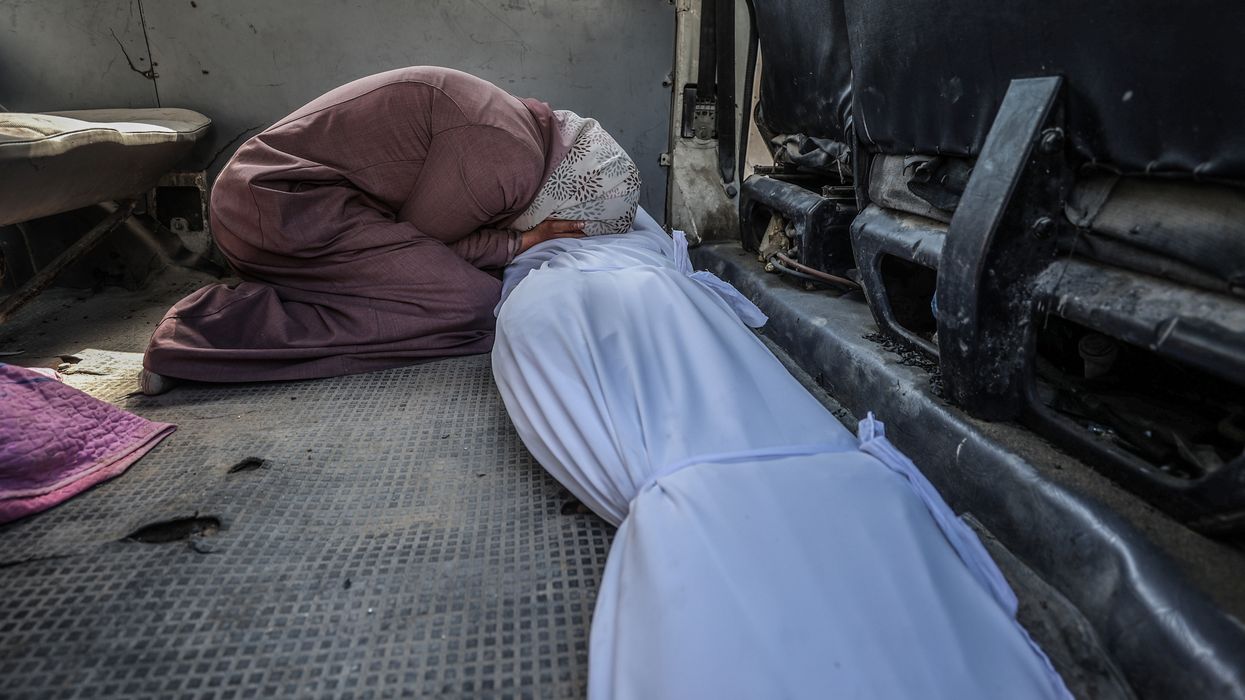
"We cannot continue to watch what is happening," said Mirjana Spoljaric. "It's surpassing any acceptable legal, moral, and humane standard."
The president of one of the world's top humanitarian groups said in an interview Wednesday that nearly 20 months after Israel began its relentless assault on Gaza, the international community is watching "a type of warfare... that deprives civilians of their dignity entirely."
Jeremy Bowen, international editor for BBC News, asked International Committee of the Red Cross (ICRC) president Mirjana Spoljaric about comments she made last month when she visited Gaza, several weeks into Israel's total blockade on humanitarian aid, and declared that the enclave had been transformed into "hell on Earth."
"Has anything changed?" asked Bowen.
"It has become worse," replied Spoljaric. "Humanity is failing in Gaza... We cannot continue to watch what is happening. It's surpassing any acceptable legal, moral, and humane standard."
Spoljaric's latest remarks came a week after the U.S.- and Israel-backed Gaza Humanitarian Foundation (GHF) began its aid operations, with proponents claiming the private company staffed by U.S. security contractors would save the lives of Gaza residents who have faced increasing starvation and malnutrition since the current blockade began in March—while ensuring Hamas did not steal or divert the aid. The United Nations has said there is no evidence Hamas has systematically diverted relief from civilians.
Fears about the GHF's plan—expressed by aid organizations, the U.N., and the former executive director who resigned the day before operations began—have been proven correct since the group opened its distribution sites in southern Gaza last week. At least 27 Palestinians were killed Tuesday at one of the aid sites when the Israel Defense Forces opened fire—yet another incident of the IDF killing of people trying to obtain aid.
The ICRC said its field hospital in Rafah received "a mass casualty influx of 184 patients" early on Tuesday morning.
"This includes nineteen cases who were declared dead upon arrival and eight more who died due to their wounds shortly after," said the group. "The majority of cases suffered gunshot wounds. Again, all responsive patients said they were trying to reach an assistance distribution site."
Mohamed Zidan, the husband of a woman named Reem al-Akhras who was killed in Tuesday's mass shooting, said the GHF operation was "not humanitarian aid—it's a trap."
"She went to bring us some food, and this is what happened to her," her son Zain Zidan told Al Jazeera.
Journalist Rania Khalek condemned corporate news outlets for their reports of "conflicting accounts" as Israel said that the IDF fired only at "several suspects moving toward them."
"Outrageous," said Khalek. "The Israelis are proven liars, their narrative should not be given any legitimacy. CNN continues to cover for genocide, shameful."
Israeli forces also opened fire at one of the sites on Sunday, killing 20 people and wounding hundreds who had walked an average of 9.3 miles to the distribution hub, hoping to carry home food boxes weighing about 44 pounds, with enough food to last about three days before they would need to make the trek—and avoid IDF soldiers stationed at the sites—again.
On Wednesday, the GHF said its four distribution sites would be closed for the day to improve "organization and efficiency," while the IDF warned Palestinians to stay away from the sites and the roads leading to them, saying they had been designated "combat zones."
U.N. Secretary-General António Guterres demanded an independent inquiry into the killing of Palestinians at food distribution sites.
"It is unacceptable that Palestinians are risking their lives for food," Guterres said.
Gaza's Health Ministry reported Wednesday that at least 94 Palestinians had been killed and 440 had been wounded in Israel's attacks across the enclave in the past 24 hours.
In her interview with the BBC, Spoljaric said that the destruction of more than 90% of Gaza's housing units, the risk of famine for the entire population, and the forced displacement of 90% of Palestinians in the enclave represent "a people being entirely stripped of its human dignity."
"There is no excuse for depriving children of their access to food, health, and security," said Spoljaric. "There are rules in the conduct of hostilities that every party to every conflict has to respect."
Spoljaric called on international leaders to take all available actions to stop "a type of warfare that shows utmost disrespect for civilians."
"Today we are in it," she said. "Today we can reverse it. We can save lives today."
Few U.S. officials have called for an end to the government's support for the IDF, and the U.S. continues to repeat Israel's claim that it is acting in self-defense and targeting Hamas rather than civilians.
Several European leaders in recent weeks have harshly criticized Israel's intensified military campaign in Gaza and its humanitarian aid blockade, with German Foreign Minister Johann Wadephul suggesting the country could soon impose arms export sanctions.
"It's important to act now," said Spoljaric. "State leaders are under an obligation to act."
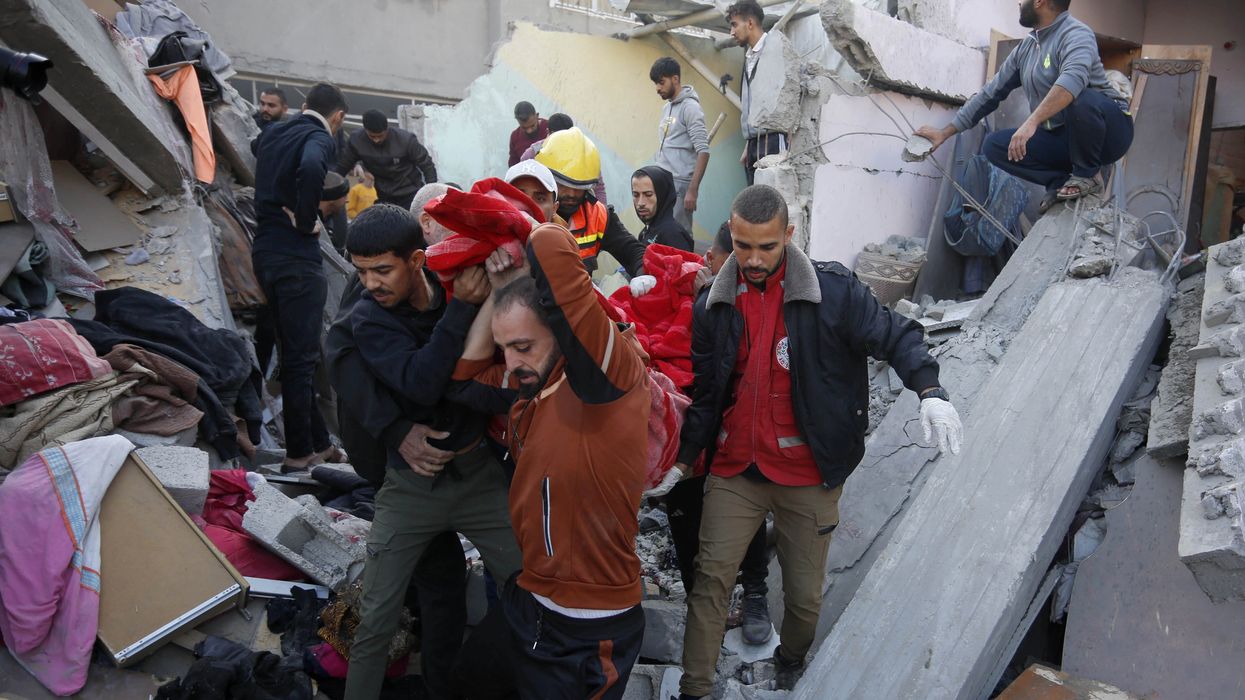
"Anything other than sustained peace and at-scale emergency aid will mean catastrophe for the children of Gaza," said a UNICEF spokesperson.
Israel resumed its assault on the Gaza Strip Friday morning just minutes after the pause with Hamas officially expired, ending a fragile seven-day truce that created conditions for the release of hundreds of Israeli and Palestinian captives and allowed additional—but still inadequate—humanitarian aid to enter the besieged territory.
Gaza's health ministry said that Israel's post-pause airstrikes killed more than 30 people and wounded dozens more, hitting a multi-story residential building and other civilian infrastructure in the southern part of the strip, where many Gazans sought refuge as Israeli forces targeted the north in earlier stages of its attack.
The Associated Press reported that Israeli forces "dropped leaflets over parts of southern Gaza urging people to leave their homes, suggesting it was preparing to widen its offensive."
"The Israeli military also released a map carving up the Gaza Strip into hundreds of numbered parcels, and asked residents to learn the number associated with their location in case of an eventual evacuation," AP added. "It said the map would eventually be interactive, but it was not immediately clear how Palestinians would be updated on their designated parcel numbers and calls for evacuation."
Robert Mardini, director general of the International Committee of the Red Cross, told Agence France-Presse that the resumption of bombing drags Gazans "back to the nightmarish situation they were in before the truce took place," with millions of people in desperate need of food, medicine, clean water, and sanitary living conditions.
"People are at a breaking point, hospitals are at a breaking point, the whole Gaza Strip is in a very precarious state," said Mardini. "There is nowhere safe to go for civilians. We have seen in the hospitals where our teams have been working, that over the past days, hundreds of severely injured people have arrived. The influx of severely wounded outpaced the real capacity of hospitals to absorb and treat the wounded, so there is a massive challenge."
James Elder, spokesperson for the United Nations International Children's Emergency Fund (UNICEF), warned Friday that "the humanitarian situation in Gaza is so perilous that anything other than sustained peace and at-scale emergency aid will mean catastrophe for the children of Gaza."
"To accept the sacrifice of the children in Gaza is humanity giving up," said Elder. "This is our last chance, before we delve into seeking to explain yet another utterly avoidable tragedy."
Israeli Prime Minister Benjamin Netanyahu, who is clinging to his job amid plummeting approval ratings, had pledged to continue assailing Gaza following the end of the truce, which marked the first pause in fighting since the war began in the wake of a Hamas-led attack on southern Israel in early October.
The Financial Times reported Friday that Israel's government is preparing for a war that "will stretch for a year or more, with the most intensive phase of the ground offensive continuing into early 2024."
"The multi-phase strategy envisages Israeli forces, who are garrisoned inside north Gaza, making an imminent push deep into the south of the besieged Palestinian enclave," FT reported, citing unnamed sources familiar with the planning. "The goals include killing the three top Hamas leaders—Yahya Sinwar, Mohammed Deif, and Marwan Issa—while securing 'a decisive' military victory against the group's 24 battalions and underground tunnel network and destroying its 'governing capability in Gaza.'"
An investigation published Thursday by +972 Magazine and Local Call found that Israeli forces have used "expanded authorization for bombing non-military targets" and "the loosening of constraints regarding expected civilian casualties," as well as "an artificial intelligence system to generate more potential targets than ever," to wage its devastating war on Gaza, killing more than 14,500 people in less than two months and displacing 70% of the territory's population.
In one case that anonymous Israeli sources described to the two outlets, Israel's military command "knowingly approved the killing of hundreds of Palestinian civilians in an attempt to assassinate a single top Hamas military commander."
"Another reason for the large number of targets, and the extensive harm to civilian life in Gaza, is the widespread use of a system called 'Habsora' ('The Gospel'), which is largely built on artificial intelligence and can 'generate' targets almost automatically at a rate that far exceeds what was previously possible," +972 and Local Call found. "This AI system, as described by a former intelligence officer, essentially facilitates a 'mass assassination factory.'"
U.S. Secretary of State Antony Blinken reportedly urged Israel to do more to protect civilians in Gaza during a meeting with the nation's leaders on Thursday, but the Israeli government has repeatedly brushed aside public and private concerns expressed by the Biden administration, which continues to provide unconditional support for the assault.
"Blinken suggested that his call for protecting Palestinian civilians had reached receptive ears, at least in general terms," The New York Times reported. "He did not cite any specific commitments by Israel, however."
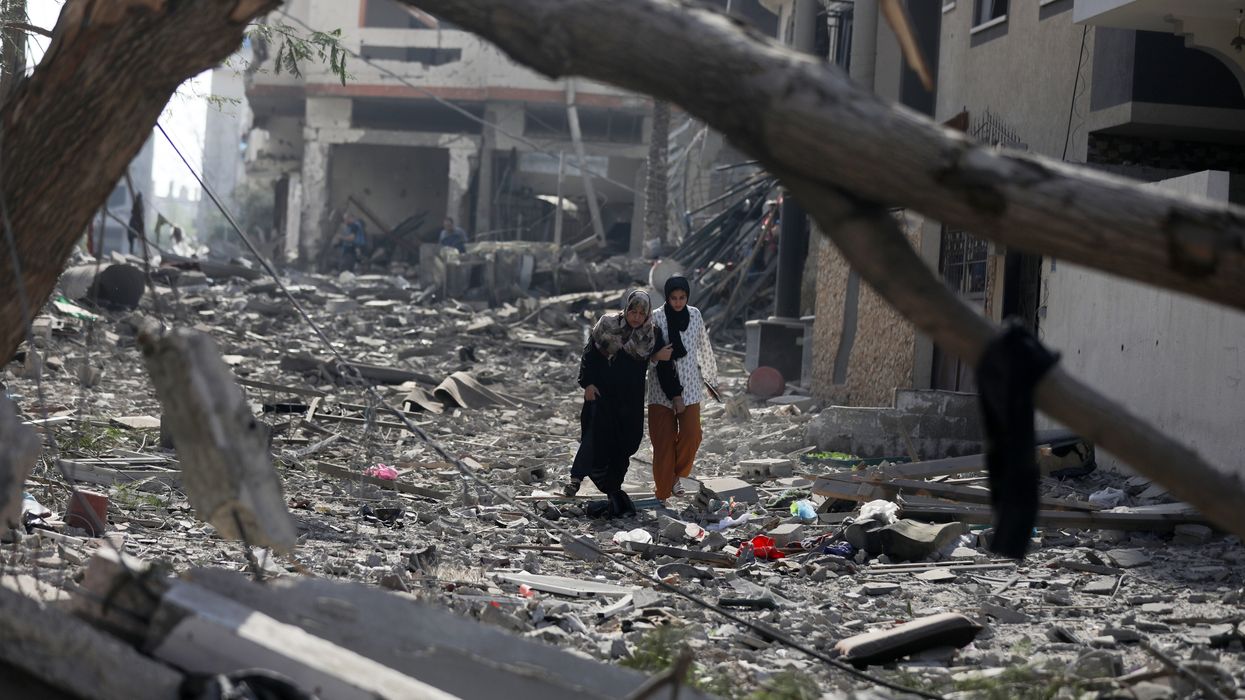
"The mass expulsion of over 1 million people in a day is ethnic cleansing," said U.S. Rep. Ilhan Omar. "We must use all diplomatic tools to stop this."
Progressive members of the U.S. Congress joined humanitarian groups and the United Nations on Friday in condemning Israel's 24-hour evacuation order for the entire population of the northern Gaza Strip, a directive that will be impossible for many in the region to meet—particularly the thousands wounded by Israeli airstrikes.
"Any person can see that ordering 1+ million people to move in under 24 hours is not possible. It is unacceptable," U.S. Rep. Alexandria Ocasio-Cortez (D-N.Y.) wrote on social media. "Humanity is at stake. Nearly half are children. We must halt this."
More than 400,000 Palestinians have been displaced since Israel began its latest bombing campaign in Gaza following a deadly Hamas attack on October 7.
In the wake of Israel's order—which came hours before the nation launched ground raids in Gaza—many panicked residents fled their homes in the northern part of the enclave, with some fearing another permanent displacement on the scale of the 1948 Nakba.
"As I am packing my things I am wondering, is this really another Nakba?" 56-year-old Arwa El-Rayes, an internal medicine doctor, told The New York Times shortly before fleeing her home in Gaza City. "I am taking my house key and thinking, will I ever return to my home, will I ever see my home again?"
Reuters reported that "several thousand residents could be seen on roads heading out of the northern part of the Gaza Strip, but it was impossible to tell their numbers. Many others said they would not go."
A 33-year-old woman in Gaza City told The Washington Post that she's staying along with dozens of family members, including her elderly parents.
"There are no cars to take us anywhere," she said. "There is no gas in cars. Cab companies don't have cars anymore. The streets are so, so, so, so crowded, it's like it's the Day of Judgement."
U.S. Rep. Ilhan Omar (D-Minn.) argued that "the mass expulsion of over 1 million people in a day is ethnic cleansing."
"We have to stop ignoring the thousands of Palestinian lives lost and millions at stake!" Omar added. "We must use all diplomatic tools to stop this."
Echoing aid groups, the Minnesota lawmaker emphasized that many in northern Gaza—including people with disabilities and those wounded by Israeli bombs—"can't simply pick up and leave" in compliance with Israel's evacuation directive, which the U.N.
said is untenable and should be rescinded.
"With communications and electricity shut down by Israel, the order cannot be communicated," Omar wrote. "Roads are bombed and many cars are out of fuel, making fleeing impossible for many. Plus there has been no announcement of a pause in hostilities to allow for safe civilian evacuation, so people are afraid to leave and risk bombardment. Even if it were successful, there is no infrastructure in southern Gaza to receive an additional 1.1 million people."
The Palestine Red Crescent Society underscored those warnings in a statement Friday, saying it doesn't have "the means to evacuate the sick and the wounded in our hospitals, or the elderly and the disabled."
"There are no safe areas in the whole of the Gaza Strip," the group said. "The world must intervene to stop this catastrophe."
Israeli forces have already been accused of targeting Gazans attempting to flee to the south with airstrikes.
Despite urgent appeals from lawmakers and aid organizations, officials in the U.S.—Israel's top ally and leading supplier of weaponry—have provided no public indication that they will pressure Israel to reverse course.
The Israel Defense Forces (IDF) told people in Gaza City on Friday to "evacuate south for your own safety and the safety of your families" as it amasses tanks and troops for an apparently imminent full-scale ground invasion. Hamas has reportedly told Gazans to defy the IDF's instructions.
Asked about Israel's evacuation order during a CNN appearance on Friday, White House national security spokesperson John Kirby said he doesn't want to get involved in "armchair quarterbacking" the situation, adding, "We understand what they're trying to do."
"Now it's a tall order," Kirby admitted. "It's a million people, and it's a very urban, dense environment. It's already a combat zone. So I don't think anybody's underestimating the challenge here of effecting that evacuation."
The White House's soft-pedaling of Israel's directive contrasts sharply with the assessments of human rights organizations, which argued the order amounts to a war crime that will worsen an already calamitous situation.
"The instructions issued by the Israeli authorities for the population of Gaza City to immediately leave their homes, coupled with the complete siege explicitly denying them food, water, and electricity, are not compatible with international humanitarian law," the International Committee of the Red Cross (ICRC) said Friday. "When military powers order people to leave their homes, all possible measures must be taken to ensure the population has access to basic necessities like food and water and that members of the same family are not separated."
"Gaza is a closed area of limited size and resources," the ICRC added. "People have nowhere safe to go and many, including the disabled, elderly, and sick, will not be able to leave their homes. International humanitarian law protects all civilians, including those who remain. Today, it is impossible for Gazans to know which areas will next face attack."
"There are no extra beds in any hospitals anywhere for people to move to. Most of the wounded are unstable, they'll die en route.
Gaza's health ministry told The Independent that it would be "impossible" to move the wounded in its care to southern Gaza, given that the entire territory's healthcare system is overwhelmed and teetering on the brink of total collapse due to the rapid influx of airstrike victims and Israel's blockade, which has cut off the enclave's supply of electricity, fuel, and critical supplies.
More than 6,600 people in Gaza have been injured by Israel's relentless aerial campaign, which dropped roughly
6,000 bombs on the occupied enclave over just a six-day period, leveling entire neighborhoods and damaging medical facilities, schools, and other civilian infrastructure.
"There are no extra beds in any hospitals anywhere for people to move to," Gaza's health ministry said. "Most of the wounded are unstable, they'll die en route. All hospitals in Gaza, even after they've been expanded, are full."
Tarik Jasarevic, a spokesperson for the World Health Organization, noted that "there are severely ill people whose injuries mean their only chances of survival is being on life support, such as mechanical ventilators."
"So moving those people is a death sentence," said Jasarevic. "Asking health workers to do so is beyond cruel."
Meinie Nicolai, general director of Doctors Without Borders, said in a statement Friday that the Israeli military's evacuation order is "outrageous." The group said Israel has given Al Awda Hospital—where Doctors Without Borders staff are treating patients—just two hours to evacuate.
"This represents an attack on medical care and on humanity. We are talking about more than a million human beings," said Nicolai. "'Unprecedented' doesn't even cover the medical humanitarian impact of this. Gaza is being flattened, thousands of people are dying. This must stop now. We condemn Israel's demand in the strongest possible terms."

The International Committee of the Red Cross warned that as Israel's relentless airstrikes and blockade continue, Gaza hospitals "risk turning into morgues."
The Palestinian Ministry of Health warned Thursday that Gaza's medical system "has begun to collapse" as the combined impacts of Israel's total blockade and devastating bombing campaign leave the impoverished enclave's hospitals without sufficient resources to care for the growing flood of airstrike victims.
In a statement, the ministry said that intensive care unit (ICU) beds "have already been filled" even after they were expanded to cope with the rapid influx of patients, including many children. More than 6,200 people in Gaza have been injured by Israeli airstrikes since Saturday and more than 1,400 have been killed.
"The wounded who need an ICU bed now have no place to be admitted," the Palestinian Health Ministry said, noting that hospitals have been forced to place injured patients in corridors due to a lack of space.
Further straining Gaza's health system is Israel's total siege of the territory, which has cut off the supply of electricity, fuel, food, and other key supplies. On Wednesday, Gaza's lone power plant shut down after running out of fuel.
Adnan Abu Hasna, media adviser for the United Nations Relief and Works Agency for Palestine Refugees in the Near East (UNRWA), told the Financial Times that hospitals are using generators, "but this is very dangerous because they can't operate them 24 hours a day."
"They also have limited supplies of fuel that will run out soon," he added. "Whole districts have been bombed and their residents displaced... we're talking about 500,000 people. There are some 250,000 in UNRWA schools and the rest sheltering in other locations. The situation is catastrophic."
Fabrizio Carboni, regional director for the Near and Middle East for the International Committee of the Red Cross, issued a stark warning about the consequences of widespread power loss in the besieged enclave, which is home to 2.3 million people.
"As Gaza loses power, hospitals lose power, putting newborns in incubators and elderly patients on oxygen at risk," Carboni said in a statement. "Kidney dialysis stops, and X-rays can't be taken. Without electricity, hospitals risk turning into morgues."
"Our teams are witnessing a level of destruction that may already exceed previous escalations."
The appalling and increasingly dire situation on the ground in Gaza has heightened calls for, at minimum, a temporary cease-fire to allow humanitarian aid to enter the occupied strip.
"We call for the international community to press for a temporary humanitarian cease-fire for 24 hours in Gaza to avert an impending major disaster," the Euro-Mediterranean Human Rights Monitor wrote in a social media post on Thursday. "Gaza is running out of drinking water, electricity, and food supplies. Health sector is collapsing. Every minute counts."
The social justice group Right Livelihood also called for a cease-fire and denounced Israel's "indiscriminate airstrikes on residential buildings, schools, and hospitals across the Gaza Strip."
"We strongly condemn the crimes committed since October 7 and call on all parties to abide by international humanitarian law and international human rights law," the group added. "The deliberate targeting of civilians is illegal, inhumane, and immoral."
Israel has thus far provided no indication that it plans to ease its assault on Gaza any time soon. Over the past several days, Israel has amassed troops along its southern border structure in preparation for a large-scale ground invasion of Gaza, which observers warn will only exacerbate civilian suffering.
Israel has also pledged to not lift its devastating blockade of Gaza until Hamas frees all hostages.
With the siege in place and bombs continuing to fall for the sixth consecutive day, humanitarian workers say they're having an extremely difficult time operating in Gaza.
Doctors Without Borders, which is running a makeshift clinic in downtown Gaza City, said Thursday that members of its staff have been "unable to obtain safe passage to support Palestinian medical colleagues working day and night to treat the injured." The group said it has received reports from Gaza medical officials that they are running out of key supplies, including painkillers and anesthetics.
"People playing no role in the hostilities do not have a safe haven to go to," the group added. "Our teams are witnessing a level of destruction that may already exceed previous escalations."
Aid workers in Gaza have also accused Israeli forces of intentionally targeting medical personnel and facilities. At least 13 healthcare facilities in Gaza have been damaged by Israeli bombing, according to the World Health Organization.
The Palestine Red Crescent Society (PRCS) said that Israeli airstrikes killed four of its paramedics "in less than half an hour" on Wednesday "despite prior coordination."
"PRCS demands accountability for this war crime, urging immediate investigation and justice for the victims," the group said in a statement. "Targeting medical personnel is a grave breach to international humanitarian law and to humanity."