SUBSCRIBE TO OUR FREE NEWSLETTER
Daily news & progressive opinion—funded by the people, not the corporations—delivered straight to your inbox.
5
#000000
#FFFFFF
To donate by check, phone, or other method, see our More Ways to Give page.
Daily news & progressive opinion—funded by the people, not the corporations—delivered straight to your inbox.
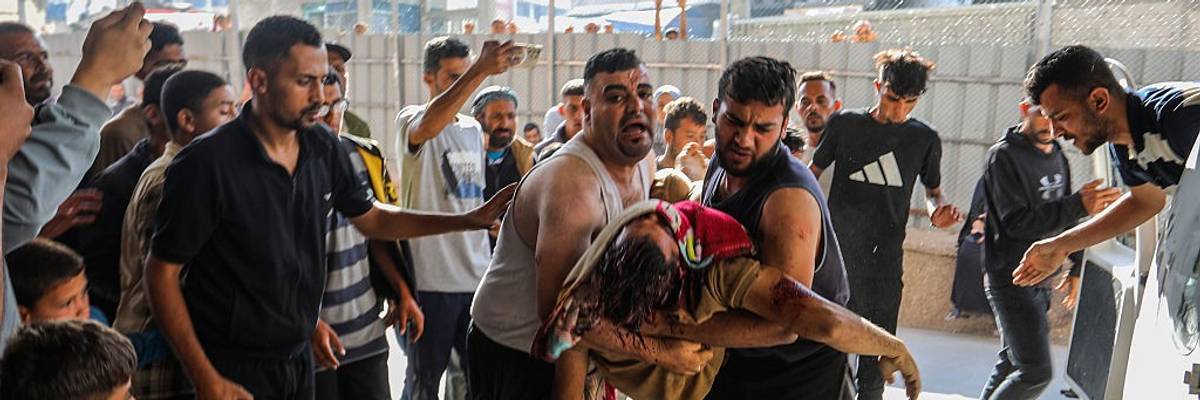
Wounded Palestinians, including children, are brought to Nasser Hospital to receive medical treatment after Israeli forces opened fire on people gathered for food aid in Khan Younis, Gaza on June 3, 2025.
"It is unacceptable that Palestinians are risking their lives for food," said the United Nations secretary-general.
Israeli forces on Tuesday gunned down dozens of people, including children, close to a privatized aid distribution site in southern Gaza, marking the third consecutive day that Israel's military has opened fire on Palestinians seeking food amid an increasingly dire humanitarian emergency.
A doctor at nearby Nasser Hospital, which is barely functioning and unequipped to handle an influx of patients, told The New York Times that the facility received 19 of those killed in Tuesday's massacre. Most of the victims, according to Dr. Ahmad al-Farra, were children between the ages of 10 and 13, "many with gunshot wounds to the head or chest."
The Israeli newspaper Haaretz reported that "the incident shocked local residents and activists, who describe it as 'another aid massacre' targeting defenseless civilians."
"It is one of the deadliest incidents since the beginning of aid allocation in the southern Gaza Strip," the newspaper observed.
The Israel Defense Forces (IDF) confirmed that its soldiers opened fire near the aid site operated by the Gaza Humanitarian Foundation, but claimed "shots were directed near individual suspects who advanced toward the troops." The Times reported that an IDF spokesperson "declined to explain the nature of the perceived threat."
Testimony from witnesses, health officials, and humanitarian workers on the ground contradicted the IDF's account of limited firing at "individual suspects."
According to The Associated Press, "Hisham Mhanna, a spokesperson for the International Committee of the Red Cross, said its field hospital in Rafah received 184 wounded people."
AP went on to cite several Palestinians who witnessed Tuesday's massacre:
Yasser Abu Lubda, a 50-year-old displaced Palestinian from Rafah, said the shooting started around 4 am in the city's Flag Roundabout area, around one kilometer (1,000 yards) away from the aid distribution hub. He said he saw several people killed or wounded.
Neima al-Aaraj, a woman from Khan Younis, gave a similar account.
"There were many martyrs and wounded," she said, saying the shooting by Israeli forces was "indiscriminate."
She said she managed to reach the hub but returned empty-handed. "There was no aid there," she said. "After the martyrs and wounded, I won't return," she said. "Either way we will die."
Rasha al-Nahal, another witness, said "there was gunfire from all directions." She said she counted more than a dozen dead and several wounded along the road. She said she also found no aid when she arrived at the distribution hub, and that Israeli forces "fired at us as we were returning."
At least 27 people were killed by Israeli forces Tuesday morning, according to the Gaza Health Ministry.
The deadly incident occurred after IDF troops killed more than 30 people and wounded dozens of others near the privatized aid distribution site on Sunday and Monday.
United Nations Secretary-General António Guterres said Monday that "it is unacceptable that Palestinians are risking their lives for food."
"I call for an immediate and independent investigation into these events and for perpetrators to be held accountable," Guterres said. "Israel has clear obligations under international humanitarian law to agree to and facilitate humanitarian aid. The unimpeded entry of assistance at scale to meet the enormous needs in Gaza must be restored immediately. The U.N. must be allowed to work in safety and security under conditions of full respect of humanitarian principles."
Dear Common Dreams reader, It’s been nearly 30 years since I co-founded Common Dreams with my late wife, Lina Newhouser. We had the radical notion that journalism should serve the public good, not corporate profits. It was clear to us from the outset what it would take to build such a project. No paid advertisements. No corporate sponsors. No millionaire publisher telling us what to think or do. Many people said we wouldn't last a year, but we proved those doubters wrong. Together with a tremendous team of journalists and dedicated staff, we built an independent media outlet free from the constraints of profits and corporate control. Our mission has always been simple: To inform. To inspire. To ignite change for the common good. Building Common Dreams was not easy. Our survival was never guaranteed. When you take on the most powerful forces—Wall Street greed, fossil fuel industry destruction, Big Tech lobbyists, and uber-rich oligarchs who have spent billions upon billions rigging the economy and democracy in their favor—the only bulwark you have is supporters who believe in your work. But here’s the urgent message from me today. It's never been this bad out there. And it's never been this hard to keep us going. At the very moment Common Dreams is most needed, the threats we face are intensifying. We need your support now more than ever. We don't accept corporate advertising and never will. We don't have a paywall because we don't think people should be blocked from critical news based on their ability to pay. Everything we do is funded by the donations of readers like you. When everyone does the little they can afford, we are strong. But if that support retreats or dries up, so do we. Will you donate now to make sure Common Dreams not only survives but thrives? —Craig Brown, Co-founder |
Israeli forces on Tuesday gunned down dozens of people, including children, close to a privatized aid distribution site in southern Gaza, marking the third consecutive day that Israel's military has opened fire on Palestinians seeking food amid an increasingly dire humanitarian emergency.
A doctor at nearby Nasser Hospital, which is barely functioning and unequipped to handle an influx of patients, told The New York Times that the facility received 19 of those killed in Tuesday's massacre. Most of the victims, according to Dr. Ahmad al-Farra, were children between the ages of 10 and 13, "many with gunshot wounds to the head or chest."
The Israeli newspaper Haaretz reported that "the incident shocked local residents and activists, who describe it as 'another aid massacre' targeting defenseless civilians."
"It is one of the deadliest incidents since the beginning of aid allocation in the southern Gaza Strip," the newspaper observed.
The Israel Defense Forces (IDF) confirmed that its soldiers opened fire near the aid site operated by the Gaza Humanitarian Foundation, but claimed "shots were directed near individual suspects who advanced toward the troops." The Times reported that an IDF spokesperson "declined to explain the nature of the perceived threat."
Testimony from witnesses, health officials, and humanitarian workers on the ground contradicted the IDF's account of limited firing at "individual suspects."
According to The Associated Press, "Hisham Mhanna, a spokesperson for the International Committee of the Red Cross, said its field hospital in Rafah received 184 wounded people."
AP went on to cite several Palestinians who witnessed Tuesday's massacre:
Yasser Abu Lubda, a 50-year-old displaced Palestinian from Rafah, said the shooting started around 4 am in the city's Flag Roundabout area, around one kilometer (1,000 yards) away from the aid distribution hub. He said he saw several people killed or wounded.
Neima al-Aaraj, a woman from Khan Younis, gave a similar account.
"There were many martyrs and wounded," she said, saying the shooting by Israeli forces was "indiscriminate."
She said she managed to reach the hub but returned empty-handed. "There was no aid there," she said. "After the martyrs and wounded, I won't return," she said. "Either way we will die."
Rasha al-Nahal, another witness, said "there was gunfire from all directions." She said she counted more than a dozen dead and several wounded along the road. She said she also found no aid when she arrived at the distribution hub, and that Israeli forces "fired at us as we were returning."
At least 27 people were killed by Israeli forces Tuesday morning, according to the Gaza Health Ministry.
The deadly incident occurred after IDF troops killed more than 30 people and wounded dozens of others near the privatized aid distribution site on Sunday and Monday.
United Nations Secretary-General António Guterres said Monday that "it is unacceptable that Palestinians are risking their lives for food."
"I call for an immediate and independent investigation into these events and for perpetrators to be held accountable," Guterres said. "Israel has clear obligations under international humanitarian law to agree to and facilitate humanitarian aid. The unimpeded entry of assistance at scale to meet the enormous needs in Gaza must be restored immediately. The U.N. must be allowed to work in safety and security under conditions of full respect of humanitarian principles."
Israeli forces on Tuesday gunned down dozens of people, including children, close to a privatized aid distribution site in southern Gaza, marking the third consecutive day that Israel's military has opened fire on Palestinians seeking food amid an increasingly dire humanitarian emergency.
A doctor at nearby Nasser Hospital, which is barely functioning and unequipped to handle an influx of patients, told The New York Times that the facility received 19 of those killed in Tuesday's massacre. Most of the victims, according to Dr. Ahmad al-Farra, were children between the ages of 10 and 13, "many with gunshot wounds to the head or chest."
The Israeli newspaper Haaretz reported that "the incident shocked local residents and activists, who describe it as 'another aid massacre' targeting defenseless civilians."
"It is one of the deadliest incidents since the beginning of aid allocation in the southern Gaza Strip," the newspaper observed.
The Israel Defense Forces (IDF) confirmed that its soldiers opened fire near the aid site operated by the Gaza Humanitarian Foundation, but claimed "shots were directed near individual suspects who advanced toward the troops." The Times reported that an IDF spokesperson "declined to explain the nature of the perceived threat."
Testimony from witnesses, health officials, and humanitarian workers on the ground contradicted the IDF's account of limited firing at "individual suspects."
According to The Associated Press, "Hisham Mhanna, a spokesperson for the International Committee of the Red Cross, said its field hospital in Rafah received 184 wounded people."
AP went on to cite several Palestinians who witnessed Tuesday's massacre:
Yasser Abu Lubda, a 50-year-old displaced Palestinian from Rafah, said the shooting started around 4 am in the city's Flag Roundabout area, around one kilometer (1,000 yards) away from the aid distribution hub. He said he saw several people killed or wounded.
Neima al-Aaraj, a woman from Khan Younis, gave a similar account.
"There were many martyrs and wounded," she said, saying the shooting by Israeli forces was "indiscriminate."
She said she managed to reach the hub but returned empty-handed. "There was no aid there," she said. "After the martyrs and wounded, I won't return," she said. "Either way we will die."
Rasha al-Nahal, another witness, said "there was gunfire from all directions." She said she counted more than a dozen dead and several wounded along the road. She said she also found no aid when she arrived at the distribution hub, and that Israeli forces "fired at us as we were returning."
At least 27 people were killed by Israeli forces Tuesday morning, according to the Gaza Health Ministry.
The deadly incident occurred after IDF troops killed more than 30 people and wounded dozens of others near the privatized aid distribution site on Sunday and Monday.
United Nations Secretary-General António Guterres said Monday that "it is unacceptable that Palestinians are risking their lives for food."
"I call for an immediate and independent investigation into these events and for perpetrators to be held accountable," Guterres said. "Israel has clear obligations under international humanitarian law to agree to and facilitate humanitarian aid. The unimpeded entry of assistance at scale to meet the enormous needs in Gaza must be restored immediately. The U.N. must be allowed to work in safety and security under conditions of full respect of humanitarian principles."