

SUBSCRIBE TO OUR FREE NEWSLETTER
Daily news & progressive opinion—funded by the people, not the corporations—delivered straight to your inbox.
5
#000000
#FFFFFF
To donate by check, phone, or other method, see our More Ways to Give page.


Daily news & progressive opinion—funded by the people, not the corporations—delivered straight to your inbox.
"EPA owes it to Americans to put people’s health first—not give hidebound corporations more time to keep using outdated chemicals," said one critic.
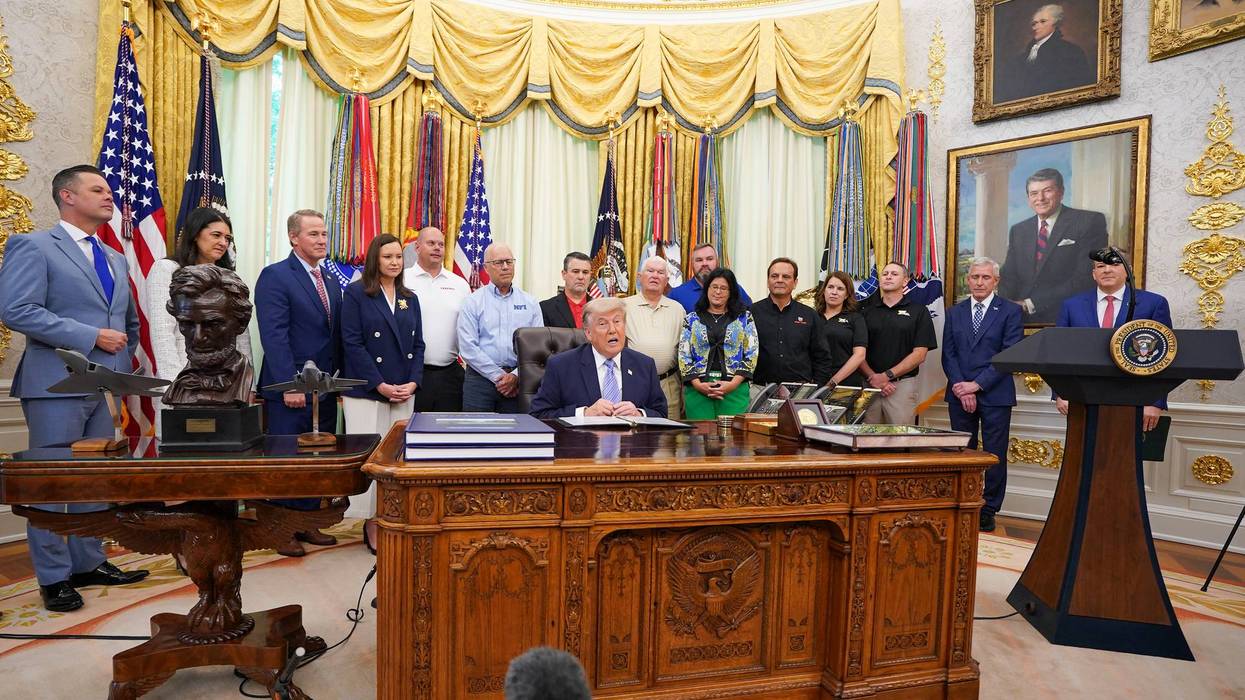
In a reversal of his past position and what critics are calling yet another betrayal of his "Make America Healthy Again" campaign pledge, US President Donald Trump announced Thursday that his administration is loosening limits on so-called "super pollutant" hydrofluorocarbons used in air conditioners and refrigerators at the expense of the environment and climate.
Trump and Environmental Protection Agency Administrator Lee Zeldin spun the move as a measure that will "save American families and businesses more than $2.4 billion" by revising "costly overreaching restrictions" imposed during the Biden administration "limiting the type of refrigerants American businesses and families can use."
"Today, the Trump EPA is fulfilling President Trump’s promise to lower costs and is fixing every problem we can under the authority Congress gave us," Zeldin said. "Our actions allow businesses to choose the refrigeration systems that work best for them, saving them billions of dollars. This will be felt directly by American families in lower grocery prices.”
Grocery prices have continued to rise during Trump’s second term, driven by the administration's erratic trade wars and actual war on Iran. Critics of Thursday's move argue that it will do little to reduce consumer costs, while increasing pollution and health risks for American families.
“It’s nice that they are paying attention to affordability, but if they want to make a difference, it’s tariffs and the Iran War," Ryan Young, a senior economist at the Competitive Enterprise Institute, a libertarian think tank, told NOTUS, estimating that the move would save consumers about $2 per year.
Hydrofluorocarbons (HFCs) are called “super pollutants” because they trap far more heat in the atmosphere than carbon dioxide, even though they are emitted in much smaller quantities. They were originally introduced to replace ozone-depleting chemicals like chlorofluorocarbons (CFCs) that ravaged the ozone layer.
However, scientists soon realized that HFCs are extremely powerful greenhouse gases in their own right. As air conditioning use and demand grows worldwide, so has HFC use.
As the EPA's own website acknowledges on its "Operation: Disrupt HFCs" webpage:
HFCs are potent greenhouse gases... with high global warming potential. HFCs are commonly utilized as refrigerants, aerosol propellants, foam blowing agents, solvents, and fire retardants across residential, commercial, and industrial applications. The major source of HFC emissions is their use as refrigerants—for example, in air conditioning systems in both vehicles and buildings. Emissions occur during manufacturing, as well as through leaks, servicing, and disposal of equipment containing HFCs.
Former EPA Assistant Administrator Joseph Goffman said in a statement Thursday that "families are already stretched thin by high grocery bills and everyday expenses, and weakening safeguards on these super-polluting refrigerant chemicals isn’t going to change that."
"Even manufacturers are saying this delay likely won’t lower prices for consumers because supplies of these chemicals are already being phased down in favor of cleaner, innovative replacements," he added.
Stephen Yurek, president and CEO of the Air-Conditioning, Heating, and Refrigeration Institute (AHRI)—an industry lobby—warned that the "reckless" new policy could actually cause refrigerant prices to increase.
“This rule works against basic supply and demand,” Yurek said. “By extending the compliance deadline, the EPA is maintaining and even increasing demand in the market for existing refrigerants while supply continues to fall under the AIM Act."
The American Innovation and Manufacturing (AIM) Act of 2020, bipartisan legislation signed by Trump during his first term, directed the EPA to "phase down the production and consumption of listed HFCs in the United States by 85% by 2036" and "facilitate the transition to next-generation technologies that do not rely on HFCs."
As of this year, more than 170 countries—including the United States—plus the European Union have ratified the Kigali Amendment to the Montreal Protocol, the main global agreement to phase down HFCs.
Yurek explained that "instead of falling, refrigerant prices are likely to rise, resulting in higher service costs, and higher costs for consumers."
Addressing the EPA's reversal on HFCs, Goffman said, "All this action does is slow the shift to cleaner technologies while risking continued releases of climate super pollutants and leaving families to face the much greater costs and health threats of dangerous climate change."
"EPA owes it to Americans to put people’s health first—not give hidebound corporations more time to keep using outdated chemicals," he added. "Americans deserve affordable groceries that don’t come at the expense of the strong safeguards they count on to keep our families safer, not sicker.”
The EPA move comes amid mounting calls by over 160 civil rights, environmental, faith, health, and labor groups to fire Zeldin over his agency's deregulation spree.
"Folks very close to the White House... were sitting on properties that were causing them losses every year," said a journalist tracking the purchases. "The decision was made to buy them at taxpayer expense."
In what More Perfect Union described as a "new level of corruption" for the Trump administration, an investigation by the progressive news outlet revealed how members of the president's inner circle are cashing in on the Department of Homeland Security's purchase of warehouses for immigrant detention.
It was reported earlier this year that under then-Secretary Kristi Noem, who has since been fired, DHS was planning to spend nearly $40 billion to buy up dozens of warehouses around the US to convert them into makeshift detention camps that could each hold anywhere from 1,000 to 10,000 people arrested as part of President Donald Trump's mass deportation effort.
But when Mae Ryan, a reporter at More Perfect Union, looked into the contracts, she said she "noticed something weird."
"Many of these warehouses had been sitting on the market for years," she explained in a video posted Wednesday. "Now DHS was buying them at a massive markup."
She pointed to one warehouse in Socorro, Texas, recently valued at $11 million, which Immigration and Customs Enforcement (ICE) purchased from the company El Paso Logistics II LLC for $123 million—more than a 1,000% profit.
According to Michael Wriston, an ex-military analyst and investigative journalist who tracked the enormous markups for several of these warehouse purchases for his website Project Salt Box back in March, "across more than a dozen warehouse acquisitions, ICE paid prices that exceeded both prior property valuations and recent market comparables at nearly every site."
For one warehouse in Surprise, Arizona, previously valued at just under $12 million, ICE paid over $70 million. For another in Social Circle, Georgia, valued at about $30 million, the agency paid nearly $130 million.

Many of the warehouses that raked in obscene taxpayer-funded purchases by DHS were owned by financial institutions with deep connections to the Trump administration, Ryan explained.
One warehouse in Roxbury, New Jersey, valued at about $54.6 million in 2025, inexplicably sold to ICE for over $129 million, more than double. Its majority owner was the investment bank Goldman Sachs, where many Trump appointees during his first term—including former Treasury Secretary Steve Mnuchin and Trump financial adviser Gary Cohn—were formerly employed.
ICE paid double for another warehouse in Tremont, Pennsylvania, buying it for nearly $120 million despite a valuation of about $60 million. It was owned by the private capital firm Blue Owl, where at least 33 members of Trump's administration have investments in its funds, including the president himself, who has about $5 million invested in the firm.
Another in Salt Lake City, valued at just $97 million, was purchased by ICE for $145 million, and the agency now plans to convert it into a 10,000-bed facility. It was owned by Deutsche Bank, which has loaned Trump about $2.5 billion over the past two decades.
Wriston told More Perfect Union that the financial payout to Trump allies was top of mind for DHS as it drew up the controversial warehouse plan.
"ICE doesn't necessarily want to be using warehouses," he said. "The plan came from folks very close to the White House who were sitting on properties that were causing them losses every year. And the decision was made to buy them at taxpayer expense."
It's part of a larger pattern of ICE contracts being distributed to companies that have given major financial support to Trump.
According to an investigation in March by OpenSecrets, the GEO Group and CoreCivic, two private prison companies that have collectively received more than $2.8 billion in ICE contracts, each donated $500,000 to Trump's inaugural committee. The GEO Group's employee-funded political action committee contributed $1 million to the pro-Trump super PAC Make America Great Again, Inc. during his reelection campaign in 2024.
The vast majority of those who have been detained during Trump's second term have had no criminal records, despite claims by the administration that they are targeting "the worst of the worst" criminals for deportation.
Those who have been held in ICE detention centers—often without any due process or access to a lawyer—have consistently reported being held in horrendous conditions, denied access to basic food, sanitation, and medical care, and subject to torture and sexual assault by guards.
DHS has reportedly spent only about $1 billion of the more than $38 billion allotted for immigration detention warehouses so far. According to The New York Times, the administration is hoping to build a mass detention system that could stuff these warehouses with over 100,000 detainees at a time across more than 20 facilities.
According to Wriston's running tracker of ICE warehouse sales, at least 13 purchases have been canceled, in many cases due to public backlash. Still, the administration has already purchased enough warehouse space to hold more than 41,500 people at once.
"What we're seeing happen now—I never in a million years envisioned seeing this happen on US soil," Wriston said. "Never. Never once."
The union leader "is running a campaign focused on raising wages for working people, expanding healthcare, protecting Social Security, and building a strong labor movement," said the progressive senator.
Amid a wave of progressive primary victories and growing support for working-class congressional candidates—from Democrat Graham Platner in Maine to Nebraska Independents Austin Ahlman and Dan Osborn—US Sen. Bernie Sanders on Thursday threw his support behind Trey Martin in Oklahoma.
"Now more than ever, Oklahoma needs leaders willing to fight for working people and take on the powerful corporate interests that are making life harder for families across the state," Sanders (I-Vt.) said in a statement. "Trey understands these struggles firsthand and is running a campaign focused on raising wages for working people, expanding healthcare, protecting Social Security, and building a strong labor movement. That's why I'm proud to endorse Trey Martin for Congress in Oklahoma's 5th District."
An eighth-generation Oklahoman who has served as the president of Ironworkers Local 48 for nearly a decade, Martin is facing off against fellow Democrat Jena Nelson in the June 16 primary. In addition to the policies Sanders highlighted, he is campaigning on a congressional stock trading ban, honoring tribal sovereignty, funding public schools, ending blank-check wars, and more.
Martin welcomed the support of Sanders, who twice sought the Democratic Party's presidential nomination, has traveled the country for his Fighting Oligarchy Tour over the past year, and has been using his national platform throughout this election cycle to promote progressive and working-class candidates running for federal, state, and local offices.
"Sen. Sanders has spent decades fighting for working families in Washington," said Martin. "Sen. Sanders has been one of the loudest, strongest voices in our country's most important fights—from making the most wealthy in this country pay their fair share, to standing up to corporate power, to bringing down healthcare costs. It's a true honor to have his support."
In a social media post, Martin added that "I remember sitting on the couch with my wife in 2016, hearing Bernie for the first time. It inspired me to get more involved in my local, to organize and build power for working people in Oklahoma. He was the first politician who made me truly believe someone in Washington was genuinely committed to standing up for the working class."
Martin and Nelson are competing to challenge Republican Congresswoman Stephanie Bice, who is seeking a fourth term in November—after considering a run for the Senate seat vacated by Homeland Security Secretary Markwayne Mullin.
As The Frontier executive editor Dylan Goforth reported last week, "Redistricting has made the path to victory steeper in Oklahoma's 5th Congressional District since the last time a Democrat was elected to the seat in 2018."
However, Oklahoma Democratic Party Chair Erin Brewer told Goforth that "CD-5 is absolutely flippable," and "a win here not only shifts the power dynamic in our state, it would also expand the votes in Congress to hold the president in check."
Polling by CNN on the first year of President Donald Trump's second term showed a majority of Americans were dissatisfied with his mass deportations, aggression toward other countries, and gutting the federal workforce rather than cutting costs. More recent surveys have made clear that the US public is frustrated with the high prices stemming from Trump's tariffs and Iran War.
Last week, when Trump told reporters that he does not think about Americans' financial situation "even a little bit" when it comes to his illegal war on Iran, Martin responded, "That tells you everything you need to know about where his priorities are, and that's exactly why I'm running to focus this conversation on working-class issues and real relief for families, not endless wars."
Earlier this week, another working-class champion and union leader, Bob Brooks, won a Democratic primary for Pennsylvania's 7th Congressional District, setting up the retired firefighter to challenge Republican Congressman Ryan Mackenzie in the midterms.
Congratulating Brooks, Sanders noted that "his win follows the recent progressive victories of ironworker and union leader Brian Poindexter in Ohio, and union organizer Analilia Mejía in New Jersey. We're making progress!"
On the other side of Pennsylvania, in the 3rd District, democratic socialist Chris Rabb also won his primary on Tuesday. After his win, Kendra Brooks and Nicolas O'Rourke, co-chairs of the state's Working Families Party, stressed that "the question in this race was not whether we would elect a Democrat, but what kind of Democrat we would choose."
"The people of Philadelphia made their choice clear: Bold, working-class leadership, and an end to the broken status quo," the pair continued. "They chose a message of real affordability that resonated with working-class voters. They chose a fighter who is not afraid to ruffle feathers and stand up for working people to fight back against Trumpism."
"Tennessee has effectively made the case against the death penalty," said one opponent of capital punishment.
A Tennessee man set to be executed on Thursday got a temporary reprieve—but not due to any intervention by the US Supreme Court.
As reported by The Associated Press, the execution of Tony Carruthers was called off after medical officials struggled to locate a vein during the scheduled lethal injection procedure.
After the failed execution, Republican Tennessee Gov. Bill Lee ordered a one-year stay for Carruthers, who has been on death row for three decades after being convicted of kidnapping and murdering three people in 1996.
Maria DeLiberato, an attorney representing Carruthers, told the AP that she saw her client "wincing and groaning" during the botched procedure, which she described as "horrible" to watch.
DeLiberato, who is also senior counsel at the ACLU’s Capital Punishment Project, later issued a statement describing the execution attempt as "outright barbaric," and reiterated demands for state investigators to examine potentially exculpatory forensic evidence before proceeding with any future attempt.
"We are incredibly relieved Gov. Lee issued a reprieve," DeLiberato said. "We will also continue to push the governor to use this moment to allow the forensic testing that should have happened long ago. Tennessee cannot continue torturing a man while refusing to answer serious questions about his innocence."
The ACLU on Wednesday had called for the US Supreme Court to block Carruthers' execution until all potentially exculpatory evidence had been fully examined.
Lucas Cameron-Vaughn, legal director of the ACLU of Tennessee, said the state had a duty to ensure that it had convicted the right man, and he pointed to troubling aspects of the case that should give courts pause before signing off on his execution.
“Mr. Carruthers was forced to represent himself at trial, and now faces death based on flimsy circumstantial evidence, and unreliable witnesses,” Cameron-Vaughn said. “Forensic evidence the state refuses to test could change everything."
Laura Porter, executive director for US Campaign to End the Death Penalty, argued that the botched execution shouldn't just give Carruthers a one-year reprieve, but should push the US to end capital punishment all together.
"Tennessee has effectively made the case against the death penalty," said Porter. "They forced Tony Carruthers to represent himself at his own capital trial, failed to test DNA and fingerprint evidence and now they have failed to execute him. It is time to end the death penalty."
Stacy Rector, executive director for Tennesseans for Alternatives to the Death Penalty, described the failed execution as "horrifying but not surprising," adding that her organization "has sounded the alarm for years about the serious problems with lethal injection and urged our state toward greater transparency so these problems can be addressed."