SUBSCRIBE TO OUR FREE NEWSLETTER
Daily news & progressive opinion—funded by the people, not the corporations—delivered straight to your inbox.
5
#000000
#FFFFFF
To donate by check, phone, or other method, see our More Ways to Give page.
Daily news & progressive opinion—funded by the people, not the corporations—delivered straight to your inbox.
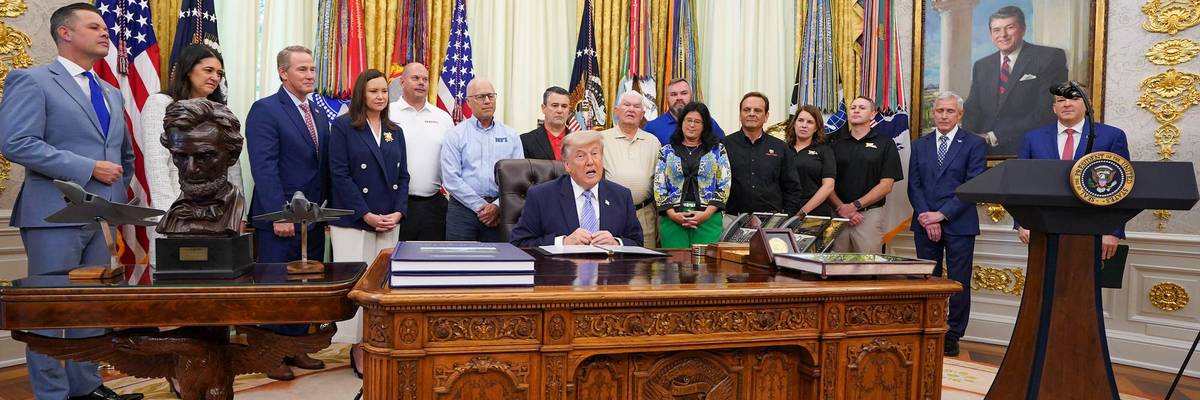
US President Donald Trump speaks at an event with Environmental Protection Agency Administrator Lee Zeldin in the White House Oval Office in Washington, DC on May 21, 2026.
"EPA owes it to Americans to put people’s health first—not give hidebound corporations more time to keep using outdated chemicals," said one critic.
In a reversal of his past position and what critics are calling yet another betrayal of his "Make America Healthy Again" campaign pledge, US President Donald Trump announced Thursday that his administration is loosening limits on so-called "super pollutant" hydrofluorocarbons used in air conditioners and refrigerators at the expense of the environment and climate.
Trump and Environmental Protection Agency Administrator Lee Zeldin spun the move as a measure that will "save American families and businesses more than $2.4 billion" by revising "costly overreaching restrictions" imposed during the Biden administration "limiting the type of refrigerants American businesses and families can use."
"Today, the Trump EPA is fulfilling President Trump’s promise to lower costs and is fixing every problem we can under the authority Congress gave us," Zeldin said. "Our actions allow businesses to choose the refrigeration systems that work best for them, saving them billions of dollars. This will be felt directly by American families in lower grocery prices.”
Grocery prices have continued to rise during Trump’s second term, driven by the administration's erratic trade wars and actual war on Iran. Critics of Thursday's move argue that it will do little to reduce consumer costs, while increasing pollution and health risks for American families.
“It’s nice that they are paying attention to affordability, but if they want to make a difference, it’s tariffs and the Iran War," Ryan Young, a senior economist at the Competitive Enterprise Institute, a libertarian think tank, told NOTUS, estimating that the move would save consumers about $2 per year.
Hydrofluorocarbons (HFCs) are called “super pollutants” because they trap far more heat in the atmosphere than carbon dioxide, even though they are emitted in much smaller quantities. They were originally introduced to replace ozone-depleting chemicals like chlorofluorocarbons (CFCs) that ravaged the ozone layer.
However, scientists soon realized that HFCs are extremely powerful greenhouse gases in their own right. As air conditioning use and demand grows worldwide, so has HFC use.
As the EPA's own website acknowledges on its "Operation: Disrupt HFCs" webpage:
HFCs are potent greenhouse gases... with high global warming potential. HFCs are commonly utilized as refrigerants, aerosol propellants, foam blowing agents, solvents, and fire retardants across residential, commercial, and industrial applications. The major source of HFC emissions is their use as refrigerants—for example, in air conditioning systems in both vehicles and buildings. Emissions occur during manufacturing, as well as through leaks, servicing, and disposal of equipment containing HFCs.
Former EPA Assistant Administrator Joseph Goffman said in a statement Thursday that "families are already stretched thin by high grocery bills and everyday expenses, and weakening safeguards on these super-polluting refrigerant chemicals isn’t going to change that."
"Even manufacturers are saying this delay likely won’t lower prices for consumers because supplies of these chemicals are already being phased down in favor of cleaner, innovative replacements," he added.
Stephen Yurek, president and CEO of the Air-Conditioning, Heating, and Refrigeration Institute (AHRI)—an industry lobby—warned that the "reckless" new policy could actually cause refrigerant prices to increase.
“This rule works against basic supply and demand,” Yurek said. “By extending the compliance deadline, the EPA is maintaining and even increasing demand in the market for existing refrigerants while supply continues to fall under the AIM Act."
The American Innovation and Manufacturing (AIM) Act of 2020, bipartisan legislation signed by Trump during his first term, directed the EPA to "phase down the production and consumption of listed HFCs in the United States by 85% by 2036" and "facilitate the transition to next-generation technologies that do not rely on HFCs."
As of this year, more than 170 countries—including the United States—plus the European Union have ratified the Kigali Amendment to the Montreal Protocol, the main global agreement to phase down HFCs.
Yurek explained that "instead of falling, refrigerant prices are likely to rise, resulting in higher service costs, and higher costs for consumers."
Addressing the EPA's reversal on HFCs, Goffman said, "All this action does is slow the shift to cleaner technologies while risking continued releases of climate super pollutants and leaving families to face the much greater costs and health threats of dangerous climate change."
"EPA owes it to Americans to put people’s health first—not give hidebound corporations more time to keep using outdated chemicals," he added. "Americans deserve affordable groceries that don’t come at the expense of the strong safeguards they count on to keep our families safer, not sicker.”
The EPA move comes amid mounting calls by over 160 civil rights, environmental, faith, health, and labor groups to fire Zeldin over his agency's deregulation spree.
Dear Common Dreams reader, It’s been nearly 30 years since I co-founded Common Dreams with my late wife, Lina Newhouser. We had the radical notion that journalism should serve the public good, not corporate profits. It was clear to us from the outset what it would take to build such a project. No paid advertisements. No corporate sponsors. No millionaire publisher telling us what to think or do. Many people said we wouldn't last a year, but we proved those doubters wrong. Together with a tremendous team of journalists and dedicated staff, we built an independent media outlet free from the constraints of profits and corporate control. Our mission has always been simple: To inform. To inspire. To ignite change for the common good. Building Common Dreams was not easy. Our survival was never guaranteed. When you take on the most powerful forces—Wall Street greed, fossil fuel industry destruction, Big Tech lobbyists, and uber-rich oligarchs who have spent billions upon billions rigging the economy and democracy in their favor—the only bulwark you have is supporters who believe in your work. But here’s the urgent message from me today. It's never been this bad out there. And it's never been this hard to keep us going. At the very moment Common Dreams is most needed, the threats we face are intensifying. We need your support now more than ever. We don't accept corporate advertising and never will. We don't have a paywall because we don't think people should be blocked from critical news based on their ability to pay. Everything we do is funded by the donations of readers like you. When everyone does the little they can afford, we are strong. But if that support retreats or dries up, so do we. Will you donate now to make sure Common Dreams not only survives but thrives? —Craig Brown, Co-founder |
In a reversal of his past position and what critics are calling yet another betrayal of his "Make America Healthy Again" campaign pledge, US President Donald Trump announced Thursday that his administration is loosening limits on so-called "super pollutant" hydrofluorocarbons used in air conditioners and refrigerators at the expense of the environment and climate.
Trump and Environmental Protection Agency Administrator Lee Zeldin spun the move as a measure that will "save American families and businesses more than $2.4 billion" by revising "costly overreaching restrictions" imposed during the Biden administration "limiting the type of refrigerants American businesses and families can use."
"Today, the Trump EPA is fulfilling President Trump’s promise to lower costs and is fixing every problem we can under the authority Congress gave us," Zeldin said. "Our actions allow businesses to choose the refrigeration systems that work best for them, saving them billions of dollars. This will be felt directly by American families in lower grocery prices.”
Grocery prices have continued to rise during Trump’s second term, driven by the administration's erratic trade wars and actual war on Iran. Critics of Thursday's move argue that it will do little to reduce consumer costs, while increasing pollution and health risks for American families.
“It’s nice that they are paying attention to affordability, but if they want to make a difference, it’s tariffs and the Iran War," Ryan Young, a senior economist at the Competitive Enterprise Institute, a libertarian think tank, told NOTUS, estimating that the move would save consumers about $2 per year.
Hydrofluorocarbons (HFCs) are called “super pollutants” because they trap far more heat in the atmosphere than carbon dioxide, even though they are emitted in much smaller quantities. They were originally introduced to replace ozone-depleting chemicals like chlorofluorocarbons (CFCs) that ravaged the ozone layer.
However, scientists soon realized that HFCs are extremely powerful greenhouse gases in their own right. As air conditioning use and demand grows worldwide, so has HFC use.
As the EPA's own website acknowledges on its "Operation: Disrupt HFCs" webpage:
HFCs are potent greenhouse gases... with high global warming potential. HFCs are commonly utilized as refrigerants, aerosol propellants, foam blowing agents, solvents, and fire retardants across residential, commercial, and industrial applications. The major source of HFC emissions is their use as refrigerants—for example, in air conditioning systems in both vehicles and buildings. Emissions occur during manufacturing, as well as through leaks, servicing, and disposal of equipment containing HFCs.
Former EPA Assistant Administrator Joseph Goffman said in a statement Thursday that "families are already stretched thin by high grocery bills and everyday expenses, and weakening safeguards on these super-polluting refrigerant chemicals isn’t going to change that."
"Even manufacturers are saying this delay likely won’t lower prices for consumers because supplies of these chemicals are already being phased down in favor of cleaner, innovative replacements," he added.
Stephen Yurek, president and CEO of the Air-Conditioning, Heating, and Refrigeration Institute (AHRI)—an industry lobby—warned that the "reckless" new policy could actually cause refrigerant prices to increase.
“This rule works against basic supply and demand,” Yurek said. “By extending the compliance deadline, the EPA is maintaining and even increasing demand in the market for existing refrigerants while supply continues to fall under the AIM Act."
The American Innovation and Manufacturing (AIM) Act of 2020, bipartisan legislation signed by Trump during his first term, directed the EPA to "phase down the production and consumption of listed HFCs in the United States by 85% by 2036" and "facilitate the transition to next-generation technologies that do not rely on HFCs."
As of this year, more than 170 countries—including the United States—plus the European Union have ratified the Kigali Amendment to the Montreal Protocol, the main global agreement to phase down HFCs.
Yurek explained that "instead of falling, refrigerant prices are likely to rise, resulting in higher service costs, and higher costs for consumers."
Addressing the EPA's reversal on HFCs, Goffman said, "All this action does is slow the shift to cleaner technologies while risking continued releases of climate super pollutants and leaving families to face the much greater costs and health threats of dangerous climate change."
"EPA owes it to Americans to put people’s health first—not give hidebound corporations more time to keep using outdated chemicals," he added. "Americans deserve affordable groceries that don’t come at the expense of the strong safeguards they count on to keep our families safer, not sicker.”
The EPA move comes amid mounting calls by over 160 civil rights, environmental, faith, health, and labor groups to fire Zeldin over his agency's deregulation spree.
In a reversal of his past position and what critics are calling yet another betrayal of his "Make America Healthy Again" campaign pledge, US President Donald Trump announced Thursday that his administration is loosening limits on so-called "super pollutant" hydrofluorocarbons used in air conditioners and refrigerators at the expense of the environment and climate.
Trump and Environmental Protection Agency Administrator Lee Zeldin spun the move as a measure that will "save American families and businesses more than $2.4 billion" by revising "costly overreaching restrictions" imposed during the Biden administration "limiting the type of refrigerants American businesses and families can use."
"Today, the Trump EPA is fulfilling President Trump’s promise to lower costs and is fixing every problem we can under the authority Congress gave us," Zeldin said. "Our actions allow businesses to choose the refrigeration systems that work best for them, saving them billions of dollars. This will be felt directly by American families in lower grocery prices.”
Grocery prices have continued to rise during Trump’s second term, driven by the administration's erratic trade wars and actual war on Iran. Critics of Thursday's move argue that it will do little to reduce consumer costs, while increasing pollution and health risks for American families.
“It’s nice that they are paying attention to affordability, but if they want to make a difference, it’s tariffs and the Iran War," Ryan Young, a senior economist at the Competitive Enterprise Institute, a libertarian think tank, told NOTUS, estimating that the move would save consumers about $2 per year.
Hydrofluorocarbons (HFCs) are called “super pollutants” because they trap far more heat in the atmosphere than carbon dioxide, even though they are emitted in much smaller quantities. They were originally introduced to replace ozone-depleting chemicals like chlorofluorocarbons (CFCs) that ravaged the ozone layer.
However, scientists soon realized that HFCs are extremely powerful greenhouse gases in their own right. As air conditioning use and demand grows worldwide, so has HFC use.
As the EPA's own website acknowledges on its "Operation: Disrupt HFCs" webpage:
HFCs are potent greenhouse gases... with high global warming potential. HFCs are commonly utilized as refrigerants, aerosol propellants, foam blowing agents, solvents, and fire retardants across residential, commercial, and industrial applications. The major source of HFC emissions is their use as refrigerants—for example, in air conditioning systems in both vehicles and buildings. Emissions occur during manufacturing, as well as through leaks, servicing, and disposal of equipment containing HFCs.
Former EPA Assistant Administrator Joseph Goffman said in a statement Thursday that "families are already stretched thin by high grocery bills and everyday expenses, and weakening safeguards on these super-polluting refrigerant chemicals isn’t going to change that."
"Even manufacturers are saying this delay likely won’t lower prices for consumers because supplies of these chemicals are already being phased down in favor of cleaner, innovative replacements," he added.
Stephen Yurek, president and CEO of the Air-Conditioning, Heating, and Refrigeration Institute (AHRI)—an industry lobby—warned that the "reckless" new policy could actually cause refrigerant prices to increase.
“This rule works against basic supply and demand,” Yurek said. “By extending the compliance deadline, the EPA is maintaining and even increasing demand in the market for existing refrigerants while supply continues to fall under the AIM Act."
The American Innovation and Manufacturing (AIM) Act of 2020, bipartisan legislation signed by Trump during his first term, directed the EPA to "phase down the production and consumption of listed HFCs in the United States by 85% by 2036" and "facilitate the transition to next-generation technologies that do not rely on HFCs."
As of this year, more than 170 countries—including the United States—plus the European Union have ratified the Kigali Amendment to the Montreal Protocol, the main global agreement to phase down HFCs.
Yurek explained that "instead of falling, refrigerant prices are likely to rise, resulting in higher service costs, and higher costs for consumers."
Addressing the EPA's reversal on HFCs, Goffman said, "All this action does is slow the shift to cleaner technologies while risking continued releases of climate super pollutants and leaving families to face the much greater costs and health threats of dangerous climate change."
"EPA owes it to Americans to put people’s health first—not give hidebound corporations more time to keep using outdated chemicals," he added. "Americans deserve affordable groceries that don’t come at the expense of the strong safeguards they count on to keep our families safer, not sicker.”
The EPA move comes amid mounting calls by over 160 civil rights, environmental, faith, health, and labor groups to fire Zeldin over his agency's deregulation spree.