

SUBSCRIBE TO OUR FREE NEWSLETTER
Daily news & progressive opinion—funded by the people, not the corporations—delivered straight to your inbox.
5
#000000
#FFFFFF
To donate by check, phone, or other method, see our More Ways to Give page.
Daily news & progressive opinion—funded by the people, not the corporations—delivered straight to your inbox.
This model is also a map; it shows us how to leave the open space of privilege and move toward the center of the proverbial prison where a long line of people wait to be murdered with our money. And yet, if we follow this map, then freedom may be our reward.
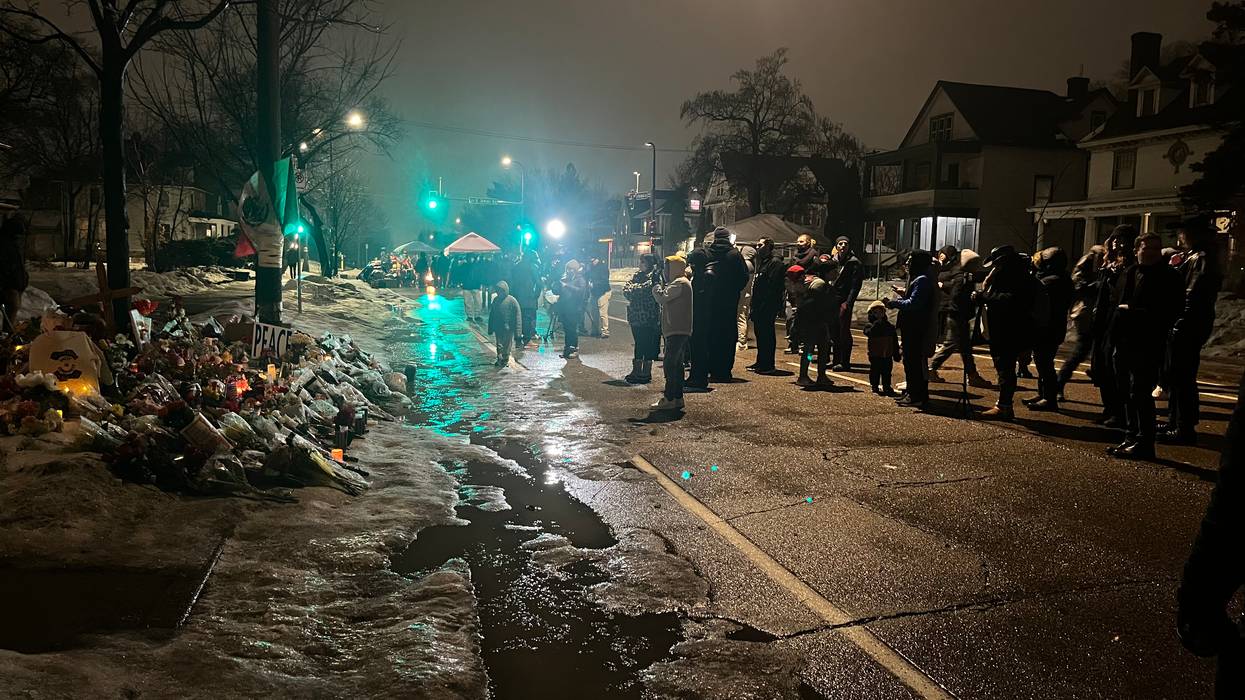
On the evening of January 8, a friend and I parked our car in Minneapolis' Powderhorn neighborhood where Renee Good—a white, unarmed mother of three—was murdered by a federal agent. We proceeded on foot because mourners had cordoned off several blocks of Portland Avenue into a mostly quiet commons where people, instead of passing by, wandered and conversed. We walked for perhaps 1,000 feet among strangers, and we discovered a crime scene that had been transformed, overnight, into a place of pilgrimage.
Traveling south, we passed through two barricades. At the first, two young men stood behind a section of mobile fence that usually indicates a detour at a construction site. A traffic sign hanging on the fence was overwritten with a red spray-painted message: Fuck ICE. The men calmly waved their arms to alert oncoming traffic that this was a turning point.
Two white tents stood behind the second barricade, composed of wooden pallets, traffic cones, and plastic trash bins. Beneath these tents, volunteers distributed bottles of water and food from foil trays. They chatted amiably and laughed with one another. Further north, fires burned in a pair of steel barrels, one near and one far, lighting hands and faces within the outer dark.
Beyond the second blaze and across 33rd Street, we joined a broken circle of those holding vigil. With phones aglow, people recorded the flickering candles. They circled the profusion of frozen flowers. Mostly, they stood in silence with their arms around friends and loved ones.
If I tell my spouse I'm horrified that a masked gunman, on government payroll, killed a nonviolent protester, and I do nothing else, then have I chosen to accept it?
On the way back to our car—two middle-aged white men with homes in neighborhoods full of unlocked doors—we dodged black puddles, shuffled across patches of ice, and I thought of "A Hanging," George Orwell's masterwork on the numbing agents of distance and privilege.
In the essay, Orwell, who worked as an Imperial Police Officer from 1922 to 1927, describes how the hanging of a Burmese prisoner by British jailers is disrupted by unexpected empathies. A dog sprints toward the prisoner and licks his face; the prisoner uses a few of his final steps to avoid a puddle and keep his feet dry. Close enough to notice these tiny bursts of vitality, the narrator begins to feel sorrow over the particularity of the man's existence and how any single death leaves us all "with one mind less, one world less."
Then, when his noose is fixed, the prisoner begins to chant the name of his god from the gallows. And that is too much, too near, an intolerable call to attention for the jailers, warders, and magistrates standing yards away. So, the superintendent snaps the order, the prisoner is "vanished," and the rope begins "twisting on itself".
What happens next, though, is what allows the essay to transcend time, space, and experience—what makes it so awfully personal. Clearly shaken, the superintendent leads Orwell and his colleagues out of the gallows yard, past other men waiting to be hung. Upon entering the central yard, they find some reprieve: Convicts, not yet condemned, eating their breakfast—a "jolly scene, after the hanging."
The overseers begin to joke about past executions, and by the time they exit the prison gates, everyone is laughing. The further they flee, the better they feel. At last, they retrieve a bottle of whiskey from the superintendent's car and put the matter fully behind them. How far behind? With a final sentence, Orwell reminds us: "The dead man was a hundred yards away."
Throughout the essay, Orwell demonstrates how it's easier to be someone standing by than to be someone standing beside. It's easier to look on from afar than to see what is near. It's more comfortable to understand our choices vaguely, as the instruments of an order that is beyond our control, rather than specifically, as forces that inflict pain on strangers. In the end, it is preferable to regard violence inflicted on other people as if it were weather visiting some faraway place.
As we walked away from the streetlight where Renee Good's car came to a stop—one mind less, one world less—my own mind began to churn. What level of acceptance have distance and privilege inspired in me? If I tell my spouse I'm horrified that a masked gunman, on government payroll, killed a nonviolent protester, and I do nothing else, then have I chosen to accept it? What if I attend this vigil and nothing more, how many yards from the execution will I be? Far enough to put it behind me?
Today, Orwell's implicit critique of imperial insensitivity could be read as a tremor that presaged the earthquake of Omar El Akkad's One Day, Everyone Will Have Always Been Against This, an explicit indictment of Americans' privileged addiction to normalcy and of our willingness to accept mass murder, in Gaza and so many other places, as a normal outcome of American life.
"Perhaps [what] it comes to, in the end, is some pathetic adherence to the idea that certain peoples simply need to be crushed," El Akkad writes. "But whoever subscribes to this idea should at least have the spine to embrace it. To look upon the body of the little girl hanging from the wall, limbs severed by the force of the blast, and say: I'm fine with this, I am this."
A block from where Renee Good's bullet-torn body lay 36 hours earlier, I could sense in myself this shameful fear that my own normalcy might be discontinued. I could already feel that unconscious scheming to which I, like so many Americans, am accustomed. How much do I have to circumscribe my role and responsibilities to feel like I am fine with this? How far do I have to walk before I begin to feel that her body doesn't exist?
This model is simple. It requires us to put our bodies on the line and to ask ourselves what, precisely, are we giving up to alleviate the suffering of others?
As we passed back through the penultimate barricade, a man called out to us. With one hand, he lifted the topmost cup from a small Styrofoam tower. With the other, he depressed a black air pot. Then, he passed the steaming cup into my freezing hands, and the aroma of chai spices entered my lungs. "Somali tea," he smiled. "Black tea with milk."
Awakened, I lifted my eyes again to the sudden solidarity that kept Portland Avenue from returning to normal. The convivial spirit of confrontation reminded me of experiences I'd had in Guatemala 20 years earlier, living and volunteering among people who instinctively placed their bodies on the line without regard for the precious barriers of privilege. The conversion of a crime scene—by people who appreciate the consequences of vanishing bodies better than me—into a sanctuary for insubordinate grief felt powerfully abnormal. These people were breaking routines and beginning to engage in actual resistance.
"Th[e] work of leaving," El Akkad writes, "of aiming to challenge power on the field where it maintains the least glaring asymmetry, demands one answer the question: What are you willing to give up to alleviate someone else's suffering?"
"A Hanging" showcases the usual answer offered by people, like me, who are either enriched by empire or not harmed by its enrichment. That answer is nothing. Of course, our obligation—in the past, in the future, and certainly now—is to ask and answer this question differently.
Presently, thousands of Minneapolitans are modeling this transformation by standing watch on street corners armed with nothing but whistles, by organizing direct action that results in the arrest of protesters by the busload, by providing food and shelter to migrants targeted by Immigration and Customs Enforcement, and by actively and publicly grieving each new murder, every loss of human life.
This model is simple. It requires us to put our bodies on the line and to ask ourselves what, precisely, are we giving up to alleviate the suffering of others? It requires us to keep stepping forward and to continue asking: Are we risking something valuable enough to register in the conscience of strangers? Are we risking enough to register as a nonviolent threat to the architects of unconscionable violence? It requires us to persist, further and further beyond the fortified walls of our comfort zones, until our answers to these questions are overwhelmingly affirmative.
This model is also a map. It shows us how to leave the open space of privilege and move toward the center of the proverbial prison where a long line of people wait to be murdered with our money. And yet, if we follow this map, then freedom may be our reward.
If we follow, then we will be free to help ourselves and others. We will be free to express, with our whole body, what we were only willing to say to close friends or trusted colleagues in the past. We will be free to say: No, I am not this. I am changed.
International activists kidnapped and brought to Israel by force, people simply being alive in a place an Israeli minister doesn’t want them to be, anyone near a place Israel has decided might be a Hamas tunnel—how are all these people terrorists?
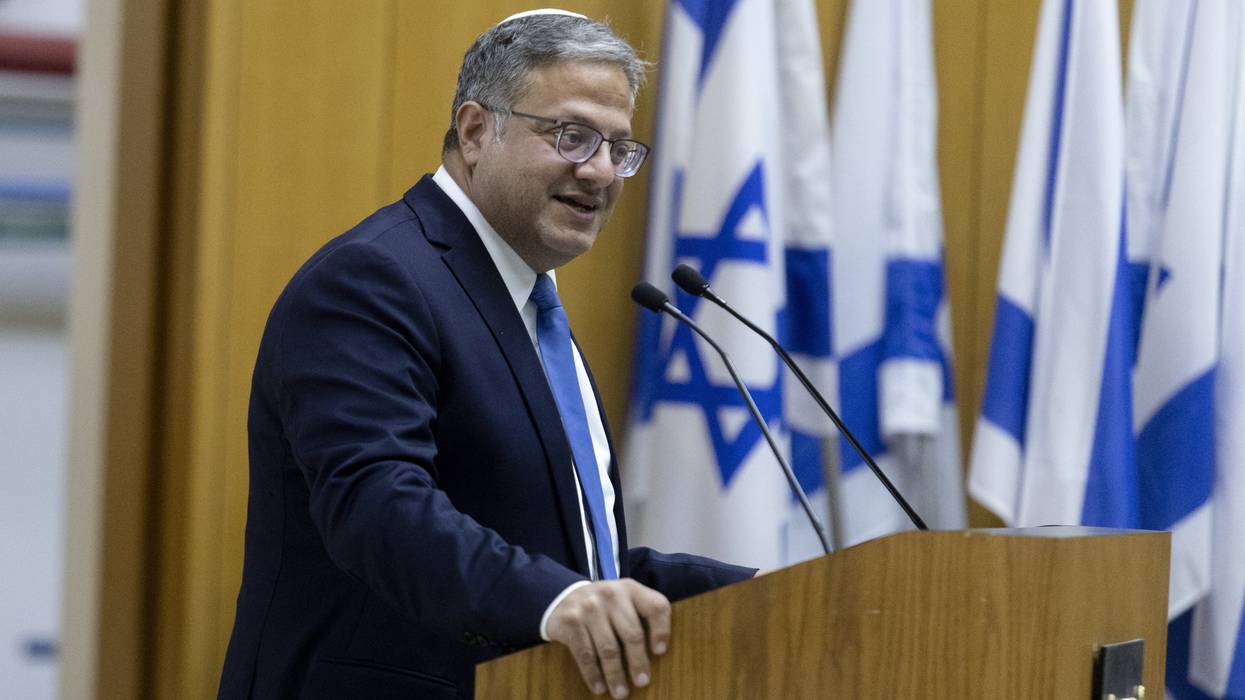
When activists from the Global Sumud Flotilla were being held in Ktziot prison, Israeli Minister of National Security Itamar Ben Gvir staged a photo op taunting them and saying, “I was proud that we are treating the ‘flotilla activists’ as terror supporters, whoever supports terrorism is a terrorist and deserves the conditions ofterrorists”…the conditions in Ktziot prison.
This requires a little unpacking. First, Ben Gvir’s claim that the Global Sumud Flotilla (GSF), and the Conscience and Thousand Madleens flotilla that followed a week later, support terrorism requires a bit of jiujitsu. When Israel drops 2,000-pound dumb bombs on hospitals and defenseless people, they always insist they are actually targeting the hidden Hamas fighters in tunnels beneath the visible injury and death of people on the surface. They make a distinction between the terrorist below ground and the “collateral damage” above. But when anyone tries to bring aid to the victims, Israel erases their own distinction between hidden fighters and visible victims and claim that the aid is for terrorists. They claim that the activists are supporting terrorists, and that the flotillas are “Hamas Flotillas.”
Next, Ben Gvir does a bit of leapfrog, claiming that the activists he just defined as terror supporters are themselves terrorists. And, as terrorists, they deserve to be held in a terrorist prison like Ktziot, because, apparently, all prisoners of Israel are terrorists.
Similar language was used by Defense Minister Israel Katz, saying that anyone still in Gaza City, for any reason at all, after the Israelis ordered them to move out were “terrorists or terror supporters.”
Political violence is a serious subject, and we need to be able to think about it and discuss it in a serious way. The word terrorism is too important to that discussion for such sloppy usage and deliberate misuse by politicians.
International activists kidnapped and brought to Israel by force, people simply being alive in a place Katz doesn’t want them to be, anyone near a place Israel has decided might be a Hamas tunnel—how are all these people terrorists? What actions have they taken to earn the accusation? Ben Gvir and Katz don’t say.
This is, at best, broad and imprecise language.
In his essay “Politics and the English Language,” George Orwell warned against this. He said that our language is, “ugly and inaccurate because our thoughts are foolish, but the slovenliness of our language makes it easier for us to have foolish thoughts.”
Orwell also said that our words are often “meaningless, in the sense that they do not point to any discoverable object.” For a word to have meaning it has to refer to some thing: an object, an idea—something. Even the “yada, yada, yada” in the Seinfeld episode referred to the act of glossing over possibly important information.
How can the word terrorist used in this wildly imprecise way have any useful meaning? How can it lead to anything but imprecise and foolish thoughts? Can we actually think and talk about the important question of political violence with such a vague word? I don’t think so.
Fortunately, Orwell also said that sloppy thinking and use of meaningless words can be reversed, “if one is willing to take the necessary trouble.”
So, let’s take the trouble.
There is no universally accepted definition of terrorism, perhaps because governments, the main source of agreement on questions like this, don’t want a definition that covers their own behavior. The US law against terrorism specifically exempts “activities undertaken by military forces of a state in the exercise of their official duties." This nation state exemption is a problem, but it’s a problem for another day.
All the definitions of terrorism we do have share three basic components: 1) violence committed by civilians against civilians 2) with the intent to cause fear of violence in a group or the general population 3) and done with the intent to bring about political change.
Applying this three-part test can bring some of the clarity Orwell suggested.
When Hamas and other fighters, non-state actor—civilians—broke out of Gaza on October 7, 2023, in addition to attacking soldiers they did commit violence against civilians. They did intend to create wider fear, and to bring about political change. It was terrorism. No question.
For the past two years any action by Hamas and other fighters in Gaza has been against uniformed Israeli soldiers. Further, the fighting was not intended to create wider fear in the general population, or with any hope of political change. It fails on all three counts. It is armed resistance to be sure, but it is not terrorism.
Acts of violence committed by Israeli soldiers against the people of Gaza may well be crimes against humanity and genocide. But, because of the nation-state exemption, actions by the Israeli army are not terrorism. If we are going to resurrect the word terrorism we must apply it precisely.
Ben Gvir wanted to bring the Flotilla activists to Ktziot prison, for the activists to see where Israelis keep terrorists, and to experience the conditions of convicted terrorists, the implication being that any inmate of Ktziot is a terrorist.
But the over 10,000 Palestinians imprisoned by Israel are often in prison for minor infractions against uniformed Israeli soldiers that are not, by definition, terrorism. Or they are imprisoned for other offenses that fall far short of terrorism.
When those imprisoned Palestinians are convicted of acts that get them sent to places like Ktziot it’s by Israel’s military “courts” with a 99.74% conviction rate. Rubber stamps have a higher failure rate. Apparently the “judges” in these Israeli military “courts” never run out of ink.
And that’s when Palestinian prisoners actually have a trial. Many never see a charge, a lawyer, a judge, or trial before they are put in prison indefinitely. The notion that all the Palestinians imprisoned by Israel are terrorists strains the definition beyond the breaking point.
By contrast, every act of “settler” violence against Palestinians in the West Bank is violence by civilians against civilians intended to cause widespread fear among Palestinians, and intended to push Palestinians to leave their land—a political change. Avoiding those Orwellian “foolish thoughts,” and using clear language, with words that point to a “discoverable object,” leads us to this inescapable conclusion: West Bank “settler” violence is terrorism. Every murder, every punch, every burned car or olive tree or killed livestock is an act of terrorism.
Further, very often we hear countries like Iran accused of being a state sponsor of terrorism. The accusation is that they support non-state actors in the commission of terrorism. It’s a way of getting around the exclusion of nation states from the definition of terrorism.
Similarly, when West Bank “settler” violence is done with uniformed Israeli soldiers standing in the background, threatening deadly force against Palestinians who even think of defending themselves, those soldiers are backing up and supporting “settler” terrorism. This is the case in nearly every video you can find. Just look. Such “settler” violence is state sponsored terrorism.
Ben Gvir is no stranger to terrorism. The political party he started, Otzma Yehudit, or Jewish Power, is a “legal rendition” of the outlawed Kach Party of Meir Kahane, the convicted bomb maker who founded the Jewish Defense League, a group responsible for many bombings in the United States.
Another hero of Ben Gvir is Baruch Goldstein, a Kachist who, in 1994 gunned down 29 people while they prayed at the al-Ibrahimi Mosque and injured 150 more. Ten percent of Israelis still consider Baruch Goldstein a national hero. Ben Gvir had a picture of Goldstein in his living room for years. That is until he had to clean up his act when Israeli Prime Minister Benjamin Netanyahu maneuvered to get Ben Gvir into the Knesset and created the Minister of National Security job for him.
But though he knows what it is, Ben Gvir doesn’t use the word terrorism to communicate clearly or honestly. Neither do Katz or Netanyahu.
When you’re actually trying to communicate, not only do you need to use words that point to a discoverable object, that actually mean something, the speaker needs to chose words that they hope roughly point to a similar object in the mind of the hearer.
But Orwell warns that in politics ambitious words,“are often used in a consciously dishonest way. That is, the person that uses them has his own private definition, but allows his hearer to think he means something quite different.”
When Ben Gvir, Katz, and Netanyahu use the word terrorism to refer to any support for the people of Gaza, any action of resistance by Palestinians, or even Gazas’ bare existence in a place they have been ordered to leave, they know they are intentionally using a nearly meaningless word. They know this and rely upon the fact that most hearers think they are referring to something closer to that three-part definition. They intend to deceive and make serious thinking about these subjects more difficult and more, as Orwell said, “foolish."
Ben Gvir had the Jewish activists in the GSF flotilla, citizens of the United States, dragged by their ears to kneel before him and the Israeli flag. He screamed down at them that they were terrorists. Yes, the cabinet ministers of Israel actually behave this way. I have no idea what he meant by the word he was screaming. Neither does he.
In the 1946 essay Orwell said that “fascism has now no meaning except in so far as it signifies ‘something not desirable.’” These days we might, unfortunately, have some more concrete examples of fascism, and the word might now actually have some meaning.
But taking Orwell’s point, the word terrorist, most of the times it is used, as when Ben Gvir screamed it at Jewish activists he forced to their knees, simply means “bad guys I don’t like.” All too often that is how the word is used, and not just by Israelis. The word is wildly thrown around in American politics as well.
Political violence is a serious subject, and we need to be able to think about it and discuss it in a serious way. The word terrorism is too important to that discussion for such sloppy usage and deliberate misuse by politicians. This is especially true now, when the genocide in Gaza might be ending, or pausing, when the world might finally see what Israel has done to Gaza, and when the blame and denials escalate.
We need to be “willing to take the necessary trouble” to resurrect the word terrorism and try to move beyond these “foolish thoughts.”
The contemporary US is a far cry from Orwell’s Oceania. Yet the Trump administration is doing its best to exert control over the present and the past.
When people use the term “Orwellian,” it’s not a good sign.
It usually characterizes an action, an individual, or a society that is suppressing freedom, particularly the freedom of expression. It can also describe something perverted by tyrannical power.
It’s a term used primarily to describe the present, but whose implications inevitably connect to both the future and the past.
In his second term, US President Donald Trump has revealed his ambitions to rewrite America’s official history to, in the words of the Organization of American Historians, “reflect a glorified narrative… while suppressing the voices of historically excluded groups.”
If it is illegal to even speak of systemic racism, for example, let alone discuss its causes and possible remedies, it constrains the potential for, even prohibits, social change.
This ambition was manifested in efforts by the Department of Education to eradicate a “DEI agenda” from school curricula. It also included a high-profile assault on what detractors saw as “woke” universities, which culminated in Columbia University’s agreement to submit to a review of the faculty and curriculum of its Middle Eastern Studies department, with the aim of eradicating alleged pro-Palestinian bias.
Now, the administration has shifted its sights from formal educational institutions to one of the key sites of public history-making: the Smithsonian, a collection of 21 museums, the National Zoo, and associated research centers, principally centered on the National Mall in Washington, DC.
On August 12, 2025, the Smithsonian’s director, Lonnie Bunch III, received a letter from the White House announcing its intent to carry out a systematic review of the institution’s holdings and exhibitions in the advance of the nation’s 250th anniversary in 2026.
The review’s stated aim is to ensure that museum content adequately reflects “Americanism” through a commitment to “celebrate American exceptionalism, [and] remove divisive or partisan narratives.”
On Aug. 19, 2025, Trump escalated his attack on the Smithsonian. “The Smithsonian is OUT OF CONTROL, where everything discussed is how horrible our Country is, how bad Slavery was…” he wrote in a Truth Social post. “Nothing about Success, nothing about Brightness, nothing about the Future. We are not going to allow this to happen.”
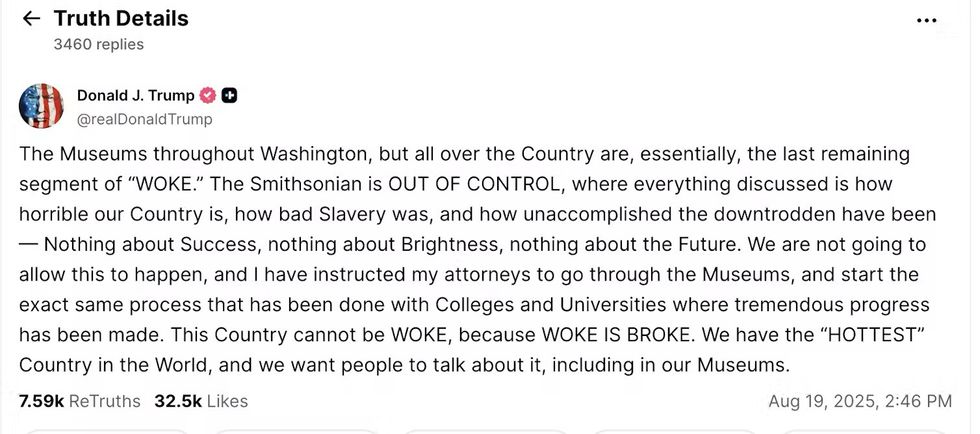 A screenshot is shown of President Donald Trump’s August 19, 2025 Truth Social post about the Smithsonian.
Such ambitions may sound benign, but they are deeply Orwellian. Here’s how.
Author George Orwell believed in objective, historical truth. Writing in 1946, he attributed his youthful desire to become an author in part to a “historical impulse,” or “the desire to see things as they are, to find out true facts and store them up for the use of posterity.”
But while Orwell believed in the existence of an objective truth about history, he did not necessarily believe that truth would prevail.
Truth, Orwell recognized, was best served by free speech and dialogue. Yet absolute power, Orwell appreciated, allowed those who possessed it to silence or censor opposing narratives, quashing the possibility of productive dialogue about history that could ultimately allow truth to come out.
As Orwell wrote in 1984, his final, dystopian novel, “Who controls the past controls the future. Who controls the present controls the past.”
Historian Malgorzata Rymsza-Pawlowska has written about America’s bicentennial celebrations that took place in 1976. Then, she says, “Americans across the nation helped contribute to a pluralistic and inclusive commemoration… using it as a moment to question who had been left out of the legacies of the American Revolution, to tell more inclusive stories about the history of the United States.”
This was an example of the kind of productive dialogue encouraged in a free society. “By contrast,” writes Rymsza-Pawlowska, “the 250th is shaping up to be a top-down affair that advances a relatively narrow and celebratory idea of Americanism.” The newly announced Smithsonian review aims to purge counternarratives that challenge that celebratory idea.
The desire to eradicate counternarratives drives Winston Smith’s job at the ironically named Ministry of Truth in 1984.
The novel is set in Oceania, a geographical entity covering North America and the British Isles and which governs much of the Global South.
Oceania is an absolute tyranny governed by Big Brother, the leader of a political party whose only goal is the perpetuation of its own power. In this society, truth is what Big Brother and the party say it is.
The regime imposes near total censorship so that not only dissident speech but subversive private reflection, or “thought crime,” is viciously prosecuted. In this way, it controls the present.
But it also controls the past. As the party’s protean policy evolves, Smith and his colleagues are tasked with systematically destroying any historical records that conflict with the current version of history. Smith literally disposes of artifacts of inexpedient history by throwing them down “memory holes,” where they are “wiped… out of existence and out of memory.”
At a key point in the novel, Smith recalls briefly holding on to a newspaper clipping that proved that an enemy of the regime had not actually committed the crime he had been accused of. Smith recognizes the power over the regime that this clipping gives him, but he simultaneously fears that power will make him a target. In the end, fear of retaliation leads him to drop the slip of newsprint down a memory hole.
The contemporary US is a far cry from Orwell’s Oceania. Yet the Trump administration is doing its best to exert control over the present and the past.
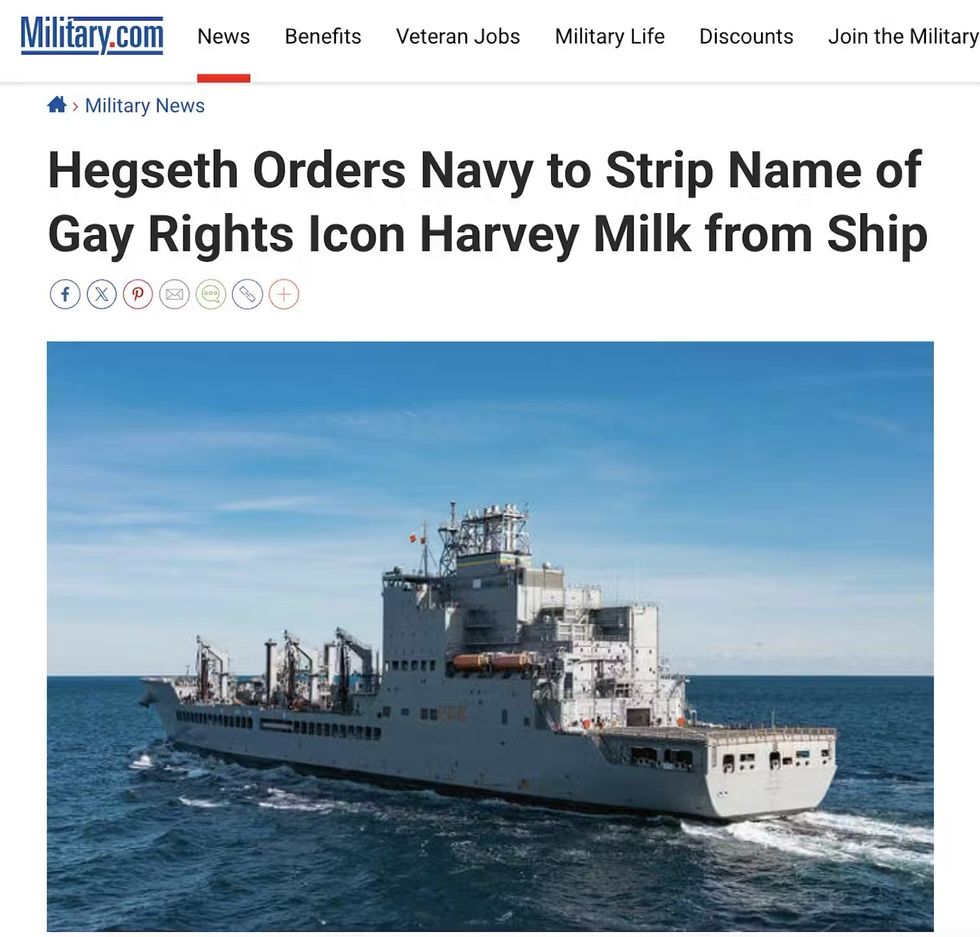 As part of efforts to purge references to gay people, US Defense Secretary Pete Hegseth has ordered the removal of gay rights advocate Harvey Milk’s name from a Navy ship. (Photo: Screenshot/Military.com)
Even before the Trump administration announced its review of the Smithsonian, officials in departments across government had taken unprecedented steps to rewrite the nation’s official history, attempting to purge parts of the historical narrative down Orwellian memory holes.
Comically, those efforts included the temporary removal from government websites of information about the Enola Gay, the plane that dropped the atomic bomb over Hiroshima. The plane was unwittingly caught up in a mass purge of references to “gay” and LGBTQ+ content on government websites.
Other erasures have included the deletion of content on government sites related to the life of Harriet Tubman, the Maryland woman who escaped slavery and then played a pioneering role as a conductor of the Underground Railroad, helping enslaved people escape to freedom.
Public outcry led to the restoration of most of the deleted content.
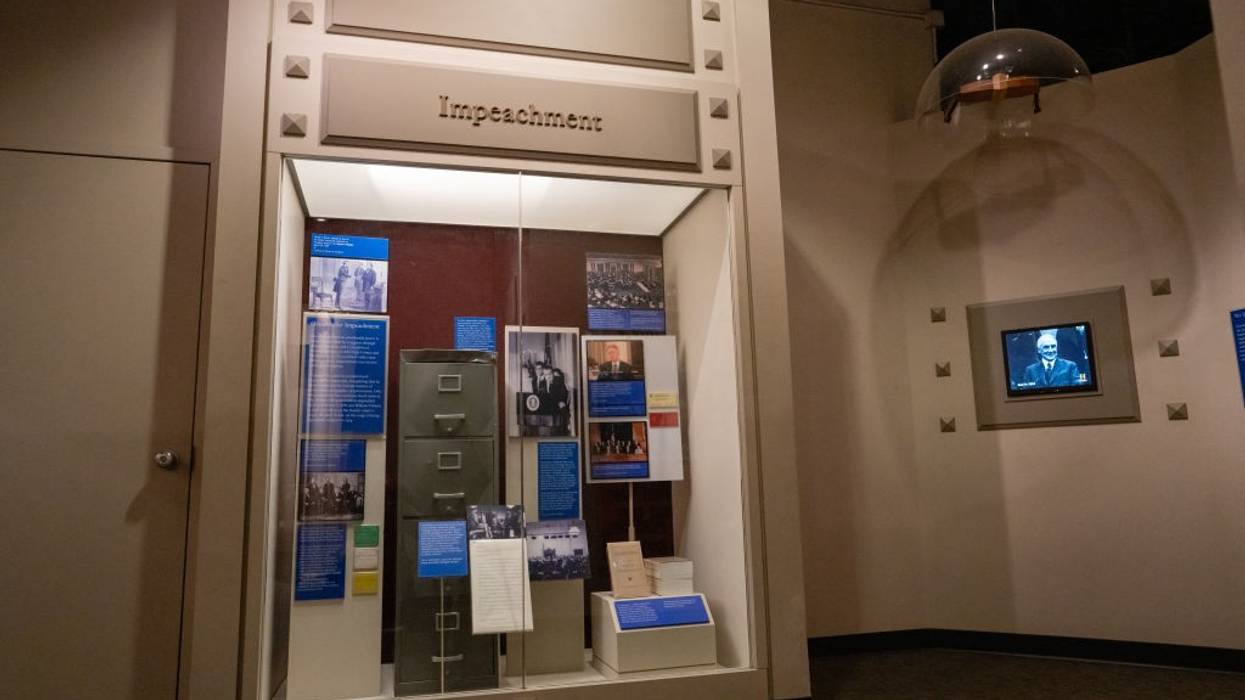
Over at the Smithsonian, which earlier in the year had been criticized by Trump for its “divisive, race-centered ideology,” staff removed a temporary placard with references to President Trump’s two impeachment trials from a display case on impeachment that formed part of the National Museum of American History exhibition on the American presidency. The references to Trump’s two impeachments were modified, with some details removed, in a newly installed placard in the updated display.
Responding to questions, the Smithsonian stated that the placard’s removal was not in response to political pressure: “The placard, which was meant to be a temporary addition to a 25-year-old exhibition, did not meet the museum’s standards in appearance, location, timeline, and overall presentation.”
Orwell’s 1984 ends with an appendix on the history of “Newspeak,” Oceania’s official language, which, while it had not yet superseded “Oldspeak” or standard English, was rapidly gaining ground as both a written and spoken dialect.
According to the appendix, “The purpose of Newspeak was not only to provide a medium of expression for the worldview and mental habits proper to the devotees of [the Party], but to make all other modes of thought impossible.”
Orwell, as so often in his writing, makes the abstract theory concrete: “The word free still existed in Newspeak, but it could only be used in such statements as ‘This dog is free from lice’ or ‘This field is free from weeds.’ … political and intellectual freedom no longer existed even as concepts.”
The goal of this language streamlining was total control over past, present, and future.
If it is illegal to even speak of systemic racism, for example, let alone discuss its causes and possible remedies, it constrains the potential for, even prohibits, social change.
It has become a cliché that those who do not understand history are bound to repeat it.
As George Orwell appreciated, the correlate is that social and historical progress require an awareness of, and receptivity to, both historical fact and competing historical narratives.
This story is an updated version of an article originally published on June 9, 2025.
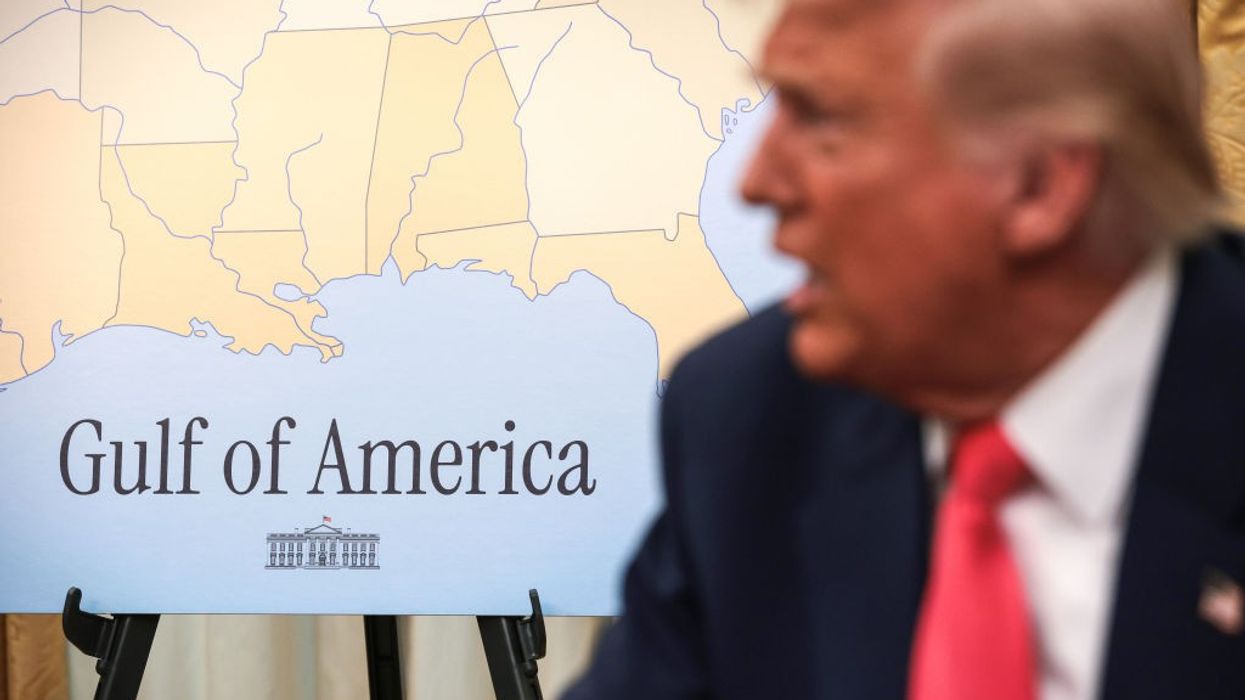
Trump’s vision resembles Orwell’s ultimate horror: a world divided into three great continental blocs, with humanity held in thrall to omnipotent leaders like Big Brother through endless wars against an ever-changing enemy.
Most of us can remember at least a few troubling scenes from George Orwell’s dystopian novel 1984: the mandatory love demanded for the spectral dictator Big Brother; the malleability of facts at the Ministry of Truth; or the ruling party’s memorably grim slogans, “War is Peace, Freedom is Slavery.” But for me, the most disturbing image of all—and I first read the book in high school—was the “Two Minutes Hate,” aroused among the public by threatening images on giant video screens.
Within just 30 seconds, Orwell wrote, “A hideous ecstasy of fear and vindictiveness, a desire to kill, to torture, to smash faces in with a sledgehammer, seemed to flow through the whole group of people like an electric current, turning one even against one’s will into a grimacing, screaming lunatic.” As those moments of hate continued, what appeared was “the figure of a Eurasian soldier who seemed to be advancing, huge and terrible, his sub-machine gun roaring, and seeming to spring out of the surface of the screen, so that some of the people in the front row actually flinched out of their seats.”
Finally, as “row after row of solid-looking men with expressionless Asiatic faces… swam up to the screen” and brought those two minutes of Hate to their terrifying climax, the face of Big Brother appeared “full of power and mysterious calm,” prompting spectators to shout, “My Saviour!,” and to break into “a deep, slow, rhythmical chant of ‘B-B!… B-B!’—over and over.”
In its totality, Trump’s vision is of a continental Fortress America, formed by annexing the northern lands of Canada and Greenland, while sealing off Mexico for ethnic reasons as a separate but subordinate state.
For, as Orwell explained, those people of Oceania were “at war with Eurasia and in alliance with Eastasia.” Officially, “Oceania had always been at war with Eurasia,” which “represented absolute evil.” Yet through some quirk of memory, the novel’s hero Winston “well knew, it was only four years since Oceania had been at war with Eastasia and in alliance with Eurasia.”
That was, in some fashion, Orwell’s ultimate horror: a world divided into three great continental blocs, with humanity held in thrall to omnipotent leaders like Big Brother through endless wars against an ever-changing enemy. Even though he published1984 nearly 80 years ago in 1948, just two years before he died, more than three quarters of a century later, in the age of U.S. President Donald Trump, his fictional fantasy is fast becoming an unsettling simulacrum of our current geopolitical reality and that couldn’t be eerier (at least to me).
Amid a torrent of confusing, often contradictory foreign policy pronouncements pouring forth almost daily from the Trump White House, the overall design of his de facto geopolitical strategy has taken shape with surprising speed. Instead of maintaining mutual-security alliances like NATO, President Trump seems to prefer a globe divided into three major regional blocs, each headed by an empowered leader like himself—with Russia dominating its European periphery, China paramount in Asia, and the United States controlling, in a version of fortress America, all of North America (including, of course, the Panama Canal). Reflecting what his defense secretary called a “loathing of European freeloading” and his administration’s visceral disdain for the European Union, Trump is pursuing that tricontinental strategy at the expense of the traditional trans-Atlantic alliance, embodied by NATO, that has been the foundation for American foreign policy since the start of the Cold War.
Trump’s desire for ultimate continental hegemony lends a certain geopolitical logic to his otherwise seemingly off-the-wall, quixotic overtures to claim Greenland as part of the United States, reclaim the Panama Canal, and make Canada “the 51st state.” On his sixth day in office, President Trump told reporters aboard Air Force One, “I think Greenland will be worked out with us. I think we’re going to have it.” He then added, “I don’t know really what claim Denmark has to it. But it would be a very unfriendly act if they didn’t allow that to happen because it’s for protection of the free world.” After Vice President JD Vance made a flying visit to a remote U.S. military base in Greenland and claimed its people “ultimately will partner with the United States,” Trump insisted that he would never take military force “off the table” when it came to claiming the largest island on this planet.
Turning to his northern neighbor, Trump has repeatedly insisted that U.S. statehood would mean “the people of Canada would pay a much lower tax…They would have no military problems.” During his first weeks in office, he imposed a 25% duty on all imports from Canada and Mexico, which was quickly followed by a blizzard of similar tariffs that instantly sparked multiple trade wars with once-close allies. In response, Justin Trudeau, then Canada’s prime minister, whom Trump was already referring to as “governor” (as in the head of that 51st state), charged in an emotional speech that the American president wants “to see a total collapse of the Canadian economy, because that’ll make it easier to annex us.”
In his inaugural address last January, President Trump also complained that “the Panama Canal… has foolishly been given to the country of Panama after the United States… spent more money than ever spent on a project before and lost 38,000 lives in the building of the Panama Canal.” He added that “we have been treated very badly from this foolish gift that should have never been made, and Panama’s promise to us has been broken… And above all, China is operating the Panama Canal. And we didn’t give it to China.” To a burst of applause, he insisted, “We gave it to Panama, and we’re taking it back.” No surprise then that, on his very first trip as secretary of state, Marco Rubio stormed into Panama City where he pressured its president, José Raúl Mulino, to placate Trump by withdrawing from Beijing’s global Belt and Road Initiative.
In its totality, Trump’s vision is of a continental Fortress America, formed by annexing the northern lands of Canada and Greenland, while sealing off Mexico for ethnic reasons as a separate but subordinate state. Then, sweeping aside what had long been a U.S. reliance on global multilateral defense pacts and, with the country’s Arctic approaches under its control, the administration would draw a defensive frontier around Greenland and through the North Atlantic Ocean, secure the Panama Canal as a southern bastion, and maintain military control over the entire Pacific Ocean. Every major component of such a strategy would, of course, be laden with the potential for conflict, particularly the administration’s plans for the Pacific, where the U.S. faces a continuing challenge from China.
Following his second inauguration in January 2025, President Trump has pursued this distinctive tricontinental strategy by working with remarkable speed to demolish the institutional pillars of the “rules-based international order” the U.S. had supported and tried to advance since the end of World War II. Standing in the Rose Garden on his April 2 “liberation day,” Trump proclaimed a roster of tariffs reaching as high as 49% that, said Foreign Policy magazine, “will shatter the world economy” the U.S. has built since 1945, while the respected Economist observed that it “heralds America’s total abandonment of the world trading order.” After calling the United States Agency for International Development (USAID) “corrupt” and falsely claiming that he had “stopped $50 million being sent to Gaza to buy condoms for Hamas,” Trump abolished just about all the global humanitarian initiatives of that agency. He cut 5,800 programs that provided food rations for a million Rohingya refugees in Bangladesh, malaria prevention for 53 million people globally, and polio immunization for millions of children worldwide, among all too many other things. In a further flurry of executive orders, he also shut down the global broadcaster Voice of America, spuriously claiming that it was “radical” (though a judge has, for now, stopped that shutdown process), withdrew from the World Health Organization (WHO), and quit the Paris climate accords for a second time. Apart from the harm inflicted on poor communities across three continents, the closure of most USAID programs has crippled the key instrument of America’s “soft power,” ceding China the role as prime development partner in at least 40 countries worldwide.
In junking that Paris climate agreement, Trump has ensured that the U.S. would abdicate any leadership role when it comes to the most consequential issue facing the international community, climate change and the potential devastation of the planet. In the process, he has left a void that China may readily fill by offering stable world climate leadership in contrast to the “aggressive unilateralism” of Trump’s “drill, baby, drill” second term.
With its military alliances compromised and its trade relations roiled by tariff wars, Washington’s international influence will, in all probability, be significantly reduced (or worse) by the end of Trump’s second term in 2029.
Reflecting his aversion to multilateral alliances, Trump’s first major foreign policy initiative was a unilateral attempt to negotiate an end to the Russia-Ukraine war. On February 12, he launched peace talks through what he called a “lengthy and highly productive” phone call with Russian President Vladimir Putin, agreeing that “our respective teams start negotiations immediately.” By month’s end, tensions from that tilt toward Moscow had culminated in a televised Oval Office meeting in which Trump berated Ukrainian President Volodymyr Zelenskyy, saying, “You’re either going to make a deal or we’re out, and if we’re out, you’ll fight it out. I don’t think it’s going to be pretty.”
That unilateral approach not only weakened Ukraine’s ability to defend itself, but also disregarded and even degraded NATO, which had, for the past three years, expanded its membership and military capacity by supporting Ukraine’s resistance to Russia’s invasion. Recoiling from the “initial shock” of that utterly unprecedented breach, Europeans quickly appropriated $160 billion to begin reinforcing their own arms industry in collaboration with both Canada (not eager to become the 51st state) and Ukraine, thereby aiming in the future to reduce their dependence on American weaponry. If his administration does not formally withdraw from NATO, Trump’s ongoing hostility, particularly toward its crucial mutual-defense clause, may yet serve to weaken if not eviscerate the alliance—even as, recently, Trump has also gotten “very angry” and “pissed off” at Russian President Vladimir Putin for not responding effusively enough to his gestures. Consider that an indication that American relations across much of Eurasia could soon prove all too unpredictably chaotic.
In the Asia-Pacific region, Trump’s new global strategy is already straining longstanding U.S. alliances. At the start of his second term, the American presence there rested on three sets of mutual-defense pacts: the AUKUS entente with Australia and Britain, the Quadrilateral Security Dialogue (with Australia, India, and Japan), and a chain of bilateral defense agreements stretching along the Pacific littoral from Japan to the Philippines. However, Trump’s disdain for military alliances, his penchant for abusing allies, and his imposition of ever more punitive tariffs on the exports of all too many of those allies will undoubtedly only weaken such ties and so American power in the region.
Although his first administration famously waged a trade war with Beijing, Trump’s attitude toward the island of Taiwan has been ambiguous. “I think Taiwan should pay us for defense,” he said last June during the presidential campaign, adding, “You know, we’re no different than an insurance company.” Once in office, however, his defense secretary, Pete Hegseth, issued an interim strategic guidance stating that “denial of a Chinese fait accompli seizure of Taiwan… is the department’s sole pacing scenario,” requiring that the U.S. shift some of its forces from Europe to Asia. In similar signs of a commitment to that island, the administration has noisily raised tariffs and technology controls on China, while quietly releasing $870 million in military aid for Taiwan. Should Beijing indeed attack Taiwan outright or, as appears more probable in the future, impose a crippling economic blockade on the island, Trump could find himself faced with a difficult choice between a strategic retreat or a devastating war with China.
However it might happen, the loss of that island would break the U.S. position along the Pacific littoral, possibly pushing its naval forces back to a “second island chain” running from Japan to Guam, a major blow to America’s geopolitical position in the region. In short, even within Trump’s tricontinental strategy, the Western Pacific will remain at best a contested terrain between Beijing and Washington, fraught with the possibility of armed conflict in that continuing great-power rivalry, and war will remain a grim possibility.
With little chance of success, Trump’s attempt at a grand Fortress America strategy will likely leave a residue of ruin—corroding American global power, compromising the current world order, and harming countless millions worldwide who once benefitted from this country’s humanitarian aid. His attempt at consolidating control over North America has already encountered determined resistance in Ottawa, which responded to him with a strong bid to join Europe’s accelerated development of its own defense industries.
While the Trump administration’s aversion to formal alliances and its imposition of protective tariffs will likely weaken diplomatic ties to traditional allies in Asia and Europe, both China and Russia are likely to gain greater influence in their respective regions. From a strategic perspective, this start of a staged U.S. retreat from its military bastions at the antipodes of Eurasia in Western Europe and eastern Asia will weaken its longstanding influence over that vast landmass, which remains the epicenter of geopolitical power globally. With its military alliances compromised and its trade relations roiled by tariff wars, Washington’s international influence will, in all probability, be significantly reduced (or worse) by the end of Trump’s second term in 2029.
In the meantime, as he takes Americans on his own version of a succession of Two Minute Hates—of freeloading Europeans, prevaricating Panamanians, vile Venezuelans, Black South Africans, corrupt humanitarians, illegal immigrants, and lazy Federal workers—count on one thing: he’s leading us on a path eerily reminiscent of 1984. Unless, of course, like Orwell’s hero Winston, all too many of us somehow come to love Big Brother and so set aside our musty old Constitution and take Donald Trump’s often-repeated hints to elect him to a third term on a planet plunging headlong into a tempest of armed conflict, commercial chaos, and climate change.
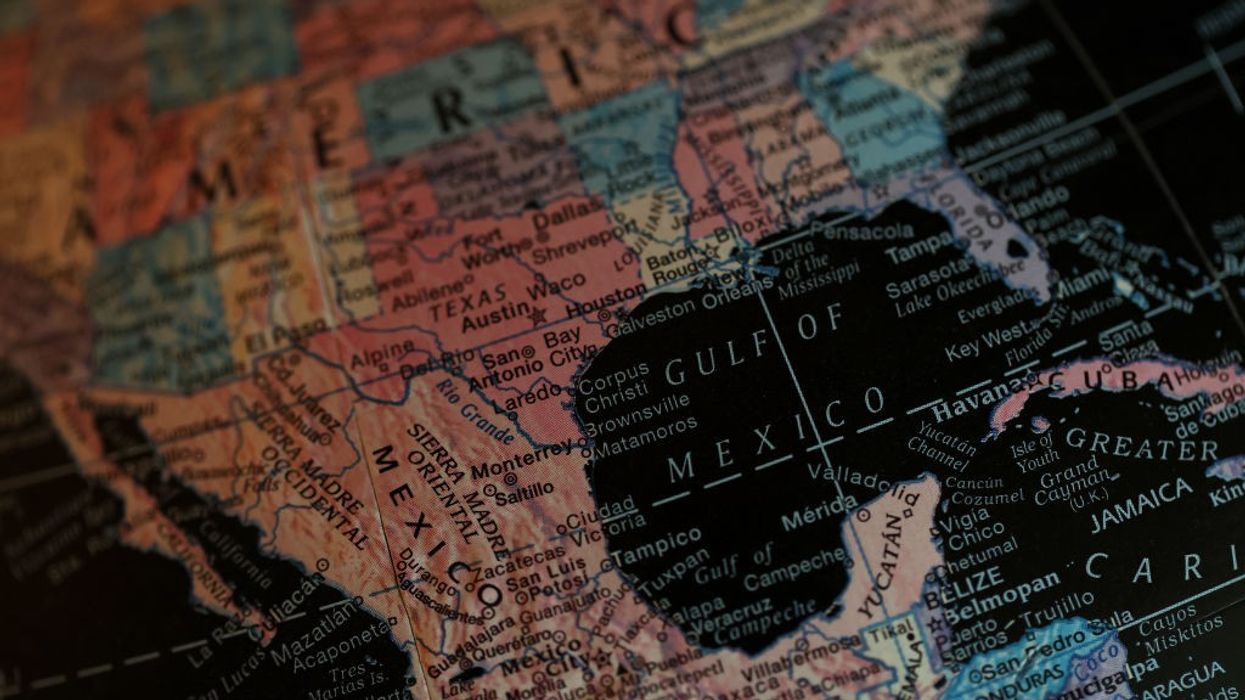
How serious is Trump’s Orwellian effort? Can it really succeed in reshaping public discourse? We can hope not. But can we be sure?
“If we feel that there are lies being pushed by outlets in this room, we are going to hold those lies accountable. And it is a fact that the body of water off the coast of Louisiana is called the Gulf of America. I’m not sure why news outlets don’t want to call it that, but that is what it is. The Secretary of the Interior has made that designation . . . and Apple has recognized that, Google has recognized that, pretty much every other outlet in this room has recognized that body of water as the Gulf of America, and its very important to this administration that we get that right.” —White House press secretary Karoline Leavitt, speaking at her February 12 daily press briefing.
Back in 1997, in the dim pre-history of American Greatness, David King published a book entitled The Commissar Vanishes: The Falsification of Photographs and Art in Stalin’s Russia. In almost two hundred pages of photos, it demonstrated the ways that Stalin’s Soviet regime literally erased historical events and persons no longer considered to be consistent with the dictat of The Leader.
Such efforts involved extensive censorship and coercion, typically requiring the removal not simply of images and documents but the people to whom they were attached, who often wound up in a Gulag if they were lucky or in a ditch if they were not. At the same time, as the book shows, even more insidious than the coercion was the regime’s wholly cynical attitude towards truth—an attitude so well analyzed by George Orwell’s 1984 that it has come to be described by the colloquialism “Orwellian.” The regime and its Leader regarded themselves as literally authorized to dictate what is and what is not. It was not enough to denounce or disappear an opponent or to censor an image. It was considered necessary, and legitimate, to figuratively and literally erase the opponent and to produce an appropriately revised image or document in which that opponent did not appear, and thus did not exist, and indeed perhaps had never existed.
For Stalin—and, in different ways, for Hitler and Mussolini too—the essential principle of rule was simply stated: “what is, is what I declare it to be.”
On January 20, 2025, within minutes of his inauguration as President of the United States, Donald J. Trump declared, via Executive Order 14172, that heretofore the U.S. government would rename “the area formerly known as the Gulf of Mexico” as “the Gulf of America.”
Trump’s “Restoring [of] Names That Honor American Greatness” generated enthusiasm among his supporters, criticism among his opponents, and incredulity among most people, including most journalists. For the designation “Gulf of Mexico” has been in use for centuries, since before there was a United States. It has long been the internationally recognized designation for the body of water in question. And, until a few weeks ago, it was the designation employed by every American and especially by every American travel agent and resort owner.
And yet, with a stroke of a pen, Donald Trump declared it was now and forever the “Gulf of America.”
Google and Apple complied with Trump’s order. So too Axios.
But Associated Press chose a more nuanced response: “The Gulf of Mexico has carried that name for more than 400 years. The Associated Press will refer to it by its original name while acknowledging the new name Trump has chosen.”
As a consequence, the White House very publicly blocked AP from Oval Office and Air Force One, making an example of the news agency for its temerity in failing to fall in line.
When questions were raised by journalists about whether such a move was consistent with either the First Amendment or long-standing White House practice, Trump doubled down, and went one step further, issuing a Proclamation declaring February 9 as “Gulf of America Day,” and calling “upon public officials and all the people of the United States to observe this day with appropriate programs, ceremonies, and activities.” Describing his renaming as a “momentous occasion,” he thus declared that Americans must not only change their language but celebrate him for proclaiming the change.
It was in this context that CNN reporter Kaitlin Collins pressed White House Press Secretary Karoline Leavitt, who responded as she did on February 12, by not simply defending the denunciation and punishment of AP, but by declaring AP to be lying, and misleading the public, by refusing to acknowledge what is a fact.
Her logic was impeccable. Trump declared it. His hand-picked Interior Secretary “made that designation.” And thus it simply is. And to raise any question about this is to be not simply against what Trump says, but against the simple truth. The rhetorical coup de gras is the gaslighting at the end, the seemingly straightforward claim that “pretty much everyone else” knows this to be true, which renders anyone outside this supposed consensus very peculiar, suspicious, and indeed dangerous.
This is the methodology of totalitarian and quasi-totalitarian rule.
It is playing out in the renaming of the Gulf of Mexico. And in the widespread scrubbing of federal government websites, an effort recently described by CBS News as a deliberate attempt “to remove content contrary to the president’s thinking.” And in the many directives requiring the repudiation of any and all signs of “wokeness” (citing recent Trump administration guidance, the Maryland National Guard just backed out of its long-standing participation in the state’s official celebration of the birthday of Frederick Douglass. One wonders how long until it is declared that Douglass himself is a much more complicated figure than many have thought, and perhaps never really lived, and the true heroes of the Civil War were Jefferson Davis and Stonewall Jackson).
But the most serious instance of this quasi-totalitarian approach to truth, also declared in a January 20 Executive Order, was Trump’s pardoning of all individuals convicted of or charged with crimes associated with the January 6, 2021 insurrection. Through this edict, Trump explicitly redescribed every insurrectionist as a patriot, and every government official involved in the defense of the Capitol on January 6 or the arrest or prosecution of the insurrectionists as a “deep state” oppressor. As I argued recently, in “It’s Official: Donald Trump Won the 2020 Election,” through these pardons “Trump has commenced the process of erasing the truth not simply about January 6, 2021, but about the last four years.”
How serious is Trump’s Orwellian effort? Can it really succeed in reshaping public discourse? We can hope not. But can we be sure?
I am reminded of Vaclav Havel’s famous essay “The Power of the Powerless.” Writing in 1978, at a moment that he describes as “post-totalitarian,” Havel asks whether and how it might be possible to break through the repressive Czech regime’s veneer of invulnerability. He tells the story of a greengrocer who, upon instruction from the Party, “places among the onions and carrots, the slogan ‘Workers of the World Unite,’” not because he believes the slogan but because it is the easiest way to get by in a very cynical society. As Havel writes:
We have seen that the real meaning of the greengrocer’s slogan has nothing to do with what the text of the slogan actually says. Even so, this real meaning is quite clear and generally comprehensible because the code is so familiar: the greengrocer declares his loyalty (and he can do no other if his declaration is to be accepted) in the only way the regime is capable of hearing; that is, by accepting the prescribed ritual, by accepting appearances as reality, by accepting the given rules of the game. In doing so, however, he has himself become a player in the game, thus making it possible for the game to go on, for it to exist in the first place.
The Czechoslovakia of the 1970’s was not a full-blown Stalinist regime—thus Havel’s designation “post-totalitarianism.” But both parts of the designation matter, and while the Communist regime did not practice mass terror, and allowed a sphere of civil freedom in which individuals were free to “go about their business,” the regime very much claimed the authority to decide the limits of such business, and to exercise substantial control over both political and cultural life. When the regime circulated Communist slogans, it was well understood that the slogans were to be honored, and that every “good citizen” was expected to act as if they were not simply followers of the law but sincere and enthusiastic Communists. To do otherwise was to flout the official “truth,” which was the only accepted “truth”—and thus to be a dangerous liar if not certifiably insane.
We do not live in 1970’s Czechoslovakia.
But we do live at a moment when the democratically elected President of the United States, Donald J. Trump, seems intent on pursuing a very similar approach to public life, dictating what is and what shall be, and expecting those around him, and the citizenry at large, to follow in lockstep, and with at least feigned enthusiasm.
Havel makes clear in his 1978 essay that he understands the very real reasons why so many fellow citizens will make such accommodations with the regime, which are surely rational from the vantage point of the individuals involved. But he also holds out the hope that there are individuals who, following the example of his Charter 77 colleagues, will eventually discover that such accommodations come at too high a price, and thus will begin to raise questions, and to refuse to comply. Whether, when, and how such refusals might grow, he acknowledges, are open questions. What is important, he insists, is that there be some refusal, on the basis of which hope for the future can be sustained.
It took over a decade before Havel’s hope was vindicated (even if briefly, for the Europe of today is not the Europe of Havel’s hope).
Trump has only just begun to do the damage that he will surely do. On what basis can we sustain hope for a future beyond Trump? And how long must we wait for such hope to be vindicated?

Honestly, who would have guessed that we humans might prove capable of making1984 seem like an upbeat fantasy?
Honestly, what would George Orwell have written about this planet of ours, four decades after that ominous year 1984 passed from his fiction into history?
And yes, in case you think that, as in his novel 1984, published in 1949, a year before his death and just as the Cold War (a term he was the first to use in an essay in October 1945) was getting underway, our world, too, seems to be heading for a nightmarish future, I suspect that — were he capable of returning to this planet of ours — he wouldn’t disagree with you for a moment. Phew! Sorry for such a long, complicated sentence, but little wonder given the way our world is now tying itself in knots. Yes, just last week, with the election of climate-change denier and (to steal from Orwell) our very own Big Brother Donald Trump as president of the United States (again!), we just paved the way for an instant all-American nightmare. Still, even without him, the world was anything but peachy keen.
As a matter of fact, we live in a country on the brink of who knows what, on a planet on the brink of… well, yes, who has any idea anymore? One thing, however, is obvious (even if not to The Donald, who plans to “drill, baby, drill” on day one back in the White House): it’s getting hotter by the year (after year after year) in every sense imaginable, as heat records are broken, week by week, month by month around the world. After all, 2024 is expected to be the hottest year in human history, beating out 2023 for that record, and yet, all too sadly, it’s not likely to hold that record for more than a year. As Kristina Dahl, a climate scientist at the Union of Concerned Scientists, pointed out recently: “The latest scientific data shows a devastating scientific duality: not only is 2024 slated to be the hottest year on record to date, but it could also be one of the coolest years we’ll see in the decades ahead.”
Yikes!
War, War, and More War
Just consider that, so many thousands of years after we humans first began making war on each other, we’re on a planet that seems to be going down big-time in ways Orwell couldn’t have imagined. And no matter its state, we just can’t seem to stop ourselves from, or even evidently stop wanting to make war again… and again… and again.
Let’s face it, whether we’re talking about fire, drought, floods, unprecedented storms, or so much else, we increasingly live on a different planet.
At this point, in fact, at least three thoroughly nightmarish, seemingly never-ending conflicts are being fought (and fought and fought) on this planet of ours. There is, of course, the war in Ukraine that began with Russian President Vladimir Putin’s painful decision in February 2022 to invade that country. More than two and a half years later, with perhaps 200,000 or more deaths and the destruction of significant parts of Ukraine, it seems as if that particular war is in a nightmarish slog of endless devastation leading who knows where or to who knows what end (including, possibly, the first use of nuclear weapons since August 1945, something Orwell was already thinking about in that Cold War essay of his only months after the U.S. nuked the Japanese cities of Hiroshima and Nagasaki to end World War II).
And oh yes, only recently, a third country, also nuclear-armed like the Russians, and its leader, like Vladimir Putin, also willing to threaten the use of such weaponry, decided to directly enter the fray. I’m thinking, of course, about the neighboring state of North Korea. And don’t be confused by that “neighboring.” After all, that country’s only about 4,500 miles away from Ukraine, but it’s certainly a neighbor of Russia’s, right?
Whoops, sorry about that! After a glance at a map, I realize that I must have meant a neighbor of China, which is indeed a neighbor of Russia, which is more or less the same thing. Under the circumstances, why shouldn’t North Korean leader Kim Jong-un have sent 8,000 to10,000 of his crack troops to more or less the other side of the planet (or do I mean the universe?) to help an atomic near-neighbor? And I certainly have no right to be critical of such a decision, since in this century my own country has dispatched its military endless thousands of miles away to fight (losing) wars in places like Afghanistan and Iraq.
Of course, whatever my country did, what’s now going on in Ukraine should still be the definition of a nightmare first class, a war without end that only seems to be growing more severe. But perhaps when compared to what’s now taking place in the Middle East, it might have to be seen as a nightmare second class. After all, another nuclear-armed country, Israel, in response to a horrifying terror attack on its citizens by the Palestinian group Hamas on October 7, 2023, has spent more than a year (14 months!) devastating and decimating just about anything left standing, including human beings, in the tiny Gaza Strip. It has by now killed tens of thousands of Palestinians, including staggering numbers of children, destroyed most of the infrastructure there, promoted famine, and well… honestly, that’s just a start, since Vladimir Putin…oh, sorry, my mistake, I meant Israeli Prime Minister Benjamin Netanyahu has been spreading the war on Gaza in a thoroughly — yes! — devastating way to Lebanon (where, forget the growing numbers of dead, more than 1.2 million Lebanese have been displaced from their homes and turned into refugees in next to no time at all). Meanwhile, he’s been going face to face, or perhaps I mean bomb to bomb and missile to missile — and keep in mind that most of those bombs and missiles come from my own remarkably generous country, since Israel is “the largest cumulative recipient of U.S. military aid since World War II” — with Iran. And who knows where that set of wars may, in fact, go from here (though undoubtedly, nowhere good), or where else in the Middle East the Israelis might still want to expand their military campaigns.
And if all of that isn’t enough for you, or this deeply battered planet of ours, then don’t forget Sudan, where a devastating civil war has been raging for a year and a half, killing untold tens of thousands of Sudanese, displacing eight and a half million more of them from their homes, and causing a brutal famine affecting millions that could destroy an inconceivable number of lives. And like the horrifying conflicts in Ukraine and the Middle East, that war between two local military factions shows not the slightest sign of ending any time soon.
So, three devastating regional wars on one small planet. If that isn’t distinctly an achievement of sorts for a humanity that continues to arm itself to the teeth, then I’m not sure what is.
Planetary War
And sadly, all three of those wars, which have essentially nothing to do with each other — you seldom see even two of them, no less all three, in the same news coverage — are distracting us remarkably well from what might be considered the real, or at least the most devastating war on Planet Earth. I’m thinking, of course, of the war that, thanks to us, this planet is now waging on — yes! — us.
After all, even where there hasn’t been horrific war-making, all too often there have been other kinds of devastation. Take Spain recently, where in the neighborhood of the city of Valencia, a year’s worth of rain fell in eight hours in a stunning weather event leading to floods that killed hundreds and destroyed much property. Consider that a reminder, amid humanity’s seemingly unending wars (and our unending ability to keep on waging them), that thanks to the greenhouse gases we humans, especially the two great global powers, the United States and China, are still pouring into the atmosphere at — all too sadly — a record pace, this planet is essentially responding by making war on us. (And don’t forget that our wars and the militaries that fight them are another devastating way we humans have discovered to pour yet more greenhouse gases into the atmosphere, heating this planet further, and the U.S. military, even when not at war, remains a gigantic emitter of such gases.)
While my country is historically the greatest producer of greenhouse gases ever, in our own moment it’s fallen into second place to China, which (despite its impressive investment in the production of green energy) continues to increase its use of coal, in particular, pouring yet more carbon dioxide into the atmosphere in a fashion never before seen on Planet Earth.
It’s not that we haven’t been warned, not just by scientists, but by the weather itself. And you don’t have to be in Spain to notice it. After all, if you live in the southeastern United States, you’re not likely to soon forget the devastation caused by hurricanes Helene and Milton, after they revved up while passing over the record-hot waters of the Gulf of Mexico, before clobbering Florida and the Southeast. And that’s just one example among so many, including for instance the stunning fires that swept across Canada in the summer of 2023 (and again in 2024), sending devastating clouds of smoke south into the United States.
Let’s face it, whether we’re talking about fire, drought, floods, unprecedented storms, or so much else, we increasingly live on a different planet. After all, in 2023, the average global rise in temperature hit 1.48 degrees Celsius above pre-industrial times. Worse yet, by July of this year, it had hit the ultimate 1.5 degree mark that the 2015 Paris climate accord set as the level not to be reached by the end of this century 12 (yes, 12!) months in a row. Worse yet, scientists are now talking about a possible devastating rise of 3 degrees or more by century’s end. With that in mind, just imagine what future hurricanes are going to feel like when they sweep across parts of this country.
In short, while we humans have anything but given up our old ways of making war on ourselves, it seems that we’ve found a new way of doing so as well, and if that isn’t dystopian, what is? I suspect that George Orwell would be stunned by the planet we now seem to be on and the climate-denying president Americans just sent back into the White House to create an all-too-literal hell on Earth.
And given all of that, I wonder what this planet could prove to be like in 2084, if we don’t change our habits, whether it comes to making war or burning fossil fuels? Will we still be slaughtering each other on a planet that could be truly experiencing truly devastating weather in ways we may not yet be able to imagine? It’s hard even to dream (as in having a nightmare, of course) of a future in which neither those recent hurricanes, nor the flooding in Spain will seem all that disastrously out of the ordinary, anything but — and that’s assuming none of the nine countries on this planet that have already gone nuclear (or others which may be heading in that direction) decide to atomize the planet instead.
Now, mind you, it’s also possible that (thanks to some miracle) by 2084, we humans will have figured out how to truly green ourselves and this planet, leaving all those greenhouse gases to the history books, along with our endless centuries of increasingly devastating war-making.
But given our past and the recent American election, I wouldn’t count on it.
Honestly, who would have guessed that we humans might prove capable of making Orwell’s 1984 seem like an upbeat fantasy a century later when, whatever wars might then be underway, the planet itself could prove to be a genuine hell on earth?
And here’s the truth of it all: it shouldn’t have to be this way.
The level of power and influence the world's richest man has amassed is a danger to all citizens, whether they like Musk or not. It is also, without a shadow of a doubt, a threat to democracy.
Elon Musk is perhaps one of the purest examples in recent years of the conversion of raw economic power into informational, social, and political power. What makes Musk such a dangerous figure is those various forms of power combined with his willingness to openly lie about his personal and corporate relationships to issues of free speech and democracy.
The level of power and influence he has amassed is a danger to all citizens, whether they like Musk or not. It is also, without a shadow of a doubt, a threat to democracy.
After the riots that broke out in the UK following the murder of three young children in the town of Southport, a number of social media users were arrested and charged in relation to those riots. Musk amplified tweets that claimed the use of the law in this manner was “Orwellian.” In other words, a repressive state was cracking down on citizens for little more than expressing their opinions or thinking in the wrong way. But that argument hid the fact that many of those arrested were charged under UK law with inciting both violence and racial hatred: forms of speech rightly illegal in many countries.
Nevertheless, in “1984” terms Musk pitched himself as standing alongside the Winston Smiths of this world in battle against the Big Brothers. As the defender of the rights of the “ordinary person” in the face of a violent, elite, repressive machine.
You could cut the irony with a knife.
Musk’s rhetoric on free speech and democracy, and the willingness of so many of his followers to accept that rhetoric despite the obvious contradictions, is a perfect example of “doublethink.”
Elon Musk, the richest man in the world, bought a communication platform that enables him to control information and messaging across the globe. With that platform he also gathers huge amounts of data on users. He uses his position to advocate for political candidates and political agendas he supports and cooperates with various authoritarian regimes to shut down messages and accounts critical of their power. His company literally pays individuals whose accounts spread and amplify proven disinformation, and has himself spread and amplified proven disinformation. He throttled access to news outlets he disagreed with. He threatened to sue individuals and organizations that have been nothing more than critical of his own communication platform and other business dealings. When advertisers decide that they no longer wish to spend money on his platform because of increasing levels of disinformation and hate speech, he threatened to sue them as well.
There is something Orwellian going on here, but not in the way Musk claims.
In “1984” Orwell came up with the term “doublethink” to refer to how the exercise of pure authoritarian power includes getting people to believe two things at the same time, even if those two things are in direct contradiction. The most classic examples from the book being the expressions War is Peace, Freedom is Slavery, and Ignorance is Strength.
Musk’s rhetoric on free speech and democracy, and the willingness of so many of his followers to accept that rhetoric despite the obvious contradictions, is a perfect example of “doublethink.”
With Musk, we see enormous economic, informational and political power in the hands of the richest man in the world. There is no rational argument for how such a situation cannot and will not damage informed citizenship and democracy in the long run.
Musk is the defender of free speech and democracy who censors opponents of authoritarian regimes. Musk is the advocate of free and open debate who sues people who criticize his platform. Musk is the lover of the free market who threatens to take advertisers who won’t give him money to court. Musk is the defender of workers who actively fights organized labor.
As an academic, I realize that my criticism of Musk will likely be dismissed along ideological grounds. But I can tell you that academics have been warning about the dangers of excessive concentration of private and corporate mainstream media ownership for decades, and that criticism was in relation to all media, including mainstream outlets people call “left-wing.” We warned that power would continue to concentrate and that the damage to democracy could be severe. Yet, when we made those warnings, mainstream journalists, editors and owners largely dismissed them as out of touch and irrelevant. What do academics know of the real world?
Well, here we are now with Musk.
With Musk, we see enormous economic, informational and political power in the hands of the richest man in the world. There is no rational argument for how such a situation cannot and will not damage informed citizenship and democracy in the long run. By his actions Musk has shown no indication that he has no real interest in freedom of speech or ordinary working people. This should be of grave concern to all citizens regardless of their political inclination.
Orwell, a social democrat, was ahead of his time in anticipating the use of technology in surveillance and disinformation in the service of power. Musk is right that Orwell is relevant to today’s society. He’s just wrong about what side of the fight he is on.

A speech that denied the suffering of Palestinians was a journey into an alternative universe of political guile from a president who just six days earlier had approved sending $20 billion worth of more weapons to Israel.
An observation from George Orwell—“those who control the present, control the past and those who control the past control the future”—is acutely relevant to how President Biden talked about Gaza during his speech at the Democratic convention Monday night. His words fit into a messaging template now in its eleventh month, depicting the U.S. government as tirelessly seeking peace, while supplying the weapons and bombs that have enabled Israel’s continual slaughter of civilians.
“We’ll keep working, to bring hostages home, and end the war in Gaza, and bring peace and security to the Middle East,” Biden told the cheering delegates. “As you know, I wrote a peace treaty for Gaza. A few days ago I put forward a proposal that brought us closer to doing that than we’ve done since October 7th.”
It was a journey into an alternative universe of political guile from a president who just six days earlier had approved sending $20 billion worth of more weapons to Israel. Yet the Biden delegates in the convention hall responded with a crescendo of roaring admiration.
A political reflex has been in motion from top U.S. leaders, claiming to be peace seekers while aiding and abetting the slaughter. Normalizing deception about the past sets a pattern for perpetrating such deception in the future.
Applause swelled as Biden continued: “We’re working around-the-clock, my secretary of state, to prevent a wider war and reunite hostages with their families, and surge humanitarian health and food assistance into Gaza now, to end the civilian suffering of the Palestinian people and finally, finally, finally deliver a ceasefire and end this war.”
In Chicago’s United Center, the president basked in adulation while claiming to be a peacemaker despite a record of literally making possible the methodical massacres of tens of thousands of Palestinian civilians.
Orwell would have understood. A political reflex has been in motion from top U.S. leaders, claiming to be peace seekers while aiding and abetting the slaughter. Normalizing deception about the past sets a pattern for perpetrating such deception in the future.
And so, working inside the paradigm that Orwell described, Biden exerts control over the present, strives to control narratives about the past, and seeks to make it all seem normal, prefiguring the future.
The eagerness of delegates to cheer for Biden’s mendaciously absurd narrative about his administration’s policies toward Gaza was, in a broader context, the convention’s lovefest for the lame-duck president.
Hours before the convention opened, Peter Beinart released a short video essay anticipating the fervent adulation. “I just don't think when you’re analyzing a presidency or a person, you sequester what’s happened in Gaza,” he said. “I mean, if you’re a liberal-minded person, you believe that genocide is just about the worst thing that a country can do, and it’s just about the worst thing that your country can do if your country is arming a genocide.”
Beinart continued: “And it’s really not that controversial anymore that this qualifies as a genocide. I read the academic writing on this. I don’t see any genuine scholars of human rights international law who are saying it's not indeed there. . . . If you’re gonna say something about Joe Biden, the president, Joe Biden, the man, you have to factor in what Joe Biden, the president, Joe Biden, the man, has done, vis-a-vis Gaza. It’s central to his legacy. It's central to his character. And if you don’t, then you’re saying that Palestinian lives just don’t matter, or at least they don’t matter this particular day, and I think that’s inhumane. I don’t think we can ever say that some group of people’s lives simply don't matter because it’s inconvenient for us to talk about them at a particular moment.”
Underscoring the grotesque moral obtuseness from the convention stage was the joyful display of generations as the president praised and embraced his offspring. Joe Biden walked off stage holding the hand of his cute little grandson, a precious child no more precious than any one of the many thousands of children the president has helped Israel to kill.
David Barsamian: Let's head into the most obvious nightmare of this moment, the war in Ukraine and its effects globally. But first a little background. Let's start with President George H.W. Bush's assurance to then-Soviet leader Mikhail Gorbachev that NATO would not move "one inch to the east"--and that pledge has been verified. My question to you is, why didn't Gorbachev get that in writing?
If you imagine some extraterrestrials, if they existed, they'd think we were all totally insane. And they'd be right.
Noam Chomsky: He accepted a gentleman's agreement, which is not that uncommon in diplomacy. Shake-of-the-hand. Furthermore, having it on paper would have made no difference whatsoever. Treaties that are on paper are torn up all the time. What matters is good faith. And in fact, H.W. Bush, the first Bush, did honor the agreement explicitly. He even moved toward instituting a partnership in peace, which would accommodate the countries of Eurasia. NATO wouldn't be disbanded but would be marginalized. Countries like Tajikistan, for example, could join without formally being part of NATO. And Gorbachev approved of that. It would have been a step toward creating what he called a common European home with no military alliances.
Clinton in his first couple of years also adhered to it. What the specialists say is that by about 1994, Clinton started to, as they put it, talk from both sides of his mouth. To the Russians he was saying: Yes, we're going to adhere to the agreement. To the Polish community in the United States and other ethnic minorities, he was saying: Don't worry, we'll incorporate you within NATO. By about 1996-97, Clinton said this pretty explicitly to his friend Russian President Boris Yeltsin, whom he had helped win the 1996 election. He told Yeltsin: Don't push too hard on this NATO business. We're going to expand but I need it because of the ethnic vote in the United States.
In 1997, Clinton invited the so-called Visegrad countries--Hungary, Czechoslovakia, Romania--to join NATO. The Russians didn't like it but didn't make much of a fuss. Then the Baltic nations joined, again the same thing. In 2008, the second Bush, who was quite different from the first, invited Georgia and Ukraine into NATO. Every U.S. diplomat understood very well that Georgia and Ukraine were red lines for Russia. They'll tolerate the expansion elsewhere, but these are in their geostrategic heartland and they're not going to tolerate expansion there. To continue with the story, the Maidan uprising took place in 2014, expelling the pro-Russian president and Ukraine moved toward the West.
From 2014, the U.S. and NATO began to pour arms into Ukraine--advanced weapons, military training, joint military exercises, moves to integrate Ukraine into the NATO military command. There's no secret about this. It was quite open. Recently, the Secretary General of NATO, Jens Stoltenberg, bragged about it. He said: This is what we were doing since 2014. Well, of course, this is very consciously, highly provocative. They knew that they were encroaching on what every Russian leader regarded as an intolerable move. France and Germany vetoed it in 2008, but under U.S. pressure, it was kept on the agenda. And NATO, meaning the United States, moved to accelerate the de facto integration of Ukraine into the NATO military command.
In 2019, Volodymyr Zelensky was elected with an overwhelming majority--I think about 70% of the vote--on a peace platform, a plan to implement peace with Eastern Ukraine and Russia, to settle the problem. He began to move forward on it and, in fact, tried to go to the Donbas, the Russian-oriented eastern region, to implement what's called the Minsk II agreement. It would have meant a kind of federalization of Ukraine with a degree of autonomy for the Donbas, which is what they wanted. Something like Switzerland or Belgium. He was blocked by right-wing militias which threatened to murder him if he persisted with his effort.
Well, he's a courageous man. He could have gone forward if he had had any backing from the United States. The U.S. refused. No backing, nothing, which meant he was left to hang out to dry and had to back off. The U.S. was intent on this policy of integrating Ukraine step by step into the NATO military command. That accelerated further when President Biden was elected. In September 2021, you could read it on the White House website. It wasn't reported but, of course, the Russians knew it. Biden announced a program, a joint statement to accelerate the process of military training, military exercises, more weapons as part of what his administration called an "enhanced program" of preparation for NATO membership.
It accelerated further in November. This was all before the invasion. Secretary of State Antony Blinken signed what was called a charter, which essentially formalized and extended this arrangement. A spokesman for the State Department conceded that before the invasion, the U.S. refused to discuss any Russian security concerns. All of this is part of the background.
On February 24th, Putin invaded, a criminal invasion. These serious provocations provide no justification for it. If Putin had been a statesman, what he would have done is something quite different. He would have gone back to French President Emmanuel Macron, grasped his tentative proposals, and moved to try to reach an accommodation with Europe, to take steps toward a European common home.
The U.S., of course, has always been opposed to that. This goes way back in Cold War history to French President de Gaulle's initiatives to establish an independent Europe. In his phrase "from the Atlantic to the Urals," integrating Russia with the West, which was a very natural accommodation for trade reasons and, obviously, security reasons as well. So, had there been any statesmen within Putin's narrow circle, they would have grasped Macron's initiatives and experimented to see whether, in fact, they could integrate with Europe and avert the crisis. Instead, what he chose was a policy which, from the Russian point of view, was total imbecility. Apart from the criminality of the invasion, he chose a policy that drove Europe deep into the pocket of the United States. In fact, it is even inducing Sweden and Finland to join NATO--the worst possible outcome from the Russian point of view, quite apart from the criminality of the invasion, and the very serious losses that Russia is suffering because of that.
So, criminality and stupidity on the Kremlin side, severe provocation on the U.S. side. That's the background that has led to this. Can we try to bring this horror to an end? Or should we try to perpetuate it? Those are the choices.
There's only one way to bring it to an end. That's diplomacy. Now, diplomacy, by definition, means both sides accept it. They don't like it, but they accept it as the least bad option. It would offer Putin some kind of escape hatch. That's one possibility. The other is just to drag it out and see how much everybody will suffer, how many Ukrainians will die, how much Russia will suffer, how many millions of people will starve to death in Asia and Africa, how much we'll proceed toward heating the environment to the point where there will be no possibility for a livable human existence. Those are the options. Well, with near 100% unanimity, the United States and most of Europe want to pick the no-diplomacy option. It's explicit. We have to keep going to hurt Russia.
You can read columns in the New York Times, the London Financial Times, all over Europe. A common refrain is: we've got to make sure that Russia suffers. It doesn't matter what happens to Ukraine or anyone else. Of course, this gamble assumes that if Putin is pushed to the limit, with no escape, forced to admit defeat, he'll accept that and not use the weapons he has to devastate Ukraine.
There are a lot of things that Russia hasn't done. Western analysts are rather surprised by it. Namely, they've not attacked the supply lines from Poland that are pouring weapons into Ukraine. They certainly could do it. That would very soon bring them into direct confrontation with NATO, meaning the U.S. Where it goes from there, you can guess. Anyone who's ever looked at war games knows where it'll go--up the escalatory ladder toward terminal nuclear war.
So, those are the games we're playing with the lives of Ukrainians, Asians, and Africans, the future of civilization, in order to weaken Russia, to make sure that they suffer enough. Well, if you want to play that game, be honest about it. There's no moral basis for it. In fact, it's morally horrendous. And the people who are standing on a high horse about how we're upholding principle are moral imbeciles when you think about what's involved.
Barsamian: In the media, and among the political class in the United States, and probably in Europe, there's much moral outrage about Russian barbarity, war crimes, and atrocities. No doubt they are occurring as they do in every war. Don't you find that moral outrage a bit selective though?
Chomsky: The moral outrage is quite in place. There should be moral outrage. But you go to the Global South, they just can't believe what they're seeing. They condemn the war, of course. It's a deplorable crime of aggression. Then they look at the West and say: What are you guys talking about? This is what you do to us all the time.
It's kind of astonishing to see the difference in commentary. So, you read the New York Times and their big thinker, Thomas Friedman. He wrote a column a couple of weeks ago in which he just threw up his hands in despair. He said: What can we do? How can we live in a world that has a war criminal? We've never experienced this since Hitler. There's a war criminal in Russia. We're at a loss as to how to act. We've never imagined the idea that there could be a war criminal anywhere.
When people in the Global South hear this, they don't know whether to crack up in laughter or ridicule. We have war criminals walking all over Washington. Actually, we know how to deal with our war criminals. In fact, it happened on the twentieth anniversary of the invasion of Afghanistan. Remember, this was an entirely unprovoked invasion, strongly opposed by world opinion. There was an interview with the perpetrator, George W. Bush, who then went on to invade Iraq, a major war criminal, in the style section of the Washington Post--an interview with, as they described it, this lovable goofy grandpa who was playing with his grandchildren, making jokes, showing off the portraits he painted of famous people he'd met. Just a beautiful, friendly environment.
So, we know how to deal with war criminals. Thomas Friedman is wrong. We deal with them very well.
Or take probably the major war criminal of the modern period, Henry Kissinger. We deal with him not only politely, but with great admiration. This is the man after all who transmitted the order to the Air Force, saying that there should be massive bombing of Cambodia--"anything that flies on anything that moves" was his phrase. I don't know of a comparable example in the archival record of a call for mass genocide. And it was implemented with very intensive bombing of Cambodia. We don't know much about it because we don't investigate our own crimes. But Taylor Owen and Ben Kiernan, serious historians of Cambodia, have described it. Then there's our role in overthrowing Salvador Allende's government in Chile and instituting a vicious dictatorship there, and on and on. So, we do know how to deal with our war criminals.
Still, Thomas Friedman can't imagine that there's anything like Ukraine. Nor was there any commentary on what he wrote, which means it was regarded as quite reasonable. You can hardly use the word selectivity. It's beyond astonishing. So, yes, the moral outrage is perfectly in place. It's good that Americans are finally beginning to show some outrage about major war crimes committed by someone else.
Barsamian: I've got a little puzzle for you. It's in two parts. Russia's military is inept and incompetent. Its soldiers have very low morale and are poorly led. Its economy ranks with Italy's and Spain's. That's one part. The other part is Russia is a military colossus that threatens to overwhelm us. So, we need more weapons. Let's expand NATO. How do you reconcile those two contradictory thoughts?
Chomsky: Those two thoughts are standard in the entire West. I just had a long interview in Sweden about their plans to join NATO. I pointed out that Swedish leaders have two contradictory ideas, the two you mentioned. One, gloating over the fact that Russia has proven itself to be a paper tiger that can't conquer cities a couple of miles from its border defended by a mostly citizens' army. So, they're completely militarily incompetent. The other thought is: they're poised to conquer the West and destroy us.
George Orwell had a name for that. He called it doublethink, the capacity to have two contradictory ideas in your mind and believe both of them. Orwell mistakenly thought that was something you could only have in the ultra-totalitarian state he was satirizing in 1984. He was wrong. You can have it in free democratic societies. We're seeing a dramatic example of it right now. Incidentally, this is not the first time.
Such doublethink is, for instance, characteristic of Cold War thinking. You go way back to the major Cold War document of those years, NSC-68 in 1950. Look at it carefully and it showed that Europe alone, quite apart from the United States, was militarily on a par with Russia. But of course, we still had to have a huge rearmament program to counter the Kremlin design for world conquest.
That's one document and it was a conscious approach. Dean Acheson, one of the authors, later said that it's necessary to be "clearer than truth," his phrase, in order to bludgeon the mass mind of government. We want to drive through this huge military budget, so we have to be "clearer than truth" by concocting a slave state that's about to conquer the world. Such thinking runs right through the Cold War. I could give you many other examples, but we're seeing it again now quite dramatically. And the way you put it is exactly correct: these two ideas are consuming the West.
Barsamian: It's also interesting that diplomat George Kennan foresaw the danger of NATO moving its borders east in a very prescient op-ed he wrote that appeared in The New York Times in 1997.
Chomsky: Kennan had also been opposed to NSC-68. In fact, he had been the director of the State Department Policy Planning Staff. He was kicked out and replaced by Paul Nitze. He was regarded as too soft for such a hard world. He was a hawk, radically anticommunist, pretty brutal himself with regard to U.S. positions, but he realized that military confrontation with Russia made no sense.
Russia, he thought, would ultimately collapse from internal contradictions, which turned out to be correct. But he was considered a dove all the way through. In 1952, he was in favor of the unification of Germany outside the NATO military alliance. That was actually Soviet ruler Joseph Stalin's proposal as well. Kennan was ambassador to the Soviet Union and a Russia specialist.
Stalin's initiative. Kennan's proposal. Some Europeans supported it. It would have ended the Cold War. It would have meant a neutralized Germany, non-militarized and not part of any military bloc. It was almost totally ignored in Washington.
There was one foreign policy specialist, a respected one, James Warburg, who wrote a book about it. It's worth reading. It's called Germany: Key to Peace. In it, he urged that this idea be taken seriously. He was disregarded, ignored, ridiculed. I mentioned it a couple of times and was ridiculed as a lunatic, too. How could you believe Stalin? Well, the archives came out. Turns out he was apparently serious. You now read the leading Cold War historians, people like Melvin Leffler, and they recognize that there was a real opportunity for a peaceful settlement at the time, which was dismissed in favor of militarization, of a huge expansion of the military budget.
Now, let's go to the Kennedy administration. When John Kennedy came into office, Nikita Khrushchev, leading Russia at the time, made a very important offer to carry out large-scale mutual reductions in offensive military weapons, which would have meant a sharp relaxation of tensions. The United States was far ahead militarily then. Khrushchev wanted to move toward economic development in Russia and understood that this was impossible in the context of a military confrontation with a far richer adversary. So, he first made that offer to President Dwight Eisenhower, who paid no attention. It was then offered to Kennedy and his administration responded with the largest peacetime buildup of military force in history--even though they knew that the United States was already far ahead.
The U.S. concocted a "missile gap." Russia was about to overwhelm us with its advantage in missiles. Well, when the missile gap was exposed, it turned out to be in favor of the U.S. Russia had maybe four missiles exposed on an airbase somewhere.
You can go on and on like this. The security of the population is simply not a concern for policymakers. Security for the privileged, the rich, the corporate sector, arms manufacturers, yes, but not the rest of us. This doublethink is constant, sometimes conscious, sometimes not. It's just what Orwell described, hyper-totalitarianism in a free society.
Barsamian: In an article in Truthout, you quote Eisenhower's 1953 "Cross of Iron" speech. What did you find of interest there?
Chomsky: You should read it and you'll see why it's interesting. It's the best speech he ever made. This was 1953 when he was just taking office. Basically, what he pointed out was that militarization was a tremendous attack on our own society. He--or whoever wrote the speech--put it pretty eloquently. One jet plane means this many fewer schools and hospitals. Every time we're building up our military budget, we're attacking ourselves.
He spelled it out in some detail, calling for a decline in the military budget. He had a pretty awful record himself, but in this respect he was right on target. And those words should be emblazoned in everyone's memory. Recently, in fact, Biden proposed a huge military budget. Congress expanded it even beyond his wishes, which represents a major attack on our society, exactly as Eisenhower explained so many years ago.
The excuse: the claim that we have to defend ourselves from this paper tiger, so militarily incompetent it can't move a couple of miles beyond its border without collapse. So, with a monstrous military budget, we have to severely harm ourselves and endanger the world, wasting enormous resources that will be necessary if we're going to deal with the severe existential crises we face. Meanwhile, we pour taxpayer funds into the pockets of the fossil-fuel producers so that they can continue to destroy the world as quickly as possible. That's what we're witnessing with the vast expansion of both fossil-fuel production and military expenditures. There are people who are happy about this. Go to the executive offices of Lockheed Martin, ExxonMobil, they're ecstatic. It's a bonanza for them. They're even being given credit for it. Now, they're being lauded for saving civilization by destroying the possibility for life on Earth. Forget the Global South. If you imagine some extraterrestrials, if they existed, they'd think we were all totally insane. And they'd be right.

These days, witnessing the administration's never-ending cruelty at the border, the shenanigans of a White House caught red-handed in attempted bribery in Ukraine, and the disarray of this country's foreign policy, I feel like I'm seeing a much-scarier remake of a familiar old movie. The cast of characters and the headlines are different, but the thinking underlying it all is, in many ways, eerily reminiscent of what we as a nation experienced during the early years of the Global War on Terror, particularly when it comes to the interactions between the White House and the public. As then, so today, there is distrust, there are conflicting facts, and there is little in the way of a widely agreed upon narrative about what's happening, no less how to interpret those events.
The most blatant attack on facts comes in the form of the unabashed lying of President Donald Trump, who obfuscates and changes his many stories with impressive regularity. By this October, after almost 1,000 days in office, according to the Washington Post's Fact Checker's database, he had made 13,435 false or misleading claims. He had lied about immigration, the stock market, the impact his sanctions and tariffs were having on the American economy, U.S. troop withdrawals from the Middle East, the size of his crowds, and even the weather, which, of course, is just the beginning of a far longer list.
Still, despite the breadth of his falsehoods, the president's behavior has actually been anything but novel at a fundamental level. After all, President George W. Bush and his vice president, Dick Cheney, took this country to war based on an outright lie--that there were weapons of mass destruction in Saddam Hussein's arsenal in Iraq--a falsehood which cost the U.S. more than a trillion dollars and took staggering numbers of Iraqi and American lives, a war that has never really ended and is widely seen (as Trump and Bernie Sanders have both said) as the worst mistake in our history.
The corrosiveness of official lying has long been the subject of philosophers. Hannah Arendt, writing about the Pentagon Papers and the corrosive effects of falsehoods back in 1971, called "the right to unmanipulated factual information" basic, one "without which all freedom of opinion becomes a cruel hoax." But it's important to note that, when it comes to the Trump presidency, there is so much more to the strategy of degrading public discourse and debasing the facts than anything as simple and straightforward as mere lying. Political scientist Kelly Greenhill has aptly termed Trump's assault on the truth "extra-factual information," pointing to "distraction, threat conflation, normalization, and repetition" as among the methods he employs to make facts anything but what they used to be.
For Trump, lying is but the tip of the iceberg and in this he reflects far more than his own predilections. He reflects as well our moment, our age. George Orwell, that prescient twentieth-century observer, warned in his classic essay "Politics and the English Language" about one key aspect of such a lying mindset: the way "lack of precision" in language can pose a danger to society and to political stability.
When it comes to imprecision today, the dangers couldn't be more real. In fact, the strategies employed in Washington to confuse and mislead the public have subtly eaten away at the country's collective mindset, creating fertile ground for Trumpian-style lying to successfully take root. In many ways, the focus on Donald Trump's blatant and persistent lying only serves to obfuscate other no less destructive methods of deceiving the public that preceded him into the White House and helped create the conditions that make the president's lies so destabilizing.
Consider just six ways in which, in this century, imprecision and cloudiness have come to define American political discourse.
The Recasting of Language: The gutting of the customary uses of language and the substitution of new, imprecise replacements has, as Orwell warned, set the stage for lying and duplicity to multiply. Officials of the Bush administration, for instance, redefined basic legal terms specifically to circumvent the law. Instead of "prisoners" at their Guantanamo Bay detention center, they had "detainees." Instead of "lawful enemy combatants," they just had "enemy combatants," a term without a commonly understood or precise definition that conveniently skipped the idea of lawfulness entirely.
In her famous book Eichmann in Jerusalem, Arendt reminded us how new "language rules" became part and parcel of the Nazi propaganda world in ways meant to confuse the public about the changing German reality. The forced imprisonment of Jews in concentration camps was, for instance, referred to as a "change of residence." In The Death of Truth, Michiko Kakutani reflects on Trump's version of such an "assault on language," his penchant, in particular, for "the taking of words and principles intrinsic to the rule of law and contaminating them with personal agendas and political partisanship." As examples, she notes his use of words "to mean the exact opposite of what they really mean," particularly the way he took the words of his accusers and robbed them of meaning by turning them back on the accusers themselves. For instance, Hillary Clinton "colluded" with Ukraine, not he with Russia (ditto, of course, for Hunter and Joe Biden). Words, in other words, become exactly what he cares to make of them.
Uncertain Numbers: Numbers, which otherwise might seem so precise, have similarly been used to create a sense of imprecision in Washington. A short trip down memory lane should remind us of some of the ways in which vagueness and imprecision were instrumental parts of the war on terror in particular. For Donald Rumsfeld, President George W. Bush's secretary of defense, numerical precision of a distinctly imprecise sort provided an effective means of refusing to offer any meaningful information to the media on the administration's illegal acts. He had, for instance, a penchant for referring to the number of detainees at Guantanamo in approximate rather than specific terms. "More than 150," for instance, sounded innocuously close to precise, but also served his purpose--creating a lack of transparency around the administration's war on terror.
The detention of migrants at the border in the Trump years echoes Rumsfeld's refusal to share real numbers, but has gone even further in creating a kind of numerical imprecision around reality itself. The U.S. Immigration and Customs Enforcement Agency (ICE) has, for instance, been strikingly obstructionist when it comes to announcing the numbers of migrants in its custody. Last July, for instance, Acting Secretary of the Department of Homeland Security Kevin McAleenan claimed that fewer than 1,000 children had been separated from their parents. As it turned out, he wasn't even close to accurate. Under Attorney General Jeff Sessions alone, 2,800 families had been separated in this fashion. Only recently, a suit brought by the ACLU led to the release of government statistics showing that an additional 1,500 families had, in fact, experienced such separations.
Willful Ignorance: Hiding or ignoring facts has been yet another tactic integral to the deception of these years. The Bush administration, for instance, purposely disregarded then-CIA Director George Tenet's comments about the striking lack of certainty regarding the presence of nuclear and biological weaponry in Saddam Hussein's Iraq. Instead, they relied on false claims about the presence of WMDs in Iraq as the premise for invading that country.
Sometimes, Bush officials quite deliberately put their heads in the sand rather than face reality. For example, when the first accounts of the grim abuse of Iraqi captives at the American prison at Abu Ghraib in Iraq were reported by CBS News (and later even by Fox News) in 2004, according to journalist Andrew Cockburn, Undersecretary of Defense Douglas Feith "sent an urgent memo round the Pentagon warning officials not to read [such reports], or even discuss [them] with family members."
More recently, upon the release of the Mueller Report, President Trump expanded on this strategy, applying it to himself when he boasted that "I have not seen the Mueller report. I have not read the Mueller report. I won. No collusion, no obstruction."
Unabashedly choosing to bury his head in the sand in a similar fashion, Republican Senator Lindsey Graham told the media that he wouldn't read the transcripts of witnesses at the initial closed Congressional impeachment proceedings when they were made public. "I made up my mind... There's nothing there." Several Republican senators, including Senate Majority Leader Mitch McConnell, have similarly said that they won't be watching the House impeachment hearings, claiming they have "better things to do."
Withholding Evidence: In addition to ignoring facts and embracing ignorance, withholding evidence has been one obvious path to blunting awareness. From the first Abu Ghraib photos to today's military commissions at Guantanamo, evidence of torture has, for instance, been purposely withheld or misrepresented. Likewise, the Trump administration has consistently withheld documents and records about its migrant detention system and the methods used in it, as illustrated by a determination to claim absolute immunity for officials refusing to testify in Congress on the subject. Similarly, ICE has refused to release records of the agency's surveillance and data-collection methods, including the use of facial-recognition software at the border. It's no surprise then that the White House has employed the same tactic -- not allowing officials of all sorts to testify before Congress -- in the ongoing impeachment hearings. As the whistleblower in the Ukraine quid pro quo bribery scandal has informed us, White House lawyers were directed "to remove the electronic transcript [of Trump's phone conversation with the Ukrainian president] from the computer system in which such transcripts are typically stored for coordination, finalization, and distribution to Cabinet-level officials."
The Destruction of the Record: A fifth tactic meant to confuse and enable governmental lying in these years has been the destruction of the facts themselves. Worse than linguistic sloppiness, omissions, and willful ignorance has been the actual destruction of potentially incriminating documents. (We, of course, only know about examples of this that have come to light.) The Bush administration pioneered such tactics. We know, for instance, that Jose Rodriguez, director of the CIA's National Clandestine Service, destroyed tapes of sessions with war-on-terror prisoners in Agency "black sites" around the world in which so-called enhanced interrogation techniques (acts of torture) were used. Prosecutor John Durham, who is now tasked by Attorney General Barr with looking into the origins of the Mueller Russia investigation, was asked by Bush Attorney General Michael Mukasey and then Obama Attorney General Eric Holder to look into the destruction of those tapes, only to conclude that there wasn't enough evidence to pursue charges.
Under Trump, a strategy of destroying government records has evolved into one of not creating such records to begin with. In 2017, for instance, the National Security Archive and Citizens for Responsibility and Ethics in Washington filed a suit charging the Trump administration with violating the Presidential Records Act (PRA) by using an encrypted application designed to delete the contents of the president's email messages. This May, the two groups, along with the Society for Historians of American Foreign Relations, filed a complaint against the White House for violating the PRA and the Federal Records Act by failing to create records of conversations with foreign leaders. Last month, the plaintiffs intensified their efforts by asking a judge for an immediate injunction to require the White House to preserve the records of all calls with foreign leaders.
Spreading Conflicting Facts: Trump and his team have added a new layer of confusion to all of this by making the spreading of contradictory stories a normal part of everyday life in Washington. The impeachment hearings are a case in point. Potential administration witnesses say one thing one day, only to contradict it without blinking soon after. Acting White House Chief of Staff Mick Mulvaney, for instance, said that there had indeed been a "quid pro quo" in Trump's dealings with Ukrainian President Volodymyr Zelensky, only to retract his statement hours later. Gordon Sondland, the U.S. ambassador to the European Union who became a key figure in the Ukraine negotiations, first claimed that there was "no quid pro quo," only to later revise his testimony. "I now recall" otherwise, he acknowledged, in a supplemental declaration issued three weeks later. Military aid had, in fact, been withheld pending a Ukrainian agreement to investigate Hunter Biden and Burisma.
This is increasingly the norm and not just in relation to the impeachment hearings either. Only recently, for instance, White House economic advisor Larry Kudlow told reporters that China and the U.S. had reached an agreement about reducing tariffs, only to be contradicted within hours by the president's senior trade advisor who swore that no such agreement existed. And so it goes in Washington as 2019 comes to an end.
The New Norm in Washington
Of course, neither George W. Bush nor Donald Trump invented such methods of compromising truth and facts, but in recent years this has become something like the new norm. Through the centuries, as Orwell and Arendt made clear long ago, the connection between the integrity of language, the validity of facts, and the strength of any country has been acknowledged. The Greek historian Thucydides, writing about the Peloponnesian Wars thousands of years ago, associated the gutting of language with the dissolution of the state. "Words had to change their ordinary meaning and to take that which was now given them. Reckless audacity came to be considered the courage of a loyal ally... moderation was held to be a cloak for unmanliness; ability to see all sides of a question, inaptness to act on any."
Historically, the degradation of words has gone hand in hand with the undermining of stability for which the accepted meaning of things remains essential. Armed with the integrity of words, knowledge can be shared among a citizenry, otherwise chaos becomes the order of the day. In his farewell to the nation, George Washington, himself an admirer of the classical thinkers, tied such diffusion of knowledge, the means by which the government could "give force to public opinion," to the strength of the republic.
Today, in Donald Trump's Washington anything goes, linguistically speaking. Sadly, words are more important than we as a nation seem to believe. They are the bedrock on which facts are built and facts are the bedrock on which nations stand in order to make decisions. The Trump administration has little respect for the integrity of words, no respect for educating the public with the facts, and every intention of clouding the space between fact and fiction, certainty and uncertainty.
Perhaps the best strategy for finding our way forward is to hold one another accountable, first and foremost, for the very words we use.