SUBSCRIBE TO OUR FREE NEWSLETTER
Daily news & progressive opinion—funded by the people, not the corporations—delivered straight to your inbox.
5
#000000
#FFFFFF
To donate by check, phone, or other method, see our More Ways to Give page.
Daily news & progressive opinion—funded by the people, not the corporations—delivered straight to your inbox.
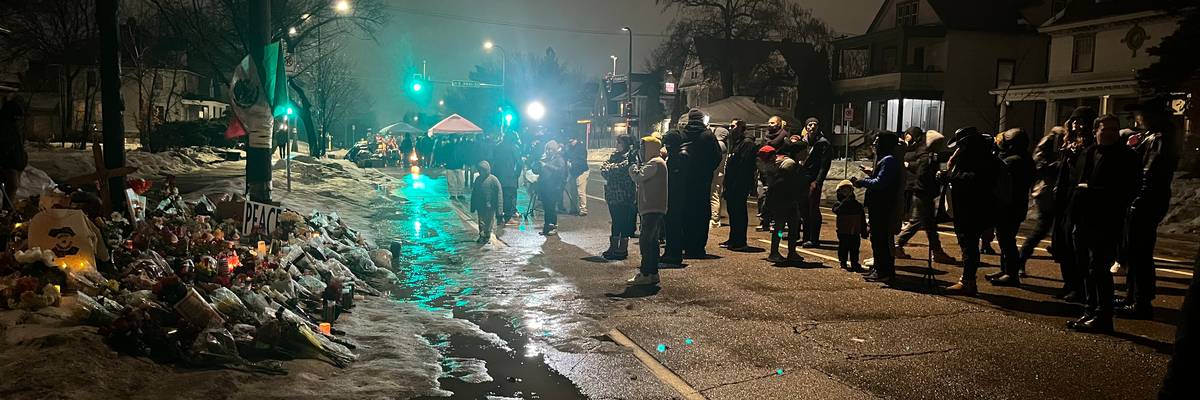
People attend a makeshift vigil for Renee Good in Minneapolis, Minnesota.
This model is also a map; it shows us how to leave the open space of privilege and move toward the center of the proverbial prison where a long line of people wait to be murdered with our money. And yet, if we follow this map, then freedom may be our reward.
On the evening of January 8, a friend and I parked our car in Minneapolis' Powderhorn neighborhood where Renee Good—a white, unarmed mother of three—was murdered by a federal agent. We proceeded on foot because mourners had cordoned off several blocks of Portland Avenue into a mostly quiet commons where people, instead of passing by, wandered and conversed. We walked for perhaps 1,000 feet among strangers, and we discovered a crime scene that had been transformed, overnight, into a place of pilgrimage.
Traveling south, we passed through two barricades. At the first, two young men stood behind a section of mobile fence that usually indicates a detour at a construction site. A traffic sign hanging on the fence was overwritten with a red spray-painted message: Fuck ICE. The men calmly waved their arms to alert oncoming traffic that this was a turning point.
Two white tents stood behind the second barricade, composed of wooden pallets, traffic cones, and plastic trash bins. Beneath these tents, volunteers distributed bottles of water and food from foil trays. They chatted amiably and laughed with one another. Further north, fires burned in a pair of steel barrels, one near and one far, lighting hands and faces within the outer dark.
Beyond the second blaze and across 33rd Street, we joined a broken circle of those holding vigil. With phones aglow, people recorded the flickering candles. They circled the profusion of frozen flowers. Mostly, they stood in silence with their arms around friends and loved ones.
If I tell my spouse I'm horrified that a masked gunman, on government payroll, killed a nonviolent protester, and I do nothing else, then have I chosen to accept it?
On the way back to our car—two middle-aged white men with homes in neighborhoods full of unlocked doors—we dodged black puddles, shuffled across patches of ice, and I thought of "A Hanging," George Orwell's masterwork on the numbing agents of distance and privilege.
In the essay, Orwell, who worked as an Imperial Police Officer from 1922 to 1927, describes how the hanging of a Burmese prisoner by British jailers is disrupted by unexpected empathies. A dog sprints toward the prisoner and licks his face; the prisoner uses a few of his final steps to avoid a puddle and keep his feet dry. Close enough to notice these tiny bursts of vitality, the narrator begins to feel sorrow over the particularity of the man's existence and how any single death leaves us all "with one mind less, one world less."
Then, when his noose is fixed, the prisoner begins to chant the name of his god from the gallows. And that is too much, too near, an intolerable call to attention for the jailers, warders, and magistrates standing yards away. So, the superintendent snaps the order, the prisoner is "vanished," and the rope begins "twisting on itself".
What happens next, though, is what allows the essay to transcend time, space, and experience—what makes it so awfully personal. Clearly shaken, the superintendent leads Orwell and his colleagues out of the gallows yard, past other men waiting to be hung. Upon entering the central yard, they find some reprieve: Convicts, not yet condemned, eating their breakfast—a "jolly scene, after the hanging."
The overseers begin to joke about past executions, and by the time they exit the prison gates, everyone is laughing. The further they flee, the better they feel. At last, they retrieve a bottle of whiskey from the superintendent's car and put the matter fully behind them. How far behind? With a final sentence, Orwell reminds us: "The dead man was a hundred yards away."
Throughout the essay, Orwell demonstrates how it's easier to be someone standing by than to be someone standing beside. It's easier to look on from afar than to see what is near. It's more comfortable to understand our choices vaguely, as the instruments of an order that is beyond our control, rather than specifically, as forces that inflict pain on strangers. In the end, it is preferable to regard violence inflicted on other people as if it were weather visiting some faraway place.
As we walked away from the streetlight where Renee Good's car came to a stop—one mind less, one world less—my own mind began to churn. What level of acceptance have distance and privilege inspired in me? If I tell my spouse I'm horrified that a masked gunman, on government payroll, killed a nonviolent protester, and I do nothing else, then have I chosen to accept it? What if I attend this vigil and nothing more, how many yards from the execution will I be? Far enough to put it behind me?
Today, Orwell's implicit critique of imperial insensitivity could be read as a tremor that presaged the earthquake of Omar El Akkad's One Day, Everyone Will Have Always Been Against This, an explicit indictment of Americans' privileged addiction to normalcy and of our willingness to accept mass murder, in Gaza and so many other places, as a normal outcome of American life.
"Perhaps [what] it comes to, in the end, is some pathetic adherence to the idea that certain peoples simply need to be crushed," El Akkad writes. "But whoever subscribes to this idea should at least have the spine to embrace it. To look upon the body of the little girl hanging from the wall, limbs severed by the force of the blast, and say: I'm fine with this, I am this."
A block from where Renee Good's bullet-torn body lay 36 hours earlier, I could sense in myself this shameful fear that my own normalcy might be discontinued. I could already feel that unconscious scheming to which I, like so many Americans, am accustomed. How much do I have to circumscribe my role and responsibilities to feel like I am fine with this? How far do I have to walk before I begin to feel that her body doesn't exist?
This model is simple. It requires us to put our bodies on the line and to ask ourselves what, precisely, are we giving up to alleviate the suffering of others?
As we passed back through the penultimate barricade, a man called out to us. With one hand, he lifted the topmost cup from a small Styrofoam tower. With the other, he depressed a black air pot. Then, he passed the steaming cup into my freezing hands, and the aroma of chai spices entered my lungs. "Somali tea," he smiled. "Black tea with milk."
Awakened, I lifted my eyes again to the sudden solidarity that kept Portland Avenue from returning to normal. The convivial spirit of confrontation reminded me of experiences I'd had in Guatemala 20 years earlier, living and volunteering among people who instinctively placed their bodies on the line without regard for the precious barriers of privilege. The conversion of a crime scene—by people who appreciate the consequences of vanishing bodies better than me—into a sanctuary for insubordinate grief felt powerfully abnormal. These people were breaking routines and beginning to engage in actual resistance.
"Th[e] work of leaving," El Akkad writes, "of aiming to challenge power on the field where it maintains the least glaring asymmetry, demands one answer the question: What are you willing to give up to alleviate someone else's suffering?"
"A Hanging" showcases the usual answer offered by people, like me, who are either enriched by empire or not harmed by its enrichment. That answer is nothing. Of course, our obligation—in the past, in the future, and certainly now—is to ask and answer this question differently.
Presently, thousands of Minneapolitans are modeling this transformation by standing watch on street corners armed with nothing but whistles, by organizing direct action that results in the arrest of protesters by the busload, by providing food and shelter to migrants targeted by Immigration and Customs Enforcement, and by actively and publicly grieving each new murder, every loss of human life.
This model is simple. It requires us to put our bodies on the line and to ask ourselves what, precisely, are we giving up to alleviate the suffering of others? It requires us to keep stepping forward and to continue asking: Are we risking something valuable enough to register in the conscience of strangers? Are we risking enough to register as a nonviolent threat to the architects of unconscionable violence? It requires us to persist, further and further beyond the fortified walls of our comfort zones, until our answers to these questions are overwhelmingly affirmative.
This model is also a map. It shows us how to leave the open space of privilege and move toward the center of the proverbial prison where a long line of people wait to be murdered with our money. And yet, if we follow this map, then freedom may be our reward.
If we follow, then we will be free to help ourselves and others. We will be free to express, with our whole body, what we were only willing to say to close friends or trusted colleagues in the past. We will be free to say: No, I am not this. I am changed.
This country and this world are at a monumental crossroads. US voters have an opportunity to beat back the forces of fascism and confront the billionaires who are rigging the economy, our media system, and our democracy, making it increasingly impossible for ordinary people to get by. We’re not just talking about the election. We’re talking about what must be done once these fascist elements are vanquished from power. We need a bolder set of solutions than what either major party has so far been willing to offer and a working-class movement ready to fight like hell for it. Trump didn't emerge from nowhere. The conditions that fueled MAGA authoritarianism were created by decades of radical neoliberal economic policies and a corrupt political system dominated by corporate interests. They slashed taxes on the super-rich, promising that the benefits would trickle down. They said giveaways to the corporate titans would make life more affordable for the rest of us. It was all bullshit. And when a bitter, betrayed populace searches for someone to blame, right-wing demagogues have little trouble finding scapegoats. People know when they're being lied to, but you won't hear any of this from the corporate media. Only independent journalism—powered and funded by people who believe in building a better world—can deliver truly trustworthy daily news. If you share our vision, please contribute whatever you can to sustain our work. |
On the evening of January 8, a friend and I parked our car in Minneapolis' Powderhorn neighborhood where Renee Good—a white, unarmed mother of three—was murdered by a federal agent. We proceeded on foot because mourners had cordoned off several blocks of Portland Avenue into a mostly quiet commons where people, instead of passing by, wandered and conversed. We walked for perhaps 1,000 feet among strangers, and we discovered a crime scene that had been transformed, overnight, into a place of pilgrimage.
Traveling south, we passed through two barricades. At the first, two young men stood behind a section of mobile fence that usually indicates a detour at a construction site. A traffic sign hanging on the fence was overwritten with a red spray-painted message: Fuck ICE. The men calmly waved their arms to alert oncoming traffic that this was a turning point.
Two white tents stood behind the second barricade, composed of wooden pallets, traffic cones, and plastic trash bins. Beneath these tents, volunteers distributed bottles of water and food from foil trays. They chatted amiably and laughed with one another. Further north, fires burned in a pair of steel barrels, one near and one far, lighting hands and faces within the outer dark.
Beyond the second blaze and across 33rd Street, we joined a broken circle of those holding vigil. With phones aglow, people recorded the flickering candles. They circled the profusion of frozen flowers. Mostly, they stood in silence with their arms around friends and loved ones.
If I tell my spouse I'm horrified that a masked gunman, on government payroll, killed a nonviolent protester, and I do nothing else, then have I chosen to accept it?
On the way back to our car—two middle-aged white men with homes in neighborhoods full of unlocked doors—we dodged black puddles, shuffled across patches of ice, and I thought of "A Hanging," George Orwell's masterwork on the numbing agents of distance and privilege.
In the essay, Orwell, who worked as an Imperial Police Officer from 1922 to 1927, describes how the hanging of a Burmese prisoner by British jailers is disrupted by unexpected empathies. A dog sprints toward the prisoner and licks his face; the prisoner uses a few of his final steps to avoid a puddle and keep his feet dry. Close enough to notice these tiny bursts of vitality, the narrator begins to feel sorrow over the particularity of the man's existence and how any single death leaves us all "with one mind less, one world less."
Then, when his noose is fixed, the prisoner begins to chant the name of his god from the gallows. And that is too much, too near, an intolerable call to attention for the jailers, warders, and magistrates standing yards away. So, the superintendent snaps the order, the prisoner is "vanished," and the rope begins "twisting on itself".
What happens next, though, is what allows the essay to transcend time, space, and experience—what makes it so awfully personal. Clearly shaken, the superintendent leads Orwell and his colleagues out of the gallows yard, past other men waiting to be hung. Upon entering the central yard, they find some reprieve: Convicts, not yet condemned, eating their breakfast—a "jolly scene, after the hanging."
The overseers begin to joke about past executions, and by the time they exit the prison gates, everyone is laughing. The further they flee, the better they feel. At last, they retrieve a bottle of whiskey from the superintendent's car and put the matter fully behind them. How far behind? With a final sentence, Orwell reminds us: "The dead man was a hundred yards away."
Throughout the essay, Orwell demonstrates how it's easier to be someone standing by than to be someone standing beside. It's easier to look on from afar than to see what is near. It's more comfortable to understand our choices vaguely, as the instruments of an order that is beyond our control, rather than specifically, as forces that inflict pain on strangers. In the end, it is preferable to regard violence inflicted on other people as if it were weather visiting some faraway place.
As we walked away from the streetlight where Renee Good's car came to a stop—one mind less, one world less—my own mind began to churn. What level of acceptance have distance and privilege inspired in me? If I tell my spouse I'm horrified that a masked gunman, on government payroll, killed a nonviolent protester, and I do nothing else, then have I chosen to accept it? What if I attend this vigil and nothing more, how many yards from the execution will I be? Far enough to put it behind me?
Today, Orwell's implicit critique of imperial insensitivity could be read as a tremor that presaged the earthquake of Omar El Akkad's One Day, Everyone Will Have Always Been Against This, an explicit indictment of Americans' privileged addiction to normalcy and of our willingness to accept mass murder, in Gaza and so many other places, as a normal outcome of American life.
"Perhaps [what] it comes to, in the end, is some pathetic adherence to the idea that certain peoples simply need to be crushed," El Akkad writes. "But whoever subscribes to this idea should at least have the spine to embrace it. To look upon the body of the little girl hanging from the wall, limbs severed by the force of the blast, and say: I'm fine with this, I am this."
A block from where Renee Good's bullet-torn body lay 36 hours earlier, I could sense in myself this shameful fear that my own normalcy might be discontinued. I could already feel that unconscious scheming to which I, like so many Americans, am accustomed. How much do I have to circumscribe my role and responsibilities to feel like I am fine with this? How far do I have to walk before I begin to feel that her body doesn't exist?
This model is simple. It requires us to put our bodies on the line and to ask ourselves what, precisely, are we giving up to alleviate the suffering of others?
As we passed back through the penultimate barricade, a man called out to us. With one hand, he lifted the topmost cup from a small Styrofoam tower. With the other, he depressed a black air pot. Then, he passed the steaming cup into my freezing hands, and the aroma of chai spices entered my lungs. "Somali tea," he smiled. "Black tea with milk."
Awakened, I lifted my eyes again to the sudden solidarity that kept Portland Avenue from returning to normal. The convivial spirit of confrontation reminded me of experiences I'd had in Guatemala 20 years earlier, living and volunteering among people who instinctively placed their bodies on the line without regard for the precious barriers of privilege. The conversion of a crime scene—by people who appreciate the consequences of vanishing bodies better than me—into a sanctuary for insubordinate grief felt powerfully abnormal. These people were breaking routines and beginning to engage in actual resistance.
"Th[e] work of leaving," El Akkad writes, "of aiming to challenge power on the field where it maintains the least glaring asymmetry, demands one answer the question: What are you willing to give up to alleviate someone else's suffering?"
"A Hanging" showcases the usual answer offered by people, like me, who are either enriched by empire or not harmed by its enrichment. That answer is nothing. Of course, our obligation—in the past, in the future, and certainly now—is to ask and answer this question differently.
Presently, thousands of Minneapolitans are modeling this transformation by standing watch on street corners armed with nothing but whistles, by organizing direct action that results in the arrest of protesters by the busload, by providing food and shelter to migrants targeted by Immigration and Customs Enforcement, and by actively and publicly grieving each new murder, every loss of human life.
This model is simple. It requires us to put our bodies on the line and to ask ourselves what, precisely, are we giving up to alleviate the suffering of others? It requires us to keep stepping forward and to continue asking: Are we risking something valuable enough to register in the conscience of strangers? Are we risking enough to register as a nonviolent threat to the architects of unconscionable violence? It requires us to persist, further and further beyond the fortified walls of our comfort zones, until our answers to these questions are overwhelmingly affirmative.
This model is also a map. It shows us how to leave the open space of privilege and move toward the center of the proverbial prison where a long line of people wait to be murdered with our money. And yet, if we follow this map, then freedom may be our reward.
If we follow, then we will be free to help ourselves and others. We will be free to express, with our whole body, what we were only willing to say to close friends or trusted colleagues in the past. We will be free to say: No, I am not this. I am changed.