

SUBSCRIBE TO OUR FREE NEWSLETTER
Daily news & progressive opinion—funded by the people, not the corporations—delivered straight to your inbox.
5
#000000
#FFFFFF
To donate by check, phone, or other method, see our More Ways to Give page.
Daily news & progressive opinion—funded by the people, not the corporations—delivered straight to your inbox.
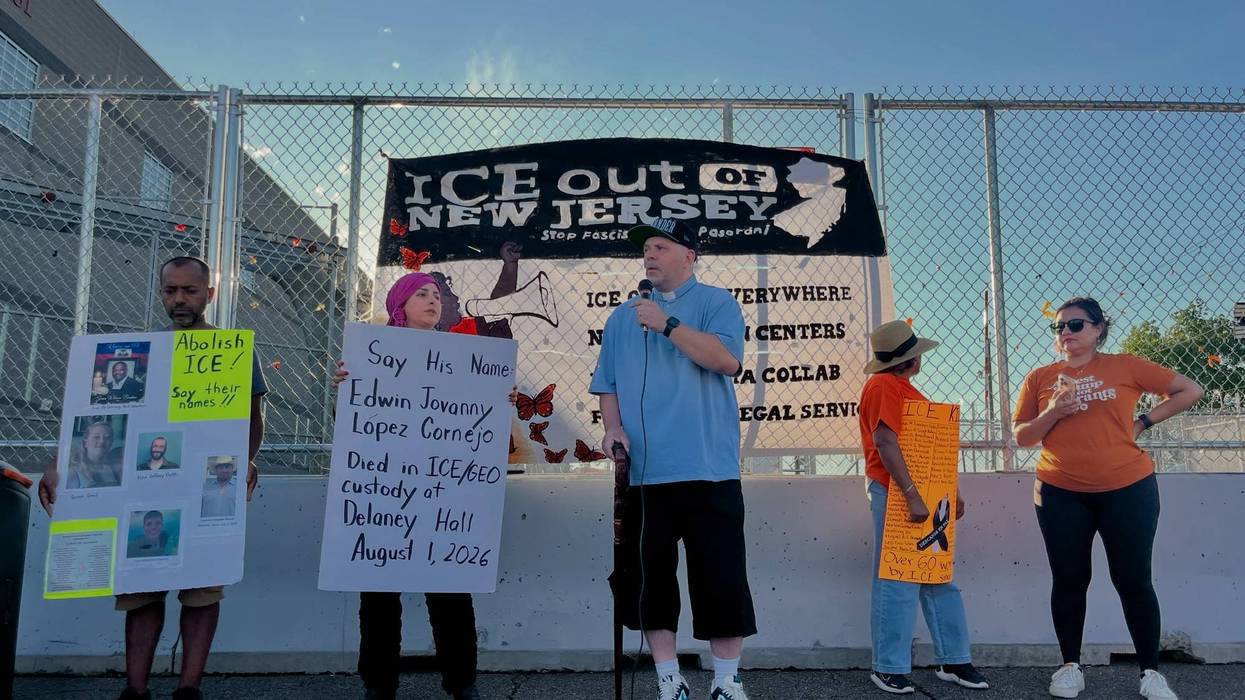
By rescinding policies that mandate accountability and oversight, while simultaneously purchasing privately held detention centers, the Trump administration is working to hide the abuses, death, and violence occurring at their facilities.
On August 1, Edwin Lopez-Cornejo, a Salvadorian migrant imprisoned at the Delaney Hall Detention Facility in Newark, died.
While Immigration and Customs Enforcement (ICE) insists that Lopez-Cornejo “received proper medical care and was seen by medical professionals” while in custody, there are reasons to be doubtful. In May, 300 detainees launched a labor and hunger strike protesting medical neglect, being fed spoiled and rotten food, and other “torturous” conditions.
In June, Gothamist reported that more than 70 detainees at Delaney Hall had filed federal lawsuits alleging medical neglect. That includes 30 who claim they were denied prescribed medications for chronic conditions such as asthma, epilepsy, diabetes, and cancer.
Lopez-Cornejo likely experienced the same. Rep. Rob Menendez (D-NJ) said he spoke with ICE officials who told him Lopez-Cornejo had expressed feeling dizzy and fatigued earlier that day. Menendez further added, “We asked certain medical questions, which ICE couldn’t give us answers to.”
Detention centers have always been deadly. Under Trump, ICE is doing everything it can to make them even more dangerous.
Lopez-Cornejo had been prescribed medication for diabetes, high blood pressure, and seizures—conditions that, if not properly treated, can lead to those symptoms as well as death. In an interview, his mother, Maria Cornejo, explained, “That is one of the reasons that I believe caused the death of my son, the negligence—that he wasn't given his medication that he had to take.”
Lopez-Cornejo is at least the 23rd person to die in ICE custody this year. In 2025, at least 33 people died in detention centers—the highest total in more than two decades according to the National Immigration Project.
Importantly, those numbers only represent the deaths that ICE has reported. During his visit to Delaney Hall on August 3, Menendez learned that another detainee had died at the detention center last month. That death was not reported because ICE agents had granted him a “discretionary release” in the middle of his medical emergency.
In June, ICE rescinded a Biden-era policy that required them to report on the deaths of detainees that occurred within 30 days of their release. ICE is now exploiting this change to obscure their death count.
And this is just the tip of the iceberg. In July, the Department of Homeland Security (DHS) purchased the Otay Mesa Detention Center and the California City Detention Facility for $1.5 billion from the private prison company CoreCivic.
According to an ICE spokesperson, these purchases were necessary because “the state’s sanctuary politicians continue to push legislation to outlaw or make private prisons financially infeasible.” Shifting ownership from CoreCivic to the federal government circumvents these measures, thereby allowing ICE to retain “crucial” detention capacity.
This, however, is not all it does. In 2025, California passed legislation that granted its Department of Justice (DOJ) oversight to regularly inspect and report on the conditions of “county, local, or private locked detention facilities in which noncitizens are being housed or detained for purposes of civil immigration proceedings.” In June 2026, the California DOJ found that conditions at Otay Mesa were overcrowded and dirty. Medical recordkeeping was “disorganized and violated PBNDS [Performance-Based National Detention Standards] requirements” which resulted in “lapses in basic care.” At California City, the department found that detainees spent “unnecessarily long periods locked down in their cells” and experienced “extremely cold temperatures, with leaks during rainy periods.” California DOJ reported that healthcare infrastructure and systems at the center were “inadequate,” including “crisis-level health care understaffing.”
By taking ownership of those detention centers, the Trump administration is placing them beyond the reach of state inspections. As Alexa Van Brunt, the Director of the Illinois office at the McArthur Justice Center, explains, inspection reports are crucial in lawsuits alleging constitutional violations. Without them, it is far more difficult to obtain evidence of ICE’s wrongdoings. “To that point,” she remarks, “it will make it more onerous to hold DHS liable.”
It is also worth emphasizing that while ownership is being transferred, CoreCivic will remain in charge of managing those facilities. Same management, same abuses, but now with less oversight—the perfect recipe for more unaccounted detainee deaths.
In July, CBS News reported that only 15 of the 45 detention centers holding 500 or more people had been inspected by ICE’s Office of Detention Oversight in the last 12 months. This follows a shift in ICE’s policies whereby dedicated facilities, which exclusively hold ICE detainees, are now inspected once a year rather than twice; and non-dedicated facilities, such as county jails, are inspected every other year.
Notably, ICE’s detention center purchases extend beyond sanctuary cities. On August 5, CoreCivic announced that ICE had purchased the Prairie Correctional Facility in Minnesota and the Midwest Regional Reception Center in Kansas for a total of $734 million. Both facilities were previously shut down—the former in 2010; and the latter in 2021 as the Biden administration shifted away from private prison contracts. CoreCivic had been struggling since last year to reopen Midwest Regional amid protest from local residents—in a famously pro-prison town that Trump won with more than 60% of the vote in 2024—and legal challenges from city officials. Now it will, despite their objections and with possibly fewer guardrails.
Officials with CoreCivic and The Geo Group—which owns Delaney Hall—have reportedly discussed selling several more sites to the Trump administration.
By rescinding policies that mandate accountability and oversight, while simultaneously purchasing privately held detention centers, the Trump administration is working to hide the abuses, death, and violence occurring at their facilities. At the same time, these purchases have been a major windfall for CoreCivic, which has used our taxpayer dollars to pay down its $600 million debt.
Detention centers have always been deadly. Under Trump, ICE is doing everything it can to make them even more dangerous. Before it's too late, Congress must act immediately to not only abolish ICE, but punish everyone involved in enacting their campaign of domestic terrorism and death.
"I don't want my son's death to go unanswered. If justice isn't served, they'll just keep doing this, and there's no telling how many more people in this country we might lose."
The mother of a man who became the second immigrant held at the notorious Delaney Hall US Immigration and Customs Enforcement lockup in Newark, New Jersey to die in ICE custody said Monday that she believes her son's death was the result of medical negligence.
Longtime Plainfield resident Edwin Jovanny López Cornejo, a 41-year-old Salvadoran national who had reportedly entered the United States as a child, died Saturday at University Hospital. He had a 12-year-old daughter.
According to ICE, López Cornejo "experienced a medical emergency," and staff at Delaney Hall—which is run by prison profiteer GEO Group—"responded immediately and called 911 for emergency medical services."
However, in a video interview posted on Facebook by the immigrant justice group Movimiento Cosecha, López Cornejo's mother, María Cornejo said that her son had been prescribed medication for diabetes, high blood pressure, and seizures, and that she suspects that staff at Delaney Hall may not have given him his medicines during the six weeks he was held there.
Cornejo said Lopéz Cornejo called her the night before his death and said that something was wrong.
“He said his right hand and face were numb," she said. "He told me he was going to be examined, but I don’t know if he actually received care. I also don’t know if he was being given his medication.”
According to Cornejo, University Hospital informed her of her son's death, saying he arrived at the facility lifeless.
Congressman Bob Menendez (D-NJ) said ICE told him that López Cornejo was administered CPR during some of the 37 minutes it took for first responders to arrive.
"That is one of the reasons that I believe caused the death of my son, the negligence—that he wasn't given his medication that he had to take," Cornejo told Movimiento Cosecha.
ICE said that "while in custody, López Cornejo received proper medical care and was seen by medical professionals."
Numerous Democratic politicians from New Jersey and beyond called for the immediate closure of Delaney Hall, which has become a symbol of broader concerns about President Donald Trump's deadly anti-immigrant crackdown, detention in what some critics call concentration camps, aggressive enforcement, and prison profiteering.
Among them was recently elected progressive Congresswoman Analilia Mejia, who represents the district adjacent to the one in which Delaney Hall is located.
"My gravest concerns about conditions for medically vulnerable people at Delaney Hall are now confirmed," she wrote in a statement.
"Under these conditions, medically vulnerable people are being given death sentences due to the lack of care."
"This is not the first life we’ve lost inside that facility," Mejia continued, referring to Haitian national Jean Wilson Brutus, also 41, who collapsed and died there in December of what a medical examiner said was a lung blockage.
New Jersey’s own health inspectors have been denied full access, including the medical unit, again and again. If there’s nothing to hide, there’s no reason to keep them out," Mejia said.
"DHS must carry out a full, independent investigation," she demanded. "This family, and New Jersey, deserve real answers, justice, and accountability. Under these conditions, medically vulnerable people are being given death sentences due to the lack of care."
"Delaney Hall must be shut down," Mejia added. "Abolishing and replacing ICE is the only way to correct this—a system that lets this happen again and again cannot be reformed. It must be rebuilt around human dignity.”
At least 56 people have died while in ICE custody during Trump's second term.
Congresswoman Bonnie Watson Coleman (D-NJ) said that López Cornejo's "detention alone was an act of cruelty, and if he indeed was denied his medication as his family reports, the operators at Delaney Hall should be charged with homicide."
"A second person has died at the for-profit prison. Delaney Hall is a stain on our country. Its continued use is a daily reminder of the cruelty of our immigration and criminal justice systems. It should be shut down at once, and those responsible for its inhumane conditions should be investigated and tried.”
Delaney Hall has become one of the nation's most controversial immigration detention centers since reopening in 2025. Detainees have reported inadequate food, poor sanitation, overcrowding, retaliation for protests, and delayed access to medical treatment. Earlier this year, hunger strikes and demonstrations drew national attention, while lawmakers who repeatedly sought access to inspect conditions inside the facility were attacked along with protesters.
Democratic New Jersey Gov. Mikie Sherrill said she was "deeply disturbed" by López Cornejo's death.
"I have long opposed the use of private, for-profit prisons operating in a space that should be reserved for government,” Sherrill said in a statement. “Corporations should not have the right to monetize imprisoning people while avoiding public accountability. This is why we are fighting to close Delaney Hall, and why we will continue using every tool available to stop new private detention facilities—like the proposed facility in Roxbury—from opening their doors."
Newark Mayor Ras Baraka, a Democrat, released a statement on social media:
Civil rights and immigrant defense groups condemned López Cornejo's death.
"This tragedy is another devastating result of the rampant inhumane conditions at Delaney Hall and detention centers across the country, including the routine denial of proper medical care, sanitary conditions, and food," ACLU of New Jersey executive director Amol Sinha said in a statement.
"The Trump administration’s detention and deportation machine continues to terrorize and traumatize communities at an unprecedented level, yet numbers cannot encapsulate the grief and devastation that these abuses cause," Sinha added. "We demand accountability from ICE, the immediate closure of Delaney Hall, and an end to immigration detention once and for all.”
Jorge Torres, organizing director of the National Day Laborer Organizing Network, said that “Edwin Jeovanny López Cornejo should be alive today. His death was preventable, and his family deserves answers, accountability, and justice."
Cornejo told Movimiento Cosecha that she wants "justice" for her son.
“These men go around grabbing hard-working people,” she said of federal immigration enforcers. “This country moves forward because of immigrants... But they don’t see that. They only see the damage they are doing, but they don’t see the good things one does in this country.”
"I don't want my son's death to go unanswered," Cornejo added. "If justice isn't served, they'll just keep doing this, and there's no telling how many more people in this country we might lose."