SUBSCRIBE TO OUR FREE NEWSLETTER
Daily news & progressive opinion—funded by the people, not the corporations—delivered straight to your inbox.
5
#000000
#FFFFFF
To donate by check, phone, or other method, see our More Ways to Give page.
Daily news & progressive opinion—funded by the people, not the corporations—delivered straight to your inbox.
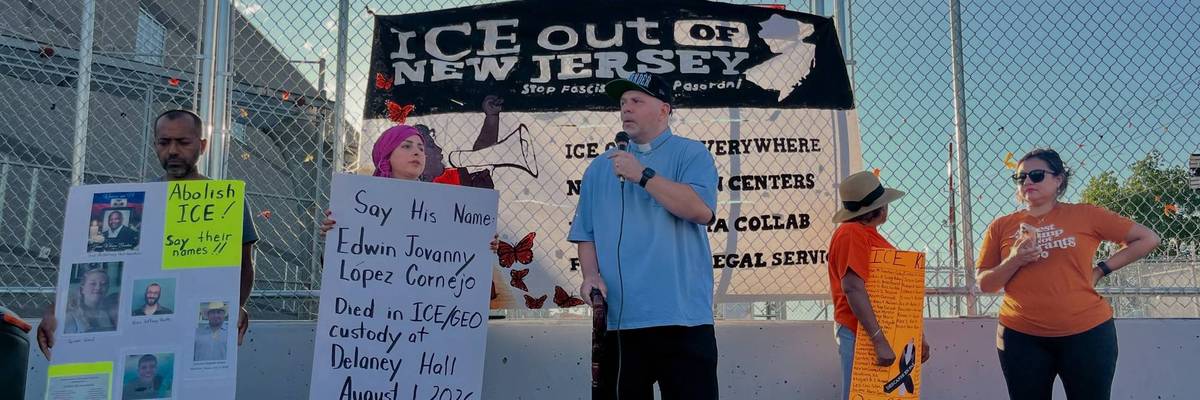
By rescinding policies that mandate accountability and oversight, while simultaneously purchasing privately held detention centers, the Trump administration is working to hide the abuses, death, and violence occurring at their facilities.
On August 1, Edwin Lopez-Cornejo, a Salvadorian migrant imprisoned at the Delaney Hall Detention Facility in Newark, died.
While Immigration and Customs Enforcement (ICE) insists that Lopez-Cornejo “received proper medical care and was seen by medical professionals” while in custody, there are reasons to be doubtful. In May, 300 detainees launched a labor and hunger strike protesting medical neglect, being fed spoiled and rotten food, and other “torturous” conditions.
In June, Gothamist reported that more than 70 detainees at Delaney Hall had filed federal lawsuits alleging medical neglect. That includes 30 who claim they were denied prescribed medications for chronic conditions such as asthma, epilepsy, diabetes, and cancer.
Lopez-Cornejo likely experienced the same. Rep. Rob Menendez (D-NJ) said he spoke with ICE officials who told him Lopez-Cornejo had expressed feeling dizzy and fatigued earlier that day. Menendez further added, “We asked certain medical questions, which ICE couldn’t give us answers to.”
Detention centers have always been deadly. Under Trump, ICE is doing everything it can to make them even more dangerous.
Lopez-Cornejo had been prescribed medication for diabetes, high blood pressure, and seizures—conditions that, if not properly treated, can lead to those symptoms as well as death. In an interview, his mother, Maria Cornejo, explained, “That is one of the reasons that I believe caused the death of my son, the negligence—that he wasn't given his medication that he had to take.”
Lopez-Cornejo is at least the 23rd person to die in ICE custody this year. In 2025, at least 33 people died in detention centers—the highest total in more than two decades according to the National Immigration Project.
Importantly, those numbers only represent the deaths that ICE has reported. During his visit to Delaney Hall on August 3, Menendez learned that another detainee had died at the detention center last month. That death was not reported because ICE agents had granted him a “discretionary release” in the middle of his medical emergency.
In June, ICE rescinded a Biden-era policy that required them to report on the deaths of detainees that occurred within 30 days of their release. ICE is now exploiting this change to obscure their death count.
And this is just the tip of the iceberg. In July, the Department of Homeland Security (DHS) purchased the Otay Mesa Detention Center and the California City Detention Facility for $1.5 billion from the private prison company CoreCivic.
According to an ICE spokesperson, these purchases were necessary because “the state’s sanctuary politicians continue to push legislation to outlaw or make private prisons financially infeasible.” Shifting ownership from CoreCivic to the federal government circumvents these measures, thereby allowing ICE to retain “crucial” detention capacity.
This, however, is not all it does. In 2025, California passed legislation that granted its Department of Justice (DOJ) oversight to regularly inspect and report on the conditions of “county, local, or private locked detention facilities in which noncitizens are being housed or detained for purposes of civil immigration proceedings.” In June 2026, the California DOJ found that conditions at Otay Mesa were overcrowded and dirty. Medical recordkeeping was “disorganized and violated PBNDS [Performance-Based National Detention Standards] requirements” which resulted in “lapses in basic care.” At California City, the department found that detainees spent “unnecessarily long periods locked down in their cells” and experienced “extremely cold temperatures, with leaks during rainy periods.” California DOJ reported that healthcare infrastructure and systems at the center were “inadequate,” including “crisis-level health care understaffing.”
By taking ownership of those detention centers, the Trump administration is placing them beyond the reach of state inspections. As Alexa Van Brunt, the Director of the Illinois office at the McArthur Justice Center, explains, inspection reports are crucial in lawsuits alleging constitutional violations. Without them, it is far more difficult to obtain evidence of ICE’s wrongdoings. “To that point,” she remarks, “it will make it more onerous to hold DHS liable.”
It is also worth emphasizing that while ownership is being transferred, CoreCivic will remain in charge of managing those facilities. Same management, same abuses, but now with less oversight—the perfect recipe for more unaccounted detainee deaths.
In July, CBS News reported that only 15 of the 45 detention centers holding 500 or more people had been inspected by ICE’s Office of Detention Oversight in the last 12 months. This follows a shift in ICE’s policies whereby dedicated facilities, which exclusively hold ICE detainees, are now inspected once a year rather than twice; and non-dedicated facilities, such as county jails, are inspected every other year.
Notably, ICE’s detention center purchases extend beyond sanctuary cities. On August 5, CoreCivic announced that ICE had purchased the Prairie Correctional Facility in Minnesota and the Midwest Regional Reception Center in Kansas for a total of $734 million. Both facilities were previously shut down—the former in 2010; and the latter in 2021 as the Biden administration shifted away from private prison contracts. CoreCivic had been struggling since last year to reopen Midwest Regional amid protest from local residents—in a famously pro-prison town that Trump won with more than 60% of the vote in 2024—and legal challenges from city officials. Now it will, despite their objections and with possibly fewer guardrails.
Officials with CoreCivic and The Geo Group—which owns Delaney Hall—have reportedly discussed selling several more sites to the Trump administration.
By rescinding policies that mandate accountability and oversight, while simultaneously purchasing privately held detention centers, the Trump administration is working to hide the abuses, death, and violence occurring at their facilities. At the same time, these purchases have been a major windfall for CoreCivic, which has used our taxpayer dollars to pay down its $600 million debt.
Detention centers have always been deadly. Under Trump, ICE is doing everything it can to make them even more dangerous. Before it's too late, Congress must act immediately to not only abolish ICE, but punish everyone involved in enacting their campaign of domestic terrorism and death.
Dear Common Dreams reader, It’s been nearly 30 years since I co-founded Common Dreams with my late wife, Lina Newhouser. We had the radical notion that journalism should serve the public good, not corporate profits. It was clear to us from the outset what it would take to build such a project. No paid advertisements. No corporate sponsors. No millionaire publisher telling us what to think or do. Many people said we wouldn't last a year, but we proved those doubters wrong. Together with a tremendous team of journalists and dedicated staff, we built an independent media outlet free from the constraints of profits and corporate control. Our mission has always been simple: To inform. To inspire. To ignite change for the common good. Building Common Dreams was not easy. Our survival was never guaranteed. When you take on the most powerful forces—Wall Street greed, fossil fuel industry destruction, Big Tech lobbyists, and uber-rich oligarchs who have spent billions upon billions rigging the economy and democracy in their favor—the only bulwark you have is supporters who believe in your work. But here’s the urgent message from me today. It's never been this bad out there. And it's never been this hard to keep us going. At the very moment Common Dreams is most needed, the threats we face are intensifying. We need your support now more than ever. We don't accept corporate advertising and never will. We don't have a paywall because we don't think people should be blocked from critical news based on their ability to pay. Everything we do is funded by the donations of readers like you. When everyone does the little they can afford, we are strong. But if that support retreats or dries up, so do we. Will you donate now to make sure Common Dreams not only survives but thrives? —Craig Brown, Co-founder |
On August 1, Edwin Lopez-Cornejo, a Salvadorian migrant imprisoned at the Delaney Hall Detention Facility in Newark, died.
While Immigration and Customs Enforcement (ICE) insists that Lopez-Cornejo “received proper medical care and was seen by medical professionals” while in custody, there are reasons to be doubtful. In May, 300 detainees launched a labor and hunger strike protesting medical neglect, being fed spoiled and rotten food, and other “torturous” conditions.
In June, Gothamist reported that more than 70 detainees at Delaney Hall had filed federal lawsuits alleging medical neglect. That includes 30 who claim they were denied prescribed medications for chronic conditions such as asthma, epilepsy, diabetes, and cancer.
Lopez-Cornejo likely experienced the same. Rep. Rob Menendez (D-NJ) said he spoke with ICE officials who told him Lopez-Cornejo had expressed feeling dizzy and fatigued earlier that day. Menendez further added, “We asked certain medical questions, which ICE couldn’t give us answers to.”
Detention centers have always been deadly. Under Trump, ICE is doing everything it can to make them even more dangerous.
Lopez-Cornejo had been prescribed medication for diabetes, high blood pressure, and seizures—conditions that, if not properly treated, can lead to those symptoms as well as death. In an interview, his mother, Maria Cornejo, explained, “That is one of the reasons that I believe caused the death of my son, the negligence—that he wasn't given his medication that he had to take.”
Lopez-Cornejo is at least the 23rd person to die in ICE custody this year. In 2025, at least 33 people died in detention centers—the highest total in more than two decades according to the National Immigration Project.
Importantly, those numbers only represent the deaths that ICE has reported. During his visit to Delaney Hall on August 3, Menendez learned that another detainee had died at the detention center last month. That death was not reported because ICE agents had granted him a “discretionary release” in the middle of his medical emergency.
In June, ICE rescinded a Biden-era policy that required them to report on the deaths of detainees that occurred within 30 days of their release. ICE is now exploiting this change to obscure their death count.
And this is just the tip of the iceberg. In July, the Department of Homeland Security (DHS) purchased the Otay Mesa Detention Center and the California City Detention Facility for $1.5 billion from the private prison company CoreCivic.
According to an ICE spokesperson, these purchases were necessary because “the state’s sanctuary politicians continue to push legislation to outlaw or make private prisons financially infeasible.” Shifting ownership from CoreCivic to the federal government circumvents these measures, thereby allowing ICE to retain “crucial” detention capacity.
This, however, is not all it does. In 2025, California passed legislation that granted its Department of Justice (DOJ) oversight to regularly inspect and report on the conditions of “county, local, or private locked detention facilities in which noncitizens are being housed or detained for purposes of civil immigration proceedings.” In June 2026, the California DOJ found that conditions at Otay Mesa were overcrowded and dirty. Medical recordkeeping was “disorganized and violated PBNDS [Performance-Based National Detention Standards] requirements” which resulted in “lapses in basic care.” At California City, the department found that detainees spent “unnecessarily long periods locked down in their cells” and experienced “extremely cold temperatures, with leaks during rainy periods.” California DOJ reported that healthcare infrastructure and systems at the center were “inadequate,” including “crisis-level health care understaffing.”
By taking ownership of those detention centers, the Trump administration is placing them beyond the reach of state inspections. As Alexa Van Brunt, the Director of the Illinois office at the McArthur Justice Center, explains, inspection reports are crucial in lawsuits alleging constitutional violations. Without them, it is far more difficult to obtain evidence of ICE’s wrongdoings. “To that point,” she remarks, “it will make it more onerous to hold DHS liable.”
It is also worth emphasizing that while ownership is being transferred, CoreCivic will remain in charge of managing those facilities. Same management, same abuses, but now with less oversight—the perfect recipe for more unaccounted detainee deaths.
In July, CBS News reported that only 15 of the 45 detention centers holding 500 or more people had been inspected by ICE’s Office of Detention Oversight in the last 12 months. This follows a shift in ICE’s policies whereby dedicated facilities, which exclusively hold ICE detainees, are now inspected once a year rather than twice; and non-dedicated facilities, such as county jails, are inspected every other year.
Notably, ICE’s detention center purchases extend beyond sanctuary cities. On August 5, CoreCivic announced that ICE had purchased the Prairie Correctional Facility in Minnesota and the Midwest Regional Reception Center in Kansas for a total of $734 million. Both facilities were previously shut down—the former in 2010; and the latter in 2021 as the Biden administration shifted away from private prison contracts. CoreCivic had been struggling since last year to reopen Midwest Regional amid protest from local residents—in a famously pro-prison town that Trump won with more than 60% of the vote in 2024—and legal challenges from city officials. Now it will, despite their objections and with possibly fewer guardrails.
Officials with CoreCivic and The Geo Group—which owns Delaney Hall—have reportedly discussed selling several more sites to the Trump administration.
By rescinding policies that mandate accountability and oversight, while simultaneously purchasing privately held detention centers, the Trump administration is working to hide the abuses, death, and violence occurring at their facilities. At the same time, these purchases have been a major windfall for CoreCivic, which has used our taxpayer dollars to pay down its $600 million debt.
Detention centers have always been deadly. Under Trump, ICE is doing everything it can to make them even more dangerous. Before it's too late, Congress must act immediately to not only abolish ICE, but punish everyone involved in enacting their campaign of domestic terrorism and death.
On August 1, Edwin Lopez-Cornejo, a Salvadorian migrant imprisoned at the Delaney Hall Detention Facility in Newark, died.
While Immigration and Customs Enforcement (ICE) insists that Lopez-Cornejo “received proper medical care and was seen by medical professionals” while in custody, there are reasons to be doubtful. In May, 300 detainees launched a labor and hunger strike protesting medical neglect, being fed spoiled and rotten food, and other “torturous” conditions.
In June, Gothamist reported that more than 70 detainees at Delaney Hall had filed federal lawsuits alleging medical neglect. That includes 30 who claim they were denied prescribed medications for chronic conditions such as asthma, epilepsy, diabetes, and cancer.
Lopez-Cornejo likely experienced the same. Rep. Rob Menendez (D-NJ) said he spoke with ICE officials who told him Lopez-Cornejo had expressed feeling dizzy and fatigued earlier that day. Menendez further added, “We asked certain medical questions, which ICE couldn’t give us answers to.”
Detention centers have always been deadly. Under Trump, ICE is doing everything it can to make them even more dangerous.
Lopez-Cornejo had been prescribed medication for diabetes, high blood pressure, and seizures—conditions that, if not properly treated, can lead to those symptoms as well as death. In an interview, his mother, Maria Cornejo, explained, “That is one of the reasons that I believe caused the death of my son, the negligence—that he wasn't given his medication that he had to take.”
Lopez-Cornejo is at least the 23rd person to die in ICE custody this year. In 2025, at least 33 people died in detention centers—the highest total in more than two decades according to the National Immigration Project.
Importantly, those numbers only represent the deaths that ICE has reported. During his visit to Delaney Hall on August 3, Menendez learned that another detainee had died at the detention center last month. That death was not reported because ICE agents had granted him a “discretionary release” in the middle of his medical emergency.
In June, ICE rescinded a Biden-era policy that required them to report on the deaths of detainees that occurred within 30 days of their release. ICE is now exploiting this change to obscure their death count.
And this is just the tip of the iceberg. In July, the Department of Homeland Security (DHS) purchased the Otay Mesa Detention Center and the California City Detention Facility for $1.5 billion from the private prison company CoreCivic.
According to an ICE spokesperson, these purchases were necessary because “the state’s sanctuary politicians continue to push legislation to outlaw or make private prisons financially infeasible.” Shifting ownership from CoreCivic to the federal government circumvents these measures, thereby allowing ICE to retain “crucial” detention capacity.
This, however, is not all it does. In 2025, California passed legislation that granted its Department of Justice (DOJ) oversight to regularly inspect and report on the conditions of “county, local, or private locked detention facilities in which noncitizens are being housed or detained for purposes of civil immigration proceedings.” In June 2026, the California DOJ found that conditions at Otay Mesa were overcrowded and dirty. Medical recordkeeping was “disorganized and violated PBNDS [Performance-Based National Detention Standards] requirements” which resulted in “lapses in basic care.” At California City, the department found that detainees spent “unnecessarily long periods locked down in their cells” and experienced “extremely cold temperatures, with leaks during rainy periods.” California DOJ reported that healthcare infrastructure and systems at the center were “inadequate,” including “crisis-level health care understaffing.”
By taking ownership of those detention centers, the Trump administration is placing them beyond the reach of state inspections. As Alexa Van Brunt, the Director of the Illinois office at the McArthur Justice Center, explains, inspection reports are crucial in lawsuits alleging constitutional violations. Without them, it is far more difficult to obtain evidence of ICE’s wrongdoings. “To that point,” she remarks, “it will make it more onerous to hold DHS liable.”
It is also worth emphasizing that while ownership is being transferred, CoreCivic will remain in charge of managing those facilities. Same management, same abuses, but now with less oversight—the perfect recipe for more unaccounted detainee deaths.
In July, CBS News reported that only 15 of the 45 detention centers holding 500 or more people had been inspected by ICE’s Office of Detention Oversight in the last 12 months. This follows a shift in ICE’s policies whereby dedicated facilities, which exclusively hold ICE detainees, are now inspected once a year rather than twice; and non-dedicated facilities, such as county jails, are inspected every other year.
Notably, ICE’s detention center purchases extend beyond sanctuary cities. On August 5, CoreCivic announced that ICE had purchased the Prairie Correctional Facility in Minnesota and the Midwest Regional Reception Center in Kansas for a total of $734 million. Both facilities were previously shut down—the former in 2010; and the latter in 2021 as the Biden administration shifted away from private prison contracts. CoreCivic had been struggling since last year to reopen Midwest Regional amid protest from local residents—in a famously pro-prison town that Trump won with more than 60% of the vote in 2024—and legal challenges from city officials. Now it will, despite their objections and with possibly fewer guardrails.
Officials with CoreCivic and The Geo Group—which owns Delaney Hall—have reportedly discussed selling several more sites to the Trump administration.
By rescinding policies that mandate accountability and oversight, while simultaneously purchasing privately held detention centers, the Trump administration is working to hide the abuses, death, and violence occurring at their facilities. At the same time, these purchases have been a major windfall for CoreCivic, which has used our taxpayer dollars to pay down its $600 million debt.
Detention centers have always been deadly. Under Trump, ICE is doing everything it can to make them even more dangerous. Before it's too late, Congress must act immediately to not only abolish ICE, but punish everyone involved in enacting their campaign of domestic terrorism and death.