

SUBSCRIBE TO OUR FREE NEWSLETTER
Daily news & progressive opinion—funded by the people, not the corporations—delivered straight to your inbox.
5
#000000
#FFFFFF
To donate by check, phone, or other method, see our More Ways to Give page.
Daily news & progressive opinion—funded by the people, not the corporations—delivered straight to your inbox.
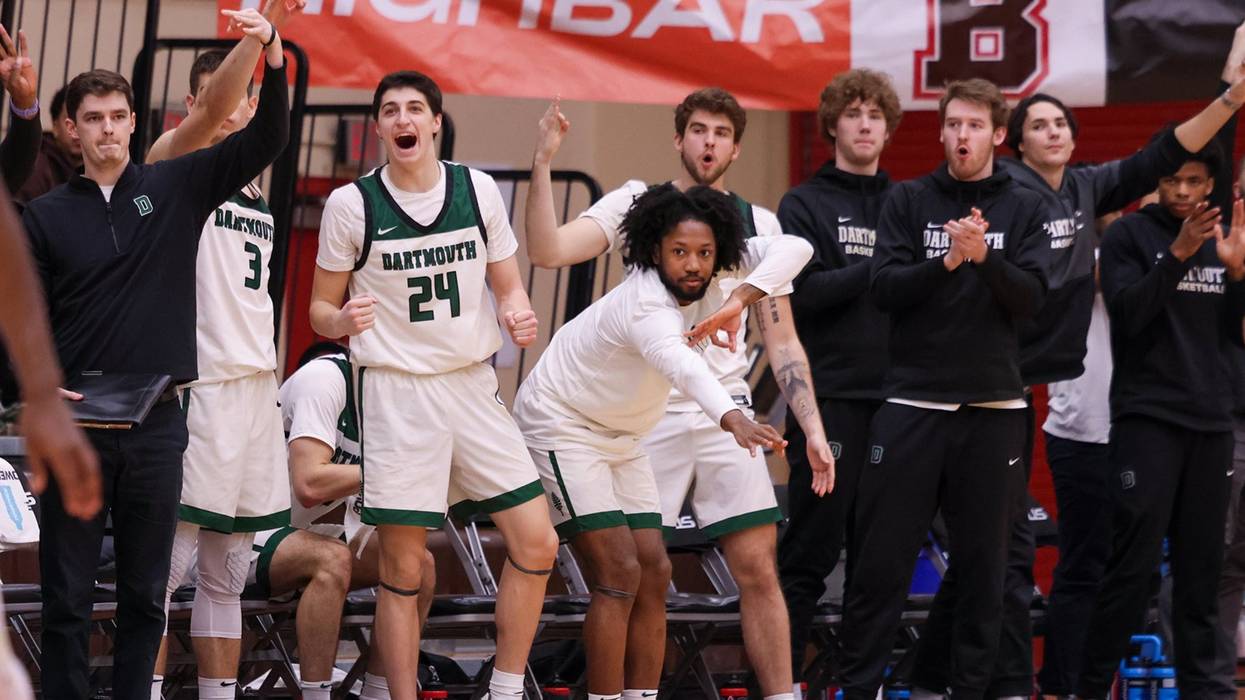
More Perfect Union called the move "a precedent that could change college sports."
The Dartmouth College men's basketball team voted Tuesday to unionize, becoming the first-ever U.S. collegiate athletes to do so—but the private New Hampshire university is mounting a challenge to the move that could end up in federal court.
Dartmouth players voted 13-2 to join the Service Employees International Union (SEIU) Local 560 in an election supervised by the U.S. National Labor Relations Board (NLRB) and the university's human resources department.
"Today is a big day for our team," said Dartmouth players Cade Haskins and Romeo Myrthil, two leaders of the organizing effort. "We stuck together all season and won this election. It is self-evident that we, as students, can also be both campus workers and union members. Dartmouth seems to be stuck in the past. It's time for the age of amateurism to end."
Haskins told the Associated Press that "I think this is just the start" and that the Dartmouth vote "is going to have a domino effect on other cases across the country, and that could lead to other changes."
SEIU Local 560 president Chris Peck said he is "looking forward to standing in solidarity" with Dartmouth players "as they begin to negotiate their historic first contract."
Last month, the NLRB's regional office ruled that the Dartmouth players are employees of the school with collective bargaining rights. Team members had previously petitioned the NLRB to organize with the SEIU.
Dartmouth officials appealed to the full NLRB.
"For Ivy League students who are varsity athletes, academics are of primary importance, and athletic pursuit is part of the educational experience," the school said in a statement. "Classifying these students as employees simply because they play basketball is as unprecedented as it is inaccurate. We, therefore, do not believe unionization is appropriate."
Colleges and universities have been urging U.S. lawmakers to pass legislation prohibiting student-athletes from being classified as employees, asserting that being forced to provide pay and benefits and allowing them to form or join unions threatens their multibillion-dollar monopoly.
The National Collegiate Athletic Association weighed in on the Dartmouth vote:
The association believes change in college sports is long overdue and is pursuing significant reforms. However, there are some issues the NCAA cannot address alone, and the association looks forward to working with Congress to make needed changes in the best interest of all student-athletes.
Labor advocates and progressive politicians cheered the vote, with the AFL-CIO calling it a "huge moment."
AFL-CIO president Liz Shuler said that "NCAA athletes make billions in profits for their universities and they deserve a seat at the table. This is the start of a new chapter in collegiate athletics."
U.S. Sen. Bernie Sanders (I-Vt.) wrote on social media: "Congratulations to the members of the Dartmouth men's basketball team on voting overwhelmingly to become the first college sports team in America to form a union. It's time for Dartmouth to respect their constitutional right to organize and bargain for a fair contract now."
The spectacular resurgence of unionization across America—with the support and encouragement of Biden’s National Labor Relations Board—is occurring under the national radar.
I did not star on the Dartmouth basketball team when I attended that ivy-clad institution, but I never imagined its basketball team might become the first unionized sports program in the country.
You heard me right. The institution that gave us Dinesh D’Souza, Ben Hart, Laura Ingraham, and “Animal House” (as well as yours truly) is on the way to making union history.
In September, all 15 players on Dartmouth’s varsity basketball team signed and filed a petition with the National Labor Relations Board to unionize (with the Service Employees International Union).
Workers are tractable no longer.
On October 5, Dartmouth’s lawyers responded by arguing that the players did not have the right to collectively bargain because, as members of the Ivy League, they received no athletic scholarships and the program lost money each year.
The National Labor Relations Board’s regional director in Boston, Laura Sacks, just ruled that because Dartmouth has “the right to control the work” of the team and because the team does that work “in exchange for compensation” like equipment and game tickets, the players are “employees” under the National Labor Relations Act.
This ruling now allows the team to take a vote that could make it the nation’s first unionized college sports program.
For years now, the National Collegiate Athletic Association (NCAA) and its member schools have resisted moves by college athletes to unionize—defending the “student-athlete” model that has come under increasing fire from judges, labor activists, and elected officials.
But the National Labor Relations Board, under President Joe Biden, has signaled support for unionization efforts among college athletes.
In September 2021, Jennifer A. Abruzzo, the general counsel of the board, said college athletes should be considered employees under federal labor law—citing the Supreme Court’s ruling that year that college sports was a profitable enterprise, and argued that classifying them simply as “student-athletes” would lead to a “chilling effect” on organization efforts at collegiate programs.
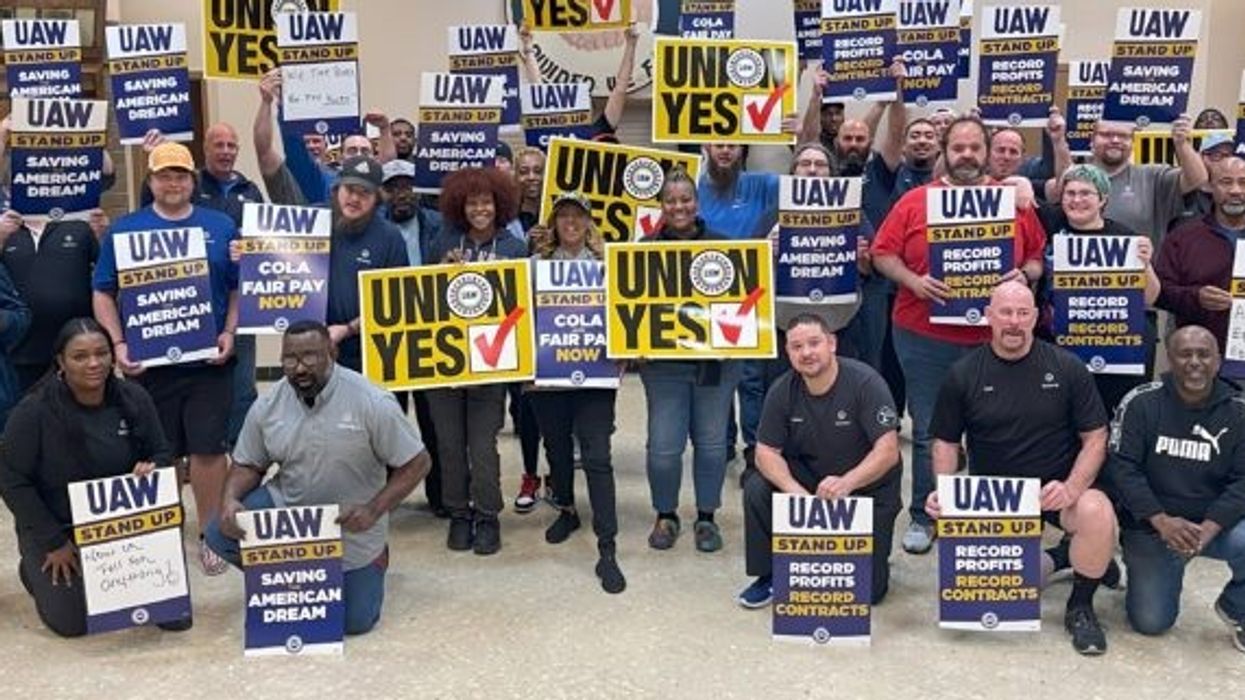
Meanwhile, in a move almost as improbable as the unionization of Dartmouth’s basketball team, the United Auto Workers’ effort to organize 4,100 autoworkers at Volkswagen’s Chattanooga, Tennessee, assembly plant appears to be paying off.
The UAW said on Tuesday that a majority of workers have signed cards to join the union, so the union is now setting its sights on securing 70% of their votes before filing for an election with the National Labor Relations Board.
The UAW is on a roll. After successful negotiations this fall with General Motors, Ford, and Stellantis that netted UAW members a 25% pay raise, the union is expanding its reach with campaigns at VW, Toyota, Tesla, Honda, Mercedes, Volvo, Nissan, Subaru, Mazda, Rivian Lucid, and Hyundai. (More than 30% of autoworkers at the Montgomery, Alabama, Hyundai plant have already signed union cards.)
The spectacular resurgence of unionization across America—with the support and encouragement of Biden’s National Labor Relations Board—is occurring under the national radar. The mainstream media is barely reporting on it.
But it’s hugely important. And it’s coming at exactly the right time. Across America, support for unions is at its highest in 50 years, according to available polling.
That support is especially strong among young people, whether they’re Dartmouth basketball players or Starbucks baristas.
Support is also growing in places that had written off unions, such as southern “right-to-work” states and the corporations that fled to such anti-union enclaves in pursuit of tractable workers. Workers are tractable no longer.
About time.
The sharp decline of unions—from representing over a third of America’s private-sector workers in the 1950s and early 1960s to representing only 6% today—is largely responsible for the stagnation of non-supervisory workers’ wages, soaring income inequality, and an ever-angrier working class susceptible to Trumpian demagoguery.
At first glance, the unionization of a Dartmouth basketball team and of a VW plant in Tennessee might not appear to be reversing these long-term trends. But they signal a sea change.
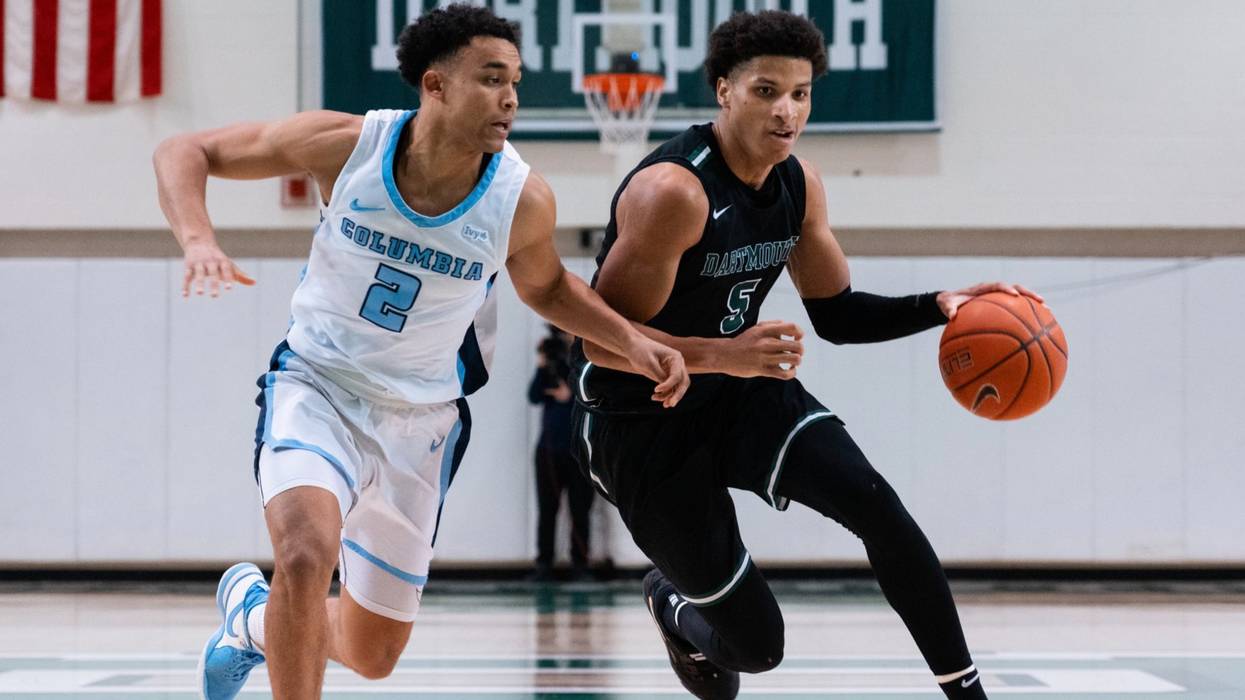
A National Labor Relations Board regional director found that members of Dartmouth's men's basketball team are "employees" and ordered a union election.
"It's time for worker power in the NCAA."
That was the message from labor advocate More Perfect Union Monday after the U.S. National Labor Relations Board (NLRB) ruled that the student-athletes of Dartmouth College's men's basketball team are employees of the school with collective bargaining rights.
Refuting the New Hampshire school's claim that the players are not employees and that asserting jurisdiction over them would "create instability in labor relations," Laura Sacks, the NLRB's regional director in Boston, said in her ruling: "I find that because Dartmouth has the right to control the work performed by the men's varsity basketball team, and because the players perform that work in exchange for compensation, the petitioned-for basketball players are employees. Additionally, I find that asserting jurisdiction would not create instability in labor relations."
"Accordingly," she added, "I shall direct an election in the petitioned-for unit."
Last year, Dartmouth players petitioned the NLRB to organize with a local branch of the Service Employees International Union. Colleges and universities have been pushing Congress to enact legislation barring student-athletes from being classified as employees, arguing that being forced to provide pay and benefits and allowing them to form or join unions threatens their multibillion-dollar monopoly.
If the Dartmouth players choose to unionize, they'll be the first NCAA student-athletes to do so.
"The NCAA brings in $1 billion each year," More Pefect Union recently noted. "Its coaches are multimillionaires. Schools and TV networks are making fortunes. But most college athletes make zero, for the sole reason that the NCAA chooses to exploit them. It's time for this to change."
Dartmouth College said Monday that it would repeal the NLRB ruling.

"We can say with certainty that societies and economies absolutely do not just take a hit and recover," said the lead author of research showing a downturn after the warm phase could last 14 years or longer.
With experts anticipating El Niño will return in the months ahead, a pair of Dartmouth College researchers warned this week that the long-term cost to the global economy could be as much as $3 trillion by 2029—which could be largely felt by poorer countries.
The El Niño-Southern Oscillation (ENSO), a climate pattern that affects sea surface temperatures across the tropical Pacific Ocean, has three phases: the cooler La Niña; neutral, which the world is now experiencing; and the warmer El Niño that is expected soon.
"El Niño triggers far-reaching changes in weather that result in devastating floods, crop-killing droughts, plummeting fish populations, and an uptick in tropical diseases," explained a Dartmouth statement about the study, published Thursday in the journal Science.
Doctoral candidate Christopher Callahan and Justin Mankin, an assistant professor of geography at the college, examined economic conditions for several years after the 1982-83 and 1997-98 El Niño events. They connected those two warm phases to $4.1 trillion and $5.7 trillion in global income losses, respectively—far higher than previous estimates.
"El Niño amplifies the wider inequities in climate change, disproportionately impacting the least resilient and prepared among us."
"We can say with certainty that societies and economies absolutely do not just take a hit and recover," said Callahan, the study's lead author, noting that their data suggest an El Niño-related downturn could last up to 14 years or longer.
"In the tropics and places that experience the effects of El Niño, you get a persistent signature during which growth is delayed for at least five years," he continued. "The aggregate price tag on these events has not ever been fully quantified—you have to add up all the depressed growth moving forward, not just when the event is happening."
The pair found that the gross domestic product of the United States was roughly 3% lower in 1988 and 2003 than it would have been without the preceding El Niño events—and, for the latter phase, GDPs in coastal tropical countries were more than 10% lower.
"The global pattern of El Niño's effect on the climate and on the prosperity of different countries reflects the unequal distribution of wealth and climate risk—not to mention the responsibility for climate change—worldwide," said Mankin. "El Niño amplifies the wider inequities in climate change, disproportionately impacting the least resilient and prepared among us."
"The duration and magnitude of the financial repercussions we uncovered suggests to me that we are maladapted to the climate we have," he added. "Our accounting dramatically raises the cost estimate of doing nothing. We need to both mitigate climate change and invest more in El Niño prediction and adaptation because these events will only amplify the future costs of global warming."
Models for the latter research showed that sea surface temperature extremes were about 10% more intense for the six decades after 1960, compared with the previous 60 years. Co-author Mike McPhaden, a senior research scientist at the U.S. National Oceanic and Atmospheric Administration (NOAA), said that "the big events pack the most punch, so even though 10% doesn't sound like much, it juices up the strongest and most societally relevant year-to-year climate fluctuation on the planet."
"In practical terms, this translates into more extreme and frequent droughts, floods, heatwaves, wildfires, and severe storms, just like we observed during the recent triple dip La Niña that ended in March," McPhaden told The Guardian.
Given that observed trend and expectations it will continue, the Dartmouth researchers project that even if countries pursue their pledges to cut planet-heating emissions, global economic losses related to El Niño could reach $84 trillion for the 21st century.
"If you're estimating the costs of global warming without considering El Niño," Mankin warned, "then you are dramatically underestimating the costs of global warming."
"Our welfare is affected by our global economy, and our global economy is tied to the climate," he said. "When you ask how costly climate change is, you can start by asking how costly climate variation is. We're showing here that such variation, as embodied in El Niño, is incredibly costly and stagnates growth for years, which led us to cost estimates that are orders of magnitudes larger than previous ones."
The Associated Press reported Thursday that "some—but not all—outside economists have issues with the new research out of Dartmouth College, saying its damage estimates are too big."
However, McPhaden welcomed the findings, telling the AP that he has long believed previous estimates were far too low and the "big loser during El Niño is the Global South."
While the Dartmouth projections suggest 2023's looming warm phase could cost trillions of dollars, the NOAA scientist stressed that "the economic impacts of the El Niño that is predicted for later this year will depend on how strong it is."
"Monster El Niños" like the 1997-98 event "can be hugely damaging with lingering effects that carry over into following years," he said. "On the other hand, if it turns out to be a garden variety El Niño, the consequences may be more muted and the recovery time shortened."