SUBSCRIBE TO OUR FREE NEWSLETTER
Daily news & progressive opinion—funded by the people, not the corporations—delivered straight to your inbox.
5
#000000
#FFFFFF
To donate by check, phone, or other method, see our More Ways to Give page.
Daily news & progressive opinion—funded by the people, not the corporations—delivered straight to your inbox.
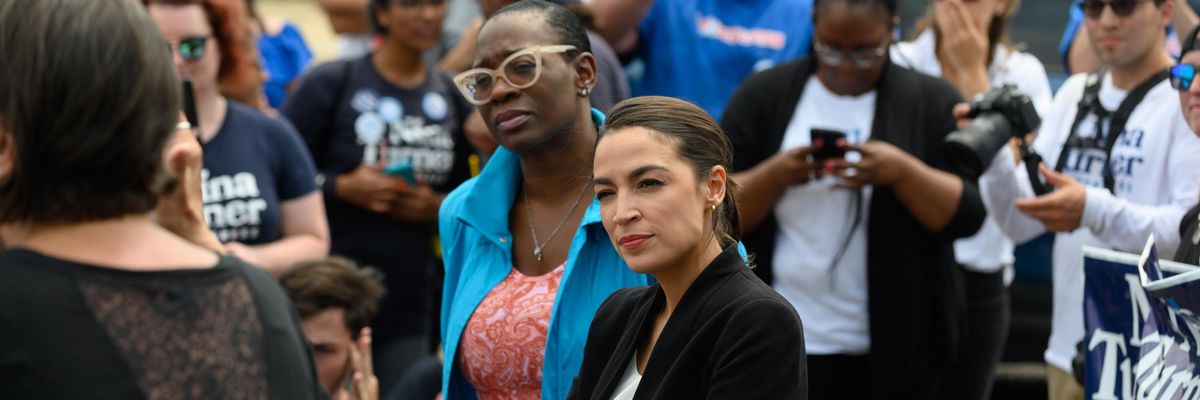
Nina Turner and Rep. Alexandria Ocasio-Cortez (D-N.Y.) appear together at a July 24, 2021 campaign event in Cleveland.
A Democratic National Committee panel on Thursday refused to allow a vote on a resolution aimed at banning dark money from the party's primary process, a decision that sparked outrage from progressive DNC members and others who backed the proposal.
Former Ohio state Sen. Nina Turner, a DNC member who faced an onslaught of dark money during her recent campaigns for a U.S. House seat, told Common Dreams that "it's really a sad state of affairs" for the DNC Resolutions Committee to "not even bring this to the floor so that the members of the DNC can weigh in."
"Dark money taints the will of the people of these communities because dark money is doing the bidding of the elites."
"This should be judged through the lens of right and wrong," said Turner. "It is wrong to allow dark money to enter any primary in any state, in any race. What it does is it suffocates the will of the people in those districts. Let's take my district, for example: Do you think the dark money that came in after me cares that Cleveland is the poorest city of its size in the nation? Do they care that 50% of the children who live in Cleveland live in poverty? No, they don't give a damn."
"Dark money taints the will of the people of these communities because dark money is doing the bidding of the elites and the oligarchs who don't give a damn about the conditions people are living in," she added. "The Democratic Party, by not allowing this resolution to come to the floor, is complicit in the railroading of democracy itself."
Led by Nevada Democratic Party Chair Judith Whitmer, the resolution would have prohibited dark money funding "during any and all Democratic primary elections" and established "procedures for the investigation of 'dark money' use by candidate committees as well as possible disciplinary action."
Dark money refers to spending whose source isn't disclosed and is often untraceable.
Supporters of the ban cited the torrent of dark money that poured into Democratic primary races across the country this year in an effort to defeat progressive candidates and bolster powerful incumbents--a strategy that, in a number of high-profile cases, succeeded.
During her argument in favor of a vote on the proposed ban, which was backed by dozens of DNC members and progressive members of Congress, Whitmer said dark money has allowed "our elections to devolve into auctions."
Joseph Geevarghese, executive director of the progressive advocacy group Our Revolution, called the DNC panel's decision to block a vote on Whitmer's resolution "abhorrent and anti-democratic."
"Democrats can't be the party of democracy in one breath and then let an astronomical sum of money from Republican megadonors and corporate interests flood Democratic primaries," Geevarghese added.
The proposed dark money ban's path forward is uncertain. Our Revolution said in an email to supporters Thursday that two of its board members, Larry Cohen and Jane Kleeb, are planning to "lead a coalition of 33 progressive DNC members to get this resolution to the full floor" despite the party panel's obstruction.
"The 33 of us are not going to stand down just because the resolution committee pulled a fast one," Turner told Common Dreams.
The Democratic Party's 2020 platform includes an explicit rebuke of dark money, which has surged in the years following the U.S. Supreme Court's 2010 decision in Citizens United v. FEC.
The platform states that Democrats "will bring an end to 'dark money' by requiring full disclosure of contributors to any group that advocates for or against candidates, and bar 501(c)(4) organizations from spending money on elections."
"Dark money should have no role in deciding elections."
"Democrats will ban corporate PACs from donating to candidates and bar lobbyists from donating, fundraising, or bundling for anyone they lobby," the document adds.
Shortly before refusing to allow a vote on the proposed dark money ban, the resolutions committee approved a separate, toothless measure that "condemns the use of 'dark money' that runs contrary to the values and principles of donors."
James Zogby, founder of the Arab American Institute and a longtime DNC member, tweeted that he is "furious" about Thursday's outcome and "all Dems should be too."
"The last time party leaders did this was on my February 2003 resolution to oppose the Iraq War," Zogby added. "Wrong then, wrong now!"
In an interview Friday, Zogby--who previously chaired the DNC's resolutions panel--gave his account of the committee meeting:
In recent months, prominent progressive lawmakers including Sen. Bernie Sanders (I-Vt.) and Rep. Alexandria Ocasio-Cortez (D-N.Y.) have called on the Democratic leadership to support a dark money ban to prevent anonymous donors from manipulating the primary process and stacking the deck against candidates who rely on grassroots support.
"It is well beyond time for the Democratic Party to practice what we preach and ban super PAC spending from our primaries," Ocasio-Cortez tweeted in May after progressive Summer Lee narrowly overcame millions in opposition spending. "Dark money should have no role in deciding elections."
This story has been updated to include an interview clip from DNC member James Zogby.
Dear Common Dreams reader, It’s been nearly 30 years since I co-founded Common Dreams with my late wife, Lina Newhouser. We had the radical notion that journalism should serve the public good, not corporate profits. It was clear to us from the outset what it would take to build such a project. No paid advertisements. No corporate sponsors. No millionaire publisher telling us what to think or do. Many people said we wouldn't last a year, but we proved those doubters wrong. Together with a tremendous team of journalists and dedicated staff, we built an independent media outlet free from the constraints of profits and corporate control. Our mission has always been simple: To inform. To inspire. To ignite change for the common good. Building Common Dreams was not easy. Our survival was never guaranteed. When you take on the most powerful forces—Wall Street greed, fossil fuel industry destruction, Big Tech lobbyists, and uber-rich oligarchs who have spent billions upon billions rigging the economy and democracy in their favor—the only bulwark you have is supporters who believe in your work. But here’s the urgent message from me today. It's never been this bad out there. And it's never been this hard to keep us going. At the very moment Common Dreams is most needed, the threats we face are intensifying. We need your support now more than ever. We don't accept corporate advertising and never will. We don't have a paywall because we don't think people should be blocked from critical news based on their ability to pay. Everything we do is funded by the donations of readers like you. When everyone does the little they can afford, we are strong. But if that support retreats or dries up, so do we. Will you donate now to make sure Common Dreams not only survives but thrives? —Craig Brown, Co-founder |
A Democratic National Committee panel on Thursday refused to allow a vote on a resolution aimed at banning dark money from the party's primary process, a decision that sparked outrage from progressive DNC members and others who backed the proposal.
Former Ohio state Sen. Nina Turner, a DNC member who faced an onslaught of dark money during her recent campaigns for a U.S. House seat, told Common Dreams that "it's really a sad state of affairs" for the DNC Resolutions Committee to "not even bring this to the floor so that the members of the DNC can weigh in."
"Dark money taints the will of the people of these communities because dark money is doing the bidding of the elites."
"This should be judged through the lens of right and wrong," said Turner. "It is wrong to allow dark money to enter any primary in any state, in any race. What it does is it suffocates the will of the people in those districts. Let's take my district, for example: Do you think the dark money that came in after me cares that Cleveland is the poorest city of its size in the nation? Do they care that 50% of the children who live in Cleveland live in poverty? No, they don't give a damn."
"Dark money taints the will of the people of these communities because dark money is doing the bidding of the elites and the oligarchs who don't give a damn about the conditions people are living in," she added. "The Democratic Party, by not allowing this resolution to come to the floor, is complicit in the railroading of democracy itself."
Led by Nevada Democratic Party Chair Judith Whitmer, the resolution would have prohibited dark money funding "during any and all Democratic primary elections" and established "procedures for the investigation of 'dark money' use by candidate committees as well as possible disciplinary action."
Dark money refers to spending whose source isn't disclosed and is often untraceable.
Supporters of the ban cited the torrent of dark money that poured into Democratic primary races across the country this year in an effort to defeat progressive candidates and bolster powerful incumbents--a strategy that, in a number of high-profile cases, succeeded.
During her argument in favor of a vote on the proposed ban, which was backed by dozens of DNC members and progressive members of Congress, Whitmer said dark money has allowed "our elections to devolve into auctions."
Joseph Geevarghese, executive director of the progressive advocacy group Our Revolution, called the DNC panel's decision to block a vote on Whitmer's resolution "abhorrent and anti-democratic."
"Democrats can't be the party of democracy in one breath and then let an astronomical sum of money from Republican megadonors and corporate interests flood Democratic primaries," Geevarghese added.
The proposed dark money ban's path forward is uncertain. Our Revolution said in an email to supporters Thursday that two of its board members, Larry Cohen and Jane Kleeb, are planning to "lead a coalition of 33 progressive DNC members to get this resolution to the full floor" despite the party panel's obstruction.
"The 33 of us are not going to stand down just because the resolution committee pulled a fast one," Turner told Common Dreams.
The Democratic Party's 2020 platform includes an explicit rebuke of dark money, which has surged in the years following the U.S. Supreme Court's 2010 decision in Citizens United v. FEC.
The platform states that Democrats "will bring an end to 'dark money' by requiring full disclosure of contributors to any group that advocates for or against candidates, and bar 501(c)(4) organizations from spending money on elections."
"Dark money should have no role in deciding elections."
"Democrats will ban corporate PACs from donating to candidates and bar lobbyists from donating, fundraising, or bundling for anyone they lobby," the document adds.
Shortly before refusing to allow a vote on the proposed dark money ban, the resolutions committee approved a separate, toothless measure that "condemns the use of 'dark money' that runs contrary to the values and principles of donors."
James Zogby, founder of the Arab American Institute and a longtime DNC member, tweeted that he is "furious" about Thursday's outcome and "all Dems should be too."
"The last time party leaders did this was on my February 2003 resolution to oppose the Iraq War," Zogby added. "Wrong then, wrong now!"
In an interview Friday, Zogby--who previously chaired the DNC's resolutions panel--gave his account of the committee meeting:
In recent months, prominent progressive lawmakers including Sen. Bernie Sanders (I-Vt.) and Rep. Alexandria Ocasio-Cortez (D-N.Y.) have called on the Democratic leadership to support a dark money ban to prevent anonymous donors from manipulating the primary process and stacking the deck against candidates who rely on grassroots support.
"It is well beyond time for the Democratic Party to practice what we preach and ban super PAC spending from our primaries," Ocasio-Cortez tweeted in May after progressive Summer Lee narrowly overcame millions in opposition spending. "Dark money should have no role in deciding elections."
This story has been updated to include an interview clip from DNC member James Zogby.
A Democratic National Committee panel on Thursday refused to allow a vote on a resolution aimed at banning dark money from the party's primary process, a decision that sparked outrage from progressive DNC members and others who backed the proposal.
Former Ohio state Sen. Nina Turner, a DNC member who faced an onslaught of dark money during her recent campaigns for a U.S. House seat, told Common Dreams that "it's really a sad state of affairs" for the DNC Resolutions Committee to "not even bring this to the floor so that the members of the DNC can weigh in."
"Dark money taints the will of the people of these communities because dark money is doing the bidding of the elites."
"This should be judged through the lens of right and wrong," said Turner. "It is wrong to allow dark money to enter any primary in any state, in any race. What it does is it suffocates the will of the people in those districts. Let's take my district, for example: Do you think the dark money that came in after me cares that Cleveland is the poorest city of its size in the nation? Do they care that 50% of the children who live in Cleveland live in poverty? No, they don't give a damn."
"Dark money taints the will of the people of these communities because dark money is doing the bidding of the elites and the oligarchs who don't give a damn about the conditions people are living in," she added. "The Democratic Party, by not allowing this resolution to come to the floor, is complicit in the railroading of democracy itself."
Led by Nevada Democratic Party Chair Judith Whitmer, the resolution would have prohibited dark money funding "during any and all Democratic primary elections" and established "procedures for the investigation of 'dark money' use by candidate committees as well as possible disciplinary action."
Dark money refers to spending whose source isn't disclosed and is often untraceable.
Supporters of the ban cited the torrent of dark money that poured into Democratic primary races across the country this year in an effort to defeat progressive candidates and bolster powerful incumbents--a strategy that, in a number of high-profile cases, succeeded.
During her argument in favor of a vote on the proposed ban, which was backed by dozens of DNC members and progressive members of Congress, Whitmer said dark money has allowed "our elections to devolve into auctions."
Joseph Geevarghese, executive director of the progressive advocacy group Our Revolution, called the DNC panel's decision to block a vote on Whitmer's resolution "abhorrent and anti-democratic."
"Democrats can't be the party of democracy in one breath and then let an astronomical sum of money from Republican megadonors and corporate interests flood Democratic primaries," Geevarghese added.
The proposed dark money ban's path forward is uncertain. Our Revolution said in an email to supporters Thursday that two of its board members, Larry Cohen and Jane Kleeb, are planning to "lead a coalition of 33 progressive DNC members to get this resolution to the full floor" despite the party panel's obstruction.
"The 33 of us are not going to stand down just because the resolution committee pulled a fast one," Turner told Common Dreams.
The Democratic Party's 2020 platform includes an explicit rebuke of dark money, which has surged in the years following the U.S. Supreme Court's 2010 decision in Citizens United v. FEC.
The platform states that Democrats "will bring an end to 'dark money' by requiring full disclosure of contributors to any group that advocates for or against candidates, and bar 501(c)(4) organizations from spending money on elections."
"Dark money should have no role in deciding elections."
"Democrats will ban corporate PACs from donating to candidates and bar lobbyists from donating, fundraising, or bundling for anyone they lobby," the document adds.
Shortly before refusing to allow a vote on the proposed dark money ban, the resolutions committee approved a separate, toothless measure that "condemns the use of 'dark money' that runs contrary to the values and principles of donors."
James Zogby, founder of the Arab American Institute and a longtime DNC member, tweeted that he is "furious" about Thursday's outcome and "all Dems should be too."
"The last time party leaders did this was on my February 2003 resolution to oppose the Iraq War," Zogby added. "Wrong then, wrong now!"
In an interview Friday, Zogby--who previously chaired the DNC's resolutions panel--gave his account of the committee meeting:
In recent months, prominent progressive lawmakers including Sen. Bernie Sanders (I-Vt.) and Rep. Alexandria Ocasio-Cortez (D-N.Y.) have called on the Democratic leadership to support a dark money ban to prevent anonymous donors from manipulating the primary process and stacking the deck against candidates who rely on grassroots support.
"It is well beyond time for the Democratic Party to practice what we preach and ban super PAC spending from our primaries," Ocasio-Cortez tweeted in May after progressive Summer Lee narrowly overcame millions in opposition spending. "Dark money should have no role in deciding elections."
This story has been updated to include an interview clip from DNC member James Zogby.