SUBSCRIBE TO OUR FREE NEWSLETTER
Daily news & progressive opinion—funded by the people, not the corporations—delivered straight to your inbox.
5
#000000
#FFFFFF
To donate by check, phone, or other method, see our More Ways to Give page.
Daily news & progressive opinion—funded by the people, not the corporations—delivered straight to your inbox.
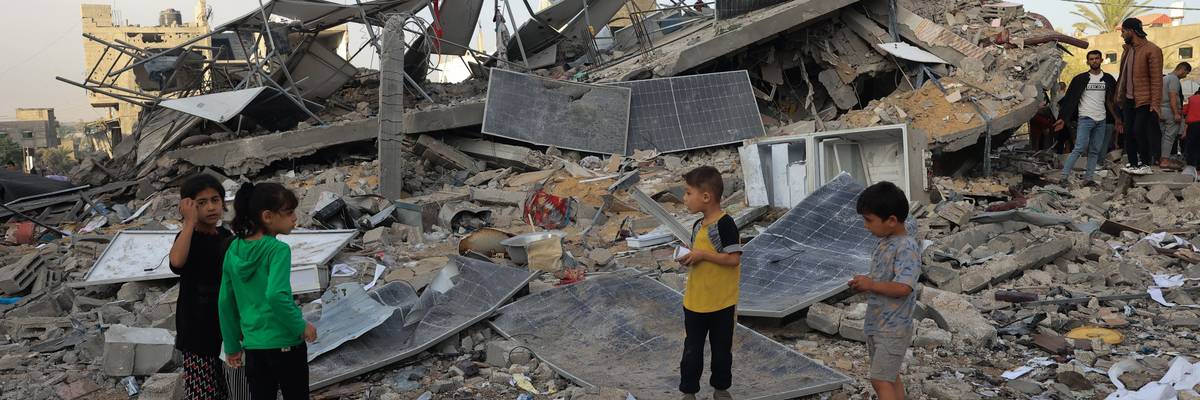
Children stand next to solar panels and a destroyed building following Israeli bombing on Rafah in the southern Gaza Strip, on November 11, 2023.
The damaged planetary ecology can only recover if people and societies see themselves as an integral part of nature and live in peace with one another.
Peace ecology considerations make it clear that a long-neglected aspect of armament and military activities is the massive environmental destruction caused worldwide by the military, especially during and after wars (Trautvetter 2021, Scheffran 2022, Moegling 2025). But even in its normal day-to-day operations and military exercises, the military is the largest institutional emitter of greenhouse gases. In addition, the environmental destruction and emissions caused by the production of weapons must be taken into account. Emissions from the reconstruction of destroyed cities must also be considered.
The concept of peace ecology has high analytical value and normative appeal and should be used in the future as an important subfield of peace studies and research. Peace ecology addresses peace between people and societies, as well as peace between humans and their ecological context, and in particular the connection between these two perspectives. The point here is that the damaged planetary ecology can only recover if people and societies see themselves as an integral part of nature and live in peace with one another. Only through peaceful coexistence can the energy and necessary measures be generated to curb or reverse the environmental destruction that is already occurring.
The poisoning and destruction of the environment, with serious consequences for the biosphere, i.e., for the earth, air, water, humans, animals, and plants, is only now gradually coming to public attention on the fringes of the current protests by the environmental and peace movements. However, Norwegian peace researcher Johan Galtung already addressed this aspect in 2004 from a peace-ecological perspective:
One thing is the damage done to the ecosystem, another is the reinforcement of the general cultural code of domination over nature, which is also part of the rape syndrome. Countless millions of people are watching not only how people are being killed and wounded, but also how nature is being destroyed and going up in flames.
Wars not only kill and injure people and destroy infrastructure, they also destroy the planet's ecology in various ways. Wars are an extreme expression of the separation of ruling powers and warring states and groups from their natural environment. What humans do to nature—and thus to the conditions necessary for all life on this planet—is of little interest to the ruling circles that wage wars and attack other states.
The fact that they are destroying the conditions for the survival of future generations is of no concern to imperialist states and governments. And there is no difference between the US and Russia in this regard. Imperialist warfare and the ecological destruction it causes are, in an extreme way, a crime of generational selfishness.
Peace ecology, as a newer subdiscipline of peace studies and research, makes it clear that wars are not only the cause of climate damage, but that the climate crisis that is already occurring is in turn a further cause of military conflicts and the destruction of political systems, especially in the poorer regions of the world, according to Michael T. Klare (2015), professor of peace and global security at Hampshire College in Massachusetts"
The strongest and richest states, especially those in more temperate climate zones, are likely to cope better with these stresses. In contrast, the number of failed states is likely to increase dramatically, leading to violent conflicts and outright wars over the remaining food sources, agriculturally usable land, and habitable areas. Large parts of the planet could thus find themselves in situations similar to those we see today in Libya, Syria, and Yemen. Some people will stay and fight for their survival; others will migrate and almost certainly encounter much more violent forms of the hostility that immigrants and refugees already face in their destination countries today. This would inevitably lead to a global epidemic of civil wars and other violent conflicts over resources.
In addition, those states that are at war with each other—but also those societies that feel threatened by this—will then use the resources necessary to combat the climate crisis to finance warfare and weapons systems. In particular, the huge sums of money within the European Union, but also in Germany, that will be spent in the future on special programs for the procurement of weapons systems will be lacking in a sensible climate policy—not to mention the enormous arms investments of the US and Russia and their unwillingness to combat the climate crisis.
The environment is destroyed by wars, but also by normal military operations in peacetime.
A study by Stuart Parkinson (Scientists for Global Responsibility) not only took into account direct carbon dioxide emissions from transport and exercises, but also emissions from weapons production, infrastructure construction, and supply chains. Parkinson calculated 340 million tons of CO2 equivalents for 2017 for the US military, by far the largest in the world, and this figure is unlikely to have decreased. For the global situation, Parkinson calculated that 5.5% of worldwide CO2 emissions are attributable to the military of all nations. This does not include wartime emissions. It can therefore be assumed that the percentage of global CO2 emissions caused by the military is significantly higher.
A study by de Klerk et al (2023) found that during one year of war in Ukraine, both sides of the conflict emitted approximately as much CO2 as Belgium did in total during the same year. This amounted to 119 million tons of CO2 equivalents.
Stuart Parkinson and Linsey Cottrell (2022) summarize their study on climate damage caused by the military and wars as follows:
If the world's armed forces were a country, they would have the fourth largest national carbon footprint in the world—larger than Russia's. This underscores the urgent need to take concerted action to reliably measure military emissions and reduce the associated carbon footprint—especially as these emissions are likely to increase as a result of the war in Ukraine.
Olena Melnyk and Sera Koulabdara (2024) estimate that approximately one-third of Ukrainian soil has been contaminated by toxic substances such as lead, cadmium, arsenic, and mercury as a result of the war. Soil and its fertile layer took thousands of years to form and have now been poisoned by the war within a few years, rendering it unusable for agriculture.
The war in Ukraine is leaving behind a devastated environment, for which the Russian Federation would have to pay billions of euros in reparations, although ultimately only the superficial damage could be repaired. The profound impact on human health due to inhaled emissions, drinking contaminated water, and exposure to radiation cannot be compensated for with money.
Hungarian climate researcher Bálint Rosz (2025) summarizes the CO2 emissions caused by the war in Ukraine in the first two years of the Ukraine war up to February 2024 and compares this with the annual emissions of 90 million vehicles with combustion engines.
Israel's campaign of destruction against the Palestinians living in the Gaza Strip, as a disproportionate response to the brutal attack by Hamas, is also causing considerable environmental destruction, in addition to the appalling suffering of the Palestinians. For example, Neimark et al. (2024) estimated that the CO2 emissions from the necessary reconstruction of the Gaza Strip, destroyed by the Israeli military, would be so high that they would exceed the emissions of 130 countries and be comparable to the emissions of New Zealand.
These are just a few examples of military-induced ecological destruction. This anthropocentric madness could be illustrated with numerous other examples (Moegling 2025).
Global military activities can be both a cause and a consequence of environmental destruction.
The environmental and peace movements therefore have a substantial common ground in their understanding of peace ecology: The demand for an end to environmental destruction by the military and wars, combined with the demand for internationally coordinated disarmament, should be addressed by both the environmental and peace movements as central expectations of politics.
Furthermore, the analyses and research findings of peace ecology could help both the environmental and peace movements to take targeted action against planetary destruction based on facts.
In this context, the question of financing the remediation of environmental damage caused by the military must also be addressed. In addition to the warring parties responsible, the producers in the arms industry should also be called upon to contribute. It is particularly unacceptable for the arms industry that the (considerable) profits are privatized while the costs are socialized and passed on to the state and taxpayers. Such externalization of costs and internalization of profits in the arms industry, which is typical of capitalist conditions, is no longer acceptable. It is completely incomprehensible why, for example, the manufacturers of landmines should not also pay for their removal and for compensation claims by the victims.
Above all, the exclusion of the military as a climate polluter from the Kyoto Protocol and the attempt to leave this non-binding in the Paris Agreements, particularly under pressure from the US at the time, further highlights the international dimension of the problem. The United Nations in particular is called upon to include environmental issues related to military activities and war missions more bindingly in international climate agreements. This should be easier for them if corresponding international civil society pressure were to be built up via interested governments and internationally coordinated NGO initiatives, e.g., via the Fridays for Future movement, Indigenous NGOs, ICAN, IPPNW, Greenpeace, and the traditional Easter March movement or other activities of the peace movement.
Peace ecology also makes it clear that the more peaceful societies are internally and externally, the more they can work to restore the destroyed ecological order. This is the common interest of the peace and environmental movements.
Dear Common Dreams reader, It’s been nearly 30 years since I co-founded Common Dreams with my late wife, Lina Newhouser. We had the radical notion that journalism should serve the public good, not corporate profits. It was clear to us from the outset what it would take to build such a project. No paid advertisements. No corporate sponsors. No millionaire publisher telling us what to think or do. Many people said we wouldn't last a year, but we proved those doubters wrong. Together with a tremendous team of journalists and dedicated staff, we built an independent media outlet free from the constraints of profits and corporate control. Our mission has always been simple: To inform. To inspire. To ignite change for the common good. Building Common Dreams was not easy. Our survival was never guaranteed. When you take on the most powerful forces—Wall Street greed, fossil fuel industry destruction, Big Tech lobbyists, and uber-rich oligarchs who have spent billions upon billions rigging the economy and democracy in their favor—the only bulwark you have is supporters who believe in your work. But here’s the urgent message from me today. It's never been this bad out there. And it's never been this hard to keep us going. At the very moment Common Dreams is most needed, the threats we face are intensifying. We need your support now more than ever. We don't accept corporate advertising and never will. We don't have a paywall because we don't think people should be blocked from critical news based on their ability to pay. Everything we do is funded by the donations of readers like you. When everyone does the little they can afford, we are strong. But if that support retreats or dries up, so do we. Will you donate now to make sure Common Dreams not only survives but thrives? —Craig Brown, Co-founder |
Peace ecology considerations make it clear that a long-neglected aspect of armament and military activities is the massive environmental destruction caused worldwide by the military, especially during and after wars (Trautvetter 2021, Scheffran 2022, Moegling 2025). But even in its normal day-to-day operations and military exercises, the military is the largest institutional emitter of greenhouse gases. In addition, the environmental destruction and emissions caused by the production of weapons must be taken into account. Emissions from the reconstruction of destroyed cities must also be considered.
The concept of peace ecology has high analytical value and normative appeal and should be used in the future as an important subfield of peace studies and research. Peace ecology addresses peace between people and societies, as well as peace between humans and their ecological context, and in particular the connection between these two perspectives. The point here is that the damaged planetary ecology can only recover if people and societies see themselves as an integral part of nature and live in peace with one another. Only through peaceful coexistence can the energy and necessary measures be generated to curb or reverse the environmental destruction that is already occurring.
The poisoning and destruction of the environment, with serious consequences for the biosphere, i.e., for the earth, air, water, humans, animals, and plants, is only now gradually coming to public attention on the fringes of the current protests by the environmental and peace movements. However, Norwegian peace researcher Johan Galtung already addressed this aspect in 2004 from a peace-ecological perspective:
One thing is the damage done to the ecosystem, another is the reinforcement of the general cultural code of domination over nature, which is also part of the rape syndrome. Countless millions of people are watching not only how people are being killed and wounded, but also how nature is being destroyed and going up in flames.
Wars not only kill and injure people and destroy infrastructure, they also destroy the planet's ecology in various ways. Wars are an extreme expression of the separation of ruling powers and warring states and groups from their natural environment. What humans do to nature—and thus to the conditions necessary for all life on this planet—is of little interest to the ruling circles that wage wars and attack other states.
The fact that they are destroying the conditions for the survival of future generations is of no concern to imperialist states and governments. And there is no difference between the US and Russia in this regard. Imperialist warfare and the ecological destruction it causes are, in an extreme way, a crime of generational selfishness.
Peace ecology, as a newer subdiscipline of peace studies and research, makes it clear that wars are not only the cause of climate damage, but that the climate crisis that is already occurring is in turn a further cause of military conflicts and the destruction of political systems, especially in the poorer regions of the world, according to Michael T. Klare (2015), professor of peace and global security at Hampshire College in Massachusetts"
The strongest and richest states, especially those in more temperate climate zones, are likely to cope better with these stresses. In contrast, the number of failed states is likely to increase dramatically, leading to violent conflicts and outright wars over the remaining food sources, agriculturally usable land, and habitable areas. Large parts of the planet could thus find themselves in situations similar to those we see today in Libya, Syria, and Yemen. Some people will stay and fight for their survival; others will migrate and almost certainly encounter much more violent forms of the hostility that immigrants and refugees already face in their destination countries today. This would inevitably lead to a global epidemic of civil wars and other violent conflicts over resources.
In addition, those states that are at war with each other—but also those societies that feel threatened by this—will then use the resources necessary to combat the climate crisis to finance warfare and weapons systems. In particular, the huge sums of money within the European Union, but also in Germany, that will be spent in the future on special programs for the procurement of weapons systems will be lacking in a sensible climate policy—not to mention the enormous arms investments of the US and Russia and their unwillingness to combat the climate crisis.
The environment is destroyed by wars, but also by normal military operations in peacetime.
A study by Stuart Parkinson (Scientists for Global Responsibility) not only took into account direct carbon dioxide emissions from transport and exercises, but also emissions from weapons production, infrastructure construction, and supply chains. Parkinson calculated 340 million tons of CO2 equivalents for 2017 for the US military, by far the largest in the world, and this figure is unlikely to have decreased. For the global situation, Parkinson calculated that 5.5% of worldwide CO2 emissions are attributable to the military of all nations. This does not include wartime emissions. It can therefore be assumed that the percentage of global CO2 emissions caused by the military is significantly higher.
A study by de Klerk et al (2023) found that during one year of war in Ukraine, both sides of the conflict emitted approximately as much CO2 as Belgium did in total during the same year. This amounted to 119 million tons of CO2 equivalents.
Stuart Parkinson and Linsey Cottrell (2022) summarize their study on climate damage caused by the military and wars as follows:
If the world's armed forces were a country, they would have the fourth largest national carbon footprint in the world—larger than Russia's. This underscores the urgent need to take concerted action to reliably measure military emissions and reduce the associated carbon footprint—especially as these emissions are likely to increase as a result of the war in Ukraine.
Olena Melnyk and Sera Koulabdara (2024) estimate that approximately one-third of Ukrainian soil has been contaminated by toxic substances such as lead, cadmium, arsenic, and mercury as a result of the war. Soil and its fertile layer took thousands of years to form and have now been poisoned by the war within a few years, rendering it unusable for agriculture.
The war in Ukraine is leaving behind a devastated environment, for which the Russian Federation would have to pay billions of euros in reparations, although ultimately only the superficial damage could be repaired. The profound impact on human health due to inhaled emissions, drinking contaminated water, and exposure to radiation cannot be compensated for with money.
Hungarian climate researcher Bálint Rosz (2025) summarizes the CO2 emissions caused by the war in Ukraine in the first two years of the Ukraine war up to February 2024 and compares this with the annual emissions of 90 million vehicles with combustion engines.
Israel's campaign of destruction against the Palestinians living in the Gaza Strip, as a disproportionate response to the brutal attack by Hamas, is also causing considerable environmental destruction, in addition to the appalling suffering of the Palestinians. For example, Neimark et al. (2024) estimated that the CO2 emissions from the necessary reconstruction of the Gaza Strip, destroyed by the Israeli military, would be so high that they would exceed the emissions of 130 countries and be comparable to the emissions of New Zealand.
These are just a few examples of military-induced ecological destruction. This anthropocentric madness could be illustrated with numerous other examples (Moegling 2025).
Global military activities can be both a cause and a consequence of environmental destruction.
The environmental and peace movements therefore have a substantial common ground in their understanding of peace ecology: The demand for an end to environmental destruction by the military and wars, combined with the demand for internationally coordinated disarmament, should be addressed by both the environmental and peace movements as central expectations of politics.
Furthermore, the analyses and research findings of peace ecology could help both the environmental and peace movements to take targeted action against planetary destruction based on facts.
In this context, the question of financing the remediation of environmental damage caused by the military must also be addressed. In addition to the warring parties responsible, the producers in the arms industry should also be called upon to contribute. It is particularly unacceptable for the arms industry that the (considerable) profits are privatized while the costs are socialized and passed on to the state and taxpayers. Such externalization of costs and internalization of profits in the arms industry, which is typical of capitalist conditions, is no longer acceptable. It is completely incomprehensible why, for example, the manufacturers of landmines should not also pay for their removal and for compensation claims by the victims.
Above all, the exclusion of the military as a climate polluter from the Kyoto Protocol and the attempt to leave this non-binding in the Paris Agreements, particularly under pressure from the US at the time, further highlights the international dimension of the problem. The United Nations in particular is called upon to include environmental issues related to military activities and war missions more bindingly in international climate agreements. This should be easier for them if corresponding international civil society pressure were to be built up via interested governments and internationally coordinated NGO initiatives, e.g., via the Fridays for Future movement, Indigenous NGOs, ICAN, IPPNW, Greenpeace, and the traditional Easter March movement or other activities of the peace movement.
Peace ecology also makes it clear that the more peaceful societies are internally and externally, the more they can work to restore the destroyed ecological order. This is the common interest of the peace and environmental movements.
Peace ecology considerations make it clear that a long-neglected aspect of armament and military activities is the massive environmental destruction caused worldwide by the military, especially during and after wars (Trautvetter 2021, Scheffran 2022, Moegling 2025). But even in its normal day-to-day operations and military exercises, the military is the largest institutional emitter of greenhouse gases. In addition, the environmental destruction and emissions caused by the production of weapons must be taken into account. Emissions from the reconstruction of destroyed cities must also be considered.
The concept of peace ecology has high analytical value and normative appeal and should be used in the future as an important subfield of peace studies and research. Peace ecology addresses peace between people and societies, as well as peace between humans and their ecological context, and in particular the connection between these two perspectives. The point here is that the damaged planetary ecology can only recover if people and societies see themselves as an integral part of nature and live in peace with one another. Only through peaceful coexistence can the energy and necessary measures be generated to curb or reverse the environmental destruction that is already occurring.
The poisoning and destruction of the environment, with serious consequences for the biosphere, i.e., for the earth, air, water, humans, animals, and plants, is only now gradually coming to public attention on the fringes of the current protests by the environmental and peace movements. However, Norwegian peace researcher Johan Galtung already addressed this aspect in 2004 from a peace-ecological perspective:
One thing is the damage done to the ecosystem, another is the reinforcement of the general cultural code of domination over nature, which is also part of the rape syndrome. Countless millions of people are watching not only how people are being killed and wounded, but also how nature is being destroyed and going up in flames.
Wars not only kill and injure people and destroy infrastructure, they also destroy the planet's ecology in various ways. Wars are an extreme expression of the separation of ruling powers and warring states and groups from their natural environment. What humans do to nature—and thus to the conditions necessary for all life on this planet—is of little interest to the ruling circles that wage wars and attack other states.
The fact that they are destroying the conditions for the survival of future generations is of no concern to imperialist states and governments. And there is no difference between the US and Russia in this regard. Imperialist warfare and the ecological destruction it causes are, in an extreme way, a crime of generational selfishness.
Peace ecology, as a newer subdiscipline of peace studies and research, makes it clear that wars are not only the cause of climate damage, but that the climate crisis that is already occurring is in turn a further cause of military conflicts and the destruction of political systems, especially in the poorer regions of the world, according to Michael T. Klare (2015), professor of peace and global security at Hampshire College in Massachusetts"
The strongest and richest states, especially those in more temperate climate zones, are likely to cope better with these stresses. In contrast, the number of failed states is likely to increase dramatically, leading to violent conflicts and outright wars over the remaining food sources, agriculturally usable land, and habitable areas. Large parts of the planet could thus find themselves in situations similar to those we see today in Libya, Syria, and Yemen. Some people will stay and fight for their survival; others will migrate and almost certainly encounter much more violent forms of the hostility that immigrants and refugees already face in their destination countries today. This would inevitably lead to a global epidemic of civil wars and other violent conflicts over resources.
In addition, those states that are at war with each other—but also those societies that feel threatened by this—will then use the resources necessary to combat the climate crisis to finance warfare and weapons systems. In particular, the huge sums of money within the European Union, but also in Germany, that will be spent in the future on special programs for the procurement of weapons systems will be lacking in a sensible climate policy—not to mention the enormous arms investments of the US and Russia and their unwillingness to combat the climate crisis.
The environment is destroyed by wars, but also by normal military operations in peacetime.
A study by Stuart Parkinson (Scientists for Global Responsibility) not only took into account direct carbon dioxide emissions from transport and exercises, but also emissions from weapons production, infrastructure construction, and supply chains. Parkinson calculated 340 million tons of CO2 equivalents for 2017 for the US military, by far the largest in the world, and this figure is unlikely to have decreased. For the global situation, Parkinson calculated that 5.5% of worldwide CO2 emissions are attributable to the military of all nations. This does not include wartime emissions. It can therefore be assumed that the percentage of global CO2 emissions caused by the military is significantly higher.
A study by de Klerk et al (2023) found that during one year of war in Ukraine, both sides of the conflict emitted approximately as much CO2 as Belgium did in total during the same year. This amounted to 119 million tons of CO2 equivalents.
Stuart Parkinson and Linsey Cottrell (2022) summarize their study on climate damage caused by the military and wars as follows:
If the world's armed forces were a country, they would have the fourth largest national carbon footprint in the world—larger than Russia's. This underscores the urgent need to take concerted action to reliably measure military emissions and reduce the associated carbon footprint—especially as these emissions are likely to increase as a result of the war in Ukraine.
Olena Melnyk and Sera Koulabdara (2024) estimate that approximately one-third of Ukrainian soil has been contaminated by toxic substances such as lead, cadmium, arsenic, and mercury as a result of the war. Soil and its fertile layer took thousands of years to form and have now been poisoned by the war within a few years, rendering it unusable for agriculture.
The war in Ukraine is leaving behind a devastated environment, for which the Russian Federation would have to pay billions of euros in reparations, although ultimately only the superficial damage could be repaired. The profound impact on human health due to inhaled emissions, drinking contaminated water, and exposure to radiation cannot be compensated for with money.
Hungarian climate researcher Bálint Rosz (2025) summarizes the CO2 emissions caused by the war in Ukraine in the first two years of the Ukraine war up to February 2024 and compares this with the annual emissions of 90 million vehicles with combustion engines.
Israel's campaign of destruction against the Palestinians living in the Gaza Strip, as a disproportionate response to the brutal attack by Hamas, is also causing considerable environmental destruction, in addition to the appalling suffering of the Palestinians. For example, Neimark et al. (2024) estimated that the CO2 emissions from the necessary reconstruction of the Gaza Strip, destroyed by the Israeli military, would be so high that they would exceed the emissions of 130 countries and be comparable to the emissions of New Zealand.
These are just a few examples of military-induced ecological destruction. This anthropocentric madness could be illustrated with numerous other examples (Moegling 2025).
Global military activities can be both a cause and a consequence of environmental destruction.
The environmental and peace movements therefore have a substantial common ground in their understanding of peace ecology: The demand for an end to environmental destruction by the military and wars, combined with the demand for internationally coordinated disarmament, should be addressed by both the environmental and peace movements as central expectations of politics.
Furthermore, the analyses and research findings of peace ecology could help both the environmental and peace movements to take targeted action against planetary destruction based on facts.
In this context, the question of financing the remediation of environmental damage caused by the military must also be addressed. In addition to the warring parties responsible, the producers in the arms industry should also be called upon to contribute. It is particularly unacceptable for the arms industry that the (considerable) profits are privatized while the costs are socialized and passed on to the state and taxpayers. Such externalization of costs and internalization of profits in the arms industry, which is typical of capitalist conditions, is no longer acceptable. It is completely incomprehensible why, for example, the manufacturers of landmines should not also pay for their removal and for compensation claims by the victims.
Above all, the exclusion of the military as a climate polluter from the Kyoto Protocol and the attempt to leave this non-binding in the Paris Agreements, particularly under pressure from the US at the time, further highlights the international dimension of the problem. The United Nations in particular is called upon to include environmental issues related to military activities and war missions more bindingly in international climate agreements. This should be easier for them if corresponding international civil society pressure were to be built up via interested governments and internationally coordinated NGO initiatives, e.g., via the Fridays for Future movement, Indigenous NGOs, ICAN, IPPNW, Greenpeace, and the traditional Easter March movement or other activities of the peace movement.
Peace ecology also makes it clear that the more peaceful societies are internally and externally, the more they can work to restore the destroyed ecological order. This is the common interest of the peace and environmental movements.